November 30, 2006 – 3:18 pm
Political disagreements, such as those that have been taking place lately in comment threads here at waka waka wakaexhibit a property not unlike that ascribed astrophysicists to the hypothetical “dark energy” that is thought to permeate the cosmos: they exert a mysterious repulsive force.
November 29, 2006 – 1:59 pm
In “Losing the Enlightenment”, a speech given at a recent dinner honoring Winston Churchill, and reprinted as an OP-Ed piece in today’s Wall Street Journal, Victor Davis Hanson argues that the West is suffering from a “loss of confidence of the spirit”.
November 24, 2006 – 7:38 pm
Bush 41 adviser James Baker, a co-chairman of the Iraq Study Group was one of the men behind the decision not to oust Saddam in 1991. Apparently he has been feeling pretty pleased with himself about that lately, and Christopher Hitchens, writing in Slate, suggests that he oughtn’t. Read his article here.
November 12, 2006 – 11:53 pm
A savory morsel from Tocqueville:
Foreign policy demands scarcely any of those qualities which are peculiar to a democracy; on the contrary it calls for the perfect use of almost all those qualities in which a democracy is deficient. Democracy … can only with great difficulty regulate the details of an important undertaking, persevere in a fixed design, and work out its execution in spite of serious obstacles. It cannot combine its measures with secrecy or await their consequences with patience. These are qualities which are more characteristic of an individual or aristocracy.
– Alexis de Tocqueville; Democracy in America, 1835 ed.; Pt I, Ch. 5
October 25, 2006 – 10:49 pm
James Taranto, in today’s Best of the Web newsletter, has published a letter he received from a U.S. army sergeant stationed northwest of Baghdad as part of an intelligence-gathering team. This sergeant, whose daily job is to interact with Iraqis and his fellow soldiers in order to “help put together the intel picture”, is in a better position than most people, including President Bush and his inner circle, to have a clear idea of what’s really going on over there, and what approach we ought to be taking in order to mitigate this disaster. He also writes well.
October 24, 2006 – 2:16 pm
If you’ve been wondering how folks in South Korea feel about their bouffanted and bellicose neighbor to the north, the irrepressible Kevin Kim has captured the nation’s semtiment in a touching little verse. Do take a look.
October 13, 2006 – 5:52 pm
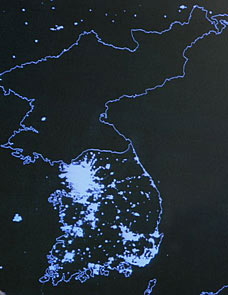
Our post a couple of days ago about the ruthless Kim Jong Il drew a visitor who left a link to a dramatic image, reproduced below:
Presumably this is a nighttime sattlite photo, showing the luminous metropolis of Seoul, and the prosperous, well-lit Republic of Korea to the south, and the veiled, darkling, and preposterously named Democratic People’s Republic of Korea to the north. The emotional power of this image is immediate, and tragic.
I assume it is genuine, but I can’t be sure. The person who left it signed in only as Kim, which narrows things down in Korea about as much as if he had signed in as “Jim” over here. The waka waka waka comment settings require that one provide an email address inorder to leave a comment, and also allow commenter to link to their websites; the email address left by Kim was from the gov.kp domain, and the website linked to was the official DPRK government website (well worth a look, by the way).
I rather doubt that our visitor is actually a member of the government of that enslaved nation, nor even a resident; I’d be curious to know more, Kim, if you’d care to drop me a line.
October 10, 2006 – 11:02 pm
One of the least palatable aspects of the situation in North Korea is the humanitarian quandary created by Kim Jong Il’s ruthless game, in which he relies on the misery of his enslaved people for his own protection. North Korea depends for its very survival on foreign aid; the United States and China are the principal benefactors. It is only this largesse that makes it possible for Kim to maintain an enormous standing army, and to play with nuclear weapons; had the Chinese seriously pressured him, he would have had to stand down. They didn’t, though, partly because they are concerned that any further instability, such as might be caused by even deeper poverty and famine, would drive hordes of refugees across their border, but also, I think in large part, because they enjoy the discomfiture that the obstreperous Kim causes the Western bloc.
The US, too, has been reluctant to cut back on the millions of tons of food we send to North Korea, but for quite different reasons — we are well aware that to do so would sentence a great many people to starvation. Kim knows that this leaves us in a difficult position: by refusing to provide any more foreign aid, we could press China to do more about the rogue state that it helps to support — but only at the cost of our conscience. Lacking one of his own, I am sure he is laughing up his sleeve at ours.
October 9, 2006 – 9:25 am
With characteristic bluster, the insane despot Kim Jong Il has defied the will of the international community generally, and the United Nations Security Council in particular, by conducting an underground nuclear test, of as-yet indeterminate magnitude. He’ll soon be sorry, because he can expect swift and certain retribution from the UN, in the form of some harsh finger-wagging, and if that isn’t enough to teach the impudent little rascal some manners, you can be sure he won’t be spared some stern tut-tutting as well.
He’ll think twice before he tries that again.
October 7, 2006 – 11:12 pm
My old pal, the guitarist Steve Khan, has many friends in Venezuela, and has spent a lot of time down there in recent years. This has given him an opportunity for a first-hand look at the enlightened presidency of Hugo Chavez, and unsurprisingly, he is not impressed. Steve sent me, yesterday links to three items by New York Post columnist Douglas Montero that show some of what life is like in that beautiful Caribbean country under this egomaniacal popinjay. Read them here, here, and here.
October 2, 2006 – 11:24 pm
The other day I ran across an item from the Boston Herald about a jihad-related kerfuffle in France. The story is about a high-school teacher named Robert Redeker, who has been driven into hiding after he published an article in Le Figaro suggesting — how dare he! — that Islam is trying to impose its cultural will upon Europe.
September 28, 2006 – 10:23 am
Well, I know I said I was going to lighten up on the political stuff, but the fact is, there’s too much of it, and it’s too important. Here is an excellent piece by Fouad Ajami, from the Wall Street Journal, in which he discusses recent intelligence reports, adresses some misconceptions about the situation in Iraq, and argues that we must not “give in to despair.” Do take a look.
September 27, 2006 – 3:33 pm
I’ve been posting a lot of political items lately; too many, really, as I don’t want political issues to dominate here. I also think I am giving the impression that I am far off on the right, when actually my opinions vary widely on an issue-by-issue basis – I tend to side with the Left on most social issues (gay marriage, church/state, abortion, drug laws, environmental and energy policy), though not all (affirmative action, gun control, border control, and pushing toward socialism generally), and with the Right, specifically the neoconservative right, on one issue only, which is foreign policy, to the extent that US influence is fairly and honestly brought to bear in a struggle against tyranny. I have defended, at length, our our decision to knock Saddam off his perch, but I agree also that the job was catastrophically bungled, and that heads that still issue orders should have rolled. I also share the Left’s low opinion of George Bush generally – his swagger, his smug religiosity, his inarticulateness, his lack of intellectual subtlety, and his inability to admit and correct error – as I have made abundantly clear in any number of posts.
So I’ll try to ease off on the political rants. But not just yet; here’s one more.
September 22, 2006 – 12:25 am
I have mentioned Bernard Lewis in these pages before; he is perhaps the West’s greatest living scholar of Islamic history and culture. This evening, as I was poking around over at the Maverick Philosopher’s place, I ran across, in a comment by Sam Graf to a post about appeasement of our foes, a link to a lecture given by Lewis earlier this year. In it he talks about the meaning of freedom and justice in Islamic societies, and of the historical events and forces that have brought us to our present crisis. The essay is brief, but Lewis is peerless, and you will learn more from these few paragraphs than from a year’s worth of the self-serving partisan din that passes for political debate these days.
September 18, 2006 – 11:43 pm
As you’ve no doubt heard, the Muslim world has its knickers in a twist once again, this time over some remarks made by the Pope during the recent “Apostolic Journey of His Holiness Benedict XVI to München, Altötting, and Regensburg”. It’s been making the rounds that the Pontiff suggested that Mohammed, in the later verses of the Qur’an, had wrongly advocated the use of violence in the defense and propagation of Islam. To imply that peace-loving Muslims are prone to violence is, of course, so preposterous that Muslims the world over, in protest of this baseless and blasphemous insult, and in defense of their faith, are erupting in violence once again.
September 2, 2006 – 3:09 pm
Jess Kaplan calls my attention to some new writing about our presence in Iraq by Christopher Hitchens – with whom I usually find myself agreeing – over at Foreign Affairs.
August 21, 2006 – 10:38 pm
From Eugene Jen comes a link to a dispiriting item by Bernard Lewis, who is perhaps the West’s preeminent scholar of the Islamic world. In this brief article Lewis gives us another good reason to be concerned about Iran’s pursuit of nuclear technology, namely that the idea of “mutual assured destruction” that has acted so far to prevent nations from engaging in nuclear war might be not a deterrent to the apocalyptically minded rulers of Iran, but an inducement. He even suggests that August 22nd might be a worrisome date, for historical reasons.
For someone as erudite and level-headed as Lewis to be making this point is unnerving, to say the least. Read the article here.
August 11, 2006 – 9:54 pm
I wrote yesterday about the irritating tendency of affluent left-leaning types here in Wellfleet and back home in Park Slope to speak in glowing terms of the many blessings that Fidel Castro (whose current status is reminiscent of Schroedinger’s famous Cat) has showered upon the fortunate citizens of Cuba. The fact that the island is an impoverished police state, where dissidents languish in dungeons, and whence people flee by the thousands in leaky boats whenever restrictions on leaving the country are lifted, is usually passed over unmentioned, so that the discussion may focus on Cuba’s fantastic health-care system, which of course puts ours to shame, and which is an enlightening example of the benign vision of the saintly Maximum Leader.
Startlingly, the vaunted Cuban health-care infrastructure actually falls somewhat short of its reputation. Have a look over here.
The Wall Street Journal’s James Taranto, in his Best of the Web newsletter of July 25th (I’m just getting around to reading it now), calls our attention to something rather odd in an NBC Nightly News video clip from the evening of the 24th. The report, by NBC’s Beirut bureau chief Richard Engel, is a tour of the havoc wrought in Lebanon by Israeli air strikes, and at one point the camera crew visits the flattened financial district of Sidon. On screen briefly are what appear to be uncut sheets of U.S. $100 bills. This is more than a little odd, Taranto points out:
Now, it’s possible to buy uncut sheets from the Bureau of Engraving and Printing, at premiums ranging from 12.5% to 275% over face value–but apparently only in denominations of up to $50. Anyhow, somehow we doubt these were collectibles.
Hezbollah is known to be involved in counterfeiting of US currency, and this may well be an example of their work. Read the item here.