Too Pooped To Post

Just a few odds and ends for tonight; I’m whipped. Nocturnal recluse that I am, I’m still not used to this up-first-thing-in-the-morning business, and I’ve been averaging about four or five hours of sleep. By the time Friday rolls around all I can see is a great Eye, rimmed with fire.

Read More »

Mouse Pad

As happens every year around this time, our charming hundred-year-old Victorian bowfront limestone has been invaded by mice. I think they spend the warmer months outside – either in our small back yards or up in Prospect Park, which is just at the end of my block – but right after Labor Day each year they set up shop indoors. I’m up late most nights, and they’ve been pretty bold this time around: skittering across the floor, squeaking behind the cupboards, even jumping out of the sink when I went to put a dish in there the other night.

Usually it’s not a big deal. I get some old-fashioned mousetraps, bait them with something attractive, set them in strategic places, and typically take out three or four of the little varmints each night. It’s the big ones at first, then the smaller ones, and after a few days it’s all over. This year, though, something has gone horribly wrong. I haven’t nailed a single one.

Read More »

Furious George

It’s video week at waka waka waka. My friend Jess sent me this clip, which is a prickly discussion between Matt Lauer and George Bush on the subject of torture. Here are two men who obviously loathe one another; they are trying as hard as they can not to attack each other physically, and just barely managing. They are standing almost toe to toe, and while Lauer is trying awfully hard to be deferential (you’re always “one down” when you’re with POTUS), W is right up in his grill, jabbing away with his index finger in a way that would certainly get my Irish up. It’s hard to believe this is the President of the United States being interviewed by one of the nation’s foremost news anchors; the whole thing seems more like two ill-tempered dads getting into it at a little league game.

Play Dead!

I’m still adjusting to rejoining the labor force; I got home awfully late this evening, and will be up at cockcrow to do it all again. As a result, all I have to offer for tonight is what seems to be a truly creepy video clip, sent along by my friend Eugene Jen, who remains an inexhaustible source of Internet arcana. This macabre flick, a bit of 1940 Soviet mad-scientist mayhem, is called “Experiments in the Revival of Organisms”, and is narrated, quite astonishingly, by the great biologist J.B.S. Haldane (who, if you will forgive me for being catty – it’s Fashion Week, after all – could have spent just a bit more time in wardrobe). The organism in question, it appears, is a dog.

I haven’t even got past the intro yet myself; let’s enjoy it together. I’ll make some popcorn.

September 11, 2006

New York City has a rapid metabolism; a lot happens here, and even when it’s something unpleasant, the wound closes quickly, and rarely leaves much of a scar. September 11th was different, though: it hurt us very badly indeed, and though we don’t have much of a limp these days, we are still shaken. Today here in Gotham the old pain was back again, throbbing and aching, and the hole where the towers used to be still feels like a missing tooth.

Our family was lucky. My wife and I were still at home in Brooklyn when the planes went in, and our son, then thirteen, was safe at school nearby. But my daughter, who had just begun her junior year, was at Stuyvesant High School, about five hundred yards from Ground Zero. She and her classmates gazed in horror from an eighth-floor classroom directly facing the doomed towers, and saw the first one fall before they were evacuated onto West Street and left to find their own way northward amid the panicking throng. My wife and I, watching from our rooftop across the harbor as the ghastly pall of smoke blew directly over us, had no idea what had become of her, and grew more and more anxious as the day wore on. It was not until five or six that evening that she was finally able to get through to us on the telephone – tearful, but safe.

But everyone, as far as I can tell, knows someone who died that day.

As I say, New York is a resilient place – vibrantly alive if any place on Earth is – and we’re fine, mostly. But there are some wounds here that will never fully heal, and today you couldn’t be in the city without being aware of the presence of a great sorrow, the collective grief of the millions who mourn the thousands who died.

As I look out my back door I see, rising from the site about three miles away, the brilliant columns of light that pierce the sky every year on this day, towering to the very zenith. I hope our neighbor, firefighter David Fontana of Rescue Company One, who gave his life – on his wedding anniversary – to save the lives of so many others, can see them too.
Just Can’t Help It

I’ve gone and done it again; I’ve jumped into an argument about free will over at Bill Vallicella’s. There are two threads at the moment; they are here and here.

Read More »

Brain Teaser

An item in the news yesterday raises once again the stubborn puzzle of consciousness. A 23-year-old British woman who has been in a “vegetative state” for five months has been shown by a sophisticated scanning technique to exhibit, in response to verbal stimuli, patterns of brain activity that are indistinguishable from those occuring in normal, conscious volunteers.

Read More »

You Can’t Win

An item in yesterday’s New York Times reported a somewhat dispiriting result on the anti-aging front. (This is a subject that seems to attract my attention more and more as time goes by, for some reason, and particularly so this week, when I feel as though I am aging about 48 hours each day, with about 90% of it happening at seven a.m. when the alarm goes off). Apparently a troika of researchers at the University of North Carolina, the University of Michigan (go blue!), and Harvard have found that a gene called p16-Ink4a, in acting to prevent cancer, might be contributing to our senescence.

Read More »

Dry Spell

This suddenly-working-for-a-living-again thing has me all worn out. So for tonight, rather than offer the eloquent and persuasive post I had planned, in which I shall reassure those readers whom I seem to have upset with recent political posts that I am not Bull Connor or Buck Turgidson, and that this editorial space is in no way funded by Karl Rove, I offer an engaging, if somewhat macabre, link dedicated to the grotesquely fascinating world of mummies. Enjoy.

Culture Shock

Well, it had to end sometime. The delightful two-month break occasioned by the infinitely avoidable death (wilful murder, more like) of PubSub has come to an end, and I find myself back in harness, this time for a large software company in midtown. I like my new coworkers – they are bright and friendly – and the work seems interesting, but I do have to say it is a bit of a jolt to be back in shoes and long pants, and to exchange the slow rhythm of the tides for the screeching chaos of Manhattan. This new outfit is also by far the most corporate environment in which I have ever found myself (having spent the first decades of my adult life in recording studios, followed by five years of small startups), and I feel like Tarzan in a dinner jacket. But with two kids in college, there are bills to pay, so we adapt.

My biggest worry is having no time for reading, writing, quiet contemplation, and unhurried, healthful exercise; I think spending the summer as a “gentleman of leisure” spoiled me no end. But I’m not complaining, appearances to the contrary – I am well aware how very lucky I was to have that much-needed break, and as my dear mum used to say, the only real peace in this world is on the other side of the churchyard gate. So for now, with freedom out of reach, it’s farewell to the beach, and back into the breach.

Oh… Here Is Thy Sting

It’s been a long day, and having just got in from a long drive back to Brooklyn from Cape Cod, I’m rather too worn out to say much tonight.

But I do want to note with shock and sorrow the bizarre and untimely death of Steve Irwin. He was a delightful character, and an iconic figure in his native Australia. His fearless and hyperkinetic enthusiasm, his genuine love of animals (and his immense skill in handling them), and his goofy smile, khaki shorts and broad Aussie accent won him millions of fans the world over (I was one too, in case you can’t tell), and I join them all in mourning his loss.

Surf’s Up

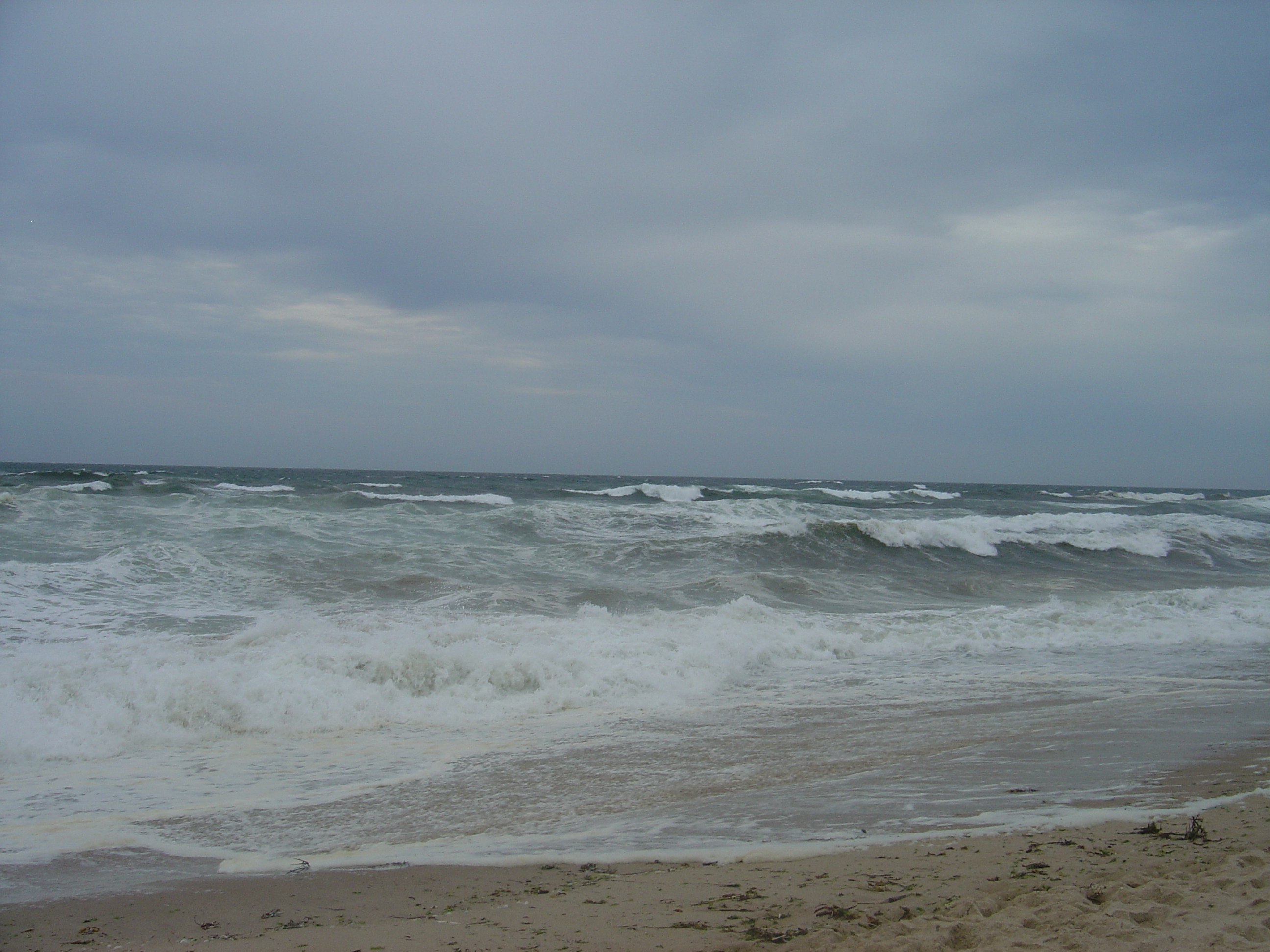
It was a damp and blustery day in Wellfleet yesterday, as the low-pressure system dubbed Ernesto passed to our west. With high pressure to the east, the resulting gradient made for strong winds blowing in from the Atlantic onto the Cape Cod backshore, whipping up some angry surf. I dropped by the beach at Newcomb Hollow with my Sony Cybershot, and snapped the image below:

click for hi-res version
the elements rage

But a still picture really doesn’t do it justice. As it happens my little camera will take movies as well, so if you’d like to, you can download a brief video clip – complete with poorly recorded audio – here. (If you actually do bother to do this, and the film runs poorly, it might be best to right-click the link and choose “Save Target As”, and then run the file on your machine.)

Mind you, the video doesn’t do it justice either.

Between Iraq and a Hard Place

Jess Kaplan calls my attention to some new writing about our presence in Iraq by Christopher Hitchens – with whom I usually find myself agreeing – over at Foreign Affairs.

Read More »

Ursa Minor

A few days ago I wrote a second post about Robert Wright’s book Nonzero, in response to Kevin Kim’s thoughts about the idea of telelology in evolution. Earlier this evening a new commenter, a blogger who goes by the nickname ‘gordsellar’, stopped by to offer some worthwhile remarks in that post’s discussion thread. I moseyed over to peek at his site, eclexys – which, being obviously the work of a curious and intelligent person, has since been added to the waka waka waka sidebar – and found an interesting item about a marvelous animal you might very well never have heard of: the tardigrade. How I can have written hundreds of posts over the last year and a half without mentioning this cuddly little creature, I can’t imagine.

Read More »

Pop Star

Our Sun is about five billion years old, which is about halfway through its expected lifespan. A star begins as a collapsing cloud of gas, mostly hydrogen, and when the ball has grown dense enough under the pressure of its own gravitation, the hydrogen atoms begin to fuse into helium, liberating a tremendous amount of energy. This outward force acts as a counterbalance to the crushing inward pull of gravity, and the star settles into a comfortable equilibrium. Over time, fusion reactions occur between helium atoms as well, and begin working their way up through a series of elements, and the star takes on a layered structure, with the more massive elements toward the core. You might think that the more hydrogen a star starts off with — in other words, the more massive the star is — the longer it would last, but in fact it goes the other way, because the increased gravitional pressure due to the extra mass causes the fusion reactions to proceed more rapidly, more than making up for the extra “fuel”. The really big stars burn very brightly, very violently, and very briefly indeed compared to a modest specimen like ours: in contrast to the ten-billion-year lifespan of our Sun, giant stars may burn for less than a million years.

Read More »

Body of Ideas

In an ongoing discussion over at Maverick Philosopher, one of the interlocutors has made the assertion, in defense of dualism, that the human mind must be more than the physical activity of the brain, because the brain is a finite physical system, and the mind of Man, allegedly, is infinite. To quote from the thread over at Dr. Vallicella’s place:

Because the human mind is not bounded, it cannot be physical.

Sounds good. We all have the feeling that we can accommodate any new concept that comes before us (though, on reflection, a peek at contemporary political discourse might be sufficient rebuttal), and adjust our behavior with limitless flexibility. But why do we think so? What makes us so sure?

Read More »

Shell Game

Today, having returned to Cape Cod from Brooklyn late last evening, I arose early and made my way to Indian Neck Beach, which forms the eastern shore of Wellfleet Bay. My arrival coincided, not accidentally, with the lowest extremity of the tide, and as expected I found the legendary oyster beds fully exposed, beckoning as winsomely as Goya’s Maja.

Read More »

Duel-ism

Well, I’ve gone and got myself into another tussle over at Maverick Philosopher, which is one reason I’ve been confecting such weightless froth over here.

These arguments never get anywhere – if it were possible, at our current stage of development, to answer such questions as the mind-body problem, we’d have done so already – but I just can’t help myself. If you’d like to drop by over there and razz the opposition, here’s the link.

TÁªte – Á  – TÁªte

I’m not much of a “morning person”. I’ve often felt that my brain is rather like those big lights that are used in school gyms – the ones that do almost nothing when they are first switched on, then gradually fade up to dazzling brightness over an interval of ten minutes or so. The analogy is far from perfect: my brain takes a good deal longer than ten minutes to warm up, and I wouldn’t say that I ever get anywhere near “dazzling brightness”. But you get the idea.

Well, as it turns out, the brain does indeed boot itself up in stages, in a fashion similar to the way a computer gets going: first the operating system itself must be loaded, and only after that can applications be run. This sequence of operations in the brain is managed by the thalamus, which, among its many functions, acts as a sort of concierge for sensory impressions, and which is itself activated by, and subsequently distributes, the chemical known as nitric oxide.

Now as it happens, nitric oxide is an important substance in the body’s regulation of blood flow, and it is by controlling the delivery of this molecular mojo to another essential organ that the sought-after medicament Viagra is able to get such, um, outstanding results.

Learn more here.

Re-animator

Here is further proof that some people simply don’t get out enough: a Flash-based simulation of that ancient (and I’m ancient enough myself to have two of them gathering dust in a closet) proto-PC, the Commodore 64.

From Pat to Verse

My old friend, the painter and art collector Patrick Goldsmith – whose peregrinations have taken him often to the remotest East – took up, a few years back, the art of the sonnet, and a collection of his work is available online. Called The Wayfarer Sonnets, they are intended as companions to the sixty-four hexagrams of the I Ching, and I do hope you will take a look. You can find them, in print or downloadable form, here. Just the thing for those of you with a Tao jones.

And Stay Out!

Property values on Pluto plummeted today as the icy worldlet, long considered a bit of an arriviste by such solar-system Brahmins as Jupiter and Venus, had its status demoted from “planet” to “dwarf planet”.

Read More »

Good Questions

One of the greatest benefits of blogging is the opportunity one has to converse with, and learn from, people whom one might otherwise never have met. Scott Carson, professor of philosophy at Ohio University and author of the blog An Examined Life, has taken the trouble to respond to my comments on his post about the defensibility of torture. He makes some excellent criticisms of my post, and I am very grateful to him for taking the time to do so.

Read More »

Land of A Thousand Dunces

On the heels of yesterday’s depressing link from Eugene, from Duncan Werner comes an item from the Washington Post about the sad state – verging on downright illiteracy – of many of today’s college students. The author, one Michael Skube, a professor of journalism at Elon College, describes a recent experience:

We were talking informally in class not long ago, 17 college sophomores and I, and on a whim I asked who some of their favorite writers are. The question hung in uneasy silence. At length, a voice in the rear hesitantly volunteered the name of … Dan Brown.

No other names were offered. The author of “The Da Vinci Code” was not just the best writer they could think of; he was the only writer they could think of.

Read it and weep, friends.

MAD-Men

From Eugene Jen comes a link to a dispiriting item by Bernard Lewis, who is perhaps the West’s preeminent scholar of the Islamic world. In this brief article Lewis gives us another good reason to be concerned about Iran’s pursuit of nuclear technology, namely that the idea of “mutual assured destruction” that has acted so far to prevent nations from engaging in nuclear war might be not a deterrent to the apocalyptically minded rulers of Iran, but an inducement. He even suggests that August 22nd might be a worrisome date, for historical reasons.

For someone as erudite and level-headed as Lewis to be making this point is unnerving, to say the least. Read the article here.

The Long March

There is more I’d like to say about Robert Wright’s Nonzero, and I’ll be getting to it tomorrow, most likely, but meanwhile I’ve just begun reading The Ancestor’s Tale, by Richard Dawkins.

Read More »

Is Wright Wrong?

The multidimensional Kevin Kim, over at his one-of-a-kind weblog Big Hominid’s Hairy Chasms, has posted a response to my mention of Robert Wright’s book Nonzero. In his post Kevin calls into question the idea of any directionality or purpose to biological evolution, making common cause in this regard with the late Stephen Jay Gould. Kevin writes:

[…I] wonder whether Wright isn’t making a mistake similar to that made by certain process theologians– people who (1) look at events happening in the “cream of the crop” of the evolutionary tumult and (2) mistakenly conclude that evolution at this top layer somehow represents a universal telos. I think human arrogance tends to suggest the “ladder” paradigm to us when we assess natural phenomena: we can’t help seeing ourselves as some sort of culmination of natural (or supernatural) processes. My own view is that life and mind are not representative of any telos at all: they are simply stochastic occurrences. Most of this cosmos, pretty though it be, is not alive.

Closed systems tend toward greater entropy over time. Within those closed systems, regions of anti-entropic activity may arise, but the overarching history of those systems is foreordained to follow the path of the “thermodynamic arrow,” as Stephen Hawking calls it. That is why, in a (theoretically) closed system like our universe, tiny pockets of life can form while most of the universe remains (as far as we know) abiotic. Billions or trillions of years hence, all that life will disintegrate as entropy settles more comfortably into its ancient throne. Those tiny pockets of life, then– those little bits of animated telos– are no evidence of a larger cosmic end or purpose. They– we– are a brief spark in the Nabokovian blackness: here and gone. The pessimist views this state of affairs with rue; the man of religion, by contrast, knows this means that each moment is absolutely precious. Life’s finitude and frailty are what give it its value.

Kevin, writing with customary eloquence, makes some very good points, and most of all I agree with his remarks about what gives life its value. But I think that he is missing the point made by Wright in his book, and is wrongly conflating the idea of telos with the possibility of there being a directionality, an “arrow”, to Darwinian evolution.

Read More »

Torture Test

An item in the English newspaper The Guardian has touched off a heated controversy. The piece refers to the airline-bombing plot that British authorites nipped in the bud last week, and says that the key witness in the case, one Rashid Rauf, a British citizen, revealed what he knew only after he was “broken” under interrogation by Pakistani questioners, which suggests rather strongly that he was tortured. The information obtained, however, most likely prevented the murder of thousands in simultaneous midair bombings. The question, of course, is whether the benefit thus achieved justifies the use of methods from which compassionate people and humane societies recoil in horror.

Read More »

Big Game

I had put it aside for a while (I tend to have too many books going at once), but have just finished reading Nonzero – The Logic of Human Destiny, by Robert Wright. It is quite brilliant, and I highly recommend it.

“The Nobel laureate Steven Weinberg once ended a book on this note: ‘The more the universe seems comprehensible, the more it also seems pointless.’ Far be it from me to argue with a great physicist about how depressing physics is. For all I know, Weinberg’s realm of expertise, the realm of inanimate matter, really does offer no evidence of higher purpose. But when we move into the realm of animate matter — bacteria, cellular slime molds, and, most notably, human beings — the situation strikes me as different. The more closely we examine the drift of biological evolution and, especially, the drift of human history, the more there seems to be a point to it all. Because in neither case is ‘drift’ really the right word. Both of these processes have a direction, an arrow. At least, that is the thesis of this book.”

Read More »

Groupthink

One of the topics in which there is keen interest around these parts is the infinitely perplexing question of consciousness – what it is, whence it arises, and just where it fits into the Big Picture.

The hallmark of consciousness is subjectivity; the existence of an awareness that experiences are happening to. Many belive that this subjectivity is ontologically irreducible; that there is an unbridgeable gulf between the objective phenomenological world we all share and our individual conscious experiences of it. The only consciousness we can know confidently to exist is our own; we assume that others are conscious as well (if nothing else, it seems unsociable not to), but we have no way to be sure. Is there, in fact, any objective way to detect consciousness? At Princeton University there is a group who are investigating this question from a new angle.

Read More »

Fish Out of Water

I am downright chopfallen this evening upon hearing some sad news from across the pond: there will be no conger cuddling in Lyme Regis, England, this year.

I’m sure that most of you have been following this exciting sport for ages; perhaps some of you have even been lucky enough to attend in person. But for those few of you who haven’t – perhaps due to a decades-long coma or a lengthy stretch in solitary – here’s the story.

Read More »

Revolutionary Treatment

I wrote yesterday about the tendency of affluent left-leaning types here in Wellfleet and back home in Park Slope to speak in glowing terms of the many blessings that Fidel Castro (whose current status is reminiscent of Schroedinger’s famous Cat) has showered upon the fortunate citizens of Cuba. The fact that the island is an impoverished police state, where dissidents languish in dungeons, and whence people flee by the thousands in leaky boats whenever restrictions on leaving the country are lifted, is usually passed over unmentioned, so that the discussion may focus on Cuba’s fantastic health-care system, which of course puts ours to shame, and which is an enlightening example of the benign vision of the saintly Maximum Leader.

Startlingly, the vaunted Cuban health-care infrastructure actually falls somewhat short of its reputation. Have a look over here.

Liberal Arts

As readers of these pages will know, I spend a good deal of time in the beautiful seaside village of Wellfleet, out on the far end of Cape Cod. Demographically, Wellfleet is an interesting mixture; its flinty and hard-working year-round population of fewer than 3,000 swells to almost 20,000 in the summertime, as affluent vacationers flock to its sheltered inlets, freshwater ponds, art galleries, theater productions, excellent restaurants, and of course its spectacular Atlantic beaches, framed by towering dunes.

Read More »

Monkey Bards

We’ve all heard the suggestion that a roomful of monkeys hammering randomly away at typewriters would, given billions of years, recreate the complete works of Shakespeare. [A “typewriter”, for those of you whose brows are wrinkled solely by bafflement, is an antique mechanical device that generated crumpled sheets of paper.] It’s an interesting idea, but if you’re like me, you’ve just been too busy to try it out.

Well, the wait is over. Take a look at this. It’s not exactly instant gratification; thus far the sedulous simian simulacra have only got as far as the first 24 letters from “Henry IV, Part II”. But, as someone once said, “how poor are they that have not patience.”

Designer Genes

The English clergyman and philosopher William Paley (1743-1805), who among his many other achievements was also the Christ’s College senior wrangler of 1763, is probably best known today for his analogy of the “watchmaker”, which was an argument-from-nature for the existence of God.

Read More »

Original Child

Today marks a sorrowful anniversary: it was on August 6th, 1945 that the city of Hiroshima was pulverized by the “Little Boy”, the first of two atomic weapons hurled in fury upon the Japanese at the close of World War II. More than two hundred thousand people died.

melted Buddha
A melted image of the Buddha

I will not opine on the justification for this horror; ample debate has ensued since the day it occurred. Certainly a ground invasion of Japan would have cost a great many lives as well, indeed perhaps a great many more. I have often wondered whether a demonstration at sea of the weapon’s awful power might have brought about a surrender, but I am sure such a course must have been considered, and I do not presume to sit in judgment of the decision that was made, at a time when the entire world, as if seized by the Devil himself, was convulsed by a dark and violent madness.

I had thought to write a bit about the curious details of the weapon itself, but that seems cavalier, somehow, and readers who wish to may learn more here.

Postage Due

Well, as warned, there have been significant service outages here at waka waka waka. Your correspondent has been shuttling back and forth between Wellfleet and sweltering Gotham, getting in in the wee hours, sleeping little, coping with a variety of unrestful obligations, and generally ignoring his bloggardly duties. I apologize to all, and do hope that by Tuesday or so life will once more be unruffled and serene, as there are a number of meaty posts in the queue.

Meanwhile, do browse our extensive archives, and rest assured that we’ll be back in harness shortly.

Tomfoolery

One of the little pleasures of growing older – and they are admittedly not numerous – is that you hold things in living memory that, as far as the hyperkinetic larvae who seem to be taking over the world these days are concerned, never even existed. One of these, for doddering old fossils such as your humble correspondent, is the musical satire of Tom Lehrer.

Read More »

Blood Money

The Wall Street Journal’s James Taranto, in his Best of the Web newsletter of July 25th (I’m just getting around to reading it now), calls our attention to something rather odd in an NBC Nightly News video clip from the evening of the 24th. The report, by NBC’s Beirut bureau chief Richard Engel, is a tour of the havoc wrought in Lebanon by Israeli air strikes, and at one point the camera crew visits the flattened financial district of Sidon. On screen briefly are what appear to be uncut sheets of U.S. $100 bills. This is more than a little odd, Taranto points out:

Now, it’s possible to buy uncut sheets from the Bureau of Engraving and Printing, at premiums ranging from 12.5% to 275% over face value–but apparently only in denominations of up to $50. Anyhow, somehow we doubt these were collectibles.

Hezbollah is known to be involved in counterfeiting of US currency, and this may well be an example of their work. Read the item here.

Cross Country

Many on the secular left have for quite a while been complaining, with not inconsiderable justification, of the deepening partnership here in America between fundamentalist Christians and the political right. While I would stop (far) short of characterizing the U.S.A. under the current administration as a “theocracy” as many of my blue-state neighbors might, there is no question that church and state have got awfully cozy lately, a trend that I imagine will be good, in the long run, for neither. From my old friend Jess Kaplan comes an AOL news item about the pastor of an evangelical megachurch who feels the same way, if perhaps for different reasons, and who has quite publicly staked out a contrarian position.

Read More »

Seasonal Adjustment

I’m allowing myself a little slack here in the dog days of July and August; excessive heat tends to randomize the syntactic patterns of my little grey cells, and I have learned to be wary of attempting ambitious cogitative efforts under such conditions, as they often go badly wrong, with unpredictable results. Readers, therefore, will most likely notice a temporary dropoff in both quantity and quality as I withdraw, at least partially, into estivation here in Wellfleet (this is going to consist of lolling on beaches, swimming in ponds, imbibing libations cooling and potent, and thinking shallow and largely non-sequential thoughts).

Read More »

He Is Not Amused

Ah, P.J. O’Rourke. If you are old enough you might remember him as a contributor to (in fact the managing editor of) The National Lampoon, way back in the seventies. I hadn’t read anything of his since I read Parliament of Whores some years ago, but while I was absorbing a post of Bill Vallicella’s on the topic of “gender-neutral language” earlier this evening I found, in a comment, a link to a review by O’Rourke of an academic volume called Guidelines for Bias-Free Writing, by Marilyn Schwartz and the Task Force on Bias-Free Language of the Association of American University Presses.

Read More »

Tahoma-san

The Ukiyo-e master Katsushika Hokusai is perhaps best known for a series of prints called 36 Views of Mt. Fuji. These images vary greatly in their depiction of the mountain; in some of them, Fuji-san is the focus of the picture, while in many others it is a barely noticeable feature off in the distance. The images show people working, playing, on the street, in town, in the country, on boats, and so forth. But the great volcano is there, somewhere, in every frame, and the set gives, in its distributed way, a sense of what a powerful presence the mountain is. Its snowclad, tapering summit often seems to float in a sea of purple mist, as though it belonged more to the heavens than the world below; at the same time, though, it is a looming token of subterranean power and mystery, and an insistent reminder of the ungraspably enormous scale at which the life of the Earth proceeds, and of Nature’s majestic indifference to the fleeting life of Man.

Read More »

The Things a Person Can Do in a Day

Tonight finds your correspondent once again in Seattle, Washington, at the end of a long day.

Read More »

Map Quest

From my daughter ChloÁ«, an undergraduate at the University of Michigan, comes a link to an interesting item at the UM website. The story is about physics professor Mark Newman, who left the Sante Fe Institute to join the UM faculty, and his work with maps and networks.

Read More »

The Best Defense

I suppose I’ll weigh in on the situation on the eastern shores of the Mediterranean, although I tend to shy away from politics in these pages. In short, my view is that Israel is doing exactly what it ought to be doing, and ought to keep doing it for a little while longer. I offer a few thoughts, none of them particularly original.

Read More »

Lapsus Manus

I have quite a few old chess books on my shelves – I have a hard time passing them up whenever I see a street vendor selling them, and so they accumulate. The other day, in the small hours of the morning, weary but not yet ready to retire, I pulled a couple of volumes at random and settled in with a board and an adult beverage, looking forward to browsing a bit and perhaps playing over a master game or two. The two books I had happened to choose were The Book of the Nottingham International Chess Tournament, 10th to 28th August, 1936, With Annotations and Analysis by A. Alekhine (probably the best tournament book ever, given the quality of the annotation, and that the field included Alekhine, Capablanca, Lasker, Fine, Tartakower, Vidmar, Bogoljuboff, Flohr, Reshevsky, Euwe, and Botvinnik, among others), and a wonderful collection called The Treasury of Chess Lore, by that most beloved of all chess writers, Fred Reinfeld.

Read More »

Alison Remembered

This weekend we held our little memorial gathering in Oceanside, CA for my mother Alison. I’ll give a brief account for the many of you who either were fortunate enough to have known her or who, having followed the sad story of her final weeks in these pages, have written with kind words of support and sympathy.

Read More »

Just Flew In From the Coast, And…

Well, we’re back from my mother‘s memorial service out in Oceanside, CA. It was everything we could have hoped for, and I will be writing about it shortly.

We flew back from San Diego to JFK on American Airlines earlier today, and we had a female captain (which is still quite unusual), by the name of Linda Parks. She did an excellent job, of course; in particular, she made an outstandingly smooth landing. She even got us home a little faster than her male counterparts usually do, because she didn’t mind stopping someone to ask directions.

Moment of Silence

Once again, waka waka waka may lie fallow for a couple of days, as Nina and I are flying out to California tomorrow for a memorial service for my mother. This is going to be a difficult weekend all around, especially for my father, and there might not be many opportunities to write, though if I can I will.

We’ll be back in New York on Monday.