Yesterday the United States Senate held a hearing on the magnitude of human impact on climate change. Giving testimony were some Actual Climate Scientists. I would like very much for you to read and carefully digest their testimony. I will excerpt some of it here, in what will be a longish post — but please, dear readers, take the time to follow the links and read it all.
One of those who testified was Dr. Judith Curry. She submitted a written paper, but she also spoke. I reproduce her remarks below in full:
I thank the Chairman and the Committee for the opportunity to offer testimony today.
Prior to 2009, I felt that supporting the IPCC consensus on climate change was the responsible thing to do. I bought into the argument: “Don’t trust what one scientist says, trust what an international team of a thousand scientists has said, after years of careful deliberation.” That all changed for me in November 2009, following the leaked Climategate emails, that illustrated the sausage making and even bullying that went into building the consensus.
I starting speaking out, saying that scientists needed to do better at making the data and supporting information publicly available, being more transparent about how they reached conclusions, doing a better job of assessing uncertainties, and actively engaging with scientists having minority perspectives. The response of my colleagues to this is summed up by the title of a 2010 article in the Scientific American: Climate Heretic Judith Curry Turns on Her Colleagues.
I came to the growing realization that I had fallen into the trap of groupthink. I had accepted the consensus based on 2nd order evidence: the assertion that a consensus existed. I began making an independent assessment of topics in climate science that had the most relevance to policy.
What have I concluded from this assessment?
Human caused climate change is a theory in which the basic mechanism is well understood, but whose magnitude is highly uncertain. No one questions that surface temperatures have increased overall since 1880, or that humans are adding carbon dioxide to the atmosphere, or that carbon dioxide and other greenhouse gases have a warming effect on the planet. However there is considerable uncertainty and disagreement about the most consequential issues: whether the warming has been dominated by human causes versus natural variability, how much the planet will warm in the 21st century, and whether warming is “dangerous”.
The central issue in the scientific debate on climate change is the extent to which the recent (and future) warming is caused by humans versus natural climate variability. Research effort and funding has focused on understanding human causes of climate change. However we have been misled in our quest to understand climate change, by not paying sufficient attention to natural causes of climate change, in particular from the sun and from the long-term oscillations in ocean circulations.
Why do scientists disagree about climate change? The historical data is sparse and inadequate. There is disagreement about the value of different classes of evidence, notably the value of global climate models. There is disagreement about the appropriate logical framework for linking and assessing the evidence. And scientists disagree over assessments of areas of ambiguity and ignorance.
How then, and why, have climate scientists come to a consensus about a very complex scientific problem that the scientists themselves acknowledge has substantial and fundamental uncertainties?
Climate scientists have become entangled in an acrimonious political debate that has polarized the scientific community. As a result of my analyses that challenge IPCC conclusions, I have been called a denier by other climate scientists, and most recently by Senator Sheldon Whitehouse. My motives have been questioned by Representative Grijalva, in a recent letter sent to the President of Georgia Tech.
There is enormous pressure for climate scientists to conform to the so-called consensus. This pressure comes not only from politicians, but from federal funding agencies, universities and professional societies, and scientists themselves who are green activists. Reinforcing this consensus are strong monetary, reputational, and authority interests.
In this politicized environment, advocating for CO2 emissions reductions is becoming the default, expected position for climate scientists. This advocacy extends to the professional societies that publish journals and organize conferences. Policy advocacy, combined with understating the uncertainties, risks destroying science’s reputation for honesty and objectivity — without which scientists become regarded as merely another lobbyist group.
I would like to thank the committee for raising the issue of data versus dogma in support of improving the integrity of climate science.
This concludes my testimony.
From Dr. Curry’s paper (which is here):
Regarding historical data:
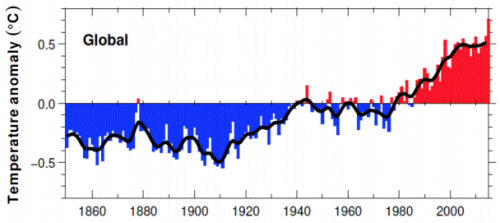
Global surface temperature anomalies since 1850 are shown below:
If the warming since 1950 was caused by humans, what caused the warming during the period 1910-1945? The period 1910-1945 comprises over 40% of the warming since 1900, but is associated with only 10% of the carbon dioxide increase since 1900. Clearly, human emissions of greenhouse gases played little role in causing this early warming. The mid-century period of slight cooling from 1945 to 1975, referred to as the “grand hiatus”, also has not been satisfactorily explained.
Apart from these unexplained variations in 20th century temperatures, there is evidence that the global climate has been warming overall for the past 200 years, or even longer… Humans contributed little if anything to this early global warming.
Regarding the “pause” (my emphasis):
The warming hiatus, or “pause”, reflects a slowdown of the rate of warming in the early 21st century, relative to the rapid rate of warming in the last quarter of the 20th century. The 2013 IPCC AR5 Report12 made the following statement: “the rate of warming over the past 15 years . . . is smaller than the rate calculated since 1951“.
The significance of a reduced rate of warming since 1998 is that during this period, 25% of human emissions of carbon dioxide have occurred. Most significantly, the observed rate of warming in the early 21st century was slower than climate model predictions. The growing discrepancy between climate model predictions and the observations has raised serious questions about the climate models that are being used as the basis for national and international energy and climate policies.
Regarding sea ice:
The IPCC AR5 states that the increase in Antarctic sea ice is not understood and is not simulated correctly by climate models. Further, Arctic surface temperature anomalies in the 1930’s were nearly as large as the recent temperature anomalies, and hence the IPCC uses the weak phrase “contributed to” in reference to anthropogenic influences on Arctic sea ice.
A recent paper by Swart et al.19 emphasized that internal climate variability can mask or enhance human induced sea-ice loss on timescales ranging from years to decades or even a century…
Clearly, there is a lot going on with respect to variability in Arctic and Antarctic sea ice that cannot be explained solely by warming from human-caused greenhouse gases. Climate models do not simulate correctly the ocean heat transport and its variations. Scientists do not agree on the explanation for the increasing Antarctic sea ice extent, and the key issue as to whether human-caused warming is the dominant cause of the recent Arctic sea ice loss remains unresolved.
Nevertheless, the IPCC AR5 concluded:
“[I]t is very likely that the Arctic sea ice cover will continue to shrink and thin all year round during the 21st century. It is also likely that the Arctic Ocean will become nearly ice-free in September before the middle of the century (medium confidence).”
Regarding sea levels:
The IPCC AR5 … concludes:
“It is very likely that there is a substantial contribution from anthropogenic forcings to the global mean sea level rise since the 1970s.”
Global sea level has been rising for the past several thousand years. The key issue is whether the rate of sea level rise is accelerating owing to anthropogenic global warming. It is seen that the rate of rise during 1920-1950 was comparable to, if not larger than, the value in recent years (a period contributing less than 10% of the human caused CO2 emissions since 1900). Hence the data does not seem to support the IPCC’s conclusion of a substantial contribution from anthropogenic forcings to the global mean sea level rise since the 1970s.
There is much more; Dr. Curry’s paper is the longest and most technical of the three I have linked to here. She goes on to discuss CO2 sensitivity, and the inaccuracy, to date, of climate models. She concludes with a section entitled “The broken social contract between climate science and society”. Read it all.
Also testifying was Dr. John R. Christy. His presentation is here. In case you have any doubts about his Actual Climate Science credentials, here’s his summary thereof:
I am John R. Christy, Distinguished Professor of Atmospheric Science, Alabama’s State Climatologist and Director of the Earth System Science Center at The University of Alabama in Huntsville. I have served as a Lead Author, Contributing Author and Reviewer of United Nations IPCC assessments, have been awarded NASA’s Medal for Exceptional Scientific Achievement, and in 2002 was elected a Fellow of the American Meteorological Society.
Regarding modeling:
A fundamental aspect of the scientific method is that if we say we understand a system (such as the climate system) then we should be able to predict its behavior. If we are unable to make accurate predictions, then at least some of the factors in the system are not well defined or perhaps even missing…
Do we understand how greenhouse gases affect the climate, i.e. the link between emissions and climate effects? A very basic metric for climate studies is the temperature of the bulk atmospheric layer known as the troposphere, roughly from the surface to 50,000-ft altitude. This is the layer that, according to models, should warm significantly as CO2 increases — even faster than the surface. Unlike the surface temperature, this bulk temperature informs us regarding the crux of the global warming question — how much heat is accumulating in the global atmosphere? And, this CO2 caused warming should be easily detectible by now, according to models. This provides a good test of how well we understand the climate system because since 1979 we have had two independent means of monitoring this layer — satellites from above and balloons with thermometers released from the surface…
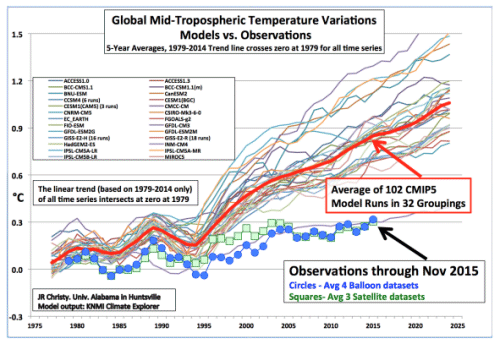
The information in this figure provides clear evidence that the models have a strong tendency to over-warm the atmosphere relative to actual observations. On average the models warm the global atmosphere at a rate three times that of the real world. This is not a short-term, specially-selected episode, but represents the past 37 years, over a third of a century. This is also the period with the highest concentration of greenhouse gases and thus the period in which the response should be of largest magnitude.
Using the scientific method we would conclude that the models do not accurately represent at least some of the important processes that impact the climate because they were unable to “predict” what has already occurred. In other words, these models failed at the simple test of telling us “what” has already happened, and thus would not be in a position to give us a confident answer to “what” may happen in the future and “why”. As such, they would be of highly questionable value in determining policy that should depend on a very confident understanding of how the climate system works.
Regarding the effectiveness of proposed regulations (my emphasis):
The impact on global temperature for current and proposed reductions in greenhouse gases will be tiny. To demonstrate this, let us assume, for example, that the total emissions from the United States were reduced to zero, as of last May 13th, 2015 (the date of the last congressional hearing on which I testified). In other words as of that day and going forward, there would be no industry, no cars, no utilities, no people — i.e. the United States would cease to exist as of that day. Regulations, of course will only hope to reduce emissions a small amount, but to make the point of how minuscule the regulatory impact will be, we shall simply go way beyond reality and cause the United States to vanish. With this we shall attempt to answer the question of climate change impact due to emissions reductions.
Using the U.N. IPCC impact tool known as Model for the Assessment of Greenhouse-gas Induced Climate Change or MAGICC, graduate student Rob Junod and I reduced the projected growth in total global emissions by U.S. emission contribution starting on this date and continuing on. We also used the value of the equilibrium climate sensitivity as determined from empirical techniques of 1.8 °C. After 50 years, the impact as determined by these model calculations would be only 0.05 to 0.08 °C — an amount less than that which the global temperature fluctuates from month to month. [These calculations used emission scenarios A1B-AIM and AIF-MI with U.S. emissions comprising 14 percent to 17 percent of the 2015 global emissions. There is evidence that the climate sensitivity is less than 1.8 °C, which would further lower these projections.]
Because changes in the emissions of our entire country would have such a tiny calculated impact on global climate, it is obvious that fractional reductions in emissions through regulation would produce imperceptible results. In other words, there would be no evidence in the future to demonstrate that a particular climate impact was induced by the proposed and enacted regulations. Thus, the regulations will have no meaningful or useful consequence on the physical climate system — even if one believes climate models are useful tools for prediction.
Did you get that, readers?
Dr. Christy goes on to consider “extreme weather” events, floods and droughts, heat waves, wildfires, and grain production.
He concludes, as did Dr. Curry, with a discussion of the academic climate, where conditions have already become far more inclement than the weather, and the signs far more ominous. His paper is not long. It is well worth your time.
Finally, the Senate panel heard from Mark Steyn, who will be the first to admit that he is not an Actual Climate Scientist. Why was he there? Because he knows from bitter experience the power against which climate dissenters must contend. I won’t excerpt his testimony; it’s Mark Steyn, after all, so you know it will be a good read. His transcript is here.
I thank you for taking the time to read all of this. Here’s the point: the Earth may or may not be warming now, and we may or may not be causing it to do so. If we are causing warming, we may be able to adjust our behavior in such a way as to have some effect on the rate of warming. These are all extremely complex empirical questions. We must also decide whether any remedies we might attempt would be worth the costs — which is also a complex question, but unlike the previous questions, is instead a normative one. To make the right decisions, we must do the very best we can to seek objective truth — unimpeded, to the best of our ability as fallible and finite and social beings, by political ends, vested interests, and the call of what substitutes for redemption and salvation in our new, secular religion.
I hope that this testimony will at least make it clear that what we have done so far falls very far short of that goal, and that the science is anything but “settled”.