Rivers Of Blood Must Flow!

Meet Mercedes-Benz’s new spokesman.

Hear Ye!

BE IT KNOWN BY ALL that Hizzonner Michael Bloomberg, Lord Mayor of Manhattan, Imperator of The Five Boroughs, Slayer of Term Limits, and Guardian In Loco Parentis of the Well-Being and Moral Probity of the Gothamite Flock, has of Late turned His Attention to the licentious Consumption of Alcoholic Liquors, and other stimulating Potations, by His intemperate Wards.

BE IT KNOWN ALSO that, Hizzonner having Determined, by the Light of His beneficent Wisdom, said Consumption to have become in recent Years EXCESSIVE, appropriate Arrangements therefore Soon shall be Made, throughout the Imperium, sharply to Limit the Vendition of intoxicating Beverages, so as to improve the Character, Comportment, and Eupepsia of His Flock.

FLOTUS: Fed Up

Here’s a dispatch from our senior White House correspondent, Milton Polchek:

WASHINGTON, Jan. 11 –

Michelle Obama, the first black woman to serve as First Lady, took to the airwaves recently to express her irritation at being characterized as an “angry black woman”.

Mrs. Obama could not be reached for comment, but a close friend and confidante spoke to this reporter, on condition of anonymity.

“As a black woman in America, Lord knows Michelle has plenty to be angry about, and of course with decades of academic and professional experience in this area, she is widely regarded as an expert in the field. But this “angry black woman” thing just really, really pisses her off. She’s trying to keep cool about it, but frankly I can’t remember the last time I saw her get so mad.”

Her friend paused.

“…well, not lately, anyway. But I’ve been out of town for a few weeks.”

The Deprong Mori

Here’s a curious item for you: the only recorded capture, in the Tripiscum Plateau of the Circum-Caribbean region of Northern South America, of the exotic Piercing Devil.

Pot Luck

With thanks to our reader Pete K., here’s a heartening item from the frontiers of science. What’s more, the story introduces a new and important fundamental unit of measurement, which I think should be called the ‘marley’.

And here’s a related video.

Spring Has Sprung

With a hat tip to VFR, here’s the Jerusalem Post’s latest report on the Islamist renaissance that is coalescing in the wake of the ‘Arab Spring’.

Meanwhile, DEBKA reports that in Egypt, General Tantawi and the SCAF grow weary of their burden, and are negotiating an early handover of the reins of power to the Muslim Brotherhood (who reiterate that they are not bound by Egypt’s agreements with Israel). DEBKA also reports on a growing deployment of U.S. military resources to Israel:

Thousands of US troops began descending on Israel this week. Senior US military sources told DEBKAfile Friday, Jan. 6 that many would be staying up to the end of the year as part of the US-IDF deployment in readiness for a military engagement with Iran and its possible escalation into a regional conflict. They will be joined by a US aircraft carrier. The warplanes on its decks will fly missions with Israeli Air Force jets.

As a result of the political upheavals in the region, Israel’s security situation has deteriorated sharply in the past year, and the buildup of U.S. forces there is unlikely, in my opinion, to be reversed any time soon. This tightening encirclement of Israel by its mortal enemies, who are in political ascendancy on all sides, will lead to an increased Israeli dependency on the United States to guarantee its survival. This in turn will give the United States — whose current administration shows no particular fondness for Israel to begin with — increasing leverage with which to pressure Israel as regards its accommodation of Palestinian demands, which are themselves merely a proxy for the eliminationist sentiments of the regional Islamic community.

A commenter recently remarked, in response to my unvarying pessimism about how the ‘Arab Spring’ was likely to affect Western interests in the region:

In the end the “Arab Spring’ might turn out to be an unmitigated disaster but at the very least it allows for possibilities not imagined in many decades.

That’s certainly true. Likewise, if I were to put on a blindfold while driving, it would allow for possibilities not imagined by nearby motorists.

Ha!

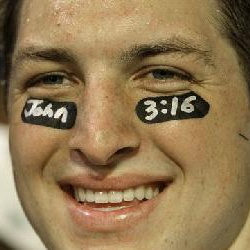
Gotta love this: the upstart Denver Broncos quarterback Tim Tebow, who has attracted nationwide attention for his ostentatious Christianity, is fond of associating himself with the New Testament verse John 3:16. For you damned heathens out there who may not be familiar with this oft-quoted passage, it says:

For God so loved the world that he gave his one and only Son, that whoever believes in him shall not perish but have eternal life.

Here’s the sort of thing I’m talking about:

Well, in tonight’s unlikely Broncos win over the Pittsburgh Steelers, Mr. Tebow completed ten passes — for a total of 316 yards. Better yet: that’s an average of 31.6 yards per completion.

I don’t know if any of them qualified as a “Hail Mary”, but that’s pretty nifty work nevertheless.

Tough Call

So, conservatives: who’s our guy going to be? Heading into the New Hampshire primary, Mitt Romney has a commanding lead — and the other candidates spent most of Saturday’s debate snarling at one another, while hardly even taking a swing at Mitt.

There are two questions.

First: who out of this lot would, by our lights, be the best president?

Second, and far more important for the future of the nation: who has the best chance of ousting Barack Obama?

To answer the most important question first: I think the answer is Mitt Romney. Newt Gingrich is simply much too off-putting to too many people. The reasons? There are several: his personal peccadilloes, his ostentatious vanity and haughty condescension (though of course you’re stuck with those that either way in a Gingrich/Obama contest), his petulance, his sequential fascination with a kaleidoscopic assortment of Big New Ideas, and more. (Even his portly middle, suggestive of hedonistic indiscipline, would no doubt be a liability in contrast to the imperially slim Mr. Obama.) I simply don’t think he would win, and if there’s one thing that all conservatives agree on, from the evangelicals to the Tea Party to the most socially liberal, godless “metrocons”, it’s that for Mr. Obama to get another four years in office would be a catastrophe for America. Mitt Romney, though brilliant by nobody’s assessment, looks radiantly presidential, holds his own well enough in debates, and clearly understands what all conservatives agree our next president must understand: the importance of a smaller, leaner, and less intrusive government to the preservation of America’s liberty and prosperity. It would be delightful to see Newt Gingrich shred Mr. Obama on the debating floor, but you can’t have everything, and it’s hard for me to imagine that Mitt won’t have a far broader appeal at the polls. I’ll invoke the Buckley Rule: you pull for the most conservative candidate who can actually get elected — and that’s Mitt Romney, I think.

As for the first question, about who would make the better President: for all of Newt’s brainy command of history, and his vast governmental experience, I’m still not sure that he’d be a better president. He has a tendency, rather like Toad of Toad Hall, to hop from one glittering attraction to another, and he has many enemies in Washington. I’m sure Mitt would be less of an activist than Newt — but Washington doing less looks pretty good right now, and I imagine most of his activism would be directed toward slimming the Federal behemoth, rather than dreaming up new and visionary initiatives. There’s no doubt that Mitt is far less imaginative than Newt, but that’s just as well, under the circumstances.

So: Mitt Romney it is, I guess. It’s hard to get excited about the guy, but if he can unseat Mr. Obama, that’s good enough for me.

Not everyone on the Right agrees, of course. In his latest essay, for example, Thomas Sowell makes the case for Newt Gingrich. I agree with much of what he says, as usual, but I think he overestimates Newt’s chance of victory in November, which completely undermines his argument. You can read it for yourself, here.

Shame!

I’ve never been a fan of Rick Santorum, and I hope he doesn’t win the GOP nomination, because then I’d have to vote to elect him President. But any criticism I might make of him begins and ends with his public life: his opinions and intentions regarding government policy.

Not so for liberal water-carriers Alan Colmes and Eugene Robinson, who disgraced themselves recently by jeering at Mr. Santorum and his wife for the way they handled what is surely the most sorrowful calamity that can ever befall any of us in this vale of tears: the death of a child.

Mark Steyn lets them have it, with both barrels, here.

P.S. I realize that, as Ross Douthat says here, privacy is to some extent “a luxury of moral consensus”, and that Mr. Santorum has made a career of pushing politics into the privacy of the bedroom — which is a big part of the reason I don’t support him. But mocking a family over their grief for a dead son is simply beyond the pale, I think, and in another age would have been considered evidence of ill breeding.

Why I Love The Internet

Just tweeted by “Karma’s janitor”, @Iowahawk:

New York New York, it’s a helluva town / 3 foot rats, but the transfats are down

The War of 2012

Peter Kirsanow comments, here, on President Obama’s scorched-earth “recess” appointments. I look forward to an adjudication in the courts.

This year’s presidential campaign is going to make Iwo Jima look like a pillow-fight. And if you thought U.S. politics were already polarized to the point of total dysfunction, Pat Buchanan argues here, just wait until it’s over — especially if Mr. Obama wins.

What’s The Point?

New tests of the extract of Japanese raisin-tree seeds (hovenia dulcis) appear to have confirmed that their “active ingredient” is highly effective at blocking the effects of alcohol. Big Think reports:

Scientists at UCLA gave a group of rats the “human equivalent” of 15 to 20 beers during a two-hour binge. We’ll call this group the Rat Blackout Brigade. These rats not only passed out cold, but also lost the reflex mechanism that allows them to flip over when placed on their backs.

Another group of rats got tanked up with the same amount of alcohol, except this group was also given a shot of DHM. While the DHM rats eventually passed out as well, it took them longer to become intoxicated and their stupor lasted only 15 minutes. These rats also regained their reflexes quickly. In other words, the study concluded that DHM counteracts intoxication and alcohol withdrawal symptoms. And most significantly, DHM was found to reduce voluntary alcohol consumption. (After a two-week bender, the rats did not become dependent).

Hovenia dulcis has been used as a folk remedy for centuries to treat a wide range of alcohol-induced ailments, including liver injuries. In fact, the Raisin Tree was recorded in the world’s first pharmacopoeia, Tang Ben Cao. It is said that during the Song Dynasty the poet Su Dongpo, who had a propensity for excessive alcohol consumption, used zhi ju zi, or Raisin Tree extract, to help him hold his liquor.

I don’t know. As far as I can tell, this h. dulcis stuff interferes with all the effects of alcohol, both the ones you don’t want and the ones you do. I know a simpler way of accomplishing that, and it’s cheap, too: don’t drink. (I give that a whirl every once in a great while, and as it happens it’s how I’m spending this January — mainly because I enjoy being able, now and then, to flip myself over when placed on my back.) I suppose this raisin-seed elixir would be good for someone who just wants a nice glass of wine with dinner, say, for purely aesthetic reasons, but I think it’s safe to say that most people consuming alcohol have a motivation that goes beyond finding the perfect pairing for their aumÁ´niÁ¨re d’oeuf poché Périgueux.

On the other hand, if someone were to come up with a medicament that reliably eliminates the existential crisis commonly known as “the morning after”, without interfering with one’s customary enjoyment of the evening before — well now, that would be something worth investing in.

Life Is Short

So I’ve decided to follow @kanyewest on Twitter. Should be great, I think.

This Just In

From the frontiers of science, here’s some breaking news —

Men, Women Really Do Have Big Personality Differences

— that any human being, plucked from anywhere on Earth at any time between the invention of language and the 1960s or so, and not in a persistent vegetative state, could have told you.

I’m “on the wagon” this month; after an outstandingly well-lubricated holiday season I thought a dry January would have a salubrious and restorative effect. Items like this make it very much more difficult.

Fish Story

Here.

Twilight Of Big Blue

Here’s something I meant to post a few weeks ago, when President Obama was delivering that Osawatomie speech. It’s an essay by Walter Russell Mead, in which he examines the persistent Hamiltonian and Jeffersonian threads in American political history, and argues that after a long period of Hamiltonian ascendancy, the time is right for the tide to turn.

Here.

One Size Fits All?

In the discussion thread of our recent post about Yusuf al-Qaradawi and the Muslim Brotherhood, the issue soon became: what should the attitude of the West have been toward the democratic uprisings in Egypt and elsewhere? On the one hand, as Americans it seems we ought to support democracy wherever we can; on the other, democracy will produce different results when practiced by different peoples. My own concern, which has so far been borne out by events, was that these revolts would lead directly to Islamist regimes in the region: hardly a gratifying outcome in terms of Western interests.

The ‘crux of the biscuit’ is this question: Do Western normative principles appeal to universal longings, and are therefore universally applicable across all peoples and cultures? Both liberal muticulturalists and neoconservative nation-builders seem to agree that they are.

Our commenter ‘The One-Eyed Man’ summed up with this:

…I do think that the principles in the Declaration of Independence are universal, applying to Muslims equally to Christians and everyone else.

This is a commonly held view, but with particular regard to Islam, it’s a fundamental error, of critical importance. I’ll try to explain.

As much as it may be fashionable (especially among unbelievers like me) to downplay the significance of religion in America’s founding, the Declaration of Independence explicitly expresses a Judeo-Christian understanding of the nature of God, and of God’s relationship with human beings. It clearly declares this understanding in its most famous passage:

We hold these truths to be self-evident, that all men are created equal, that they are endowed by their Creator with certain unalienable Rights…

The central argument of the Declaration of Independence is that the Crown, having repeatedly infringed on the rights of its American colonists, has voided its claim to sovereignty over them. So: what does it mean for men to possess inalienable rights granted to them by God, and how is this belief distinctly Judeo-Christian?

First, this assertion reflects the belief that a loving God grants these rights as part of His covenant with mankind — a covenant made first with the Jews, and then extended to the rest of humanity by Jesus Christ. Central to both is the idea of a loving God who, loving all men as individuals, directly grants each of them the assurance of His protection. The Declaration explicitly places this direct, individual assurance from God above any earthly institution’s power to abrogate.

But the idea of a loving Creator with whom mere humans may enter into this sort of personal covenant is directly at odds with the Islamic concept of God. The Islamic God Allah is perfect, transcendent, and aloof; the idea of Allah deigning to “love” a mere human is absurd, and indeed the thought is offensive to God’s majesty. The great Islamic theologian and philosopher Abu Hāmed Mohammad ibn Mohammad al-GhazzālÄ«, who died in 1111 but remains probably the most influential Islamic theorist of all time, argued against this by pointing out that love implies a need, an incompleteness, on the part of the lover that can only be fulfilled by the beloved. But God is perfect, continued Ghazzali, and complete unto Himself — so the idea that He might have a longing that can only be fulfilled by reciprocal love with mortal men is an abomination, as is the notion that He would enter into an equal partnership with anyone or anything at all.

This brings us to a second point: the very idea of an irrevocable covenant, as implicit in the concept of inalienable rights, necessarily implies a limitation of God’s sovereignty: for God to make an unbreakable promise necessarily limits God’s freedom of action. But the divine Will and infinite potency of God obviously can permit no such limitation — again, the very idea is an offense and an abomination.

Furthermore, the Declaration of Independence is a product of the philosophy of the Enlightenment, which in turn has at its foundation the idea of a lawful natural world. This concept also reflects the Judeo-Christian assumption of a loving God: one who, having endowed Man with the gift of reason, provided a world that operated without caprice, and that was subject to reliable regularities that human reason could comprehend. But again, this idea of a lawful Cosmos necessarily limits the freedom and sovereignty of God. Indeed al-Ghazali went so far as to say that because God’s power is infinite, His moment-by-moment attention to the world’s every minutest detail is what maintains the world’s seeming regularities, and the appearance of lawful connections between observed causes and effects is merely an illusion. If drinking water seems to alleviate thirst, it is only because God, on each occasion, has chosen to follow our drinking of water with the relief of thirst. But to imply that God’s choice in the workings of His creation is constrained by natural laws is again to suggest that God’s sovereignty is limited, and is again an abomination.

Finally, there is the Islamic concept of tawhid, or the unity of God. This idea was developed extensively by Taqi al-Din Ibn Taymiyya, a medieval Salafist whose teachings still exert great influence. In his widely read paper A Genealogy of Radical Islam, Quintan Wiktorowicz explained (emphasis mine):

One of Ibn Taymiyya’s most important contributions to Salafi thought is his elaboration of the concept of tawhid ”” the unity of God. He divided the unity of God into two categories: the unity of lordship and the unity of worship. The former refers to belief in God as the sole sovereign and creator of the universe. All Muslims readily accept this. The second is affirmation of God as the only object of worship and obedience. Ibn Taymiyya reasoned that this latter component of divine unity necessitates following God’s laws. The use of human-made laws is tantamount to obeying or worshipping other than God and thus apostasy. [20th-century Muslim theologian Mawlana Abul A’la] Mawdudi adopted this position and drew a sharp bifurcation between the “party of God’ and the “party of Satan,’ which included Muslims who adhered to human-made law.

This idea, which is very much a part of mainstream Islamic thought throughout the world, raises an impassable barrier between Islam and the Judeo-Christian tradition of a distinction between divine and worldly law — the root of America’s founding principle of a separation of Church and state.

There is much more I could say about all of this, but it’s late, and this post is already long enough. I hope, however, that I have shown that it is a mistake, and betrays a dangerously superficial acquaintance with core Islamic doctrine, to imagine that bedrock American principles — in particular those Enlightenment principles expressed by Jefferson in our Declaration of Independence — apply as aptly to serious Muslims as they do to those of us raised in the Western religious and cultural tradition.

Please Remain Calm

This in the mailbag from our old friend David Pauley: Freeman Dyson on catastrophes, real and imaginary.

Enunciatory Modalities

With a hat-tip to Bill Valicella, here are some prize-winning examples of spectacularly bad writing.

Well, I’ll Be

Nearly a year ago, as the uprising in Egypt was gaining traction, I wrote:

The Muslim Brotherhood (or “Ikhwan’) differs from militant Islamist factions like al-Qaeda not in its goals, which are more or less the same, but only in its strategy: it has no moral or philosophical aversion to violent jihad, but considers it unnecessarily provocative, and therefore counterproductive. As such, it can make an ostentatious public display of distancing itself from terrorism, and so it is embraced by gullible Westerners ”” for whom the only imaginable threat from Islam is terrorist violence ”” as a “moderate’ Muslim organization to be supported and embraced. This suits the Ikwhan, whose avowed strategy is to sabotage secular democratic societies from within, just fine.

The Obama administration, however, which has made “outreach’ to the Muslim world a priority (even going so far as to make NASA’s “foremost’ mission helping Muslims “feel good about their historic contribution to science and math and engineering’) clearly feels the the Muslim Brotherhood is an outfit it can do business with. We should not be surprised to see ”” in fact we should be astonished not to see ”” the Ikwhan seizing the opportunity now taking shape in Cairo, for which it has worked and waited so long. We should also not be surprised to learn that they will do so with the overt or covert support of the United States: so broad is the Brotherhood’s influence in Egypt that it is almost unimaginable that they will not take the reins, and you can be sure that Foggy Bottom and the Oval Office have already made the appropriate calculations.

For my trouble, I was berated in the comment thread for having made, under the bewitchment of “confirmation bias”, an assertion that was “unsupported by fact” and unable to “withstand even the slightest amount of scrutiny”.

A lively eleven months have passed since then, and we have yet to see any flowering of secular Jeffersonian democracy in the region, despite the lavish and effervescent optimism with which the initial disturbances were greeted by most observers here in the West. As was suggested at the time by those of us who have rather less faith in the universal appeal of Western ways, and a more sober understanding of the history of the area and its people, the likeliest outcome of these populist upheavals would be a transition to Islamic governance, with a concomitant erosion of Western interests in the region, and deepening existential peril for Israel.

Now, as Andrew McCarthy notes here, The Hindu reports that the Obama administration has turned to none other than Yusuf al-Qaradawi — the Muslim Brotherhood’s principal ideological theorist and dawa-jihad strategist — to negotiate the terms of our accommodation with the Taliban.

More confirmation bias, no doubt (after all, it’s just the Hindu, not the New York Times). We’ll just have to see.

Again?

Last January we noted in these pages a mysterious event at Beebe, Arkansas: thousands of red-winged blackbirds had fallen out of the sky on New Year’s Eve. An excerpt:

It seems that thousands of red-winged blackbirds (and as far as I can tell, only red-winged blackbirds) fell dead from the sky on New Year’s Eve in the area around the town of Beebe: victims, apparently, of some “massive trauma’. The cause is as yet unspecified; those who abhor such explanatory vacua, and must fill them, have suggested that “a loud noise’ might have been to blame.

A loud noise? It’s a dandy explanation, of course, and ought to settle the question ”” but as I head for the door I find myself turning back again, troubled, Columbo-style, by a nagging little detail. You see, the thing is that I have been around a lot of very loud noises in my day, and have even caused quite a few myself ”” and it strikes me that on no occasion did any of them, not even the very loudest, cause thousands of birds, of a single species, to drop lifeless from the firmament. So I wonder.

This seemed awfully strange then, but it seems even stranger now — because exactly the same thing has happened again, and on New Year’s Eve again, too.

I have not even the slightest inkling as to what might be going here, but it is very odd.

Happy New Year!

With grim 2011 winding down, I thought about making a New Year’s resolution to take a more positive outlook toward the future, to express more optimism in these pages, and generally to stop being so pessimistic about everything.

I figured it probably wouldn’t work out, though, so I gave up on the idea.

But just because the world (or at least Western civilization, which as far as I’m concerned amounts to pretty much the same thing) really is going down the drain doesn’t mean we can’t set aside our well-justified gloom for a moment, and raise a glass with family and friends. So here’s to you, readers! And for all I know, things really will turn around in 2012, and we’ll look back on this moment in history as the time when the West, at the very brink of disaster, awoke in sudden terror to the folly of the course it had charted, and with desperate resolve managed to steer clear of the fatal catastrophe.

Ha! Just kidding. Anyway, bottoms up, folks — and thanks as always for reading and commenting.

Search Me!

There’s something for everyone here at waka waka waka, and we’ve made it a late-December tradition to take a look back at some of the thousands of keyphrases that brought visitors our way from Google and other search engines over the past year. Here’s our 2011 selection; it’s a curious crop as always.

Read More »

This And That

We’re on something of a holiday schedule this week — so for tonight, just a grab-bag of little diversions:

An item that, if it were a post of its own, would surely have been titled “Bird Brains”, or perhaps “Counting Crows”.

A little hibernal music from the late Jackie Gleason.

— For you city dwellers yearning for a rustic getaway, some Cabin Porn.

— Some very detailed doodles.

Music hath charms, etc.

We’ll be back to normal operations sometime early next year. Until then, we’ll be focusing on our habitual last-days-of-December routine, which consists mostly of deserted seascapes, cheery blazes, old books, introspective rumination, and potent seasonal beverages.

Merry Christmas!

Whatever Christmas means to you — be it everything or nothing — I hope you all have a warm and happy one, in the company of people you love.

Christmas Eve, World At War

Here’s a time capsule from December 24th, 1941, seventy years ago today: Christmas Eve remarks from the White House lawn by Franklin D. Roosevelt and the visiting Winston Churchill. The US had just entered the war; Britain had until a fortnight earlier stood alone against the Nazis, and since September had endured the horrors of the Blitz.

This was a far different era of Western civilization. It’s hard to imagine that it was within living memory of many who are still with us.

Circling The Drain

Diana West comments here on the dismal verdict in the Elisabeth Sabaditsch-Wolff trial in Vienna.

Her crime, if you haven’t followed the case, was to comment disapprovingly on Mohammed’s deflowering of his nine-year-old wife Aisha.

Well, tolerance is paramount in a decent society, I guess.

Meanwhile, Christmas masses have been canceled in Iraq due to fears of anti-Christian violence.

Auto-Goal

Well, there you have it: a bumbling, humiliating performance by the House GOP on the ridiculous two-month payroll-tax moratorium (which, among its other shortcomings, is so idiotically brief that it presents costly problems to payroll processors). Nice work, guys.

Charles Krauthammer offers a scathing summary here.

Tower Of Babel

Here’s a page that shows a live stream of Wikipedia edits. You can filter the stream by language version and edit size. It’s curiously fascinating, for a minute or two at least.

Shadow Portrait

Here’s a clever idea.

Lil’ Kim

For you strategic-security wonks, John McCreary has published a substantial post on events in North Korea today at NightWatch — complete with a parting jab at the Times. I’ll reproduce it here.

North Korea: North Korea is demanding that foreigners either remain in their homes or leave the country. Pyongyang authorities ordered some foreigners to leave, according to Chinese nationals who frequently visit North Korea.

A Chinese student in Pyongyang said North Korean professors ordered their Chinese and Russian students to avoid leaving their residences. According to a Chinese man who flew out of Pyongyang on 20 December, foreigners were not allowed to leave their accommodations after the announcement of Kim Jong Il’s death on the 19th.

North Korea also is deporting some foreigners from Pyongyang, Sinuiju and the Rajin-Sonbong special economic zone, Chosun reported on 21 December. Missionaries and US businessmen engaged in charity work in Rajin-Sonbong and Sinuiju have been forced to leave. North Korea is preventing foreigners from entering the country and will not issue any new visas until after 29 December.

Comment: Control of foreigners, including expulsion, is one of the national civil readiness measures prescribed in a semi-war state of alert, which is a preparatory stage of war preparations for an attack as well as for defense against an attack. Such measures are out of sync with a global and increasingly integrated economic system, but for North Korea they are normal during conditions of stress, such as leadership change.

Kim Jong un’s first military order, according to Korean news services, was to order all military units to return to garrison. His military mentors, most likely Vice Marshal Ri, the chief of the General Staff, had him sign this order on 18 December. This also is prescribed in a semi-war state of alert for rear and mobile military units. For forward forces just north of the Demilitarized Zone, they are supposed to report to wartime defenses and commence tunnel living.

Comment: The context for this order is that the annual Winter Training Cycle for the Korean People’s Army began on 1 December. Winter is the period of the most intense and extensive training for the entire Army.

In December, which is the first month of the cycle, soldiers are in classrooms or at shooting ranges and other basic field training sites for the early phases of the cycle. The cycle culminates in large unit – corps- and multiple corps- echelon — field exercises in early spring.

Confining units to garrison means the early phases of the training cycle have been interrupted and the entire cycle must be truncated by at least a month. Army readiness peaks in April, after the cycle ends and remedial training is completed for units that failed to meet standards. The Army cannot now meet that schedule without sacrificing readiness.

The North Korean Marshals and Generals will appreciate that the coming year will be a period of extraordinary military vulnerability until the summer training cycle is completed. They may be expected to be prickly and prone to violence over perceived provocations by the Allies.

The order to confine troops to barracks during a time of internal stress always means the leadership does not trust its lower echelons of leadership. It does not want troops to have access to live ammunition and will not risk normal training because of the danger of a military revolt.

Special comment: The succession of Kim Chong il in 1994 was not peaceful or smooth, despite western punditry and North Korean propaganda. There were multiple assassination attempts against Kim Chong il during his first year as leader, although he was his father’s understudy for more than a dozen years. An entire North Korean Army Corps revolted against him in early 1995 and requested American and South Korean assistance, which it did not receive. Its leaders fled to China. The corps was disbanded.

Despite the North Korean propaganda and the shallow Western news coverage, the succession of Kim Jong un is likely to be much more unstable than was Kim Chong il’s, once the mourning period ends in January 2012.

All the video reports and written news items on the home pages of the Korean Central News Agency stress that the Army and the people support Kim Jong un. Every video of Kim Chong-il during his life shows Kim Jong un in the background. But all the images are quite recent and they are few. Kim Chong-il did not take his designated heir everywhere with him, as his father did with him.

Moreover, the videos and other reports do not mention that the communist party or the government support Kim Jong un. The Army always is listed or mentioned first. The North Korean people will understand that for now they are under army rule.

Finally, North Korea is an oriental despotism as described by Professor Karl August Wittfogel in his seminal book “Oriental Despotism.” It is not inscrutable or unpredictable or mysterious. It is Asian.

That means that an extended royal family governs and risks being destroyed if the government changes. It will exhibit no interest in reform that jeopardizes its status and life style.

That family pampers and depends on the loyalty of the armed forces leaders. That means that every army corps commander has a villa, Mercedes Benz personal vehicles, Rolex watches, flat screen HD TVs and all the luxuries that North Korean can afford. Kim Chong il never neglected his senior commanders and they are now in charge of national security.

All of that means that peace with South Korea is highly unlikely because the generals and vice marshals will lose their life style and the Army will lose its reason for existence.

Internal economic reform will be measured by whether it helps the Kim extended family. The young Kim is a victim of the decisions of his grandfather and father.

Anecdote: South Korea’s director of the National Intelligence Service told the press today that US satellite photos show that all of the leadership trains used by Kim Chong-il were in their normal parking areas in Pyongyang rail yards on 17 December, the day Kim died.

This means that Kim could not have died on a train during a field tour, as the Pyongyang government announced on the 19th, and as the official media broadcast. He died with no heroics.

On the 18th, however, the North Koreans did move a leadership train from Pyongyang, apparently and belatedly recognizing their gaff.

The South Korean intelligence chief reported that Kim most likely died in bed, or at least in Pyongyang. The story about dying on the train was part of the mythology the North Koreans love to indulge, but which no North Koreans believe.

Final comment: The New York Times published an absurd article about a massive intelligence failure because the US did not know that Kim was dying in his villa in Pyongyang, and learned of his death from official North Korean press statements … as it did when Kim Il-sung died in 1994.

The intelligence failure thesis reveals an ingénue’s complete misunderstanding of US intelligence. No one knows or can know when a national leader is dying suddenly, including the Chinese, even in a Web 2.0 world. There is no App for dying national leaders.

Dueling Donks?

I’ve been getting robocalls over the past few days for a “Draft Hillary” campaign. Mounting a primary opposition to the President would be a smart move for the Democrats, I think, given how deeply Mr. Obama has disappointed so many of his supporters. I have a feeling Hillary would be a lot harder to beat in November then the incumbent would, though a primary battle in which the Obama attack machine trained its fire on a fellow Democrat might be more than the party has the stomach for. It would certainly be fun for those of us in the loyal opposition to watch those two flay each other for a few months, I have to say.

This could get interesting.

Shades Of Night Descending

Here is a long and deeply depressing essay about California’s dying Central Valley, by one of its lifelong residents, Victor Davis Hanson.

How did we let this happen to ourselves?

Yeah!

Time for some NRBQ, I think. Here’s Wild Weekend. And here’s Get Rhythm.

Man, what a band.

We’ll Make It Up In Volume!

Via Drudge: According to an investigation by one James Hohman, of the Mackinac Center for Public Policy, the Chevy Volt bakes in up to a quarter of a million dollars of government subsidies per vehicle.

Meanwhile, sales of the Volt for 2011 had reached just over 6,100 by the end of November, which looks to fall short of Chevrolet’s hoped-for 10,000 units for 2011. Buoyed, however, by the fact that anyone’s buying them at all (and, no doubt, by the continuing prospect of a place at the public trough for the GM snout), the company is gearing up its plant for a production run of 60,000 Volts in 2012. Order now! They’re sure to fly off the lot.

Worlds Without Number

Here’s the latest from the Kepler planetary probe: Earth-sized exoplanets. Not in the temperate, ‘habitable’ zone, but we’ve found some of those too. All this after only a couple of years of looking, with a technology that is still in its infancy.

Can anyone really imagine anymore that the galaxy isn’t teeming with Earth-like, watery worlds? Can we really imagine that we are alone?

The Haunting of Don Carlo

An article in the current New Yorker begins:

On the night of October 16, 1590, a palace apartment near Piazza San Domenico Maggiore, in Naples, was the scene of a double murder so extravagantly vicious that people are still sifting through the evidence, more than four centuries later. The most reliable account of the crime comes from a delegation of Neapolitan officials, who inspected the apartment the following day. On the floor of the bedroom, they found the body of Don Fabrizio Carafa, the Duke of Andria, whom a contemporary described as a “model of beauty,’ one of the handsomest young men of his time. The officials’ report stated that the Duke was wearing only “a woman’s nightdress with fringes at the bottom, with ruffs of black silk.’ The corpse was “covered with blood and pierced with many wounds,’ Lying on the bed was the body of Donna Maria d’Avalos, the famously alluring wife of Don Carlo Gesualdo, the Prince of Venosa. Her throat had been cut and her nightshirt was drenched in blood.

Interviews with eyewitnesses left no doubt about who was responsible for the murders. Gesualdo had been seen entering the apartment with three men, shouting, “Kill that scoundrel, along with this harlot!’ The report ended with the observation that Gesualdo had left town. A prince being a prince, there matters rested.

Don Carlo Gesualdo was more than just a vengeful prince, however: he was also a composer, as one contemporary observer noted, “of infinite art”. He wrote choral music — madrigals — of a sort that had never been heard before, and the like of which was not heard again until the twentieth century. His compositions, which I had never listened to before last night, seem to occupy two worlds at once: a familiar and beckoning realm of sublime and uplifting harmony, and a strange, alien dimension of unnameable dissonances and constantly shifting keys. Listening to his music is a kaleidoscopic, almost hallucinatory experience; no sooner has the spirit come to rest in a pool of limpid sunlight than the scene shifts, through brief passages of swirling and often terrifying darkness, to the next open glade. The music is never still, and to surrender to it is to be borne away to a dreamlike place of lonely, haunted beauty.

Wikipedia’s article on Gesualdo notes:

The evidence that Gesualdo was tortured by guilt for the remainder of his life is considerable, and he may have given expression to it in his music.

Surely he did. Go to YouTube, search for ‘Gesualdo’, and listen.

This Just In

Kim Jong Il has died. This is going to be interesting.

Murder On The Nile

Horrifying images and video from Egypt, here.

One of the consistent lessons of history, from Aristagoras to Gorbachev, is that authoritarian systems place themselves at great risk when they attempt to liberalize. The Supreme Council of the Armed Forces is learning this lesson today; they have unleashed forces that they have no idea how to control.

Just Saying

You know who I feel sorry for? Flightless birds. Jesus, what a crappy deal.

Hitchens Pro And Con

There’s been a huge outpouring of opinion about Christopher Hitchens from both Right and Left, most of it encomiastic, but mixed in with some harsh reviews as well. That isn’t surprising; obviously a polemicist like Hitchens — especially one who crossed the aisle as publicly as he — is going to have his fair share of enemies and critics.

The hard traditionalists, like Lawrence Auster, didn’t like him at all. For Auster it was Hitchens’s militant atheism that put him far beyond the pale. It’s a fair cop, too, I think: I’m an atheist myself, but have come to believe that secularism is, as far as cultural survival is concerned, a maladaptive trait, and to recognize that religion plays, whether I like it or not, a vital role in a nation’s cohesion, vigor, and cultural continuity. Atheists should be more careful about this, if you ask me: they risk, without realizing it, kicking down the tent-pole. But in the end, it’s a matter of priorities: for Mr. Hitchens, the almost certain falsehood of most religious doctrine, and the stupidity and violence with which he so often saw it propagated and defended, was simply more than he could suffer in silence, no matter the cost.

Jonah Goldberg, who knew Hitchens, made this point in his latest ‘G-File’ newsletter:

I once wrote somewhere around NRO that I thought that maybe — just maybe — Hitchens could be considered a “man of the Right.” He was no conservative. You can’t really be a conservative in the Anglo-American tradition and hate religion. You can be a non-believer, I think. But you have to at least have respect for the role of religion and maybe a little reverence for the role of transcendence in people’s lives. Hitch had nothing but contempt. It was one of the last truly asinine Marxist things about him.

…The more I thought about it, the more it seemed to me that Hitch — who believed in the importance of Western Civilization (he said he’d rather defend Western Civilization than denounce John Ashcroft), gloried in the splendor of the Canon, admired other cultures but rejected utterly the asininity of multicultural leveling — was certainly not a man of the contemporary Left, or maybe not of the Left at all.

I no longer think Hitch was really a man of the Right, chiefly because you can’t be a man of the Right and reflexively, perhaps even childishly, reject the label.

Here’s John Derbyshire:

Christopher Hitchens has died, much too young. I can’t say I was a fan, am not in fact sure I ever read to the end of anything he wrote.

Hitch was a court jester for the liberal elites. He took care never to violate their most sacred taboos. Like Stephen Jay Gould, who also died too young, also of cancer, Hitch carried the banner of soft Marxism forward into the post-Soviet era.

I’m sorry if I sound lukewarm. I’m an opinion journalist, like Hitch, and I am fully aware, as he was, that it is a low kind of trade ”” “the vituperative arts,” as Auberon Waugh said. Hitch was superbly good at it, far better than I could ever hope to be, and miraculously productive to the end. Is that a bit better?

I’ll add this: He was often fun to watch, quick at thinking on his feet, and something like a genius at not suffering fools gladly.

There now; it didn’t come out so bad. I even think the subject might have applauded it. Goodnight, Hitch.

I don’t think that even those who were unapologetic admirers, like me, could possibly have agreed with the man about everything, or perhaps even most things. For me, as I said before, what made me a Hitchens fan were those qualities with which he seemed unfairly, impossibly gifted: his coruscating intelligence, his dazzling skill in debate, his virtuosic wordcraft, and above all, his luminous vitality and style.

In a post yesterday on atheism and death, Bill Vallicella offered this:

‘Brilliant’ is a word I don’t toss around lightly, but Hitch is one to whom it unarguably applies. Public intellectuals of his caliber are rare and it will be sad to see him go. Agree or disagree with him, it is discourse at his level that justifies the high regard we place on free speech.

Yes indeed: it’s sad to see him go.

Lumos!

The Senate has passed their stopgap spending bill, which included a rider that annuls, temporarily at least, what would effectively have been a ban on incandescent bulbs beginning this year. The intrusive legislation had made an awful lot of people hopping mad — but looking on the bright side (especially now that it has been deferred), it became such a cause célÁ¨bre for the Right, and such a poster-child for the excesses of the liberal nanny state, that it seems to have awakened a lot of people to the urgency of the conservative cause.

Getting people fired up about this wasn’t too hard, when all you had to do was quote the Energy Secretary’s remarks on the State’s rationale for the ban:

“We are taking away a choice that continues to let people waste their own money,” he said.

This sums up the paternalism of the big-government Left so precisely that it could probably be used with high accuracy to identify political orientation. Does the quoted remark seem to you a perfectly sensible policy statement from an unelected Federal executive? Or does it get you thinking dark thoughts about the the consent of the governed, and the Second Amendment? Form two lines, please.

Anyway, it’s a small victory, but we’ll take it. It’s too bad that Mr. Obama’s chum, General Electric CEO Jeff Immelt, has already closed our last domestic incandescent-bulb plant, in anticipation of a flow of consumers given no choice but to buy the more-expensive and less-popular compact-fluorescent bulbs — but chalk up one for liberty, and for the free market, nevertheless. If people actually want to buy CFLs, of course, they’re still perfectly welcome to do so.

I haven’t read the bill itself yet, but my understanding is that it also forces the White House to make a call on the Keystone pipeline project within 60 days, rather than deferring it until after the 2012 election, as the president had hoped to do. All good.

Christopher Hitchens, 1949-2011

The death of Christopher Hitchens has hit me hard today; he was something of a hero of mine. Mr. Hitchens was everything I admire in a writer: a master of language, with incomparable style and wit, and a restless and erudite scholar — but unlike so many in possession of similar (but almost invariably lesser) gifts he was also a man of real passion, fully engaged in the life of the world all around him, and always willing to be persuaded by the truth, even when it necessitated a painful public apostasy. He lived.

If all that weren’t enough, he possessed another gift I envied: that rich, beautifully accented, sonorous baritone Voice. How it ensorcelled and enchanted! Could he have woven that Hitchens spell with the pipes of, say, Gilbert Gottfried?

Ah, me. Well, now he’s gone, and we’ll just have to carry on. His obituary in our newspaper of record is here, though of course everyone who had even the slightest acquaintance with the man now seems to have gone to press with a detailed memoir of their happy time together, even if it consisted of nothing more than a pizza delivery, or a one-off dry-cleaning transaction.

I, on the other hand, shared something truly meaningful with Hitch, I’ll have you know. We had the same birthday.

Sad News Tonight

Christopher Hitchens has died.

Read this remembrance, by Christopher Buckley.

Into The Mire

In an excellent little essay at NRO, Michael Knox Beran reminds us that human suffering is, to borrow a word from the natural sciences, conserved: it can be transformed but not eliminated — and that the modern liberal obsession with its eradication at any cost is futile, and in the end destructive.

We read:

The dream of a painless world is the great illusion of liberalism. Classical liberalism, it is true, never promised to make men happier; it promised only to make them richer. Adam Smith argued that we deceive ourselves when we suppose that those material luxuries that we associate with happiness are “worth all the toil and anxiety which we are so apt to bestow’ on their attainment.

Material wealth is good, Smith says, not because it makes us permanently happier, but because it enables us to dispense, in some measure, with physical and corporeal miseries (hunger, squalor, disease, and the like). In their place we have psychological and spiritual debilities. The primitive man famishes; the civilized man despairs ”” he experiences the accidioso, the dejection and spiritual sloth, described by Dante, or the noia and “inward death’ of Leopardi, or the ennui of Baudelaire. The civilized man is not happier than the savage, but his misery is more polished and elegant, and as a general rule comely things are to be preferred to uncomely ones.

Very well said. Read the rest here.

Dawa Digest

Here are a couple of recent items on the dawa-jihad front:

First: you may have heard about the kerfuffle that arose recently when the home-improvement chain Lowe’s decided to yank its sponsorship of the “anti-Islamophobic” television series All-American-Muslim. (Dozens of other sponsors soon joined them; all are now predictably being tarred as “racists” by the ummah‘s useful idiots on the Left, although opposition to the spread of Islam in the West has nothing whatsoever to do with race, and everything to do with a perfectly sensible wariness toward a totalitarian, intolerant, and virulent ideology.) Robert Spencer comments here.

Also: what with the recent persecutions of Geert Wilders, Elisabeth Sabaditch-Wolff, and Lars Hedegaard, the witch-hunt for “instigators” following the Anders Breivik rampage (which has made the Norwegian writer Fjordman’s life a living hell), the imprisonment of (the admittedly loutish) Emma West, and the stifling effect of Europe’s incremental dhimmitude on free speech in general, it should be no surprise that the OIC, the global organizing body for dawa jihad, is feeling its oats these days — and has its eye on that last bastion of free expression, the United States.

With that in mind, Clare Lopez at American Thinker has had her eye on a meeting, now presumably concluded, between OIC and our Secretary of State. Read her substantial article here.

Don’t Let the Door Hit Ya Where That Bulldog Shoulda Bit Ya

The British New York Times columnist Roger Cohen has registered, in this recent item, his condescending disapproval of David Cameron’s rejection of the EU’s fiscal-union proposal. It is regrettable, opines Mr. Cohen, that the “pinstriped effluence” of the ancient British nation should wax so mawkishly sentimental over its silly old sovereignty, which is at this point nothing more than an embarrassing reminder of its obsolete, and morally embarrassing, imperial pretensions. Here’s a little sample of Mr. Cohen’s tone:

Since Cameron’s “No,’ there’s been much chatter about the return of Britain’s “bulldog spirit.’ Self-delusion is a lingering attribute of former imperial nations adjusting to a lesser reality.

Let’s unpack that a little:

Yes, you were once a great nation and people, but no longer, and good riddance. You are now a sagging, broken, deracinated little country, just as we planned — with nothing left to sustain you but empty traditions and fading memories, and no hope for the future but to submit to the will of your new masters.

Kneel!

In response (and with a hat tip to David Duff), here’s Ed West of the Daily Telegraph:

Of course the EU has brought wonderful benefits. In the old days one had to go through the palaver of changing currencies before going on holiday; now, thanks to the EU, that is no longer a problem, as no one can afford holidays. And, of course, after 45 years of European peace, a peace maintained by the US military (protection which, alas, has created a sort of infantile anti-Americanism among Europeans, the same sense of resentment a grown-up child living with their parents feels), the EU has done an amazing job of bringing Europeans together. The German chancellor is rarely off the front page of the Greek press, and Irishmen love the fact that their budget must first be discussed in Berlin before anyone in Dublin has a say.

But of course the EU is not about economics, and never has been ”“ it’s a moral idea with the millennial goal of destroying nationalism, which is why for four decades British Eurosceptics have been cast as moral deviants or caricatures (incidentally the latest YouGov polls show less support for the EU among women than men). That is why Guardian readers ”“ and I imagine it is quite similar with New York Times readers ”“ are always surprised to find normal, affable people who hold conservative views.

That last bit — about educated liberals who have been so deeply marinated in the warm crock-pot of smug multi-culti PC groupthink for so long that they’re genuinely surprised, upon finally making the acquaintance of an actual conservative, to find that he lacks horns and a tail — I can vouch for personally. Where I live, it happens all the time.

You can read the rest of Mr. West’s piece here.

Fry, Baby, Fry

A few months ago I started noticing a particular female announcer’s voice on radio and television commercials. She had a pleasant enough voice, but I thought it exhibited a peculiar weakness — in her falling inflections she would routinely drop below the bottom of her tonal register, and her sonorous voice would break momentarily into a pitchless croaking.

Having had a great deal of experience in recording audio for advertising, I was amazed that these defective (to my ear, anyway) voice-over performances had made it onto the air. But once I had noticed this woman, there she was, week after week, reading copy for several different products. (I wish I could remember what they were, so I could dig up a clip for you.) I also started noticing other female announcers who had the same problem.

Well it turns out this is a new fashion trend for the female voice. It has a name, too: it’s called “vocal fry“.

Learn more here.

All Quiet On the Eastern Front

Not having much to say tonight, I thought I’d just put up a few pictures I snapped around Wellfleet yesterday and today. I apologize for the mediocre quality: I’d left my camera behind in New York this time around, and so they were taken with my phone.

Yesterday I decided to explore the path leading away into the woods from the parking lot at Great Pond. These woods are crisscrossed with old trails and fire-roads, and I knew that one could make one’s way through the forest to a picturesque little kettle-hole called Dyer Pond, though I’d never done it myself.

Here’s a shot of the fire-road right by Dyer Pond:

And here’s the pond itself:

On the way back I stopped by Great Pond to have a look. There was hardly any breeze, and the water was clear and still.

In the summer, Great Pond is a very popular swimming-hole (I do a daily mile there myself), and the water never has a chance to settle. But on these clear calm days in the off-season, it becomes as limpid as glass, and the sandy bottom, undisturbed by all those vacationing feet, takes on lovely rippled patterns. I took a tall shot of the trees and sky reflecting in the smooth surface:

Then I lowered the frame so as just to show the sandy bottom, fading into the reflected sky:

How like a fingerprint those ripples are. As above, so below.

Late in the afternoon today I took a walk down to Great Island, which forms the western barrier of Wellfleet Harbor. At the northwest corner of the “island” (it isn’t really an island at all, but is more of a “tombolo”, connected to the nearby land by a narrow isthmus) there’s a steep hill accessible by a narrow sandy path (I’ve marked it here). I’d never been up there before, and it looked like a fine vantage, so up I went. Here’s the view from the top, looking north. The harbor’s on the right, and the 25-mile breadth of Cape Cod Bay is on the left:

Here’s the same view, from a few yards back along the ridgetop:

By this point the sun was setting over the Bay, with a little sun-dog in the icy clouds over to the right:

After the sun had set, I climbed down and walked out on the beach, looking west toward the mainland over the Bay. The tide was receding, and I was able to walk a long way out:

That’s all for today, I’m afraid. I’m sure there’s plenty going on in the busy wider world, but out here sometimes it’s kind of hard to care.

Eine Kleine Nachtmusik

We have coyotes out here in the Wellfleet woods, though we hear them oftener than see them. They like to socialize on moonlit nights, and last night they had a pretty good jamboree going not far from our little hilltop. The sound of it isn’t exactly musical, to my ear at least, but you can tell they’re putting their hearts into it, and maybe even having a little fun.

The coyotes around here, when you do happen to catch sight of one, have a wretched, scraggly, slinking look about them, and they skulk off directly once they realize they’ve been seen. But you don’t have to take my word for it — here’s Mark Twain, in one of my favorite passages from Roughing It:

The cayote is a living, breathing allegory of Want. He is always hungry. He is always poor, out of luck and friendless. The meanest creatures despise him, and even the fleas would desert him for a velocipede. He is so spiritless and cowardly that even while his exposed teeth are pretending a threat, the rest of his face is apologizing for it. And he is so homely! — so scrawny, and ribby, and coarse-haired, and pitiful. When he sees you he lifts his lip and lets a flash of his teeth out, and then turns a little out of the course he was pursuing, depresses his head a bit, and strikes a long, soft-footed trot through the sage-brush, glancing over his shoulder at you, from time to time, till he is about out of easy pistol range, and then he stops and takes a deliberate survey of you; he will trot fifty yards and stop again — another fifty and stop again; and finally the gray of his gliding body blends with the gray of the sage-brush, and he disappears. All this is when you make no demonstration against him; but if you do, he develops a livelier interest in his journey, and instantly electrifies his heels and puts such a deal of real estate between himself and your weapon, that by the time you have raised the hammer you see that you need a Minié rifle, and by the time you have got him in line you need a rifled cannon, and by the time you have “drawn a bead” on him you see well enough that nothing but an unusually long-winded streak of lightning could reach him where he is now. But if you start a swift-footed dog after him, you will enjoy it ever so much — especially if it is a dog that has a good opinion of himself, and has been brought up to think he knows something about speed.

The cayote will go swinging gently off on that deceitful trot of his, and every little while he will smile a fraudful smile over his shoulder that will fill that dog entirely full of encouragement and worldly ambition, and make him lay his head still lower to the ground, and stretch his neck further to the front, and pant more fiercely, and stick his tail out straighter behind, and move his furious legs with a yet wilder frenzy, and leave a broader and broader, and higher and denser cloud of desert sand smoking behind, and marking his long wake across the level plain! And all this time the dog is only a short twenty feet behind the cayote, and to save the soul of him he cannot understand why it is that he cannot get perceptibly closer; and he begins to get aggravated, and it makes him madder and madder to see how gently the cayote glides along and never pants or sweats or ceases to smile; and he grows still more and more incensed to see how shamefully he has been taken in by an entire stranger, and what an ignoble swindle that long, calm, soft-footed trot is; and next he notices that he is getting fagged, and that the cayote actually has to slacken speed a little to keep from running away from him — and then that town-dog is mad in earnest, and he begins to strain and weep and swear, and paw the sand higher than ever, and reach for the cayote with concentrated and desperate energy. This “spurt” finds him six feet behind the gliding enemy, and two miles from his friends. And then, in the instant that a wild new hope is lighting up his face, the cayote turns and smiles blandly upon him once more, and with a something about it which seems to say: “Well, I shall have to tear myself away from you, bub — business is business, and it will not do for me to be fooling along this way all day” — and forthwith there is a rushing sound, and the sudden splitting of a long crack through the atmosphere, and behold that dog is solitary and alone in the midst of a vast solitude!

It makes his head swim. He stops, and looks all around; climbs the nearest sand-mound, and gazes into the distance; shakes his head reflectively, and then, without a word, he turns and jogs along back to his train, and takes up a humble position under the hindmost wagon, and feels unspeakably mean, and looks ashamed, and hangs his tail at half-mast for a week.