The Pernicious Self-Deception Of “The Right Side Of History”

We are hearing, once again, a lot of incoherent prattle about “the right side of history”. It’s no surprise, given current events, but as time goes by, I find it increasingly annoying. It’s a vain and silly expression, full of swollen and virtuous self-pride; all it really refers to, in most people’s mouths, is whether they approve of what someone else is doing. (After all, pretty much anybody, throughout mankind’s long and bloody saga, would, if you had explained the concept to them, have said they were “on the right side of history”. Was Alaric the Goth on the “wrong side of history”? Was Tamerlane, or Suleyman the Magnificent? I doubt you’d even have been able to make them understand the question.)

Taken at that level, it’s just silly. But if you examine it more closely, it smuggles in a sneaky little enthymeme — a hidden premise — that almost nobody who uses the expression acknowledges.

History’s having right and wrong “side” assumes that it has telos, an intrinsic purpose — but if so, where does it come from? (It would have to come from somewhere, after all.) Doesn’t it seem a curious truncation to stop at “sides” of history, and not just appeal directly to the source of that purpose?

Simply put: history in itself, being just “what happens”, isn’t the sort of thing that can have intrinsic aims and values. Either they aren’t in there at all, and so the aims are entirely our own, or there really is a telos to history, which requires an external author.

It’s important to pause for a moment here to distinguish between mere social and political regularities, such as Robert Michels’ “Iron Law of Oligarchy”, or the recurring phenomena observed and described by Machiavelli, Mosca, Pareto and others – and moral laws, aims, and valuations, which imply purpose. Saying “the Right Side of History” assumes the latter. And if that’s so, then what (or whom) we should be appealing to is the source of that purpose, not the mere outworking of the process itself.

We should be clear: both “history is meaningless, and is just what happens”, and “there is a higher moral Purpose at work in the world, and we are drawn to it”, are philosophically defensible positions. (I’m still grappling with this difficult choice myself.) We are free to believe the former, with the abyss of nihilism that it necessarily implies — but if there is no objective, transcendent source of meaning and purpose in the world, then the “right side” is just your personal opinion, and you have no footing upon which to lecture anyone about it.

If, however, we choose the latter, then the “side” to be on is not that of mere “history”, but of the ultimate source of history’s underlying purpose: the creator and author of moral truth. Stopping short of this, and imagining that History anchors and embodies the Good all by itself, is a pathetic, “humanistic” cop-out. It steals a base by assuming the transcendent while being too proud to admit it; it yearns for God, and for the comfort of higher guidance, while barring the door. It illustrates with clarity why Pride is thought the most dangerous of sins: because it puts Man in the place of God.

Most people, I am sure, don’t think about any of this when they use this expression, and aren’t aware that, in its implicit reference to transcendence, it shows the lingering influence of the Old and New Testaments in our militantly secular society — whose world-changing innovation was the idea that History is not circular, or endlessly recurrent, but is instead a linear unfolding of a Creator’s purpose, with a beginning, middle, and end — and an Aim.

So: you can have it either way, but saying “the right side of History” tries to have it both ways at the same time — and so it is a pitiable self-deception, a sign of our persistent hunger for higher meaning while in the grip of a proud, naturalistic pseudoreligion that shoots the transcendent down from the sky.

Reaping The Whirlwind

Lee Smith has posted an essay at Tablet summarizing the decades-long runup to this war in Ukraine. It’s an excellent synopsis — brief, clear, and insightful — and I highly recommend it to you all.

Greed, bluster, folly, and hubris — this story has it all. Read it here.

Off We Go

That great rumbling sound you’re hearing is history resuming. Reports of its death, or that it has “sides”, were greatly exaggerated. We see tonight, as we have seen again and again and again, century after century, that imaginary “order” based on political and diplomatic abstractions — or on anything but a vector-sum of power, fear, the lust of empires to expand, and the existential concerns of human peoples for the security and preservation of their heritage and folkways — is nothing but a polite and evanescent fiction.

Decades of historical ignorance, hubris, greed and folly regarding Russia, from both of our major parties, have brought us to this moment. If you have a child, spouse, brother, sister, or parent in the military, how will you feel if he or she is sent to die in Ukraine, a place where none of our national interests are at stake, in order to satisfy the narcissistic longings of our ruling elites?

How shabby and dismal it all is, and how easily preventable this debacle might have been. But here we are. Thank God we’re in such wise and capable hands.

We Sail For Parts Unknown To Man

Sad news yesterday: Gary Brooker, the singer, composer, and pianist of the English band Procol Harum, has died of cancer at the age of 76. This was a particularly poignant passing for me; I’ve been haunted by his masterpiece A Salty Dog since the first time I heard it, more than half a century ago, and even after all these years I still think it is perhaps the most beautiful song ever written.

You can read Mr. Brooker’s obituary, at the Procol Harum website, here.

Number Three

It is with great joy that the lovely Nina and I welcome to the world little Cooper Joseph Wright, our third grandchild, born today in Hong Kong. Mother (our daughter) and son are happy and well.

Not To Worry!

You may have had some concerns about gathering tensions on the Russian frontier. (There’s much I could say about what it all means, and about our decades of folly regarding Russia, but I’ll leave that for another time.)

Well, I’m happy to say you can put your mind at ease, and get on with your life. Why? Because we’ve sent our top negotiator — quite possibly the wisest master of international affairs since Metternich — to sort things out.

I refer, of course, to the incomparable Kamala Harris, whose very presence in the room is certain, given her somber dignity, labyrinthine scholarship, and all-around gravitas, to hush and chasten these squabbling parties, and to bring them immediately to their senses. (George Washington is said to have had the same charismatic effect, but such people are rare, and we are lucky indeed that, in these parlous times, a merciful Providence has given us Ms. Harris to stand at the helm of our nation’s foreign policy, and to represent our interests abroad.)

NPR reassures us that things are well in hand:

“The vice president’s schedule is going to be very intense, and it will include a series of high-stakes, high-level diplomatic talks,” a senior administration official told reporters on Wednesday evening.

Yes, the stakes are high. Thank God we’re sending our best. Learn more here.

Gone, But Not Forgotten

Rush Limbaugh died a year ago today. Over at American Greatness, Christopher Flannery has published a remembrance. Read it here.

Negative Feedback

I’m 65, soon to be 66. My lovely wife Nina is about a year-and-a-half older. (She “robbed the cradle”!)

We are already both eligible for Social Security. Neither of us had been planning to file for it yet, though, because for each year you wait (until you’re 70), the benefit rate that you lock in increases by 8% above your full-retirement-age benefit. So if you aren’t desperate to get the money flowing in your sixties (we aren’t), and you are in good enough health to expect to live a long time yet (we are, and we do), then it makes sense to wait until you’re 70 to file your claim — which is what we have always planned to do.

Here in America, in my lifetime, all you had to think about when making this calculation were these two factors: how urgently you needed to get the extra income, and what you thought your life expectancy might be. But there was, in this reasoning, a hidden premise, so obviously true that it didn’t need to be brought into the light: that as you lived through your retirement, however long it might be, the United States of America would be able to keep its promises, and to write the checks.

The other day I found myself wondering if I was still sure enough about this to arrive at the same conclusion. I think the answer is no, and we will probably hedge our bet by having Nina start taking her benefits this October, three years ahead of schedule. Things are very uncertain now, and we might as well get what we can while we can.

I have no doubt that others are making the same re-evaluation of their prospects. Just now on Twitter someone tweeted the following thing:

Saving money during a period of extreme economic instability in which it’s possible that the markets could crash at any moment seems a bit of a waste no? Spend it all and spend it exuberantly.

This is, I’m sorry to say, completely rational. The essence of civilization itself, the fundamental organizing principle, is “low time-preference”: the belief that it makes sense to defer present consumption in order to reap a worthwhile dividend in the future. Without that belief, nobody would build, sacrifice, or invest anything. Why should they? Low time-preference is only a rational choice if you have good reason to believe that you can predict the future state of the system you are living in. Building, investing, planting seeds, etc. — all of these are, in essence, making a contract with the future.

Only stable civilizations can sign such contracts. This makes them infinitely precious, because civilizations in turn depend, for their coming into existence, on there being enough people with enough faith in the system to invest in its future — to sign that contract. This bootstrapping easily fails to work, and most attempts fail before long.

There’s a fatal risk, however, which is that when a civilization has achieved such rare success that it runs without failing for a long-enough span of generations, it can be easy to take the whole thing for granted — as just an eternally existing feature of the natural world — and to forget just how rare and fragile and precious high civilizations really are, and to forget also (or never even learn, if the taking-for-granted has gone far enough) just what virtues, duties, and precautions are required of their citizens in order to keep the thing going.

When this happens — when there is this sort of decay in the quality and understanding and virtue of the people, and they become fat and entitled, ungrateful for the mansion their ancestors built them, and careless of their duties of stewardship, things begin to unravel. This happens slowly at first, almost imperceptibly — but there comes a time when it gradually seeps into the common awareness that the future is less certain. This in turn fosters a narrowing presentism: a decreasing confidence in tomorrow’s ability to guarantee payment for the labors and investments we make today.

Now we enter a vicious circle: the breakdown of the predictable future in a collapsing civilization makes low time-preference less and less of a smart bet. This (perfectly rational) new reluctance to trust the stability of the system, and to invest in the future, further destabilizes everything, making the future even less certain — and so the cycle accelerates. What began as a slight and gradual declension suddenly becomes, once a “tipping point” is reached, a catastrophic failure.

Am I wrong to think this is happening here? I doubt it. How far along are we? All I can say is that it may be later than you think. Plan accordingly.

Swan Song

Watching those truckers standing up for their liberties against Justin Castreau has me in a feisty temper tonight, and so here’s a post that fits my mood.

I have a friend who, back in the heady days before everything became so grim and tedious, used to be a leading light, with a large following, of what has been come to be known as “Frog Twitter”. He was known online simply as “the Duck”, and on January 24th, 2016, he decided to self-immolate by posting a stream-of-consciousness series of tweets — I haven’t counted, but there must have been at least a hundred of them — that he knew would get him banned. Each of them described the horrible end that lay in wait, once Donald Trump took office, for some member of the journalistic elite who had become biddable mouthpieces for our ruling class (and for others as well, just because). If you have ever heard the term “shitpoasting”, Duck’s spectacular flameout was a virtuosic example.

I watched in awe, six years ago, as it happened — but I figured it had all been blotted out when the Duck’s account was terminated a few hours later. I have just learned, however, that the whole thing has been archived. Read it here. (Caveat lector, though: this is not the genteel fare you’ve come to expect around here.)

There’s No Crying In Baseball!

Richard Hanania has just published an excellent piece at Substack on the enfeebling and corrosive effect of the feminization of public affairs. The problem, as he describes it, is that the natural asymmetry between men and women gives women a pass when they respond emotionally to the rough-and-tumble that is an inevitable part of every aspect of public life.

Hanania points out inconsistencies on this issue on both sides of the cultural divide:

I think there’s a certain weirdness to the arguments made by both sides of the gender issue. To simplify, you have the left, which leans towards the blank slate and opposes gender stereotypes but demands women in public life be treated as too delicate for criticism, and conservatives, who believe in sex differences but say to treat people as individuals. But if men and women are the same, or are only different because of socialization that we should overcome, there’s no good reason to treat them differently. And if they are different and everyone should accept that, then we are justified in having different rules and norms for men and women in practically all areas of life, including political debate.

(Related: the lowering of physical standards to admit females to the ranks of police, military, and other occupations.)

Hanania continues:

For all our talk of equality, our culture treats violence, incivility, and aggression towards women much more seriously than the same towards men. This creates a difficult dynamic, in which if a man disagrees strongly with a woman, he has to tread very carefully if he is not to be judged harshly by observers.

Exactly so. And the problem hardly ends there; the “difficult dynamic” takes many other forms. The entry of women into traditionally male roles and occupations has without exception added tension, and operational complexity. Military combat forces, for example, have been made up exclusively of men in pretty much every human society that has ever existed (one has to imagine that this universality implies some reason far deeper than groundless cultural prejudice); the introduction of women into these mannerbunds, especially given the complications of sexual attraction and men’s instinctive protectiveness toward women, can hardly fail to be disruptive to both military culture and cohesion, and so to military effectiveness generally. So why do we do it? Because the axioms of blank-slatism tell us that to do otherwise unfairly excludes women. But then why must we lower standards to admit them? Is “fairness” based on the questionable (to say the least) axioms of the interchangeability of the sexes worth the tradeoffs? Worth it to whom? Women? Society as a whole? To pursue this example further: if the inclusion of women into the military (in order not to make women feel unfairly excluded) leads to a fatal weakening of the military, with the usual consequences that nations have suffered throughout history for being inadequately able to defend themselves, is that not, in the long run, a bad thing for women as well as men?

What is to be done? Hanania offers three alternatives:

I think we have a few options for how we treat public discourse. The first two are

1) Expect everyone who participates in the marketplace of ideas to abide by male standards, meaning you accept some level of abrasiveness and hurt feelings as the price of entry.

2 ) Expect everyone to abide by female standards, meaning we care less about truth and prioritize the emotional and mental well-being of participants in debates.

Instead of either of these options, I think we’ve stumbled upon a hybrid system, where

3) We accept gender double standards, and tolerate more aggression towards men than we do towards women. We also tolerate more hyper-emotionalism from women than men.

Option (2) is what I think most people mean by the feminization of intellectual life, but Option (3) is actually worse, because it also introduces double standards we see everywhere in our culture.

Hanania also refers to the instinct that I mentioned above: protectiveness toward women. He muses about where this might have come from (I think the answer that he passes over — that women are the limiting resource for population growth — is the right one, and I don’t share his misgivings about group selection), but regardless of its origin, it should be beyond dispute that it is what is known as a “human universal”, manifesting itself in all human societies.

Whether or not the tendency reflects a rule of human nature, it is unquestionably true that the modern West prioritizes female well-being.

There’s a funny Hillary Clinton quote that couldn’t demonstrate the point more clearly: “Women have always been the primary victims of war. Women lose their husbands, their fathers, their sons in combat.” If the gender ratio of COVID were reversed and women were more at risk than men, all we would ever hear about would be the “femdemic.” Even the way we judge fiction reflects our bias towards caring more about harm done towards women. If you include the battle scenes, Game of Thrones probably killed off hundreds of times more male than female characters, yet we had to suffer through an endless number of think pieces on the show having too much violence towards women.

That we naturally accept that men are shock-absorbers for the world’s physical dangers is plain in every direction. Men comprise about 90% of workplace deaths. When the subject of workplace “equity” comes up, how often do you hear anyone complain about that?

Returning to the alternatives he outlined above, Hanania plants a flag:

As long as men and women are treated differently by society, they cannot engage in public debate with each other in a fair and consistent way. And because of human nature, society will always treat men and women differently, as it should. So what should we do?

Given that (3) is so horrible and basically gives a veto to hysterical women over all public policy, we have to choose (1) or (2). I have no doubt that public discourse as a male space works better. That doesn’t mean women are barred from voting or discussing politics. They can participate in the public arena but as soon as they start crying over a Halloween costume or talking about “online abuse,” most people should roll their eyes and understand that someone without the emotional stability to even participate in the marketplace of ideas isn’t going to have the traits necessary to contribute much to it.

…The strength of any anti-wokeness movement depends in large part on the strengths of its antibodies to a certain kind of female emotionalism.

Read the whole thing here. It’s well worth your time.

Duh!

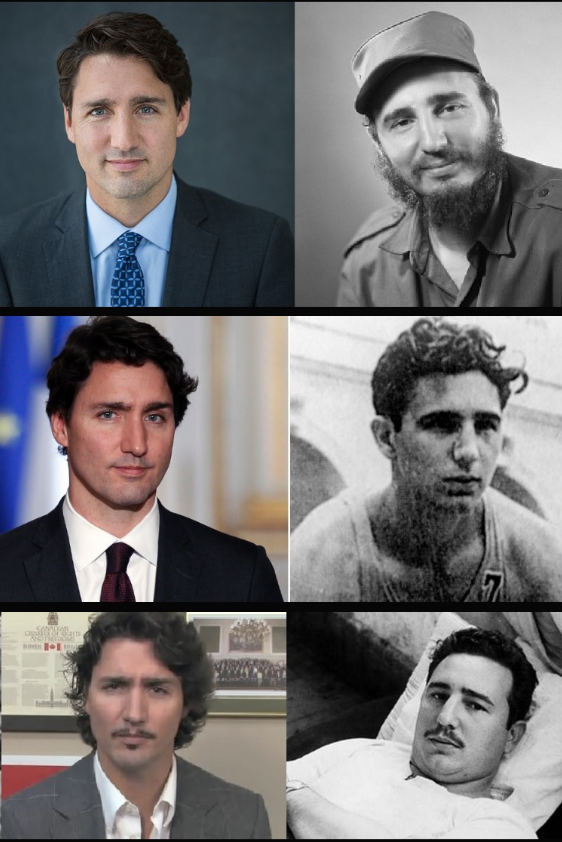
Yes, Justin “Trudeau” is Fidel Castro’s son. This is about as obvious as it could be, and if you are wondering why those in power keep lying about this, I advise you to look up “Point deer, make horse”.

If this is actually news to you, read this. (And as current events amply confirm, the fruit never falls far from the tree.)

Bill Vallicella On Reason, Faith, And Doubt

This entry is part 6 of 9 in the series Pilgrim's Progress

Readers who have been coming around here for a while will know that in recent years I have felt the need to re-examine all that I once believed about scientism, philosophical materialism, and the existence of God. It began as a grudging acceptance, even as an unbeliever myself, that atheism and secularism might have a corrosive influence on the stability and flourishing of human societies (see this post from 2009), but over time — as I engaged more and more deeply with the writings of sophisticated theists ancient and modern, and faced up more squarely to the shortcomings, limitations, hand-waving, and promissory notes of scientific materialism — my own unbelief began to crumble, leaving me, as Gurdjieff once said about people in a similar situation, “between two chairs”. I cannot yet call myself, quite, a believer, but at this point I must say, at least, that I can no longer see a compelling reason not to be, and that if I look into my heart, I find that I wish I were. I have written about this in a linked series of posts, starting here (to which, I suppose, I’ll add this one.)

Bill Vallicella, whose uncommon clarity on these difficult questions has been a steady influence on my own evolution, has just written a wee jewel of a post on the role of doubt in the life of the rational theist. In its closing paragraph, Bill considers the underpinnings of his Christian belief, and what his faith commits him to:

My acceptance takes the form, not of an acceptance of a ready-made proposition or set of propositions, but the acceptance of a task to be pursued in all seriousness, the task of investigating the matter in all its ramifications via reasoning, prayer, meditation, examination of conscience, study of all relevant literary sources, including scripture, commentaries thereon, the works of the great and not-so-great philosophers of all times and places, with no slighting of Athens, or Jerusalem, or Benares, or Alexandria, and seeking out the few living who may have been vouchsafed a higher degree of insight than that which I find in myself.

Yes! This is it exactly, as I have only lately come fully to understand: “a task to be pursued in all seriousness.” The stakes, after all, are infinite.

Read the rest here.

Lights On!

We’ve had quite a storm today here on the far end of Cape Cod, and it’s still raging as I write (5:26 PM Saturday). All day long the northeast wind off the Atlantic has been ferocious, and the snow’s been falling (or more accurately, blowing sideways) at two to three inches per hour.

I’m writing this post to salute the amazing men (and perhaps a few women as well) who work at my electric utility, Eversource, to maintain and repair the electrical lines. We lost power at about ten this morning, and by two in the afternoon it was back on. The conditions outside were absolutely brutal, yet these dedicated and fantastically competent people were able to diagnose and repair the problem, in a raging blizzard, in less than four hours.

These, and not the comfortable, soft-handed sophisticates who make up our ruling class, are the people upon whom our lives really depend — and so do the lives of those who look down on them with such haughty disdain.

None of this is breaking news, of course, but a situation like this is a clarifying reminder of just who really matters in this world — and who doesn’t, really, at all.

Snow Day

It appears we are about to be blasted by the first serious winter storm of the season here in the Outer Cape – a potent nor’easter that’s undergoing “bombogenesis” as I write. The current predictions have us getting about two feet of snow between now and Sunday morning, with howling winds. I hope the power stays on.

I haven’t had much to write about for the past few days, but I did notice a depressing item somewhere online recently: apparently Superman is now gay, or at least bisexual. How utterly dreary and predictable — not to mention, for anyone my age, sort of icky. (Can I say that? Well, I said it anyway.)

Regardless of orientation, though, the very idea of Superman having sex with humans is problematic — and running across this gloomy “news” item reminded me, across the years, that back in 1971 the author Larry Niven had taken a brief look at just why jumping into the sack with the Man of Steel would not end well.

Learn more here. (The article considers a union between Superman and a human woman, which is all that would have been imaginable in those long-ago days, but even under this new arrangement I’m sure some difficulties would arise nevertheless.)

The Pitch-Black Pill

I’ve just read an article at Substack, written by one N.S. Lyons (whose bio tells us only that he or she is an “analyst and writer working in Washington, D.C.”), listing twenty reasons why none of us should harbor any hope that we might at last be emerging from the collective insanity of Wokeness that has brought America, and the West more generally, to the brink of collapse and civil war. The article is long, and detailed, and mounts such a massive and multifaceted argument, under twenty headings, that it is perhaps the most potent “blackpill” I have yet to run across in print.

I won’t summarize it here — it’s too sprawling for that — but you can go and read the whole thing for yourself. The bullet-points are as follows:

1. One does not simply walk away from religious beliefs.
2. The void of meaning still hasn’t been filled.
3. Social atomization hasn’t reversed.
4. Atomization is probably the inevitable byproduct of liberal modernity.
5. The information revolution is still reverberating.
6. There is no authority.
7. Political parties can’t choose their policies.
8. Majorities don’t matter.
9. Personnel is policy.
10. All the institutional high ground is still occupied.
11. Long marches are long.
12. Culture wars are generational wars, and the young are woke as hell.
13. The youth are still coddled and mentally broken.
14. Elite overproduction is still in overdrive.
15. “Wokeness” is still required by law.
16. Money is still power.
17. The opposition is still only political.
18. Partisanship is still getting worse, and Wokelash 2.0 is entirely possible.
19. None of the levers of power have changed or will change hands.
20. Leviathan has a’woken.

As I said, the sheer mass of the argument given in this bleak summation is impressive, and it would be easy — as the author actually suggests that we do! — to despair. But, as I’ve written elsewhere there is never any upside to despair; there’s a reason that Hope is one of the cardinal virtues. Despair is not only useless, but it destroys the soul, and as such it is rightly considered a sin.

Much of what this article describes is undeniably true, and I’ve been saying myself — for long years now — that as a nation and a civilization we have blundered our way into such a mess that very painful consequences are inevitable. I have had, for a long time, no doubt whatsoever that things are going to get much, much worse, at a faster and faster pace, and that what we need to work at is to cherish and preserve what we can from the coming collapse.

Do I agree, then, with the author of this article that the juggernaut of Wokeness is so all-powerful that nothing can stop it, and that all we have left is to despair? Not at all, and here’s why: because the insane, parasitic, cryptoreligious ideology that has seized the Western mind is built, from top to bottom, on a hallucinatory denial and rejection of objectively existing reality: of all the lessons of history, the stubborn truths of human nature and natural law, and even the simplest facts of biology and economics. Moreover — because, by its own nominalist and materialist axioms, it has nothing better to offer — it must replace the highest human yearnings for transcendent truth, meaning, beauty, and purpose with a low and shabby telos built on little more than our basest animal urges.

Such a regime may last a while, and it may do colossal damage while it lasts (it already has!) — but it cannot win. It is aligned against all truth, and against our nature, so in the end it must fail and crash. And when it does, when the storm is over and the flood subsides, we will begin again.


* * * * * * *

As I pass through my incarnations in every age and race,
I make my proper prostrations to the Gods of the Market Place.
Peering through reverent fingers I watch them flourish and fall,
And the Gods of the Copybook Headings, I notice, outlast them all.

We were living in trees when they met us. They showed us each in turn
That Water would certainly wet us, as Fire would certainly burn:
But we found them lacking in Uplift, Vision and Breadth of Mind,
So we left them to teach the Gorillas while we followed the March of Mankind.

We moved as the Spirit listed. They never altered their pace,
Being neither cloud nor wind-borne like the Gods of the Market Place,
But they always caught up with our progress, and presently word would come
That a tribe had been wiped off its icefield, or the lights had gone out in Rome.

With the Hopes that our World is built on they were utterly out of touch,
They denied that the Moon was Stilton; they denied she was even Dutch;
They denied that Wishes were Horses; they denied that a Pig had Wings;
So we worshipped the Gods of the Market Who promised these beautiful things.

When the Cambrian measures were forming, They promised perpetual peace.
They swore, if we gave them our weapons, that the wars of the tribes would cease.
But when we disarmed They sold us and delivered us bound to our foe,
And the Gods of the Copybook Headings said: “Stick to the Devil you know.”

On the first Feminian Sandstones we were promised the Fuller Life
(Which started by loving our neighbour and ended by loving his wife)
Till our women had no more children and the men lost reason and faith,
And the Gods of the Copybook Headings said: “The Wages of Sin is Death.”

In the Carboniferous Epoch we were promised abundance for all,
By robbing selected Peter to pay for collective Paul;
But, though we had plenty of money, there was nothing our money could buy,
And the Gods of the Copybook Headings said: “If you don’t work you die.”

Then the Gods of the Market tumbled, and their smooth-tongued wizards withdrew
And the hearts of the meanest were humbled and began to believe it was true
That All is not Gold that Glitters, and Two and Two make Four
And the Gods of the Copybook Headings limped up to explain it once more.

As it will be in the future, it was at the birth of Man
There are only four things certain since Social Progress began.
That the Dog returns to his Vomit and the Sow returns to her Mire,
And the burnt Fool’s bandaged finger goes wabbling back to the Fire;

And that after this is accomplished, and the brave new world begins
When all men are paid for existing and no man must pay for his sins,
As surely as Water will wet us, as surely as Fire will burn,
The Gods of the Copybook Headings with terror and slaughter return!

“An AIDS Of The Mind”

Following on that essay on “mass formations” at American Greatness, Bill Valicella’s reply to it at his place, and my own follow-up post from a few days ago, JM Smith has posted a substantial contribution to the discussion over at The Orthosphere.

Professor Smith’s post brings to the conversation Gustave Le Bon’s 1896 study of crowd-madness, The Crowd: A Study of the Popular Mind. Le Bon notes that an essential part of this phenomenon is “cognitive misers”: people who prefer to think no more than they absolutely have to, and find it cheaper simply to let prestigious others do it for them.

We read (I have bolded a key passage):

In addition to prestige, Le Bon teaches us that mad ideas and beliefs are primarily spread through crowds by “affirmation, repetition, and contagion,” and that ideas and beliefs planted in this way, be they ever so mad, will live, grow and propagate for a very long time.

“When . . . it is proposed to imbue the mind of a crowd with ideas and beliefs—with modern social theories, for instance—the leaders have recourse to different expedients. The principle of them are three in number and clearly defined—affirmation, repetition, and contagion. Their action is somewhat slow, but its effects, once produced, are very lasting.”

When Le Bon says affirmation, he means that a mad idea or belief should be presented to a crowd without supporting arguments or evidence, since supporting arguments and evidence imply that there are people who doubt that the idea is good, or the belief is true. If you wish to pour your mad ideas and beliefs into the head of a crowd, you must always speak of those ideas and beliefs as if they were already common sense.

Go and read the whole thing, here.

Wag That Dog!

The chattering classes are atip at the titillating prospect of a Russian operation into Ukraine. The appeal is obvious: above all, they can imagine a surge of patriotic cohesion, a nation united against a familiar external foe — the Russkies — that much of our colossal Deep State still misses with a poignancy that is almost touching, but which makes sense if you know much about the arcane history of our defense and intelligence agencies. Just think: the American people set their petty squabbles aside! — and fall in, with that good old indomitable Yankee spirit, behind a re-energized Joe Biden, roused like Theoden for a great, final battle for the defense of the American Way.

This is absolutely crazy, of course. No American in his right mind wants this, and things have fallen apart far too much for this deeply fractured nation to unite behind something so completely irrelevant. (An invasion from Mars might still do it, I suppose, but at this point just barely — and even that would depend on where in America they landed. If they started by blasting the District of Columbia to smithereens, most Americans would at this point just show up to cheer them on, and to toast marshmallows.) Furthermore — and this is putting it mildly — if Joe Biden is a charismatic wartime leader, Michael Moore is an NFL cornerback.

Ukraine, besides being one of the most corrupt nations on earth (ask the Bidens!), has been a part of Russia, or a satellite of Russia, for centuries. It is of immense importance for Russian security, and our idiotic foreign policy since the fall of the Soviet Union — a policy that, if we had had any wisdom at all, would have placed top priority on cultivating Russia as a friend and ally — has instead been to do everything possible to humiliate and threaten them, in particular by pushing NATO right up to their very doorstep (perhaps that should be “doorsteppe”). Imagine if, after a strategic setback here in America, Russia swollen with pride in its temporary global hegemony, had done the same — sending arms, building bases, and installing puppet governments — in Canada and Mexico. We have had our Monroe Doctrine for 200 years, delineating our protected sphere of influence in the Western Hemisphere; what have we left Russia? With this expansion, and with our bluster, we have given Vladimir Putin very little choice but to stand up for his nation’s strategic interests — and what’s more, we have set ourselves up for a very bad embarrassment, because if push comes to shove I think that we are going to find that very few ordinary Americans, on either Left or Right, are really going to want to go to war, against a nuclear-armed Russia on its own front porch, for the sake of Ukraine, if there’s any way out of it. (Once things become kinetic, and the question is no longer a dreamy abstraction, people are going to worry far more about escalation and the realistic possibility of nuclear conflict than they will about protecting a nation most people couldn’t even find on a map.)

Putin, knowing this, will make his move, probably occupying only the eastern provinces of Ukraine and blowing Ukraine’s army effectively out of existence, all of which should take a few days or weeks. The U.S., having rattled its saber and drawn its lines in the sand, and with Joe Biden shaking his fist at the sky like Abe Simpson, will do nothing — and American prestige, to the extent that it lingers on at all, will find new depths of shabby decrepitude.

I could be wrong, of course: the people running the Biden administration, keenly aware that they have at this point little to lose, might just “cry ‘Havoc!’ and let slip the dogs of war.” That would be a very, very bad idea indeed — but the more I think about it, the more I realize that there are periods in history when whether a thing is a stupendously bad idea doesn’t really matter much at all, and that we are living through one of those times.

On “Mass Formation” In The Here And Now

Recently I published an essay at American Greatness about the idea of “mass-formation psychosis”, a concept that has gone “viral” after being discussed by Dr. Robert Malone in a widely viewed interview with Joe Rogan. (The interview was, within days, widely censored on media platforms — which is, we should note, relevant in itself.)

The essay was meant to be nothing more than a “high-altitude” overview of the concept of emergent mass formations, and a summary of some of the acute psychological and social conditions that make human beings susceptible to them. I wanted also to make clear that, far from being a novel occurrence, this process has repeated itself across cultures throughout history, and so probably has some adaptive value as a sort of wired-in “emergency mode” for sudden and potent social cohesion during times of group-level threats. As such, then, the article focused almost entirely on the abstract, general form of the mass-movement phenomenon, and hardly at all on the worrisome particulars of its current manifestation.

Alas, in such times as these – in the growing heat of a simmering civil war – for an observer to comment on social tectonics from such a remote altitude makes him seem almost blithely unconcerned with the great battle shaping up on the plain far below. As a result, commenters and correspondents have taken me to task for being too even-handed in my description of the phenomenon; for making it seem as if the craziness here in 2022 is symmetrically distributed between both factions in our current social and political conflict. Our old friend Bill Vallicella was among them; you can read his post, and my response (from which some of this post is adapted), here.

I think that’s a fair critique, and in my article I should have made it clear that right now, when it comes to the psychological manipulation of public narratives in order to focus an anxious and atomized public’s attention on objects of fear and loathing, there is no equivalence at all between the two great factions. “Mass formation” in today’s America is overwhelmingly a “Blue”, not a “Red”, phenomenon.

Readers of American Greatness, and of this blog, will need little convincing on this score, but a few points are worth mentioning:

First of all, it is a tremendous advantage in the manipulation of mass opinion to control the flow of information, and for many years now the American Left have controlled mass media, social media, internet-search technology, and education to the point of near-total information dominance.

Second, the artificiality of the public narrative blaring from the towering minarets of our institutions is shown by its transience: as soon as one story collapses (remember “Russian collusion”, and “hands up, don’t shoot”?) another takes its place (think of Jussie Smollett, or “two weeks to flatten the curve”). Likewise, the extent to which these narratives are in fact calculated propaganda offensives is given away by the aggressive censorship of dissenting views. (Magna est veritas, et praevalebit, the old saying goes – “Truth is great, and will prevail” – but to make falsehood prevail requires some assistance.)

Third, that the dominance of the Left’s message in America today relies upon a widespread psychological vulnerability is further demonstrated by the extent to which it has managed to override both tradition and common sense in getting large numbers of people to deny what, until now, have been understood by everyone everywhere to be objectively existing features and categories of the natural world.  To participate in polite society today – or, to put that more accurately, to be able to keep your job, get a college degree, or avoid being deplatformed from most media – we are expected to go along with things that most people know in their hearts are simply not so: that sex and race are purely social constructs; that men can become pregnant and bear children; that biology and heritability have nothing to do with human traits, and with their statistical distribution in populations; that cultures and peoples can be mixed and jumbled together at random without affecting the cohesion and stability of formerly homogeneous societies; that “equality” means that people cannot vary in talents, abilities, and aptitudes; that the greatest threat to American society is “white supremacy”; that everything in the modern Western world, from mathematics to nuclear families to pumpkin-spice lattes, is racist; that intelligence is a meaningless and unquantifiable concept; that when different identity groups perform differently on qualifying tests for education and employment, those tests should simply be discarded; that for nations to control their borders is inherently immoral; that the interests of criminals trump those of law-abiding citizens; that parents should have no say in how their children are educated; that members of various, designated groups are not to be considered responsible agents; that the way to deal with rising crime is to stop arresting people; that the 2020 election was squeaky-clean; that the January 6th protest was an assault on a par with Pearl Harbor and 9/11 (while the three-day siege of the White House by BLM and Antifa, in which hunrdeds of officers were injured, and the First Family had to be evacuated, was not); that the protests of that summer were “mostly peaceful”; and no end of other obvious falsehoods and absurdities.

Above all, what marks the current mental state of the American Left as psychologically abnormal is its suicidal self-abnegation. I can think of no other example in all of history of a coherent, prosperous and homogeneous society, with a robust civic culture and a proud historical mythos, suddenly deciding en masse to reject and denounce its heritage, declare its cherished cultural traditions shameful and immoral, fling open its borders to engage in deliberate ethnic, religious, and cultural dilution, and cheer on the accelerating displacement of its majority population and the gradual decomposition of cohesion and civil order. This all seems, when compared to the normal behavior of human societies, completely insane.

Considering all this, then, I hope it is clear that, although the phenomenon now being called “mass formation” has been observed in all ages and cultures, and must be considered in some sense a “universal” feature of our nature, its current manifestation in the United States is anything but symmetrical, and is overwhelmingly an affliction of the Left —  and that those of us who wish to have any chance of preserving the great American experiment must, in this hour of crisis, fight it with everything we’ve got.

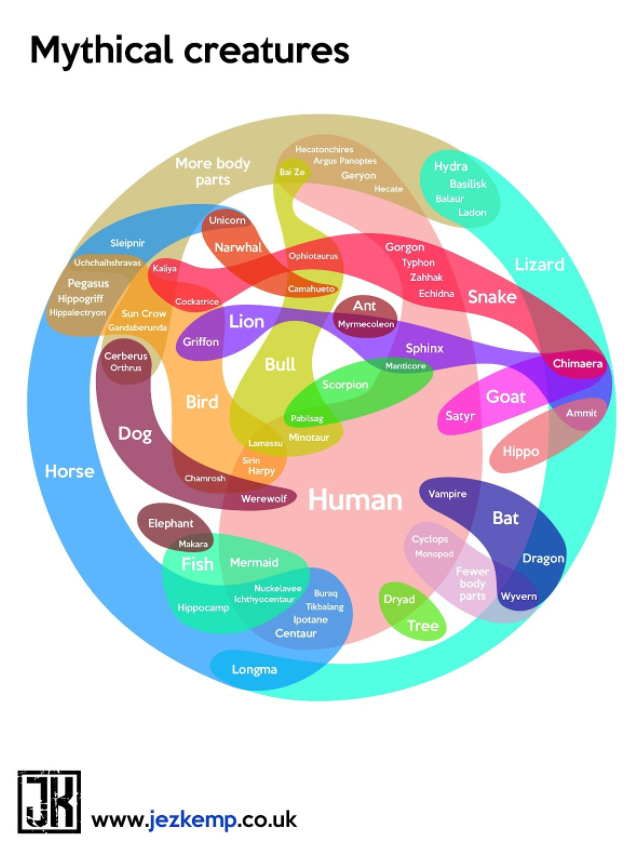
Mythical Creatures

I saw this online today. I think it’s brilliant.

All Together Now!

A few days ago I promised to put up a post about “mass formation psychosis”, but it turned into an essay that I sent off to American Greatness instead, and has been published there today. I might reprint it here, after a decent interval, but for now I’ll invite you to go read it over there.

A Hatful Of Heresies

Having just had a commenter casually toss the execrable term “climate denier” into my comment-thread, comparing any dissent on climate policy and other such technically complex, politically charged topics to stubborn belief in a flat Earth, I thought I would draw your attention to a useful resource: a collection of thirty-one pages, each presenting useful information for making up your own damn mind about carbon dioxide and Earth’s ever-changing climate. The information has been gathered and organized by a group called the CO2 Coalition, and I have no doubt that you’ll be able to find them condemned as cranks if you try. But if you are thinking of doing so here, I’ll remind you that excommunication is not in itself an argument, and neither are ad hominem attacks. It doesn’t matter in the slightest whether the author is an oil-company consultant, a paedophile, a worshipper of Moloch, or even, worst of all, a Trump supporter: the only intellectually respectable response to any of the information presented below, and the only kind that I will take seriously here, is a criticism based on methodology or conflicting information, which I will then be happy to discuss with any civil interlocutor. If any of what I will link to below is actually wrong, I would like very much to see it corrected, and to learn something in the process. (It’s no fun being a heretic, and if there is some aspect of my understanding of climate change that is mistaken, I’d be happy to have one less thing to get into arguments about with my liberal friends.)

So! There’s a lot of information here. Let’s get started.

1) 140-million-year trend of dangerously decreasing CO2.
This page asserts that CO2 levels have been decreasing steadily since the Cretaceous era — from 2,500 parts-per-million of atmospheric concentration — and are now historically, and dangerously, low. Why dangerously? Because, despite recent increases, we are still near the “line of death”, at about 150 PPM, below which plants can’t survive. Rather than being in a CO2 crisis, then, we are in fact dangerously close to CO2 starvation.

2) The warming effect of each molecule of CO2 declines as its concentration increases.
The idea here is that the change in forcing effect of CO2 is greatest when absolute concentrations are lower, and decrease as they go up. In other words, especially in the presence of other, more powerful greenhouse gases, such as water vapor, there’s a ceiling on the effect that CO2 can have on Earth’s heat loss into space (aka “flux”).

3) CO2 is plant food.
Simple enough: plants eat carbon dioxide. (Horticulturalists routinely add CO2 in greenhouses for this reason.)

4) In the last four ice ages, the CO2 level was dangerously low.
As noted above, plants die off at around 150 PPM, and during the last Ice Age we got down to 182 PPM — perhaps the lowest ever, and dangerously close to that extinction threshold.

5) CO2 emissions began accelerating in the mid-20th century.

6) CO2 increase is enhancing corn production… a lot.

7) Our current geologic period (Quaternary) has the lowest average CO2 levels in the last 600 million years.

7) Current CO2 levels are near record lows. We are CO2 impoverished.
Already pointed out above, but it bears repeating.

9) More CO2 means more plant growth.
More CO2 is better for crops, better for forests, better for animals.

10) More CO2 helps to feed more people worldwide.
More CO2 (and warmer weather) makes it easier to feed people.

11) Modern warming began more than 300 years ago.
Clearly, CO2 concentrations cannot be the only thing driving warming.

12) 11) Melting glaciers confirm modern warming predated increases of CO2.
Key point here: Glaciers don’t shrink, even during warming periods, until a threshold is crossed at which summer melting exceeds winter accumulations. That point was reached around 1800, and the effect really became noticeable in the mid-1800s — long before significant human contributions to atmospheric CO2.

13) Rising sea levels confirm modern warming predated increases of CO2.
Unsurprisingly, the effect noted above affects sea-level rise in the same way as glaciers, for obvious reasons. Sea-level rise has been steady since long before the post-war acceleration of CO2 emissions.

14) Temperatures changed dramatically during the past 10,000 years.
Clearly, there’s a lot more to the story than anything we’re doing. The idea that Earth’s temperature is somehow entirely under our control is obvious nonsense.

15) Interglacials usually last 10,000 – 15,000 years. Ours is 11,000 years old.
Look at the linked chart, and ask yourself if we are really worrying about the right thing.

16) The last interglacial was 8°C (14°F) warmer than today. The polar bears survived. Greenland didn’t melt.

17) The current warming trend is neither unusual nor unprecedented (Part 1).

18) The current warming trend is neither unusual nor unprecedented (Part 2).
During the Medieval Warming Period, people were farming in Greenland. (No SUVs in sight.)

19) Earth’s orbit and tilt drive glacial-interglacial changes.
This item is about Milankovich cycles. (There are other astronomical factors involves too, such as variations in solar activity — as I mentioned here.)

20) We are living in one of the coldest periods in all of Earth’s history.
And yet we can’t stop bitching about warming. (It’s almost enough to make you think it isn’t really about climate at all.)

21) For most of Earth’s history, it was about 10°C (18°F) warmer than today.
Have a little perspective, people.

22) IPCC models have overstated warming up to three times too much.
If you’ve been paying attention, you already know this — but again, it bears repeating. (Are you losing trust in these gigantic public institutions yet? I certainly hope so. Snap out of it, for God’s sake, and learn to think for yourself. The information is all out there, and for now at least, still freely available to anyone who bothers to make an effort.)

23) For human advancement, warmer is better than colder.
I’ll add that more people die every year from cold than heat.

24) Cold periods = crop failure, pestilence, famine, and mass depopulation.
The Little Ice Age of 1300-1800 was not an easy time, and we should be glad to keep clear of another.

25) More CO2 means moister soil.
When plants get more CO2, they have to “breathe” less, and reduced transpiration draws less moisture out of the ground. This is a good thing.

26) The current warming trend is neither unusual nor unprecedented (Part 3).
Hammering on this again — but it’s true, and it’s important, and all media are yelling in your ear to convince you of exactly the opposite.

27) CO2 rose after the Second World War, but temperature fell.
I’m old enough to remember when all the boffins were telling us that the bugaboo we really, really needed to be worrying about was global cooling. Trust the science!

28) The only thing constant about temperatures over 600 million years is that they have been constantly changing.
Getting a bit repetitious here, I admit — but this is, after all, probably the most important fact in the entire climate debate.

29) Droughts are not increasing in the U.S. (NOAA) (Part 1).

30) Droughts are not increasing in the U.S. (NOAA) (Part 2).
Just in case you missed the item just above.

Well, there you have it: just a smattering of Inconvenient Truths, all from a single website, addressing only a small subset of all the things a person should be taking into account when thinking about climate-change policy. (Not mentioned, for example: the enormous quality-of-life importance of fossil fuels for most of the world’s population; the unreliability and inefficiency of solar and wind power; the titanic economic effects of proposed “green” policies; the consolidation of power and usurpations of local sovereignty and individual liberty that such policies always just happen to entail; the “upsides” of warmer climate, such as making agriculture feasible at higher latitudes; and so on and on.)

Do you think some of these things aren’t actually truths at all — that they are, rather, tendentious falsehoods dressed up in graphs and charts and diagrams? That’s fine; we all want to converge on truth around here, right? — and if you have information to offer that specifically contradicts any of the points that the CO2 Coalition has presented in their list, I’m all ears.

But I’ll warn you in advance: be civil, and stick to facts and data, or you won’t be welcome here.

Point Deer, Make Horse

The astonishingly prolific Victor Davis Hanson observes Insurrection Day with a fine essay on just who constitutes the actual threat to the American Way. Read it here.

If you are wondering, by the way, what the title of this post refers to, you can read the story of Zhao Gao over at Spandrell’s place, here. In a nutshell, the phrase encapsulates the phenomenon by which people are led, by coercion or other means, to contradict obvious realities. (In case you hadn’t noticed, this is everywhere now; I really do feel more and more every day that we are living in a madhouse.)

This, in turn, ties in nicely with the idea of “mass formations” that has been going around lately (though the phenomenon has been observed in crowd behavior for a very long time). But that’s a post I don’t have ready to go just yet, so it will have to wait.

If you do go over to Spandrell’s blog, spend a little time and have a look around. Smart guy. (And don’t miss the post that gave the site its domain-name.)

There’s A Special Feeling In The Air Tonight

Well, tomorrow is January 6th, the anniversary of the greatest assault on civilization since the sack of Rome — and all of the good people in our news media, and all of our friendly Democratic politicians, are breathless with excitement thinking of the gifts this special day will bring. From Washington to Atlanta to New York to LA, tiny tots, with their eyes all aglow, will find it hard to sleep tonight!

Don’t forget to hang your stockings, readers.

Coming Apart

By far the most polarizing issue at the moment is the Wuhan Red Death, a.k.a. COVID — and things got sharply hotter over the past few days, when (as I’m sure you’ve heard) Dr. Robert Malone, one of the inventors of mRNA-vaccine technology and one of the world’s foremost experts on vaccinations and disease outbreaks, was banned by Twitter for insubordination, and followed right up with a scathing interview on Joe Rogan’s podcast. In the interview, Dr. Malone had plenty to say, including (but not limited to):

— That discussion of the health risks of currently available COVD vaccines is being systematically silenced;
— That such censorship is an assault upon informed consent;
— That half a million deaths might have been prevented if we had not prevented the use of effective treatments such as hydrochloroquine, famotidine, and ivermectin (and had we not persecuted and harassed those who advocated such treatments);
— That pharma companies have a strong incentive to kill these treatments, because they undercut the gigantic profits to be be made on vaccines as long as the hysteria continues;
— That natural immunity confers much better protection than vaccines;
— That taking the vaccine after you have had COVID can both increase your risk of adverse effects and reduce your natural protection against future infection;
— That scientists and physicians who backed the Great Barrington Declaration (which expressed concerns about government COVID policies) have been persecuted;
— That the vaccines appear to be causing a frightening variety of adverse effects, particularly in young people.

There is much, much more. In particular, Dr. Malone cautions that we seem to be falling victim to what he calls “mass-formation psychosis”, i.e. a collective, delusional, mass hysteria. (Longtime readers of this blog will know that I’ve been saying the same thing for a decade or more.) This refers to a coinage by Mattias Desmet, of Ghent University, describing a group-level phenomenon that occurs when certain conditions are met: social isolation and atomization, a decline in the “meaningfulness” of people’s lives, and an increase in general anxiety. In these circumstances, says Professor Desmet, it is easy for a crafty leader to offer a seed, a nucleus around which all this displaced energy can coalesce: a narrative that presents some common foe as the source of everyone’s problems. Such a leader, by focusing the society’s attention on this point, and convincing them that if they follow his guidance he will lead them to victory, can harness all of that anxiety and convert it to a fierce and unquestioning loyalty — a loyalty that, just as we’ve seen with COVID, “climate change”, Critical Race Theory, etc., can easily be turned against those in society who don’t enthusiastically join the cause.

The challenge, for those who benefit from these mass psychoses, is to keep enough believers on-side. This is why the narrative must be so aggressively policed and defended. But just as the immediacy of modern communication makes these mass psychotic formations easier to develop, it also means that it’s harder to keep dissent bottled up — and the attention that this Joe Rogan interview, and the banning of Dr. Malone from Twitter, has generated means that we are at a moment of extremely precarious balance. It will be very interesting to see what happens next.

You can see the Rogan interview here, and you should also watch Professor Desmet’s discussion of mass-formation psychosis, here.

Also, if you are even thinking of having any of your own children vaccinated, do not do so before you read this.

P.S., January 9th: YouTube has taken down the link I’d posted to the Joe Rogan interview, so I’ve replaced it with a link to Spotify. (You might have to create an account to watch it, but it’s free.)

OK, So That Was 2021

Best wishes to you all, and I hope we get some sanity back in 2022, though I won’t be betting on it.

I’ll be revving up the blog in the New Year. I’ve been idle too long, and I’m starting to miss writing.

Merry Christmas!

All the best to each and every one of you — and thanks as always for coming by.

OpenVAERS

Following on yesterday’s post; here is OpenVAERS, which is a more easily accessible front-end for the VAERS data.

Vaccine Adverse Events, By Vaccine Type

Here’s a chart I requested from the CDC’s VAERS (Vaccine Adverse Events Reporting System) website. (Keep in mind that these are totals for events from 1990 up to December 10th of this year, and that the COVID vaccines have only been around for 18 months or so.)


A Mea Culpa, And Two Good Links

I must apologize again for having so little on offer here lately. We’ve been distracted by personal matters, but I’ve also felt I have very little of value to say that I haven’t already said.

This is as much due to laziness and indiscipline as to anything else, though: not-writing has a momentum of its own, and once you’ve lost the habit of making sure to post something every day, it’s easier and easier to let weeks slip by — and it’s far too easy to let a worthwhile thought or comment go unwritten once that discipline and sense of obligation has atrophied (which in my case it clearly has). So among my resolutions for the coming New Year (which is just two weeks away!) is a determination to resuscitate the blog.

All I have for you today, I’m afraid, are two links, but they are both good ones, and well worth your time. (To paraphrase St Augustine: “Lord, make me productive — but not yet!”)

The first is a brief, scathing indictment, by George Will (yes, George Will, and no ad hominem comments, if you please), of the malevolent perversion of history calling itself The 1619 Project. Will’s column will do nothing to slow the drip of this poison into our educational system, but it may at least serve, as Lichtenberg put it, “to give strength and courage to those on our side, and to make it known to the others that they have not convinced us.” Read it here.

The second is a substantial essay by Michael Anton on the lack of prior examples, from any point in history, of the peculiar cultural pathology of present-day America. He argues that the historical uniqueness of this crisis — in particular, its obsession with suicidal self-loathing — makes confident prediction almost impossible. Here.

Zemmour: A Ray Of Hope For The West

With thanks to Bill Keezer, here is a translation of a speech given by the Frenchman Eric Zemmour announcing his candidacy for President.

May he prevail!

My dear Countrymen— For years, the same feeling has swept you along, oppressed you, shamed you: a strange and penetrating feeling of dispossession. You walk down the streets in your towns, and you don’t recognize them.

You look at your screens and they speak to you in a language that is strange, and in the end foreign. You turn your eyes and ears to advertisements, TV series, football matches, films, live performances, songs, and the schoolbooks of your children.

You take the subways and trains. You go to train stations and airports. You wait for your sons and your daughters outside their school. You take your mother to the emergency room. You stand in line at the post office or the employment agency. You wait at a police station or a courthouse. And you have the impression that you are no longer in a country that you know.

You remember the country of your childhood. You remember the country that your parents told you about. You remember the country found in films and books. The country of Joan of Arc and Louis XIV. The country of Bonaparte and General de Gaulle.

The country of knights and ladies. The country of Victor Hugo and Chateaubriand. The country of Pascal and Descartes. The country of the fables of La Fontaine, the characters of Molière, and the verses of Racine.

The country of Notre Dame de Paris and of village church towers. The country of Gavroche and Cosette. The country of barricades and Versailles. The country of Pasteur and Lavoisier.

The country of Voltaire and Rousseau,of Clemenceau and the soldiers of ’14, of de Gaulle and Jean Moulin. The country of Gabin and Delon; of Brigitte Bardot and Belmondo and Johnny and d’Aznavour and Brassens and Barbara; the films of Sautet and Verneuil.

This country— at the same time light-hearted and illustrious. This country— at the same time literary and scientific. This country— truly intelligent and one-of-a-kind. The country of the Concorde and nuclear power. The country that invented cinema and the automobile.This country— that you search for everywhere with dismay. No, your children are homesick, without even having known this country that you cherish. And it is disappearing.

You haven’t left, and yet you have the feeling of no longer being at home. You have not left your country. Your country left you.

You feel like foreigners in your own country. You are internal exiles. For a long time, you believed you were the only one to see, to hear, to think, to doubt. You were afraid to say it. You were ashamed of your feelings. For a long time, you dared not say what you are seeing, and above all you dared not see what you were seeing.

And then you said it to your wife. To your husband. To your children. To your father. To your mother. To your friends. To your coworkers. To your neighbors. And then to strangers. And you understood that your feeling of dispossession was shared by everyone.

France is no longer France, and everyone sees it.

Of course, they despised you: the powerful, the élites, the conformists, the journalists, the politicians, the professors, the sociologists, the union bosses, the religious authorities.They told you it’s all a ploy, it’s all fake, it’s all wrong. But you understood in time that it was them who were a ploy, them who had it all wrong, them who did you wrong.

The disappearance of our civilization is not the only question that harasses us, although it towers over everything. Immigration is not the cause of all our problems, although it aggravates everything. The third-worlding of our country and our people impoverishes as much as it disintegrates, ruins as much as it torments.

It’s why you often have a hard time making ends meet. It’s why we must re-industrialize France. It’s why we must equalize the balance of trade. It’s why we must reduce our growing debt, bring back to France our companies that left, give jobs to our unemployed.

It’s why we must protect our technological marvels and stop selling them to foreigners. It’s why we must allow our small businesses to live, and to grow, and to pass from generation to generation.It’s why we must preserve our architectural, cultural, and natural heritage. It’s why we must restore our republican education, its excellence and its belief in merit, and stop surrendering our children to the experiments of egalitarians and pedagogists and the Doctor Strangeloves of gender theory and Islamo-leftism.

It’s why we must take back our sovereignty, abandoned to European technocrats and judges, who rob the French people of the ability to control their destiny in the name of a fantasy – a Europe that will never be a nation. Yes, we must give power to the people, take it back from the minority that unceasingly tyrannizes the majority and from judges who substitute their judicial rulings for government of the people, for the people, by the people.

For decades, our elected officials of the right and the left have led us down this dire path of decline and decadence. Right and left have lied and concealed the gravity of our diminishment. They have hidden from you the reality of our replacement.

You have known me for many years. You know what I say, what I diagnose, what I proclaim. I have long been content with the role of journalist, writer, Cassandra, whistleblower. Back then, I believed that a politician would take up the flame that I had lit. I said to myself, to each his own job, to each his own role, to each his own fight.

I have lost this illusion. Like you, I have lost confidence. Like you, I have decided to take our destiny in hand.

I saw that no politician had the courage to save our country from the tragic fate that awaits it. I saw that all these supposed professionals were, above all, impotent.That President Macron, who had presented himself as an outsider, was in fact the synthesis of his two predecessors, or worse. That all the parties were contenting themselves with reforms, while time passes them by.

There is no more time to reform France – but there is time to save her. That is why I have decided to run for President.

I have decided to ask your votes to become your President of the Republic, so that our children and grandchildren do not know barbarism. So that our daughters are not veiled and our sons are not forced to submit. So that we can bequeath to them the France we have known and that we received from our ancestors. So that we can still preserve our way of life, our traditions, our language, our conversations, our debates about history and fashion, our taste for literature and food.

So that the French remain French, proud of their past and confident in their future. So that the French once again feel at home. So that the newest arrivals assimilate their culture, adapt their history, and are remade as French in France – not foreigners in an unknown land.

We, the French, are a great nation. A great people. Our glorious past pleads for our future. Our soldiers have conquered Europe and the world. Our writers and artists have aroused universal admiration. Our scientific discoveries and industrial production have stamped their epochs. The charm of our art de vivre excites longing and joy in all who taste it.

We have known great victories, and we have overcome cruel defeats. For a thousand years, we have been one of the powers who have written the history of the world. We are worthy of our ancestors. We will not allow ourselves to be mastered, vassalized, conquered, colonized. We will not allow ourselves to be replaced.

In front of us, a cold and determined monster rises up, who seeks to dishonor us. They will say that you are racist. They will say that you are motivated by contemptible passions, when in fact it is the most lovely passion that animates you – passion for France.

They will say the worst about me. But I will keep going amidst the jeers, and I don’t care if they spit on me. I will never bend the head. For we have a mission to accomplish.

The French people have been intimidated, crippled, indoctrinated, blamed— but they lift up their heads, they drop the masks, they clear the air of lies, they hunt down these evil perjuries.

We are going to carry France on. We are going to pursue the beautiful and noble French adventure. We are going to pass the flame to the coming generations. Join with me. Rise up. We, the French, have always triumphed over all.

Long live the Republic, and above all, long live France!

PS: BAP recently devoted a whole podcast to a discussion of Zemmour. You can find it here.

Mass Murder In America

Here’s an item from Taki’s Magazine in which Steve Sailer discusses a new study of mass murder. The results will not, I think it is safe to say, be discussed in our major media outlets, or in polite society, anytime soon.

Kingdom

Sorry not to have been writing more. (Soon the Muse will nag me again, I hope.)

So, instead: I bet you’ve never heard of Devin Townsend. Headphones on, and brace yourself.

It’s Stress!

From the UK Daily Standard:

Up to 300,000 people facing heart-related illnesses due to post-pandemic stress disorder, warn physicians

These stories are popping up all over. I wonder if there’s something else that could be responsible…

Wow, I Wonder What This Button Does

Here we go:

With the help of a supercomputer running AI software, boffins at an American university have created a new life-form they call “xenobots”, which are are tiny, motile blobs of tissue made from frog stem-cells. Under the guidance of the AI — which, as AIs tend to do these days, took off on a line of thinking that the humans who built it have no way of following — the wee animalcules assumed a shape that enabled them to develop a means of reproduction never before seen on Earth: they gather up compact piles of loose stem-cells that grow into new xenobots.

“Most people think of robots as made of metals and ceramics but it’s not so much what a robot is made from but what it does, which is act on its own on behalf of people,” said Josh Bongard, a computer science professor and robotics expert at the University of Vermont and lead author of the study.
“In that way it’s a robot but it’s also clearly an organism made from genetically unmodified frog cell.”

So: a robot “acts on its own on behalf of people”. We might ask: “Why does it do that?” (I rather think Professor Bongard et al. haven’t.)

Not to worry:

While the prospect of self-replicating biotechnology could spark concern, the researchers said that the living machines were entirely contained in a lab and easily extinguished, as they are biodegradable and regulated by ethics experts.
The research was partially funded by the Defense Advanced Research Projects Agency, a federal agency that oversees the development of technology for military use.
“There are many things that are possible if we take advantage of this kind of plasticity and ability of cells to solve problems,” Bongard said.

Right then, that’s enough for tonight, children! It’s all in the hands of experts. Off you go to bed. Sweet dreams.

Winter Is Coming

Wellfleet Harbor today, in a late-November mood:

Fair And Balanced

Please watch — this might not be up for long.

Happy Thanksgiving!

This day, my favorite holiday of the year, is consecrated to remembering the vital importance of gratitude. Yes, things are not going well in America right now, but the story is far from over, and the strength of our good people is undiminished. Dum spiro spero!

The Roche Limit

People are starting to peel away from the Democratic Party as it falls deeper into the gravity well of the Left Singularity. (Tulsi Gabbard is a prominent and recent example, but there are many others.)

If readers will forgive me for saying “I told you so”, in a post four years ago I used an astronomical metaphor for this: there’s a thing called the Roche limit, which is the orbital distance from a planet or star within which the stretching effect of tidal forces becomes so strong that they overwhelm the gravitational force holding a satellite together. (It’s why Saturn has rings.)

The context for the post was the apostasy of a liberal essayist, William Deresciewicz, from what he described as a suffocating “religion” that was taking over the universities — so the post ties in nicely also with our recent items on the “religious stance”, here and here.

Read the 2017 post here.

How Did They Know?

From 1969. Lyrics here.

Justice For Kyle!

A splendid result in Kenosha today: Kyle Rittenhouse fully exonerated.

The Left is writhing in fury, of course — which is yet another example of the fundamental, axiomatic incommensurability of the competing worldviews fighting for supremacy here in the tottering West. Our side sees a brave young man with a virile and virtuous impulse to defend his hometown against a rampaging mob of anarchists, arsonists, and looters — a mob that should never have been allowed to run riot in the streets in the first place. He was attacked by a quartet of violent criminals — including a child-rapist and another who had assaulted his own grandmother with a knife — and he defended himself with honor (and, I might add, impressive skill). He exemplifies precisely those qualities that every human society, always and everywhere, has regarded as highest and noblest in a man, and so he is precisely the sort of man that our degenerated ruling class, and those ensorcelled by their poisonous ideology, seek to denounce and destroy.

Here’s to you, Kyle Rittenhouse — and three cheers for that jury, too, who bravely answered the call of justice at what I have no doubt was considerable risk to themselves, given the very real chance that they will be doxxed and attacked. Mr. Rittenhouse now will have to “watch his six” forever, I imagine, but I’m also pretty sure he’ll never have to pay for a drink as long as he lives.

Some wag on Twitter has already proposed that the type of weapon he defended himself with should be renamed the KR-15. I hope it catches on.

PS: Others have noted that Rittenhouse’s acquittal was the entirety of Kamala Harris’s legacy from her time in office as President.

The Religious Stance, Cont’d

Following on last week’s post, here’s an essay by the Archbishop of Los Angeles, José H. Gomez, called Reflections on the Church and America’s New Religions.

The essay begins:

An elite leadership class has risen in our countries that has little interest in religion and no real attachments to the nations they live in or to local traditions or cultures. This group, which is in charge in corporations, governments, universities, the media, and in the cultural and professional establishments, wants to establish what we might call a global civilization, built on a consumer economy and guided by science, technology, humanitarian values, and technocratic ideas about organizing society.

In this elite worldview, there is no need for old-fashioned belief systems and religions. In fact, as they see it, religion, especially Christianity, only gets in the way of the society they hope to build.

That is important to remember. In practice, as our Popes have pointed out, secularization means “de-Christianization.” For years now, there has been a deliberate effort in Europe and America to erase the Christian roots of society and to suppress any remaining Christian influences.

Next, Archbishop Gomez explicitly adopts what I have called “the religious stance”:

Here is my thesis. I believe the best way for the Church to understand the new social justice movements is to understand them as pseudo-religions, and even replacements and rivals to traditional Christian beliefs.

With the breakdown of the Judeo-Christian worldview and the rise of secularism, political belief systems based on social justice or personal identity have come to fill the space that Christian belief and practice once occupied.

Whatever we call these movements — “social justice,” “wokeness,” “identity politics,” “intersectionality,” “successor ideology” — they claim to offer what religion provides.

They provide people with an explanation for events and conditions in the world. They offer a sense of meaning, a purpose for living, and the feeling of belonging to a community.

Even more than that, like Christianity, these new movements tell their own “story of salvation.”

(For a point-by-point comparison between the traditional Fall-and-Redemption story, and the ersatz version now ascendant amongst climate alarmists, see this post from 2017.)

I’ve said before that what makes religion work is that it offers a connection to the transcendent, a “skyhook”. In 2016 I wrote this:

When the supernatural basis for all of this is removed — when God dies — we’ve lost our skyhook; the warranty is void. But we are no less overborne by the chaos and mystery we face. We continue to seek the transcendent, but the sky is now empty, and the heavens have lowered. Having sliced off the apex of the sacred pyramid — the unifying presence of God — we are left with a truncated, frustrated hierarchy. God had been the Absolute from which both the natural world, and all human agency, emanated, but now the roots of both Nature and the soul of Man are exposed and disconnected.

We have not, however, lost our sense of awe, and of transcendent beauty and mystery, when we contemplate the natural world — and so in our new, sawed-off religion, we preserve Nature as a sacred object. (Indeed, with God now departed, many of us now promote Nature to fill his place.) And having lost God as the agent and guarantor of our protection and salvation, we must set our sights, and pin our hopes, upon the only thing we can still discern above us: the State.

The State! It is a low and shabby God, but it’s all that’s left. Needs must, when the Devil drives.

Archbishop Gomez sees this the same way:

Today’s critical theories and ideologies are profoundly atheistic. They deny the soul, the spiritual, transcendent dimension of human nature; or they think that it is irrelevant to human happiness. They reduce what it means to be human to essentially physical qualities — the color of our skin, our sex, our notions of gender, our ethnic background, or our position in society.

I realize that this dispute about whether Wokeness is or isn’t a religion is becoming quite useless; after all the arguing is done, most people haven’t budged. Some (like me) think it is in fact a mutated, deformed religion; the rest think that there can be no such thing as an atheistic “religion”. This is why I tried, in that earlier post, to borrow Daniel Dennett’s approach, and reframe the question by taking the “religious stance” — in other words, saying that whether or not this pernicious mind-virus is in fact a religion, it’s best understood (and its behavior predicted) by treating it as if it were one. That’s what Archbishop Gomez is doing in this essay.

Read the whole thing here.

Let’s Go!

The Religious Stance

I’ve been saying for a long time that what we are up against is a religion. (In 2017 I made the case contra Bill Vallicella, who was reluctant to apply the term.)

At the very least, I think it’s helpful to borrow a technique from the philosopher Daniel Dennett, who coined the term “the intentional stance” to describe how we should approach systems that might not possess “intrinsic intentionality”, such as a chess computer, but for which treating them as if they were genuinely intentional provides us with the most predictive and most clarifying model.

Dennett describes the intentional stance as follows:

Here is how it works: first you decide to treat the object whose behavior is to be predicted as a rational agent; then you figure out what beliefs that agent ought to have, given its place in the world and its purpose. Then you figure out what desires it ought to have, on the same considerations, and finally you predict that this rational agent will act to further its goals in the light of its beliefs. A little practical reasoning from the chosen set of beliefs and desires will in most instances yield a decision about what the agent ought to do; that is what you predict the agent will do.

In the same way, even if you are inclined to quibble about whether Wokeness is in fact a religion, I think we are entirely justified in adopting “the religious stance” toward it. Dennett’s explanation is easily refitted for the purpose:

Here is how it works: first you decide to treat the object whose behavior is to be predicted as a religious system; then you figure out what beliefs that system’s adherents ought to have, given its place in the world and its purpose. Then you figure out what goals the religion ought to have, on the same considerations, and finally you predict that this religious system will act to further its goals in the light of its beliefs. A little practical reasoning from the chosen set of beliefs and desires will in most instances yield a decision about what the religion’s faithful ought to do; that is what you predict the faithful will do.

I ask you: can anyone seriously look at this and not think we are dealing with a species of religion?

Also, ask yourself this: how would Wokeness manifest itself any differently if it were a religion?

Others have begun to make this case. John McWhorter adopts this stance in his book Woke Racism, while Michael Vlahos has been calling this movement the “Church of Woke” for at least a year or two now. Mencius Moldbug has been making the historical/genealogical/political case ever since the early days of his influential blog Unqualified Reservations, from which I often quote this piquant passage:

If you have a rule that says the state cannot be taken over by a church, a constant danger in any democracy for obvious reasons, the obvious mutation to circumvent this defense is for the church to find some plausible way of denying that it’s a church. Dropping theology is a no-brainer. Game over, you lose, and it serves you right for vaccinating against a nonfunctional surface protein.

Now Michael Schellenberg has posted a substantial item at Substack called “Why Wokeism Is A Religion“. What makes the article of particular interest is a detailed, zoomable graphic presenting the many, many qualities manifested by Wokeism that are also common features of religious systems. (You can see that presentation here.)

The case, I think, is overwhelming.

Biden: Build Back Better, By Bearing Kipling’s “Burden”

Ann Coulter reads the Build Back Better bill. Here.

What’s In A Name?

Way back in 2006, I noted that when there’s a concept out there that’s socially uncomfortable, whatever word we use to refer to it soon becomes freighted with the underlying awkwardness of the thing itself, so we have to discard that word and replace it with a new one. Before long the new word becomes similarly attainted — because the thing it describes is as uncomfortable as it ever was — and so it in turn has to be replaced. (In my original post I noted that this process is conceptually related to the geology of Hawaii.) The result is an ultimately useless conveyor-belt of approved terms.

The same thing has now happened to the term “woke”. It used to be what SJWs proudly described themselves as, but now we are hearing in the media that the word has taken on negative connotations in right-wing media, so we shouldn’t be using it any more. The problem, of course, is that the referent of the term is what is objectionable to so many people, but as always it’s the word that gets the attention, as if that will make the issue go away. (One is, of course, no less afflicted by being “crippled” than “differently abled” — you still can’t get up the stairs, either way — but somehow changing the word is supposed to make everything better.)

Here, then, is a sharp little post from Freddie deBoer, asking just what expression the Left would like us to use to describe their secular religion, and its ongoing jihad, if we can no longer call it “woke”.

Curb Your Enthusiasm

Well, that was fun. Glenn Youngkin beat Terry McAuliffe in Virginia, and various other Democrats around the country, and Democrat propositions, were defeated. It was nice to see all those folks on the other side wailing and gnashing their teeth, and blaming the whole thing on ‘racism’ (which is pretty funny, given, say, the victory by Winsome Sears for Lt. Governor in Virginia — but then of course when all you have is a hammer, everything becomes a nail).

Enjoy the moment. Have a tasty quaff of lefty tears! But don’t for a moment think, as I see a lot of people suggesting, that the Tide Has Turned, and we’ll soon have America back. These little victories were a pin-prick, a flea-bite, to the foe we stand against. The decades of systemic damage to the nation we used to be, and the consolidation of immense power in every corner of society by those who have very nearly vanquished and subjugated us (and who have infected recent generations with their enfeebling mind-viruses) will not be easily undone. This enemy is far more like kudzu than Goliath, and all we’ve done so far is cut back a little brush here and there. And let’s not kid ourselves: as nice as it was to see that scoundrel McAuliffe take a beating (especially after that disgusting tiki-torch prank), aging Clintonista bag-men like him are hardly the modern face of the Party, and would soon be devoured anyway.

Yes, we won a battle yesterday, and it feels good. (I wouldn’t win any friends, I’m sure, by saying it might have been better if we’d lost, just to build the fury on our side a little longer, though it has certainly crossed my mind.) But don’t kid yourself: a battle is one thing, but the war we are in is quite another, and when it comes to the great cycles of civilizations, the lessons of history here are not encouraging. I’m not blackpilling here, mind you: traditionally minded Americans are made of sturdy timber, and one should never bet against them. But it’s going to be a long, hard slog against an implacable, ruthless, Hydra-headed enemy, and we can’t let up for a minute.

So: seize this momentum wherever you can. Organize. Prepare. But don’t imagine for a minute that this enemy might now be broken, or soon will be.

Power!

The lights are back on here on our little dirt road in Wellfleet, where the power had been out ever since the thrashing we got from that nor’easter on Tuesday night. We get a lot of these storms out here, but this was a pretty nasty one, and it knocked down an awful lot of trees.

We want to offer our heartfelt thanks to the Eversource linemen (and, no doubt, some women as well, and battalions of others who came from all over the country) who worked around the clock to repair the electrical system and get our lights back on. These are the people — not the parasitic hot-house Laputans who deplore and sneer at them for their want of delicate sensitivities — that keep our civilization, or what’s left of it, alive. Someday very soon, if history is any guide, there is going to be a great shaking-out, in which the foundations of the nation will tremble and we will see just who owes what to whom.

I’ll say this also: three days without power is a grim reminder of how dependent we are on our brittle (and far too “tightly coupled“) global infrastructure. All it would take is a modern-day Carrington Event — which could happen at any moment — and we’d be reduced to barbarism in a matter of weeks. (Just saying.)

The lovely Nina and I (happily bathed, and with a suitcase full of clean laundry!) are heading up to Maine tomorrow to visit some old friends for a couple of days. Back mid-week.

Service Notice

We took quite a wallop from last night’s nor’easter here on the Outer Cape, with lots of trees down and widespread power outages. (I’m posting this with my phone.) We have no electricity, which means no heat, water, or internet. (I just got back from filling buckets at Long Pond.)

Back when the lights come back on — it’ll likely be a day or two.

What’s Different Now

As things fall apart in America, and talk of secession, “national divorce”, and civil war becomes more common, I’ve seen some people saying that the Sixties were just as bad, or worse — and that as bad as things were then, we got through it nevertheless, and hung together as a nation.

There’s something to this, of course. The Sixties, which I’m old enough to remember very well, were indeed a troubled time; it seemed that everything was crumbling into chaos. The Vietnam War, race relations, feminism, the Pill, the Bomb, the hippie counterculture, protests, race riots, and the assassinations of JFK, RFK, and MLK — all of these things were terribly divisive and corrosive. I can see how someone could make a persuasive argument that the nation was in greater danger of coming apart then than it is now.

I disagree, for two reasons.

The first is that we never really did fully recover from the cultural earthquake of the Sixties; the bedrock of national cohesion and shared identity was badly fractured in that era, and the damage persists. Whatever we have built back since then has been erected on those weakened foundations. Moreover, the great ideological conflict of the Sixties never ended; what happened was that the counterculture consolidated its victories in the nation as a whole, and then its soldiers — most of whom were young — set about burrowing their way into all of the nation’s institutions of power and influence. That process now being complete, the brood, like a population of locusts, has emerged in its mature form — and it is prepared to devour everything.

The other reason is that, for all its discord and strife, the troubles of the Sixties took place in a very different social context. Even at its worst there was a feeling on both sides that America itself was still a noble idea, that the Founding was a triumph of human progress, and that there were objective, natural truths we all could agree on. The conflict of the Sixties felt like like a family argument, a bad patch we needed to get through before we could be a happy family again. The conflict of the present day, by contrast, is much more like a religious war, a struggle for subjugation and territorial conquest — frankly, a battle for extermination — between bitterly antagonistic nations with nothing in common at all.

I was struck by this just the other day when I heard on the radio the old Simon and Garfunkel tune “America”. Simon and Garfunkel were most assuredly a part of the Sixties “counterculture”, but that beautiful song was a paean to the shared American mythos: it sang of the great land of liberty that we were all blessed to live in, and of the endless possibilities for transformative experience and self-realization that this vast nation — containing multitudes and contradictions, but nevertheless dedicated in all its different parts to the same founding principles of liberty and opportunity for each of its citizens, however humble — had to offer. In short, despite being a product of an era of cultural revolution, the song expressed with deep and appealing emotion the traditional, romantic ideal of America, and as such it was profoundly, movingly patriotic.

That was then. It is hard even to imagine such a song, with its poignant affection for the commonality of the American experience, bridging the chasm that separates our warring factions today. It would seem naive at best, and at would almost certainly be seen by the clerisy of our new secular religion as a manifestation of “false consciousness” to be denounced and reviled for giving comfort to the enemy.

So: yes, the Sixties were bad, and set the stage for the crisis we are living through today. But if our situation in 2021 resembles any previous decade of American history, it is not the 1960s — it is the 1850s.

SSL’s New UF8 and UC1

I mentioned in the previous post that I’ve just made some improvements to my mixing studio. I haven’t written very often about music and recording lately, so here’s a post about some of that.

For most of my recording career (I got my start as a staff member at Power Station Studios back in the late 70s), I mixed records on large analog consoles. I was trained on consoles made by Neve and Solid State Logic (SSL), and they’ve been my favorites ever since. When I first came to Power Station we had two Neve 8068s (there’s still one of these in Power Station’s legendary Studio A) but when SSL appeared on the scene we were among the first studios in America to get one. I’ve been using SSL consoles ever since; they have fantastic ergonomics and a distinctive sound. My mentor, Bob Clearmountain, was among the first adopters of SSL consoles, and mixed countless classic albums on them. (If, for example, you like the sound of “Avalon”, by Roxy Music, or “Let’s Dance”, by David Bowie, those were both mixed by Clearmountain on SSL consoles. He still has one at his studio in LA.)

Anyway, things have changed, and the advent of digital music-production equipment has made it possible to create virtual consoles that run entirely inside your computer. The technology evolved gradually, and at first was mostly used in professional studios just as a replacement for analog tape-machines, but in recent years the technology has improved so much that engineers have been able to forgo the physical console altogether, and do everything — recording, editing, overdubbing, and mixing — entirely in the virtual domain. (It’s called working “in the box”.) One platform in particular, called Pro Tools, emerged as the industry-dominating software for doing this.

This has all been enormously liberating: it means that instead of having to build a multimillion-dollar facility to make records (with a gigantic console that all by itself cost a fortune to buy and to maintain), an engineer can put together a fully operational, state-of-the-art mixing studio in his home for the cost of a decent computer, some (admittedly rather expensive) software, a digital audio interface, and some good monitor speakers. Some years ago, I did just that, and I’ve been mixing at home ever since.

The drawback to all of this is that your virtual mixing console, despite being capable of anything (and more!) that a physical console can do, is still just a display on a computer screen. For someone like me, who spent decades developing the complex “muscle memory” for all those knobs and faders on a physical console, mixing “in the box” felt, at first, like trying to play a piano with a mouse. You get used to it, but it’s never really the same, and you miss that intuitive expressiveness you felt when you could actually put your hands on the controls. Various companies have made physical controllers for digital audio workstations (DAWs), and for a few years I’ve had a little single-fader controller, but it never felt like what I’d been used to for all those years.

Last week, though, life got better: I decided to buy two newly released items from Solid State Logic, the company who made the consoles I’d earned my living on for so long.

The first is the UF8: a beautifully made controller, with eight motorized faders, that also has an assortment of user-assignable knobs and buttons for putting direct control of Pro Tools channel functions back in the engineer’s hands.

The second is the UC1. For a veteran SSL user who has rather reluctantly come round to in-the-box mixing, this thing is a godsend: it is a physical recreation of the SSL console’s channel-strip (filters, EQ, and compressor/expander), and it ships with SSL’s meticulously modeled software version of the original console-channel’s audio processors. What this means is that, by inserting an instance of this software “plugin” on each channel of your virtual console in Pro Tools, you can use the UC1 to work the channel settings with just the same tactile, “hands-on” feel as working on the analog console itself. Together, the UF8/UC1 setup looks like this (picture taken from an article here; I’d show you the thing in my own studio, but the camera on my phone is broken):

The UC1 also comes with a software version of SSL’s iconic stereo-bus compressor, and it has a set of controls — and an analog meter! — for that as well.

I’m writing this post just to go on record as saying that for me, having these two pieces of equipment on my desk is an absolute game-changer. I suppose there are lots of younger engineers who came up without ever getting their hands on a physical console, and for whom a dedicated channel-strip controller may seem an expensive luxury, but for professional engineers “of a certain age” — those for whom sitting at an SSL console was like learning to play an instrument, and who have felt a bit “numb” all these years staring at a screen with a mouse in their hand — the UF8/UC1 combination is like suddenly getting your feeling back. What’s more, the latest version of the SSL channel-strip plugin that ships with the UC1 is a fantastic recreation of the sound of the old consoles. There are other SSL plugins out there from licensed manufacturers — and they’re pretty good — but when you hear this one you realize what you’ve been missing.

If you’re an engineer reading this, and want to learn more, you can have a look at them here and here. And if you’re going to take the plunge, I recommend that you buy them from Sweetwater: best customer service in the industry.

P.S. I know all this sounds like a paid endorsement, but it isn’t; I’ve never done endorsements. I really just think these things are so good that I wanted to let others know. (And Sweetwater really is the best place to buy gear.)