Food.
This one’s a twofer: “climate change” and racism.
In yesterday’s post I quibbled with Andrew McCarthy’s call, in an article he’d published at Fox News, for full disclosure of the Mueller report and everything else associated with the Russiagate witch-hunt. Today I listened to an interview he gave with John Batchelor on Tuesday, and I see that I had missed his point. As he explained on the Batchelor show, it is that there will be further disclosure of the special prosecutor’s case — indeed, even to have had the brief summary we’ve already been given is far more than is customary in investigations where no charges are ever to be brought — and so we should have not only the Mueller team’s official version of what they dug up on Trump & Co., but also the material that a prosecutor would normally have to give the defense in a trial. In this case that includes FISA applications, the Rosenstein scope memo, whatever documents pertain to the origination of the investigation, etc.
Mr. McCarthy is right (and so is our commenter JK). I retract my quibble. Listen to the interview, in two parts, here and here.
In the previous post, I linked to a podcast by Andrew McCarthy. Do you recall the origin of the word “podcast”? It is a moment of tech history preserved in amber: a reference to the Apple iPod, a now-obsolete music player introduced in 2001. There are still many of them out there, but they will soon go the way of the cassette player and the VCR.
It’s always interesting to see how neologisms linger, long after their transient original context passes away. We still “tape” live events, and “dial” numbers, and every new political scandal is still christened as Something-gate. The whole English language is like this, and the lifespan of such coinages is potentially infinite — for example, we still draw a “salary” for our labors, even though it has been a very long time indeed since the soldiers of Rome were paid in salt.
One quibble: the Democrats and the media are bawling for the public release of the full text of the report, and Mr. McCarthy seems to think that would be OK — as long as we get everything else as well:
You want disclosure? Me too. But let’s see all of it. Not just Mueller’s report. Let’s see everything: all of the memoranda relevant to the opening of the investigation, all of the testimony at closed hearings, all of the FISA-warrant applications, all of Rosenstein’s scope memo. (A year ago, I surmised that scope memo is redacted because it relies on the Steele dossier ”” as did the FISA-warrant application Rosenstein had approved just a few weeks earlier; anyone want to bet me on that?)
I’m not so sure. There are sound reasons why we don’t release details of prosecutorial investigations of people who are never charged: mainly because it drags their names and reputations through the mud, while they have no representation or remedy. That quibble aside, though, read the article. Andrew McCarthy, who is himself a former Federal prosecutor, has been an enormously important resource throughout this long and shameful farce, and this essay is as thorough and detailed as always.
Well! The Mueller report’s in, and has confirmed that this whole Russia business was nothing but a frame-up all along. Thanks so very much, news media and Democrat saboteurs (but I repeat myself) for hijacking the nation’s public affairs for two long years of round-the-clock bile, slander, and lies.
This will end nothing, of course: Adam Schiff and Jerry Nadler will continue to abuse the awesome power of the State in hope of finding something — anything — they can use to hamper and attack the President. Rest assured they will use their subpoena power to browbeat and intimidate scores of American citizens as they search in desperation for a crime. Maxine Waters and her lynch mob in Congress will continue to slaver for impeachment.
There will be no apology forthcoming from the media; no contrition at all for their years of false accusations, or for creating a toxic atmosphere in Washington that made impossible any hope of diplomacy with Russia. (In doing this they have caused incalculable damage to American foreign policy and to global strategic security.)
Will there be punishment for those who mounted this fraud in the first place? For the people who abused the nation’s most powerful intelligence and law-enforcement agencies in the hope of overturning an election, and destroying a Presidency? For those who obtained multiple secret-court surveillance orders on false pretenses in order to spy on political opponents? For those conspirators who put their thumbs on the scale of justice to keep their own party’s candidate out of jail? Don’t hold your breath.
The insanity of the American Left will only intensify now, in their rage and frustration.
It’s going to be a long, hot, summer.
Nine years ago, in a post about the Eyjafjallajokul volcano in Iceland, I wrote the following thing:
Meanwhile, if you’re starting up an End Of Days seismic-catastrophe pool at the office, I think the smart money is on the Cascadia Subduction Zone up in the Pacific Northwest.
Admittedly, that was nine years ago, and nothing’s happened so far. But nine years, in geological terms, is the heartbeat of a gnat. Today I ran across an item at City Journal describing the CSZ threat in minatory detail:
When it happens, the earth will slip by roughly 60 feet along a rupture zone more than 600 miles long, unzipping the sea floor at roughly two miles per second and convulsing the West Coast for as long as five minutes. Bridges will fall. Wet soil will liquefy. Brick and masonry buildings will shatter. Skyscrapers built before modern earthquake codes may topple. City centers in Portland, Seattle, and Vancouver will be buried beneath glass shards and rubble. Everything underground””water mains, natural gas pipes””will be crushed. Land that has bulged upward from tectonic pressure for the past 300 or so years will collapse to baseline, permanently altering the topography and plunging low-lying coastal areas into the ocean. The inland Cascade Mountains will knock the knees out from under the earthquake, but numerous landslides will occur, especially on roads built with a “cut and fill’ method, where flat slabs get cut out of rock walls and smoothed over with soft fill. Just a few minutes after the quake finally stops, the second hammer blow will strike. Tsunami waves up to 50 feet high will rip the face of the coastal region clean off the map, pulverizing everything and killing everyone in their path.
It’s hard to say in advance how many will die. It depends on the time of year and the time of day. The Pacific Northwest as far north as British Columbia has a Mediterranean precipitation pattern, with warm, dry summers and cool, wet winters. An earthquake during the rainy season will result in a lot more liquefaction and landslides. Better for disaster to strike during the summer, then””except that thousands more tourists will be at the beach and get swept away by tsunamis. The ideal time would therefore be after Labor Day, when the beach is less crowded but before the autumn rains come, and better by far at 4 AM, when schools and downtown high-rises are empty and there’s little or no traffic on bridges. “Best case,’ says geologic-hazard coordinator Althea Rizzo at the Oregon Office of Emergency Management, “is between 2,000 and 6,000 fatalities.’ If the quake happens during the school year, she adds, fatalities could tally in the tens of thousands. “That’s just for Oregon. And that’s not factoring in the tsunami, which will kill even more people.’ The United States could conceivably lose more people in an hour, in a single part of the country, than we lost over an entire decade in the Vietnam War.
The Northwest coast being a “deep-blue” area, no doubt the primary concern will be the catastrophe’s disparate impact on women, minorities, undocumented immigrants, and endangered species. But it looks as if there will be plenty left to go around.
Read the article here.
Having read Rachel Fulton Brown’s commentary on the New Zealand massacre, you should now go and read Peter Brimelow’s. His point is a simple one: when nations are deliberately destroyed, and all peaceful means of preventing the calamity are suppressed, what remains will be evil reactions by violent men.
I’ve just read an item at American Greatness about the Christchurch massacre. The article is by Rachel Fulton Brown, a professor of medieval history who keeps an excellent blog called Fencing Bear At Prayer. I am an admirer of Ms Brown’s — there are many reasons for me to be — and her essay rightly chides those of the commentariat who have tried to read a clean and Narrative-friendly ideology into the shooter’s manifesto:
They have opined on its citations of Sir Oswald Mosley and Candace Owens, parsed claims that it makes about the shooter’s ideology, and declared the shooter’s ties to 8chan are clear evidence of his right-wing extremism. They have described the manifesto as “a document of the utmost single-minded clarity.’ And they are certain it says something about the “extreme right,’ particularly in its references to medieval European history and the Crusades.
Their confidence in their reading would be laughable if it were not so biased by their own ideological preconceptions. To put it bluntly, they have been pwnd.
Ms. Brown thinks they expect rather too much from the man behind the slaughter. Describing the manifesto as incoherent, she writes:
The whole document reads like a series of red herrings strewn about the pages of a thriller by Dan Brown. Even attempting to parse this cut-and-paste nonsense is to fall into the trap.
Nevertheless, she parses the screed in some detail. For example:
The historical ignorance on display in such gestures would be breathtaking if it were not so banal. Perhaps if the journalists and their fellow handwringers knew a bit more medieval history they would not fall so easily into the trap. The actual Crusaders, including the Knights Templar, had far more respect for their Muslim opponents as Muslims than any hand-wringing multicultural apologist does today. As one aristocratic Arab-Syrian Muslim famously recorded in the mid-12th century:
Whenever I visited Jerusalem I always entered the Aqsa Mosque, beside which stood a small mosque, which the Franks had converted into a church. When I used to enter the Aqsa Mosque, which was occupied by the Templars, who were my friends, the Templars would evacuate the little adjoining mosque so that I might pray in it.
The Templars even chastised a newly arrived Frank when he attempted to remove the gentleman from the mosque.
Professor Brown is quite right — as we should expect! — in her critique of the document, and of those who expect too much of it, and read too much into it. It is, however, the idiomatically perfect expression of a certain enthusiastic type on the new Right, one that I’m afraid to say I know rather well: the giddily reactionary “shitpoaster” whose head is filled with a vague, quasi-historical pageantry of thrones, altars, Crusaders, feudal lords, Civil War generals, and thumbnail images of legendary defenders of the of the West such as Charles Martel and Holger Danske. He is young, and beyond his comic-book version of history, he is ignorant. He knows things have gone horribly wrong in the modern world (as they have), knows that secular, multiculturalist universalism is a dangerous pathology (as it is), and knows that mass importation of Islam into Western nations is suicidal folly (right again). He knows little else — other than that, at this point, everything his eye lights upon has got to go. He feels all the excitement that action, however destructive, offers the supercharged thumos of a twentysomething male. Most such young men find some other outlet for this sort of thing, but every so often there is one who just bursts. When I said in my earlier post that I did not think this man was insane, I meant that he was not incapable of reason — but clearly he had a pathological lack of restraint.
Ms. Brown hints at the possibility of conspiracy:
The one thing that the shooter’s manifesto makes clear is that somebody out there wants a race war and that somebody wants both Christians and Muslims to bear the blame, even as decades of attacks against Christians””and Muslims””of all races have failed to spark this war. Somebody out there is confident that an attack on the right group of innocents will spark the conflagration, if only the proper trigger can be pulled.
Maybe that somebody is a person””or persons””with considerable economic and political power.
She concludes with this:
But that anybody, even for an instant, took this manifesto seriously as anything other than an effort to provoke violence? That is far more worrying than anything one might find in the manifesto itself.
Indeed, that’s all it was. And what’s more, it said so. Pace Ms. Brown, however, the manifesto did show a “single-minded clarity” in its statement of intent, and that alone. It stated very clearly that the purpose of the attack was to provoke a civil war — which, in the shooter’s imagination, would summon the avatars of the warrior heroes of the West, and would bathe this weak and corrupted world in purifying flame. All that blather about religion and The People’s Republic of China and Pope Urban was just froth and effervescence.
Read Ms. Brown’s article here.
With a hat-tip to Nick Land, here is a densely mathematical paper that purports to model the world economy in terms of the degree of restriction of migration policy.
I have looked it over, but I cannot say that I have followed its argument in detail. (If any of my readers would like to do so, I’d be interested to know what they think.) But two things are worth noting.
First, the model, as far as I can tell, treats every human on Earth as an identical, fungible token. It does take into account regional differences in “human capital”, but ascribes them entirely to remediable externalities (such as education). It is not hard to understand why a team of researchers laboring in the contemporary academy would make such an assumption, but I’ll just say (for the sake of preserving my chances for a future Supreme Court appointment) that choosing such an axiom may perhaps be a fundamental error.
Second is what caught my eye when Nick tweeted it:
[G]rowth in utility drops substantially in the short run as many people move to areas with high real GDP; hence these areas become more congested and become worse places to live (lower amenities). This initial loss in growth is, however, compensated in the long run by a large surge in productivity growth after year 2200.
You read that right: 2200. Let me restate that for the record: if the West floods itself with Third World immigrants, it will become a “worse place to live” — but only for a couple of centuries, at which point those of us who have managed to wait patiently enough will begin to be “compensated” by a surge in “productivity growth”.
I hardly know what to say in conclusion. It’s rare that I find myself at a loss for words, but…
A couple of months ago I posted an item about Germany’s ostentatious effort to rely on solar and wind power: a flamboyant exercise in virtue-signalling that has become a spectacular, and costly, failure. (I should add that I also consider those giant windmills we now see everywhere — someone has aptly called them “eco-crucifixes” — to be aesthetically hideous. They actually give me a frisson of horror, like the towering tripods from The War of the Worlds, every time I see them.)
Now I have for you an article, by the noted eco-warrior Michael Schellenberg, that makes the case against large-scale wind and solar power with clarity and passion. Solar and wind farms, he argues, are unreliable, costly, and enormously destructive — and if we really care about the environment, we should abandon them in favor of the safest and most efficient resource man has ever discovered: nuclear energy.
I couldn’t agree more. Read Mr. Schellenberg’s essay here.
The world is aghast today at the news of a massacre in a mosque in Christchurch, New Zealand. The shooter was a white Australian; the victims were Muslims. As I write the death-toll stands at forty-nine. This is a horror, a sickening atrocity.
It is important to try to understand what happened here, especially as both sides of a deeply divided civilization begin to apply their spin. The shooter left a seventy-four page manifesto, which I have just read. There is clearly a lot of irony and sarcasm in it, and a lot of trolling and “shitpoasting”, but for readers who know the argot of the darker corners of the Internet it hangs together well enough, and authentically enough, that for the purposes of this post I will take it at face value.
First of all: it is accurate to call this massacre “right-wing terrorism”. The gunman’s manifesto is a screed against demographic and cultural entropy, and as such it is of the Right. Some on the Right have already tried to paint him as a man of the Left, based on his self-identification as an “eco-fascist”; he is not. Nor is he, however, a “white supremacist”; he is an ethnic/cultural/racial separatist, who expresses explicit approval of a diversity of peoples and cultures living in separate homelands, including Muslims. Nor is he a “conservative”, in anything remotely resembling the NRO/WSJ sense. (Indeed, he mocks such “conservatives”.)
Nor can we say, in any strict sense, that he is insane, if we define insanity as an incapacity for reason. His manifesto is lucid and literate, and follows its axioms consistently. You can say, if you like, that those axioms mark him as insane all by themselves, or that only an insane person would do what he did, but he certainly was not incapable of reason. There will be no insanity defense.
If we take the manifesto seriously, his motivation was explicit: he is an accelerationist. He saw Western civilization — the “extended phenotype” of the European people — as being under assault by an entropic pathology, and believed that the only way out was to arouse a revolt that would force people to choose sides. He makes clear that he committed this atrocity in order to arouse such a heated backlash on the Left — in particular, to provoke an anti-Second-Amendment firestorm in the United States — that civil war would become inevitable.
This is not the work of a simpleton or a lunatic; this is someone who understood very well what he wanted to accomplish, and how to set about it. I should not be at all surprised if his crime does indeed provoke exactly the anti-gun, anti-Right frenzy he hoped for, which in turn will have precisely the incendiary effect he wanted. (The Left, meanwhile, will seek to blame as much of this as they can on Donald Trump — which is just another part of what the shooter was hoping for. But that has it backward: Donald Trump is a symptom, not a cause.)
In short: the shooter saw the West, as a living organism, succumbing to a wasting autoimmune disease. By exacerbating the symptoms, he hoped to provoke an immune response, in the form of civil war. His murderous rampage will almost certainly push things in exactly the direction he says he intended.
I could be wrong about all of this. The manifesto could be a sham; the shooter could be a false-flag plant, or an agent of some murky conspiracy. I’m only trying to make sense of this story as best I can, in its immediate aftermath. Such a thing wants explaining, and simply invoking Evil won’t do, not in this case — although evil it most certainly was.
Also: none of what I have written here is intended to excuse or justify this horrific crime. Do not be surprised, however, if we see more and more such savagery, from both sides of this deepening divide.
The immensely profitable and influential hate-propaganda racket known as the Southern Policy Law Center is in the news today for firing its 82-year-old founder, Morris Dees, for unspecified “personnel violations”.
I’m glad to hear it, of course: the SPLC is a “social-justice” flim-flam in the business of organized slander against everyone to its right, and its blacklist of “hate groups” is amplified with destructive force by powerful agents throughout media and politics. In particular, mainstream news outlets routinely cite the SPLC as a canonical authority on whom to despise. Morris Dees has made a fortune at this, and I’m happy to see him go — though of course he is merely retiring into luxurious senescence, which is a shame. (I suppose religious readers can take comfort in the certainty that once his cushy retirement comes to an end, he will rot in Hell.)
But there’s another SPLC story out there that should make your skin crawl. It is a story from the Detroit News, telling us that Michigan’s Attorney General, one Dana Nessen, is planning a smothering assault on “hate”:
Michigan’s attorney general and Department of Civil Rights on Friday laid out plans to increase the documentation and prosecution of hate crimes…
Bad enough already; the very idea of “hate crimes” is an abomination against justice. But it gets much, much worse:
Michigan Department of Civil Rights Director Agustin Arbulu announced the department is creating a process to document hate and bias incidents that don’t rise to the level of a crime or civil infraction.
Wait, what?
Attorney General Dana Nessel previously announced plans for a hate crimes unit in her office. She reiterated the plans Friday after a report from the Southern Poverty Law Center found active hate and extremist groups in Michigan had increased by more than 6 percent from 2017 to 2018.
The center’s report said Michigan has 31 hate and extremist organizations ”” an uptick from the 28 the group reported in 2017 ”” but some of the listed groups take issue with the classification.
I’m sure they do. But there is no court of appeal here: what the SPLC says, goes. Once they’ve called you a “hate group”, you can count on the slander being repeated anytime your name comes up in the media. But the worst is still to come:
Nessel’s new unit will fight against hate crimes and review any groups identified in the SPLC list, her spokeswoman Kelly Rossman-McKinney said.
There you have it: catch the SPLC’s attention, and you will come under “review” by the “hate-crimes” commissariat of Dana Nessel’s Ministry of Justice. (Just imagine what “review” means.) And if you think you’ve got nothing to fear, because you’ve never done anything wrong, think again:
Arbulu’s plans for a database would document hate and bias incidents that don’t rise to the level of a crime. The database would then be used to identify areas where awareness and education programs are most needed, he said.
“Education programs”.
Arbulu said he hopes the database will allow the department to be proactive and address issues before they rise to the level of a crime.
“It was a bright cold day in April, and the clocks were striking thirteen.”
Michael Anton comments on the seige of Tucker Carlson, here. The gist is in the final paragraph:
The ruling Left cannot defeat Carlson and so must silence him. As it will attempt to silence anyone who carries his message or anything like it. Every “conservative’ who joins the ritual denunciation of Carlson wishing to be eaten last may get his wish, but he surely will be eaten. In this, as in so many other things, we must, indeed, all hang together or, most assuredly, we shall all hang separately.
We are in existential territory here, friends. This man needs and deserves your support.
So good to see someone refusing to grovel for once.
Give ’em hell, Tucker.
It’s time to panic, because the disastrous effects of climate change have now caused the cherry trees in Washington to blossom exactly when they usually do.
In Christianity and Culture (1949), T.S. Eliot wrote this about liberalism:
“…it is something that tends to release energy rather than accumulate it, to relax, rather than to fortify. It is a movement not so much defined by its end, as by its starting point; away from, rather than towards, something definite. Our point of departure is more real to us than our destination; and the destination is likely to present a very different picture when arrived at, from the vaguer image formed in imagination. By destroying traditional social habits of the people, by dissolving their natural collective consciousness into individual constituents, by licensing the opinions of the most foolish, by substituting instruction for education, by encouraging cleverness rather than wisdom, the upstart rather than the qualified, by fostering a notion of getting on to which the alternative is a hopeless apathy, Liberalism can prepare the way for that which is its own negative: the artificial, mechanized or brutalised control which is a desperate remedy for its chaos.”
When one studies the Left from every angle, from inside and out, in both its historical manifestations and its action in the present day, then the human and social particularities cancel out, and its one essential characteristic — what we might call its “chief feature” — comes clearly into focus. That feature, that essence, is entropy: the implacable tendency of ordered systems to run down, to yield to chaos, to exhaust their source of energy, to decay, to decompose, and to rust.
Order is difference. It is inequalities, gradients, distinctions. It is this thing over here being dissimilar from that thing over there in a way that offers the potential for movement, for action, for work. Order is, as Eliot says, the accumulation of energy, just as the warmth of the sun lifts to a hilltop the rainwater that, flowing downward again, powers a mill-race. Entropy is what makes the water end up at the bottom sooner or later, its energy released and spent. Entropy is what reduces mountains to rubble, and what makes bodies rot. Whenever something somehow stands up, entropy is what, sooner or later, grinds it down.
Order is the electric difference between a man and a woman that drives the dynamo of life and regeneration. Entropy is what seeks, in these dying times, to make the sexes the same. Order is a diverse global community of nations and cultures — in individual homeostasis, but with a thousand points of difference, and gradients of assets and needs, that make possible an infinitely complex web of mutually profitable relations and exchanges. Entropy is open borders and mass migration. Entropy is what peels the skins off nations and cultures and boils them together in a pot.
It is only because some things are higher, and other things lower, that we can aspire to anything at all. Order, by preserving differences, is what enables us to stretch our souls.
Entropy levels, flattens, diffuses, deflates, destroys. It is the relentless enemy of everything superior, special, noteworthy, exceptional, and distinctive. It seeks, without pause, to make everything equal to everything else. It is the heat-death of the Universe.
Leftism is Entropy.
Here’s a long and meaty interview with the Twitter commando who uses the name @WokeCapital. (You can view a sample WokeCapital thread here, in honor of International Women’s Day.)
This is a heady sample of cask-strength NRx shitpoasting, as opposed to the sherry-in-crystal-stemware stuff you get from geezers like me. Go have a look.
Just before heading off to Ireland a couple of weeks ago, I linked to a discussion between John Batchelor and Stephen F. Cohen about the “Sovietization” of American political culture in recent years. By this term, Professor Cohen referred to the increasing use of social, political, economic, and legal pressure to cow and silence those who dissent from the accumulating theses of “Progressive” orthodoxy. (A particularly worrisome aspect of this is that those theses are in constant leftward motion, so that one never knows, based on what was sayable yesterday, what is unsayable today — the effect of which is to make it safest simply to say nothing.)
Writing at at PJ Media, Richard Fernandez has taken up this topic in a brief item about the possibility of a new kind of civil war. After listing some examples of deepening political viciousness, he brings up the idea of “hybrid warfare”:
While one explanation for the fractiousness is a reversion to our primitive natural tendency to mistrust outsiders, the other possibility is that it is now the way modern warfare is waged. The Russians have ascribed events unfolding in Venezuela to an American Trojan Horse strategy. It “would rely on ‘protest potential of the fifth column’ to destabilize the situation in the countries with unwanted governments … using the technologies of color revolutions.”
The Russians, whose Soviet empire was overthrown by the color revolutions, have been experimenting with similar strategies known as hybrid warfare. As the NYT reported:
General Gerasimov laid out in an article published in 2013 … which many now see as a foreshadowing of the country’s embrace of “hybrid war”… analysts see a progression from the blend of subversion and propaganda used in Ukraine to the tactics later directed against Western nations, including the United States, where Russia’s military intelligence agency hacked into Democratic Party computers during the 2016 election.
With conventional war rendered suicidal by the advent of nuclear weapons, a cocktail of lawfare, info war, deliberate population movement, and targeted physical intimidation is now the toolset of choice and the Russians, Chinese, jihadis, EU, and USA each have their versions.
“The idea that the Russians have discovered some new art of war is wrong,’ Mark Galeotti, a Russia expert at the Royal United Services Institute and the author of “Russian Political War,’ said of the general’s latest speech. “This is basically the Russians trying to grapple with the modern world.’ Hybrid war has long been a Western military term of art, analysts say, especially in the context of counterterrorism.
But since the resulting battlefields are waged inside the country, there is little reason why domestic political conflict should not resemble the international ones. Because victory is now attained by jailing opponents, silencing or financially sanctioning them, punitive prosecution, deplatforming, and universal surveillance are used alike in both cases and it is increasingly hard to tell them apart.
In recent months I’ve made frequent reference to military historian Michael Vlahos, who, as another regular guest on Mr. Batchelor’s nightly show, has been discussing the possibility of civil war in America. One of the points he’s made often is that it’s hard to say, except in retrospect, when civil wars actually begin; before the armies take the field there are years, or often decades, of deepening strife in which comity disintegrates and the two sides learn to hate and dehumanize one another. When, for example, did America’s civil war of the nineteenth century really begin? At Fort Sumter? Or was that merely the moment that a civil war already in progress for decades burst into flame? In hindsight, it’s clear that the bitter antipathy between North and South was already beyond all hope of reconciliation long before the shooting started. The evidence is plain enough: Bleeding Kansas, the John Brown atrocities, the caning of Charles Sumner, the Congressional brawl of 1858 — or even the Graves-Cilley duel, which happened all the way back in 1838, and became a rallying point for an already darkening North-South antagonism.
So: has our new civil war already begun? Mr. Fernandez continues:
If a civil war were actually underway it would take the form of hybrid warfare and look much like what can already be observed today. It would explain why, in an era obsessed with safe spaces and tolerance, there is little of either left; why no one is safe from offense, nothing is private; why everything is increasingly criminalized. That context would explain why each new restriction, whether on the use of cash, private transportation, or gun ownership can be perceived as a veiled threat. “Speaking to conservative pundit Laura Ingraham, diGenova summed up his best advice to friends: ‘I vote, and I buy guns. And that’s what you should do.'”
It might shed light on why so many people already feel like psychological refugees with the strange sense they have been evicted from their homes and wondering: what happened to my country? To the church on the corner? To family gatherings? Trust networks? Why have they been turned into battlegrounds? … Is America already in a state of civil hybrid war from which only one winner can emerge? The problem with Trojan horses and the reason they’re so effective is that they remain ambiguous until it’s almost too late.
How did we come to such a pass? For those of us on the Right side of this gaping chasm, the answer is clear: the ground under our own feet hasn’t shifted much at all, while everything to our Left has torn away at an accelerating pace. Cultural and political opinions that were shared, without controversy, by almost every American just a few years ago — opinions still held by half of the nation’s people — are now “right-wing extremism”, and their public expression denounced and suppressed as “hate speech”. Saying a thing that once was obvious to everyone can now cost you your reputation, your livelihood, and in many parts of the West today, your freedom.
In China, the government has built a “social credit” system to track every citizen’s life in granular detail, and examine it for conformance to political and cultural guidelines. A low score is to be punished by, among other things, blacklisting for jobs and bank-loans, restrictions on travel, and public shaming. How is any of this different, except perhaps quantitatively, from what is happening in America and the West? The consequences are the same: express forbidden opinions, and you can already lose your job, your social-media accounts, and your access to banking and financial services. The social-credit system in China is overseen by a group called the Central Commission for Comprehensively Deepening Reforms. Would this not be an accurate title for what the new Democratic Party, in conjunction with media and academia, have become?
In a related item at PJ Media (thanks, by the way, to Bill Keezer for both of these links), Sarah Hoyt describes our horror at this steepening slide into totalitarianism, and explains why so many of us support Donald Trump, despite his obvious flaws. Referring to the new Left, she writes:
They don’t realize how much they’re scaring most of this country. They don’t understand how much we fear and loathe the faces they’ve revealed for decades, and particularly since Hillary lost: the praise of socialism, their reluctance to condemn even Venezuela, their crazy desire for not having borders and being open to invasion, their general hatred of America and hatred of all Americans.
Even if the media soft-pedaled it, most of us understood perfectly that Mr. Obama loathed America to the point of hating our flag.
And most of us saw in his presidency the perfect example of what happens when you elect a president who hates the country he leads.
We knew that to elect Hillary was to put in power the rest of the program of our destruction and we didn’t want that…
For decades, regardless of the party nominally in power, our polity had been in the hands of those who at best thought America was uncouth and needed reform, and at worst hated us and wanted to bring us low among the nations of the world. Open borders, ever-multiplying regulations that stopped our economy cold and sent jobs overseas, destructive welfare policies that actively made it punitive to stay together as a family. It goes on.
And in 2016, when they thought us softened enough, they brought out the full panoply of “socialist this” and “Marxist that.” Hillary’s running mate, for instance. And since then? The mask has come off yet further.
So we can either allow them to destroy this country, the last great place on Earth, or we can vote for whosoever opposes them. Even if the person is not what we wish.
For anyone in that frame of mind ”“ and I think we have a majority of the country at this point ”“ it doesn’t matter if Trump slept with a sex professional or if she blackmailed him under threat of talking about sleeping with him (remember, whores lie).
Heck, if he were found with a live boy and a dead girl at the same time, most of us would go, “not before breakfast’ and keep on trucking on.
Because we’re desperate. Because a president who loves America is better than the one who hates it, and because the socialist/communist madness is so strong in the Democrat Party that anyone who opposes them is better than anyone they run. (Remember, the USSR called itself socialist. The difference is one of degree and the sort of fiddly proprietorship on paper stuff only they care about, just like only penguins care about penguin sex differences.)
Because the next Democrat president might be the last president of a free America, and then we will have to shoot our way out of socialism.
That’s it exactly: we are desperate. We know how close we are to the edge, to the dissolution of civilized order into chaos and tyranny. We can feel in our bones the implacable hatred of our would-be commissars for everything we believe is good and right and true — along with a growing understanding that their hatred doesn’t stop at our traditions and beliefs. As long as we live and breathe, we are a threat. If the blood-soaked history of the twentieth century can teach us anything at all, it should teach us that it will not be enough to see us displaced and destroyed. They will want us dead and gone.
One of the milestones along the road to civil war is the normalization of violence as a rational response to a dehumanized enemy, followed soon after by an eagerness for general conflict. This eagerness arises first in the breasts of those seeking radical change, who see violence as justified by the righteousness of their cause, and who are usually young and excitable people who have a much better sense of how to destroy what exists than to build and preserve a system that, however flawed, actually works. (This also reflects that the Right, almost by definition, moves toward order, while the Left is always entropic.) But the Right is eminently capable of reactive, or even proactive, violence when confronted by an existential threat to order, and is every bit as liable to the “othering” and dehumanization of its enemies in preparation for war.
There is, then, a spiral of mutual threat and provocation in the run-up to war, along the course of which a people can go from general comity and commonality, to political or cultural division, to rancorous debate, to increasingly bitter struggle for political power, to “othering” and dehumanization, to normalized violence, to bloodthirsty eagerness for war, to general armed conflict. We are already well into the latter stages, and even on the Right I see martial enthusiasm increasing: the hatred of the enemy, the idea that we are now so far beyond reconciliation that there is going to be a fight, and that we might as well get on with it (especially as we are the ones who will most likely win).
I’ve written before that only a fool would actually wish for civil war:
Where I think I part company with many on the dissident Right ”” in particular, those who call themselves “neoreactionaries’, most of whom are, I think, several decades younger than I ”” is that so many of them seem to have a kind of breathless excitement about all of this; it seems they just can’t wait for all the fun they are going to have watching the apocalypse, and then rolling up their sleeves to show everyone how it ought to have been done. This seems to me profoundly, childishly, foolishly, heart-breakingly naÁ¯ve.
If this Fall happens ”” slowly at first, probably, and then quite suddenly ”” it will not be fun, and it will not be exciting. It will be awful. There will almost certainly be terrible suffering and dislocation; chaos, violence, plunder, terror, and despair. A great many irreplaceable treasures ”” our children’s ancient birthright and heritage ”” will be forever lost.
Whether we will be able to build something worthwhile upon this rubble is doubtful at best, and even if we manage it, it may take a very long time. High civilizations, and in particular high-trust societies, do not grow upon trees, and they are by no means the default human condition. Whatever follows a general collapse, or a civil war, in the West will not be a swashbuckling plot from a Robert Heinlein novel; it is far more likely to be a time of brutality, poverty, suffering, uncertainty, and fear.
Others may snap their fingers at the noble experiment now coming apart in America, and may imagine, on no practical experience, that they will know how to do it better. Not I. I will mourn and grieve for the great Republic we have, in our great unwisdom, so recklessly destroyed. Perhaps, as is received doctrine amongst neoreactionary sorts, the American system was doomed ab ovo; it carried in its very democracy the disease that would kill it. I have often said the same myself. But the men who framed this system knew this all too well themselves, and they knew and named the essential qualities and principles that might have inoculated us: qualities that we not only have failed to cherish, but now actively despise.
What makes us think we will get it right next time?
Whether we wish for it or not, however, our next civil war may already have begun. I will say also that if the only alternative is tyranny, then as stewards of our civilization we must fight.
Either way, I grieve for the American nation.
The lovely Nina and I are back in the States after a ten-day visit to Ireland. We spent time with family in Lucan (a western suburb of Dublin), and toured around a bit. Among the latter were a “black-taxi” tour of the troubled sections of Belfast (an area still deeply divided, in which the walls put up during the Troubles to separate Protestant and Catholic enclaves are still standing, with their gates closed at night); a visit to the Titanic museum, also in Belfast; a look at the Book of Kells in Trinity College, Dublin, and a two-day road-trip to County Clare, on the west coast, where we visited the spectacular Cliffs of Moher, and drove extensively through the Burren.
There was also an awful lot of Guinness, and daily Irish Breakfasts, for which I now must atone.
As usual I paid little attention to the news while we were away, and I am still catching up. As far as I can tell things are pretty much the same here, by which I mean that we still seem to be moving smoothly and steadily toward civil war. Apparently even the Washington Post has finally caught on to this increasingly obvious fact, and ran a story about it last Saturday. The authors generally pooh-poohed the idea, without saying why; but because they couldn’t sign off without a swipe at Donald Trump (I think it must be in the standard contract at the Post), they offered this:
Then there’s the persistent worry by some about the 2020 election. “Given my experience working for Mr. Trump, I fear that if he loses the election in 2020, that there will never be a peaceful transition of power,’ Michael Cohen, Trump’s former fixer and personal lawyer, told a congressional committee Wednesday.
On that score, Cohen is not the only one who is concerned. As far back as 2016, Trump declined to say whether he would concede if he lost the election to Hillary Clinton, prompting then-President Barack Obama to warn that Trump was undermining American democracy. “That is dangerous,’ Obama said.
That issue was uppermost in the mind of Joshua Geltzer, a senior Justice Department official under Obama, when he recently wrote an op-ed for CNN urging the country to prepare for the possibility that Trump might not “leave the Oval Office peacefully’ if he loses in 2020.
“If he even hints at contesting the election result in 2020 .”‰.”‰. he’d be doing so not as an outsider but as a leader with the vast resources of the U.S. government potentially at his disposal,’ Geltzer, now a professor at Georgetown Law Center, wrote in his op-ed in late February.
Geltzer urged both major parties to require their electoral college voters to pledge to respect the outcome of the election and suggested that it might be necessary to ask the secretary of defense and the chairman of the Joint Chiefs of Staff to reaffirm their loyalty to the Constitution over Trump.
“These are dire thoughts,’ Geltzer wrote. “But we live in uncertain and worrying times.’
The irony of raising concerns about Republicans not accepting election results did not, I am sure, cross the authors’ minds. Meanwhile, I see that Jerrold Nadler has today subpoenaed 81 people variously associated with Donald Trump, as part of the Democrats’ tireless effort to find some way — at whatever cost to the lives and reputations of scores of innocent people who now will feel the crushing, arbitrary power of the State — to eject from office the man who won the election three years ago.
But I’ll leave all that for later. We’re a little weary, and need to rest up for a day or two. Back soon.
The lovely Nina and I are off to Ireland for ten days, for a visit with our new extended family (and a little old-fashioned tourism). Things may be quiet here till we get back.
Meantime, do listen to John Batchelor’s recent discussion with Professor Cohen on the Sovietization of America in recent years. Part 1 is here, and part 2 is here.
Justin Smollett was arrested today. His story of having been attacked by Trumpist rednecks because he is black and gay was indeed a hoax, as I think most of us pretty much knew from the beginning.
The story now is that he perpetrated this flim-flam because he was dissatisfied with what he was being paid for his role in the TV series Empire, and wanted to attract attention to himself in order to get a raise. (I’ve heard that Mr. Smollett was paid $65,000 per episode. There have apparently been 75 episodes since 2015, which would mean the disgruntled actor had, in the past four years, been paid close to five million dollars. Poverty is relative, especially among media stars.)
I suppose this latest angle is intended to put the whole thing on more ordinary, avaricious terms, and to deflect the eye from the embarrassment of Narrative Collapse. What looked like a splendid opportunity to slander white, straight America in the usual way went blooie, and very spectacularly so — and so now Mr. Smollett must become just an ordinary grifter trying to enrich himself by telling lies. The media have commodious and well-lubricated memory holes for just this sort of thing, and I’m sure l’affaire Smollett will be broomed into one just as soon as some suitable new distraction comes along.
But even the new story, the greedy-grifter story, tells a story of its own.
So: Jussie Smollett wanted to attract attention to himself, in order to get a raise? Well, what kind of attention would a person in that position seek to attract? Favorable attention. Positive attention.
When I was a kid, in a bygone epoch before the principles of ordinary existence were flipped upside down, someone who wanted to attract favorable public attention would do so by making some sort of heroic, benevolent, or self-sacrificing gesture. He’d join the Army and go to war, if he were lucky enough for there to be a war. Perhaps he’d start visiting children in hospitals, or sponsor a program for wounded veterans. Maybe he’d save a family from a burning building, or donate a kidney. Something like that.
Now when I say that “the principles of ordinary existence were flipped upside down”, I don’t mean that human nature itself has changed. That doesn’t happen. So Mr. Smollett would still be seeking to attract favorable attention by performing a heroic, self-sacrificing, and benevolent gesture. And that is, of course, just what he tried to fake. The only thing that’s different, in this new epoch, is what that means.
In short, Mr. Smollett went out there and took one for the team. It’s never any fun to be attacked and frightened and humiliated and doused with bleach, but in a time when a Narrative of persistent and ubiquitous racism and anti-homosexual bigotry is essential for the Progressive cause, and when it is more important than ever to keep up the attack on a traditional American nation that all good people nowadays are taught from childhood they should viscerally despise, such manifestations of evil are in tremendous demand — and because the Narrative is, by now, baloney from top to bottom, the demand far exceeds the supply. For Justin Smollett to endure this humiliating assault, then, was a priceless gift — and in return he expected to become a hero, a martyr, a sacred object.
And so he did! He was worshipped by our grateful media. His name reverberated in the halls of Congress, and actually catalyzed new “anti-lynching” legislation. He was fÁªted on television and radio. I’ll bet he was well on the way to getting that raise.
What does all this mean? It means that we are now in a time of holy war, in which the greatest honor is given to martyrs. Now, that’s nothing new — most wars become, in some sense, religious, or at least moral, crusades. The First World War, for example, did so quite explicitly, as I noted in this post a couple of years ago. And the great Jihad of Islam against the West expresses itself very clearly as a pitiless holy war with martyrdom as its highest glory. The reason that the Vietnam war was such a disaster was precisely that it failed to arouse that sort of religious fervor.
Holy wars are not about winning a patch of land or access to seaports. They are about taking up the flaming sword of God, and eradicating evil from the earth. The Other becomes the enemy of all that is good and holy, and the soldier of God is called upon to destroy him.
To die in such a cause is a ticket straight to heaven — and so, in these cheapened times, is just being doused with bleach and called a bunch of names. If you’re black and gay, that is.
But what it all tells us is that the holy war is on, and it’s here. It’s within our own borders. And we, friends, are the Other.
As the Jussie Smollett “hate-crime” flim-flam falls apart, the Daily Caller has put together a list of some of the more sensational faux-racist hoaxes of the Trump era. You can read it here.
It was obvious from the beginning that this Smollett business was a sham. First of all, it took place in the middle of one of the bitterest nights of the winter; the temperature in Chicago that night dipped to -9° Fahrenheit (and Chicago is, let’s not forget, the “Windy City”). Nobody who would have been walking around in such conditions, no matter how truculently partisan, would have done so in a flimsy MAGA hat.
Second, it seems extremely unlikely that Mr. Smollett himself would have been out walking around at such an hour in such conditions.
Third, even if Mr. Smollett had decided to go out, he would likely have been so bundled up that it would have been awfully hard to recognize him on a dark street, even if you happen to know what he looks like.
Fourth, as the Chicago police themselves pointed out, it is distinctly unlikely that Trump-supporting “rednecks” would be watching Empire (the show Mr. Smollett was in), or would know who Mr. Smollett even is.
Fifth, Mr. Smollett’s account of the attack involved his being doused with bleach. Who on earth would walk around Chicago late at night, in nine-degree weather, carrying a bottle of bleach, just to be able to make a point in the event they were to run into a black homosexual celebrity?
Sixth, there was a noose. (Rule of thumb: if an alleged hate attack involves a noose, it’s a hoax.)
Seventh — and this may be shocking to Blue-team members who only know about America’s “deplorables” from news coverage, TV and movie depictions, and Op-Ed pieces that generally depict them as snarling, knuckle-dragging anthropoids with horns and a tail — Trump supporters are generally just decent, well-behaved conservative people who abhor civic unpleasantness, and would never dream of doing such a thing as Mr. Smollett described.
Eighth, here’s another rule of thumb that seems reliable after many years of this nonsense: if a story like this comes up — that is to say, a story that perfectly checks off all the stereotypical qualities that make up the prevailing caricature of the racist, heterosexual, Trumpist Christian white male devil — it’s a hoax.
The fact is, such things just don’t happen much. We don’t do that sort of thing, and for people on the Left to think we actually do is simply projection.
That we aren’t in fact like this at all is, quite obviously, a disappointment. The void must be filled, though, and so these people simply make things up. Some online observer — I wish I could remember who — summed it up perfectly. The existence of all these hoaxes, he said, demonstrates that the demand for racism and bigotry exceeds the supply.
Here’s something really beautiful: a gorgeous global model of currents and temperatures in the air and sea. Click the ‘Earth’ button to change the view.
I’d been getting worried again about John Batchelor — he’s been treated for cancer recently, took time off for surgery a while back, and has been away from the microphone again for the past couple of weeks. (The archival material he runs to fill in is always well worth listening to, but his latest absence was fresh cause for concern.)
I’ve just learned that Mr. Batchelor had appeared on WABC’s Bernie and Sid morning show today to discuss his ordeal, and to say that he is now fully recovered and will be back to regular programming on Monday the 18th. (Apparently he’d had to complete another round of radiation treatment.)
You can download a podcast of the show here, if you like; JB’s segment begins at 48:00.
I’m very glad Mr. Batchelor is well again. His nightly show is, quite simply, the best thing on radio.
Having pushed their doddering elders down the stairs, and finding among the corpses’ effects the keys to the family car, our newly crowned juvenocracy is wasting no time in taking it for a joyride. The leader pro tempore of this posse of hopped-up teens is a yakkity Chavista bird-brain by the name of Ocasio-Cortez — and now, having consulted her months of adult experience and some stuff she read on Twitter, she has divined the solution to the problems of government, justice, and social organization that have vexed inferior intellects since Aristotle, and has brought forth her manifesto. A summary of it is here, and you can read the actual proposal here. I won’t comment on the details — others have beaten me to it — but if this is how we are to be governed going forward, it’s time to buy a few hundred-pound sacks of rice and beans, spend some afternoons at the range, and start digging the bunker.
As it happens, I ran into Mme. DeFarge this morning, who had just read the thing herself. She seemed a bit taken aback by it all. All she could say was “Á‡a alors! Zat girl really has ze ‘cheep on her shoulder’, non?”
In my previous post I expressed qualified approval for Tuesday’s State of the Union address. Some commenters took me to task for this, because hey, we’re still doomed.
They’re right, we probably are. And make no mistake, there’s plenty for a conservative, let alone a reactionary, not to like about Donald Trump, and about the speech he gave. In particular, Mr. Trump had in the past expressed serious concerns about the flood of cheap foreign labor that comes in under the H-1B visa program, and in the speech he seemed not just willing, but eager, to flood the country with more imported labor. (And he checked off some other items on the Democrat wish-list as well, such as Federally sponsored family leave, massive infrastructure projects, and so forth.)
There is a very good chance that we have already passed the demographic tipping point in America. Please read two of my older posts: Simple Common Sense About Diversity And Multiculturalism, and The Narrowing Effect Of Diversity to understand why I think the effects of too-rapid and too-diverse immigration are both irreversible and fatal. (You might also read Culture And Metaculture, while you’re at it.)
In 2015 I wrote:
All of the erosive forces at work here — demographic displacement by poorly assimilated immigrants, low birthrates among cognitive elites, multiculturalism, galloping secularism, centralization of Federal power at the expense of local government, anti-traditionalism, hedonistic apathy, instutionalized disparagement of America’s history, mission, cultural heritage, and mythos, and behind it all the universal acid of radical doubt that is the “poison pill” of the Enlightenment itself — all of these things attack and corrode the horizontal ligatures of American civil society, leaving behind only an atomized population with no binding affinities save their vertical dependence upon a Federal leviathan that is, increasingly, the source of all guidance and blessings.
What this means is that as these forces do their work, they weaken at every point our society’s structural integrity — even as the disintegrative influences, particularly the destructive action of demographic replacement, intensify. It follows naturally, then, that the pace of decay accelerates.
In passing, we should note also that this horizontal “unbinding” was, a century ago, the precursor of Fascism. The ancient symbol of the Fasces, from which the movement took its name, is a bundle of wooden rods, individually weak, but lashed together with an external binding. It is the perfect symbol for a society that has lost its organic, endogenous coherence, and so must be united by an artificial and external power.
So, yeah, I get it. Critics of multiculturalism used to say that a nation had to be something more than “a border with an economy”, and they were right. Now one of our two dominant political parties doesn’t even want a border, and an awful lot of people roosting within what used to be our borders — quite likely a popular-vote majority — seem to agree. The ones who don’t agree are increasingly silenced, reviled, denounced, shunned, ostracized, and insulted. They are also, in large part, the people who build and maintain the nation’s physical infrastructure, defend its security, and grow and distribute its food — and they are heavily armed.
The state of the Union is, in fact, very worrisome indeed, and anyone who thinks I don’t know this hasn’t been reading this blog for very long. That I took a moment’s pleasure in watching Donald Trump stick his thumb in a few well-deserving eyes on Tuesday, or stir a few nostalgic chords in the heart of an aging American who remembers when there was still hope for this nation, doesn’t change any of that.
OK then: yes, things look bad, and Donald Trump isn’t going to save us.
Any suggestions? I’m all ears.
Bueller?
Bueller?
I watched the speech last night. It was awfully good. Even for a cynic like me — who believes that this Republic, due to the inherent liabilities of democracy itself, is in the late stages of necrosis, and perhaps an early stage of civil war — Mr. Trump’s message of unity and greatness was rousing. His oratory, as usual, was blunt and unpolished, but his message was direct. It was, essentially, this:
We had a great thing going here once, people, and there may still be hope for it. Since taking office I have tried to show you what promise remains in the great nation that my predecessors, and so many still in power, have tried so hard to destroy, and the results so far have been impressive. But tonight I have also shown you what we are up against: a culture of death and victimhood that reviles our history, rejects our founding principles of national sovereignty, natural rights, and individual liberty, and seeks to replace it with a dismal, suffocating and divisive regime that breaks us into sullen and dependent enclaves, kept alive, and in our proper places, only at the pleasure of a self-interested ruling class with unlimited power. It is up to you to choose, in this moment, which America you prefer: the one that by labor, faith, and sacrifice built this great and prosperous nation that too many of us now take for granted, or a dark future of resentment, coercion, mediocrity and decline. Choose greatness! I believe it is still possible, and I hope you are with me.
Obviously you can’t please everyone, and there will be many of us who will take issue with some of what Mr. Trump put forward last night. (In particular, I think he is far too enthusiastic about increasing legal immigration, for reasons I won’t go into here.) Imagine, though, if it had been Hillary Clinton giving that speech…
Above all, Mr. Trump radiated confidence and optimism about America. Contrast that to these people, who rose to applaud only when Mr. Trump acknowledged their rise to power in the recent election:
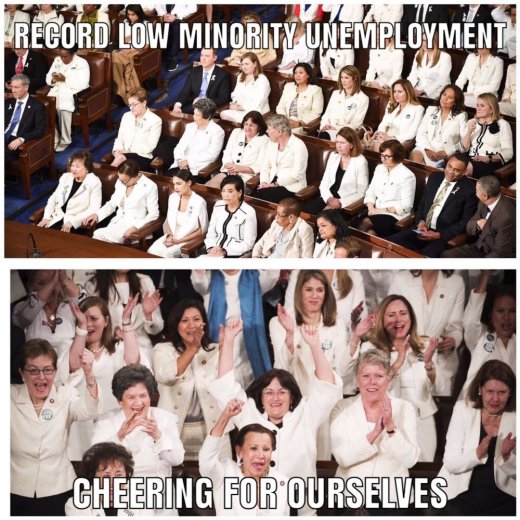
Nice optics, you fools. America was watching.
All in all: a good night for our side.
There was a horrible story in the local news today: A young woman, pregnant, was stabbed to death in an apartment-building lobby.
We read:
The killer targeted the 35-year-old woman’s stomach, according to the building super, who said she watched surveillance-video footage that captured the murder.
“He’s got a knife! He’s going to kill the baby!’ shouted five-months-pregnant Jennifer Irigoyen around 1 a.m. as her attacker pulled her from her third-floor Ridgewood walk-up and down the stairs to the building’s entranceway, horrified witness Maurice Roman Zereoue told The Post.
Police are investigating the slaying as a domestic incident and seeking Irigoyen’s boyfriend for questioning, high-ranking NYPD sources said.
A neighbor who only gave her first name, Kristin, said she heard a man and Irigoyen arguing loudly and then the victim “yelling ”¦ about wanting to protect her baby.
Building super Lisa Raymos said surveillance video showed, “The first time, he stabbed her in the stomach.’’
The killer appears to have been her boyfriend. The victim knew who the killer was, but was unable to say his name:
The mortally wounded woman tried to name her killer but couldn’t choke out the words over the blood pooling in her throat, Zereoue said.
“I asked, ”˜Do you know who he was?’ And she kept nodding yes and waving her arm,’ he said. “She couldn’t speak.
“I kept telling her, ”˜Hang on, hang on, help is coming.’ ’
Irigoyen was rushed to Wyckoff Hospital, but neither she nor her baby could be saved.
Notice the language here: “…wanting to protect her baby.” “…neither she nor her baby could be saved.”
How many people are being referred to here? It certainly sounds like two: a mother and her unborn baby. Not “she nor her body”, or “she nor her clump of cells”. Her baby.
A few days ago, that baby would have been considered the victim of a homicide. The killer would have faced two counts of murder. (And a flaying, followed by a vat of boiling oil, if it were up to me.)
As of January 2019, however, in New York State that baby, that unborn human being, has been defined out of existence. If the baby had been the only one to die, its attacker would face no homicide charge at all.
That child was murdered twice: first by a pen, and then by a knife.
Abortion’s been in the public eye lately: with the Democratic Party red-shifting leftward, legislators are seizing the opportunity to push the limits — both legal and moral — of the un-personing of the unborn. New York State just celebrated, with standing ovations and a festive light-show, a ghoulish dismantling of its moral obligations to its residents in utero, while in Virginia a state politician named Kathy Tran found herself in a national spotlight for advancing similar legislation. The Virginia bill was defeated, unlike its counterpart in New York; both bills legalized abortion right up to the moment of delivery, and pointedly left open the question of what happens to an unwanted infant who somehow manages to get itself born alive after an attempted abortion.
Ms. Tran achieved “virality” in a video showing her acknowledging that her bill would, in principle, allow abortion even during labor. Virginia’s governor, Ralph Northam, got himself caught up in the maelstrom as well, when he said, during an interview, that what would happen to a baby who survived an abortion would be a matter of “discussion” as the infant waited nearby. (He’s also become, quite suddenly, the subject of a Two Minutes’ Hate for some old yearbook photos; one wonders just who dug those up and why, but I won’t say anything more about that for now.)
No, what I want to bring to your attention is something you might not have heard about: an example of everything that is execrable about our political system (and I use the term “our political system” very broadly indeed). It is the excuse given by one Dawn Adams (D-Richmond), the co-sponsor of Kathy Tran’s bill, just as soon as Ms. Tran, and the bill they had pushed forward together, became the objects of condemnatory national attention.
Did Ms. Adams say that her thoughts “had evolved” since she helped advance this bill? No. Did she do the honest thing, and come right out and say that her sponsorship of the bill was a political calculation that had backfired badly, and she’d be more careful next time? (Just kidding with that one.)
Nope. Here is the actual excuse she settled on: that she hadn’t read the bill attentively enough — the bill she herself co-sponsored — to understand what it said.
So: after finding herself in a public-relations pickle, this woman — this elected representative of the People, charged with the sacred trust and solemn duty of making the laws that her constituents shall be bound to under the power of an irresistible State; this duly sworn executor of the great social Contract that lifts us all, by our given (or assumed) consent, from the toils of savagery and barbarism — considered how she might exculpate herself, and settled on that?? We have come to a strange and sorry pass when a public official can expect to exonerate herself from controversy by confessing egregious malpractice.
It seems to me that we had, ages ago, severe public remedies and prescriptions for scoundrels, but no longer. We still have the scoundrels.
News from North Korea:
How much is that “impossible amount” of poop that each North Korean is supposed to provide? A hundred kilograms — far more than the average North Korean’s total body weight. Per day.
At first I thought this must just be “fake news”, but then I realized — you could’t make this shit up.
With yet another hat-tip to Bill Keezer, here’s a therapeutic video.
Former Federal prosecutor Andrew McCarthy has a new item at NRO on the Roger Stone indictment. He makes an obvious but worth-repeating point about the “process crimes” Stone is charged with, which have to to an investigation into his efforts to find out what Wikileaks might have on Hillary Clinton during the 2016 campaign. Mr. McCarthy reminds us that the backbone of the Russian election-tampering narrative is that Russian hackers got hold of DNC emails, then gave them to Wikileaks, who leaked them to the press. But if that’s so, and Trump was in fact in cahoots with Putin throughout all of this, the Trump campaign could simply have gotten the information directly from the Russians, rather then sending people like Roger Stone to try to figure out what was on offer.
To put that in simple terms: if Roger Stone did the things he is said to have done, then the Trump-Russia “collusion” story is false.
You can read Mr. McCarthy’s article here.
New York’s governor, Andrew Cuomo, has just signed into law a bill called the Reproductive Health Act. (You can read it here.)
The principal effects of the bill are a) to remove all mention of abortion from the New York State penal code; b) to permit licensed heath-care practitioners to conduct abortions; and c) to codify the discretion of such providers to justify abortions up to the moment of natural birth.
Here are some salient points:
Section 125.00, which defines homicide, used to say:
Homicide means conduct which causes the death of a person or an unborn child with which a female has been pregnant for more than twenty-four weeks under circumstances constituting murder, manslaughter in the first degree, manslaughter in the second degree, OR criminally negligent homicide, abortion in the first degree or self-abortion in the first degree.
Now it will read:
Homicide means conduct which causes the death of a person under circumstances constituting murder, manslaughter in the first degree, manslaughter in the second degree, OR criminally negligent homicide.
What’s a “person”? The definition is in section 125.05 of the code:
“Person,” when referring to the victim of a homicide, means a human being who has been born and is alive.
The change in the definition of homicide, then, means that someone who attacks a pregnant woman and causes her to miscarry can no longer be charged with murder for the death of her unborn child. The unborn are thus excluded, by act of law, from the circle of morally protected beings — giving them lower legal status, as far as I can make out, than the dwarf wedge-mussel or the pine-pinion moth.
The Act removes the following two subsections of the homicide code:
2. “Abortional act” means an act committed upon or with respect to a female, whether by another person or by the female herself, whether sheis pregnant or not, whether directly upon her body or by the administering, taking or prescription of drugs or in any other manner, with intent to cause a miscarriage of such female.
3. “Justifiable abortional act.” An abortional act is justifiable when committed upon a female with her consent by a duly licensed physician acting (a) under a reasonable belief that such is necessary to preserve her life, or, (b) within twenty-four weeks from the commencement of her pregnancy. A pregnant female`s commission of an abortional act upon herself is justifiable when she acts upon the advice of a duly licensed physician (1) that such act is necessary to preserve her life, or, (2) within twenty-four weeks from the commencement of her pregnancy. The submission by a female to an abortional act is justifiable when she believes that it is being committed by a duly licensed physician, acting under a reasonable belief that such act is necessary to preserve her life, or, within twenty-four weeks from the commencement of her pregnancy.
Gone, then, is the 24-week limit for abortions that are not deemed necessary to save the mother’s life. This is replaced with a new section 25-A in the Public Health Law. which includes the following (my emphasis):
§ 2599-BB. ABORTION. 1. A HEALTH CARE PRACTITIONER LICENSED, CERTIFIED, OR AUTHORIZED UNDER TITLE EIGHT OF THE EDUCATION LAW, ACTING WITHIN HIS OR HER LAWFUL SCOPE OF PRACTICE, MAY PERFORM AN ABORTION WHEN, ACCORDING TO THE PRACTITIONER’S REASONABLE AND GOOD FAITH PROFESSIONAL JUDGMENT BASED ON THE FACTS OF THE PATIENT’S CASE: THE PATIENT IS WITHIN TWENTY-FOUR WEEKS FROM THE COMMENCEMENT OF PREGNANCY, OR THERE IS AN ABSENCE OF FETAL VIABILITY, OR THE ABORTION IS NECESSARY TO PROTECT THE PATIENT’S LIFE OR HEALTH.
This new “or health” wording is carefully chosen; it reflects the language of the United States Supreme Court in Doe v. Bolton, in which the Court explicitly unpacked the legal meaning of the word “health”:
[M]edical judgment may be exercised in the light of all factors — physical, emotional, psychological, familial, and the woman’s age — relevant to the wellbeing of the patient. All these factors may relate to health. This allows the attending physician the room he needs to make his best medical judgment. And it is room that operates for the benefit, not the disadvantage, of the pregnant woman.
What all this means is that abortions are now legal right up to the moment of delivery, as long as a practitioner, who must no longer even be a physician, decides that snuffing out the unborn child is OK “in light of all factors — physical, emotional, psychological, familial, and the woman’s age”.
The humanity of the unborn, all moral obligation toward them, and any legal protections they once had have now been methodically and explicitly defined out of existence.
(Some have been saying that the new law even removes protections for those unwanted babies who somehow manage to survive the abortion procedure, and emerge into the world alive. I have not been able to find this in the bill, so far — but I’m sure it’s on the Governor’s wish-list.)
Today Governor Cuomo ordered that the spire of the Freedom Tower be lit up in pink — in celebration.
UPDATE: I’ve found the section of the bill that removes protections for babies who survive the attempt to abort them. It is only one line in the bill:
3. Section 4164 of the public health law is REPEALED.
What did the repealed part of the public-health law say? I had to poke around a bit to find it, as that section of the law had already been removed from the first couple of sites I checked. But it’s still online at FindLaw.com, and here’s what it used to say. Read it slowly and carefully, and reflect on the fact that these provisions were explicitly and intentionally deleted, and replaced with nothing at all:
1.”ƒWhen an abortion is to be performed after the twelfth week of pregnancy it shall be performed only in a hospital and only on an in-patient basis. ”‚When an abortion is to be performed after the twentieth week of pregnancy, a physician other than the physician performing the abortion shall be in attendance to take control of and to provide immediate medical care for any live birth that is the result of the abortion. ”‚The commissioner of health is authorized to promulgate rules and regulations to insure the health and safety of the mother and the viable child, in such instances.
2.”ƒSuch child shall be accorded immediate legal protection under the laws of the state of New York, including but not limited to applicable provisions of the social services law, article five of the civil rights law and the penal law.
3.”ƒThe medical records of all life-sustaining efforts put forth for such a live aborted birth, their failure or success, shall be kept by attending physician. ”‚All other vital statistics requirements in the public health law shall be complied with in regard to such aborted child.
4.”ƒIn the event of the subsequent death of the aborted child, the disposal of the dead body shall be in accordance with the requirements of this chapter.
ADDITIONAL UPDATE: I’ve also just noticed that the bill repeals section (d) of Article 675 of the county law, which until now authorized a coroner to investigate deaths apparently caused by criminal abortion. I suppose this is because the very concept of a criminal abortion no longer exists in New York.
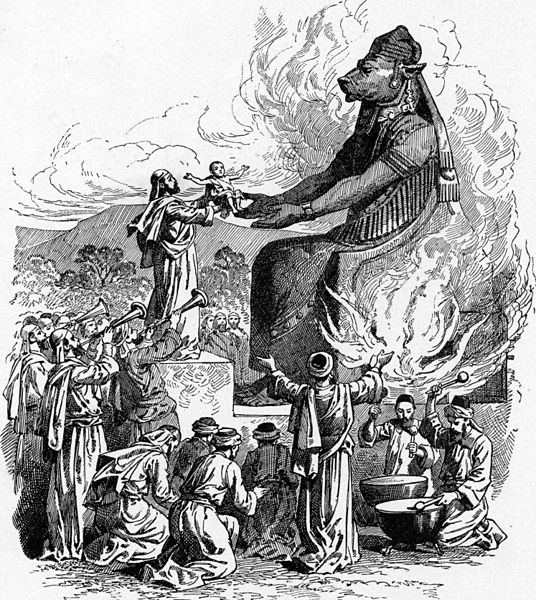
In the wake of the signing of this bill into law, the following image has been making the rounds. It seems about right.
I don’t often link to The Atlantic, but this is worth your time: everything you need to know about the hagfish.
I’ve just learned that Russell Baker, the longtime reporter and columnist for the New York Times, has died at the age of 93.
I was a fan. I read his Observer column without fail, and have several of his books. He was a wonderful writer — graceful, witty, and piercingly but unostentatiously intelligent — and he was part of a New York Times, and an era of American civilization, that have since rotted away.
Read his obituary — in the Times, of course — here.
Tucker Carlson rang in the New Year with a controversial monologue on the failure of American government to address a fundamental problem of modernity: the breakdown of families, and the growing hopelessness of those who are neither intractably poor nor insouciantly rich. Unlike nearly every other “conservative” today, however, he spread the blame around, heaping as much of it on free-market fundamentalists as on the neo-Marxist uplifters of the hegemonic Left.
Where the modern Right gets it wrong, says Carlson, is in its faith in what might be expressed as a syllogism: a) economic growth is the greatest good; b) free-market capitalism is the best path to economic growth; and therefore, c) correct public policy should always prioritize non-interference with market capitalism.
Carlson makes it very clear that he disagrees: “Anyone who thinks that the health of a nation can be summed up in GDP is an idiot… Market capitalism is not a religion. Market capitalism is a tool, like a staple-gun or a toaster. You’d have to be a fool to worship it.”
Neoreactionaries have for some time questioned the free-market syllogism that Carlson critiques here, and it’s refreshing to see such heresy put forward on the public airwaves. For his sins, Carlson has been getting it from both sides: from the Left for his defense of traditional families and support for what Amy Wax has called “bourgeois values”, and from Conservatism, Inc. for free-market apostasy. (You have to hand it to the guy: he isn’t afraid to stick his neck out.)
Now the blogger “Spandrell”, whose insightful commentary has for years been influential out here on the dissident Right, has published a substantial post expanding on Carlson’s theme.
Spandrell begins by examining available strategies to push back against the neo-Marxist coalition-building he has called Bioleninism. If you don’t know what Bioleninism means, you should read about it here, but Spandrell sums it up in his current post as follows:
As we all know, the political left, born out of the chaos of the French Revolution, came of age when Karl Marx produced a working formula: class struggle. You go find the low status people in your country, tell them the world is divided in two sorts of people: them, and the guys on top of them. The guys on top are oppressors, the guys on the bottom are oppressed: if you, the oppressed follow me, we’ll turn the table, “liberate you’ i.e. grab their stuff and their status and give it to you.
Then after WW2 the Western left realized that the oppressor/oppressed template worked much better with groups disadvantaged biologically than with mere social class. Hence we got Bioleninism. The industrial worker who was so much into socialism could after all become a manager, or start his own company and not be so interested in socialism anymore. Happened all the time. That’s not a good deal if you’re a leftist politician. You want your underlings to stick around and be loyal, and the underclass doesn’t feel so oppressed if there’s not an underclass anymore. Of course, you can change class (in modern Western societies), but you can’t change biology. The average racial minority, the sexual deviant, the mentally ill, the fat cat lady, those will always be low status, always feel oppressed. That’s firm, absolute loyalty right there.
So: how can Bioleninism be resisted? By forming a counter-coalition out of whoever Bioleninism can’t seduce:
How do you deal with Bioleninism? The only workable strategy was formulated by Steve Sailer decades ago: if the Left is the Coalition of the Fringes, the Right must be the Party of the Normal. In the US, where demographics mean that the minority-supported Democratic party will by 2025 or so have a rock-solid electoral majority, that meant the Republican Party becoming the party of White people. It’s taken a while, but as the critical date when Texas flips blue approaches, the Republicans have slowly, if somewhat unawares, moved in that direction. Hence, Donald Trump.
Of course the Right has to do a lot of work before that change of direction is complete. The Left is more flexible and responsible to change, because its basic formula is simple. They’re the party of the oppressed. If things change they just need to change the identity of the oppressed, and they’re set. Easy. The Right though, can hardly be the party of the oppressors. At its core, sociologically, the Right is the party of the people who wanna be left alone. That’s not a very exciting way of running a political movement, though, so they must always come up with random reasons to justify their attachment to the status quo. The usual are traditional religion, which is useful as it doesn’t need to be justified, and has centuries of history fighting the Left, long a force for atheism. There’s also nationalism, to the extent it is allowed to exist post-WW2, which tends to be the refuge of secular, masculine people who dislike the Left’s push for egalitarianism.
And of course, capitalism. When the Left was primarily about economic socialism, about state-control of the economy, the Right had a very strong Schelling Point in free-market ideology. Opposing socialism made for good politics for non-leftist people, it has a ready source of funding from business owners. And it just makes a lot of sense. Socialism is a very stupid economic policy, which produces poverty. And nobody likes poverty, least of all the poor. So the political Right in much of the Western world, and even out of it, became mostly a coalition of religious people, nationalists, and business owners. God, Country and Capital.
This tripod — which corresponds well to another influential concept of Spandrell’s, the neoreactionary “trichotomy” — soon came, unsurprisingly, to be dominated by the Capital faction. And capital wants to be free. This, argues Spandrell, is what gave rise to the idiomatically American ideology known as Libertarianism.
Libertarianism is what you do when you realize that the government is socialist by definition. Socialism being the control of the economy by the government, well, yes, odds are the government is going to want to control the economy. So if you don’t trust the government to respect your interests, then you go libertarian. You do that because you are a business person and have an actual reason to want the government to get away from your business. Or you do that if you are opposed to the government for other reasons, say cultural reasons, and just want to signal your distrust of the government. Libertarianism came from both sides of that. Not by coincidence, much of libertarianism came of the American South after the Civil Rights movement. US Southerners realized the US Federal Government wanted to destroy their culture; and many of them became free market fundamentalists as a way to oppose that. That again connects with the 3-way coalition of religious, nationalists and capitalists that has formed the Political Right for decades.
Libertarianism has deep roots in America’s founding philosophy. At its heart is the natural-rights theorem that the only legitimate government is that which rules by the consent of the governed; the general principle by which this leads to libertarianism is the idea that since we all have non-overlapping things we are willing to consent to, we maximize consent by minimizing the range of aspects of our lives over which government may exert power. Given that government relentlessly seeks to increase that range, the libertarian finds himself consenting to less and less over time. In essence then, libertarianism becomes increasingly a yearning for what NRx calls “Exit”. But its flaw is that it seeks Exit in situ, without actually going anywhere. This might have been possible in a simpler time, but in the modern technological “synopticon” (to borrow a term from Victor Davis Hanson), mere libertarianism — personal libertarianism — is doomed.
Except, that is, where libertarianism coincides with power. There being two major axes of power in America — the Bioleninist ruling coalition, and Capital — liberty can be the reward of loyalty. For the Bioleninist faithful, that reward is generally paid out in liberties having to do with present enjoyment and consumption: in particular, freedom from traditional cultural and sexual restraints, and freedom from the need to make one’s own way in the world. For Capital’s troops, the reward is freedom from economic and cultural supervision. And now we see something new, but unsurprising: “woke corporations” trying to play both sides. This needs to be called out — and that’s what Tucker Carlson has done:
Well, Tucker’s speech basically said this alliance was over. The alliance of God, Country and Capital has achieved some electoral victories over the decades, but it has failed miserably at the only important task: the Culture War, influencing the behavior of the people so that they form stable and moral families. The Left has destroyed traditional culture bit by bit, and neither Nixon, nor Reagan, nor Bush, nor anyone, has been able to do stop it even by an inch. And why is that? Has God failed us? Do the people not love their Country? No, it’s the other guys. Capital has betrayed us. The libertarians have been playing a double game, and they are now pretty much the enemy. They haven’t just surrendered, or been neutralized. Capital today is perhaps the biggest force of the Left. They’re the biggest enemy.
Spandrell asks, with an inner quote from Carlson:
If Capital is now Woke, if the Left has successfully captured the capitalists, why should the Right be nice to them? Because muh-free markets? That was a means, not an end. The goal of the Right is, again”¦
The goal [of government] is to have an economy which makes it possible for normal, average young people to marry and have kids.
Or in other words, to ensure a future for our children. There’s another version out there in 14 words.
Spandrell concludes:
What the Right needs to do now is to reflect on how the Left was able to capture Capital and turn it into its most lucrative constituency. Any successful country needs a business community, and the capture of the West’s by the Bioleninist left has been so unexpected that still many people refuse to believe it. But happened it has, whether by political coercion, infiltration, or just mere cultural prestige. We better think carefully on what happened, how to reverse it, and use the same tools for our own cause.
How did it happen? Infiltration, certainly — and there’s always Conquest’s Second Law, which says that “any organization not explicitly right-wing becomes left-wing over time.” But mainly it is just that capital is a weathervane, which turns as the cultural winds blow. That it is a force of the Left today, when it wasn’t in 1955, just tells you that the Left has changed: having abandoned economic Marxism for Bioleninism, it is no longer a natural enemy of Capital. But far more importantly: it tells us that here in 2019, the Left has won.
The questions Tucker Carlson has raised are what the Right needs to be thinking about right now, above all else. Read Spandrell’s essay in its entirety, here.
Here’s the perfect gift for Mom: a vibrator on a necklace. An ad for the product says “Created by a woman to spark both conversations and feelings of empowerment”, while the online blurb refers to the object’s “forward-looking approach”.
How, exactly, are these conversations supposed to go?
HE: “Hi, nice to meet you. I see you like to masturbate!”
SHE: “Yes, I love to masturbate — so much that I never seem to be able to wait until I get home. In fact, I get so eager to masturbate that I can’t even take the time to open my purse!”
HE: “Wow, that’s really interesting. Good to know!”
SHE: “Yes — and what’s more, I want everyone I meet to know that I really, really like to masturbate. It’s something I’m really proud of.”
HE: “I bet it feels… what’s the word… empowering!”
SHE: “Yes! As a woman who loves to masturbate, now I have the power to masturbate anytime I want. And with the Crave vibrator right on my necklace, I know that everybody I meet is going to have to think about that! That makes me feel special, and important.”
HE: “It’s forward-looking, too. And hey, you know what? I’m looking forward to a time when we can all just, you know, masturbate!”
SHE: “Well, of course you are! Isn’t everyone?”
TOGETHER: “YOU BET!! [laughter]”
Please forgive me for the scanty output here of late — I am deeply distracted with work and family matters, so much so that I have had very little to say.
But I will direct you to two sharp posts at The Orthosphere, by J.M. Smith and Thomas Bertonneau, on the nature of the frustrated malcontent — who is, it seems, the same in every age.
Mr. Bertonneau’s essay, which is here, quotes Gustave Le Bon on the characteristics of the socialist uplifter:
Social failures, misunderstood geniuses, lawyers without clients, writers without readers, doctors without patients, professors ill-paid, graduates without employment, clerks whose employers disdain them for their insufficiency, puffed-up university instructors ”” these are the natural adepts of Socialism. In reality they care very little for doctrines. Their dream is to create by violent means a society in which they will be the masters. Their cry of equality does not prevent them from having an intense scorn of the rabble who have not, as they have, learned out of books. They believe themselves greatly the superiors of the working man, and are really greatly his inferiors in their lack of practical sense and their exaggerated egotism.
The common denominator here is lack of traction, of humbling and instructive contact and friction with the actually existing world.
Mr. Smith’s post gives us the ambitious mediocrity, the “restive subaltern”, who in normal times is held in his place by the density of the social network around and above him, but who can worm his way up through the rotting net in times of “social decomposition” (the stench of which fills our nostrils today). Such men are cauldrons of resentment, pressurized by long humiliation, and if they get loose upon the world can explode with destructive force.
Netflix has a new hit movie: Birdbox. The idea is a simple one: there are things in the world that, if clearly seen, are so radically discomfiting that those who see them are driven to suicide. So everyone puts on a blindfold.
It’s a smashing success. I wonder why?
I’m back in the States now, and catching up on backlogs of both news and work. (The latter isn’t going to leave me much opportunity for brooding and writing for a while, I’m afraid.)
The new Democrat House is in charge. Among the most depressing consequences of that gloomy fact is that the ongoing investigations by the House Judiciary, Oversight, and Intelligence Committees into abuses of state power under the Obama administration — sickening corruption and malfeasance at the highest levels of government, for which, in a just world, the consequences would involve lamp-posts and tumbrels — will now be shut down. The bad guys are simply going to get away with all of it, and there’s nothing you or I can do about it.
The American Spectator has the dismal story, here.
This weekend, after a month in Vienna, the lovely Nina and I are heading home. We’ll be back in the States by Sunday evening. It’s been a fine time — Vienna is always a nice place to be, and we welcomed a new grandchild into our expanding extended family — but it’s time to get back to real life; we’ve neglected our affairs long enough. (Among other things, I have an album I’m supposed to be mixing, and I need to get it done.)
I haven’t thought much about the state of affairs back home, but I’ve paid enough attention to know that the new Congress is now seated, and the Democratic House is now in session. (As Will Rogers once said, the feeling is like when the baby gets hold of a hammer.) Nancy Pelosi once again wields the gavel, and the left wing of her caucus — a raucous mob of Jacobin malcontents and ignoramuses, mostly still in their teens — are itching to get to work building a new and improved United States of America. (They’ll be building it on the same patch of land as the old one, just as soon they’ve finished demolishing the original structure, ripping up the foundations, and evicting the former tenants.)
The first order of business, though, is to reverse the result of the last presidential election. As one newly elected legislatrix explained, setting the tone for the New Year: “We’re going to go in and impeach the motherfucker!”
And so they will, most likely; all they need is a one-vote majority in the House to impeach. The actual criteria given in the Constitution — that old thing! — don’t matter in the slightest; they just mean whatever the House says they mean. The Senate will need a two-thirds majority to convict, which won’t happen, but it will be good fun all around. Gonna be a great year!
Can’t wait to get home.
And away we go, friends. I have no idea what 2019 will bring, but I doubt it will be boring. Keep your powder dry!
I wish you all good health and good fortune, and I thank you all again for reading and commenting.
I met a charming and intelligent young Austrian man in a social setting this afternoon. I’d say he’s in his early thirties. He runs a small business, and lives in a very nice apartment here in Vienna with his wife and two small children. His wife’s American parents are here visiting, and we were invited over to meet them. It was a delightful gathering of three generations.
At one point the conversation turned to the fantastic quality of life in Vienna. The city consistently tops polls for the world’s best city to live in, and when you spend some time here it’s easy to see why. The social services are lavish, and expensive for the taxpayers, but everything just works.
This young father (I will call him Albert) mentioned that he wasn’t sure how much longer it would all hang together this well. He pointed out, for example, that he had found it necessary to buy private health insurance for his young family, because more and more of the good doctors in Vienna nowadays were only “in-network” with these private insurers.
I mentioned that I thought that the sort of social arrangement so common in northern and western Europe, with high taxes and abundant public amenities, could make for a very nice way of life, but that it required certain conditions to be met.
First, I said, there had to be general agreement among the people that they were willing to pay a lot in taxes — Albert said he pays about 65% of his income to the government — in return for generous social services. Albert agreed, of course.
Also, I said, there had to be a large enough fraction of the people paying into the system to carry the load: that you couldn’t just have a few people pulling the wagon, with most of the people in the wagon. Albert nodded in agreement.
Next — getting closer to the heart of the matter — I suggested that there had to be a real sense of community in order for people to be willing to pay someone else’s expenses today, with the reasonable expectation that others might pay their own expenses tomorrow. People just don’t put such trust in others with whom they feel they have nothing in common. In other words: for European-style democratic socialism to work requires strong social cohesion.
Albert agreed to this as well. (As I said above, he’s an intelligent man!) But then he added that this necessary social cohesion was now threatened by the rise of “right-wing” parties, skeptical of mass immigration, that were creating divisions, and so working against unity and comity.
I felt the need to tread carefully here, as I was a guest at a cheery holiday gathering in a foreign country, and I was also, I am quite sure, the only heretic in the room. The obvious response to Albert’s remarkable interpretation — which has things exactly backward — would have been to suggest that surging political parties do not so often create public sentiment as give an an outlet to what is already there; that in order for them to rise, they require something to lift them. I had just begun to say that such parties seem to be ascending, quite spontaneously, everywhere in Europe, even though their message was the same as it’s always been, and what ought we to make of that? — when the little children burst into the room laughing and shouting, and the moment had passed. To have brought it up again would have been rude.
This exchange, though, left me pondering a question of existential importance. Is a smart and civilized person such as Albert — who has all of the premises of the reactionary syllogism neatly in place, but just skids off the rails when it comes to arriving at the conclusion — walking on the road to Damascus, only a little way down the path from the moment of enlightenment? Will something — some item in the news, or some revelatory personal experience — suddenly knock the scales from his eyes, allowing him to see that those awful “right-wingers” are simply trying to preserve, for his children and theirs, all of the conditions that he already understands are necessary for the existence of the happy society he loves? Or is the dominance of our modern Universalist religion strong enough to resist, and to snuff out, such heresies?
We shall see. On the answer depends the survival of Europe.
I am sorry to report that This Week In Reaction, the weekly digest of writings from around the Dissident Right blogosphere that has been published at Social Matter for the last few years, has gone on what will likely be a permanent hiatus. My friend Nick Steves, the editor of TWIR, simply can’t keep up with the workload any longer: he’s a busy man with a large family, and he has other projects to look after.
Thank you, Nick, for providing this excellent resource for so long. I recommend the TWIR archives to all of you. You can find them at the Social Matter website.
We’re still in Vienna (for another ten days or so), spending time with our daughter and her young family, and enjoying a year-end break from our usual cares and concerns. I’ve scarcely paid any attention to the news, and I’ll confess that, as happens sometimes, I’ve had very little inclination to take up the pen. What quiet time I’ve had to myself I’ve spent catching up on reading.
If the Muse pays me a visit before we head back to the States, I might have something to post. You never know! But I’d prefer not to be that person who has nothing to say, and says it anyway.
Back soon. Enjoy the rest of the holidays!
…to each and every one of you. May we all put the world and its cares aside for a day to enjoy the sweet blessings of home and hearth and family, and love.
I’ve been out of the country, and not paying much attention to the news, but I did hear about Michael Flynn’s sentencing hearing last week. And what did I hear? I heard what the mainstream media wanted me to hear: that the judge at the hearing, Emmet Sullivan, had rebuked General Flynn — whom I hold in high regard as an American patriot, and a man of honor — for “treason”.
Just this morning, however, I listened to an interview, by John Batchelor, that told a very different story. Mr. Batchelor was speaking with Michael Ledeen, who was in the courtroom that day. Mr. Ledeen told him that what really happened was this:
General Flynn had come before the court to be sentenced under the terms of his deal with Robert Mueller: he had entered a guilty plea to one count of lying to the FBI. The circumstances of that charge were, to put it as charitably as I can, unusual; General Flynn had been approached by the now-disgraced Peter Strzok and another agent for what had been represented as a clarifying interagency conversation about some matters regarding Turkey, but the FBI was clearly treating it as a perjury trap, with the intention of catching General Flynn in some contradiction regarding a conversation he had had with the Russian ambassador Sergey Kislyak. (The FBI had obtained a wiretap transcript of this conversation.) The trap was successful.
Having set the hook in General Flynn, the Mueller team now set about pressuring and destroying him. His life was made a living hell — and more to the point, his family was made to suffer just as much as he was. For their sake, he decided to take a bullet: he accepted a deal from the Mueller inquisitors to plead guilty on one felony count of lying to the FBI. The judge before whom Flynn entered his plea was Rudolph Contreras, who was also a member of the FISA court that approved the surveillance warrant against Carter Page. Judge Contreras is, as it turns out, a pal of Peter Strzok, and has since recused himself from the Flynn case.
With Judge Contreras out of the picture, the sentencing hearing, after some delay, came before Judge Sullivan. From what Mr. Ledeen tells us, Judge Sullivan is no fan of prosecutorial overreach, and appears to have thought that General Flynn had been railroaded into making his deal.
What happened in the courtroom, then, according to Mr. Ledeen, was that Judge Sullivan offered to let General Flynn renounce his deal, as he was not the judge before whom Flynn had made his plea, and did everything he could to get Flynn to do so. General Flynn had had enough, though, it seems, and just wanted to be sentenced and be done with it. (I also suspect that having agreed to the deal, he might have felt it would be dishonorable to renege.)
This apparently irritated the judge, who it seems is known for a passionate approach to the law (and, know also, sometimes, for intemperate language), and when his attempt to persuade General Flynn to drop the bargain failed, tried another approach: he tried to scare the general into rejecting the plea-bargain by reminding him that it was within the judge’s power to sentence General Flynn as harshly as he liked. Judge Sullivan also added, just to add a little extra fire and brimstone, that some people might think that some of the charges swirling around the Flynn orbit — I assume this has to do with the intrigue that some of General Flynn’s associates have apparently been involved in regarding Turkey — might be regarded by some people as “treasonous”. And this, of course, became the headline that I heard all around: that the judge had accused Michael Flynn of treason.
Listen to Mr. Ledeen’s account here.