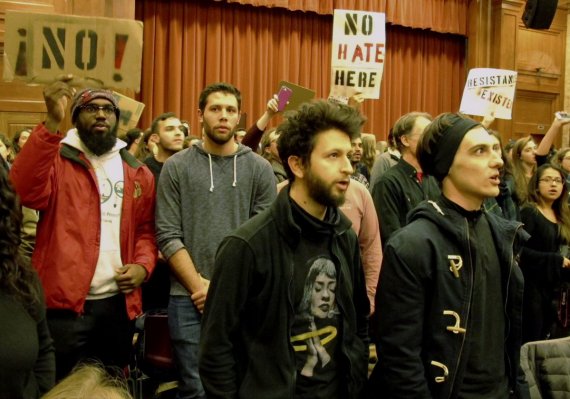
Trouble In Paradise

Here is an interview of Daily Mail reporter Katie Hopkins by Tucker Carlson. Ms. Hopkins describes her recent trip to Sweden.

By the way, speaking of Sweden and Tucker Carlson, here’s John Derbyshire’s understanding of Donald Trump’s recent “last night in Sweden” remark that set off such a commotion:

It happened that Tucker Carlson over at Fox News, which the President is known to watch, had done a segment the evening before about crime among Muslim immigrants in Sweden. Plainly the President meant to say: “You look at what’s happening in Sweden, as I saw last night.” That sentence is syntactically more complex, though, so his mind fed his tongue something simpler.

It can happen to anybody. I’ve had embarrassing experiences, and so have you.

This sounds entirely plausible, I think. The “last night” part of the remark never really made sense to me.

Posterity

Okay, enough doom and gloom.

Here’s a picture of my grandson Liam, who is, if I am not mistaken, the cutest child that ever lived.

 
Ladies?

Murray On Middlebury

Following on our earlier post — and with thanks to our commenter Jason for the link — here are Charles Murray’s own remarks on having been assaulted by a violent leftist mob at Middlebury College last week. We read (the item refers to Professor Allison Stanger, who had invited Mr. Murray for an interview, and Bill Burger, the college’s Vice President for Communications):

I had expected that they would shout expletives at us but no more. So I was nonplussed when I realized that a big man with a sign was standing right in front of us and wasn’t going to let us pass. I instinctively thought, we’ll go around him. But that wasn’t possible. We’d just get blocked by the others who were joining him. So we walked straight into him, one of our security guys pushed him aside, and that’s the way it went from then on: Allison and Bill each holding one of my elbows, the three of us plowing ahead, the security guys clearing our way, and lots of pushing and shoving from all sides.

I didn’t see it happen, but someone grabbed Allison’s hair just as someone else shoved her from another direction, damaging muscles, tendons, and fascia in her neck. I was stumbling because of the shoving. If it hadn’t been for Allison and Bill keeping hold of me and the security guards pulling people off me, I would have been pushed to the ground. That much is sure. What would have happened after that I don’t know, but I do recall thinking that being on the ground was a really bad idea, and I should try really hard to avoid that. Unlike Allison, I wasn’t actually hurt at all.

The three of us got to the car, with the security guards keeping protesters away while we closed and locked the doors. Then we found that the evening wasn’t over. So many protesters surrounded the car, banging on the sides and the windows and rocking the car, climbing onto the hood, that Bill had to inch forward lest he run over them. At the time, I wouldn’t have objected. Bill must have a longer time horizon than I do.

Again: Who? Whom? This is the real thing here, folks: a mob unafraid to do violence against its ideological enemies. If the New York Times and Hollywood celebrities are the good cop, this is the bad cop.

This is nothing new in America; it is nothing new in the world. But it is here, and it is here now — and if you are morally, politically, or religiously sympathetic to the ancient civic and cultural traditions of Western civilization, or to the historical American nation (or, indeed, to any of the human universals and natural categories that have given essential structure to every society that has ever flourished anywhere on Earth), then you, and all that you cherish, are what that mob seeks to destroy.

How long before someone is killed at one of these riots? How long before the motionless and tormented eagle reveals its “formidable beak and claws”?

R.O.E.

We offer a hat-tip to Nick Land for exhuming this two-year-old passage from John Glanton at Social Matter:

You have to admire the Left for its clarity of vision. It has identified its enemies, and it does what it can to drive them from the field. The recent fireworks in Indiana are a perfect illustration. Team blue knows that Christians are hateful homophobes, and so it goes to bat for the right of homosexuals to sue them over wedding cakes. The Right, with its characteristic acumen, mistakes this bushwhack for a principled stand. “Ah!’ they say, “But if you support the right of a gay man to force a Christian to make a cake then you must support the right of the KKK to force a black baker to make a cake!’ The average liberal couldn’t imagine a more irrelevant rejoinder. They aren’t making any such proposition at all. In their calculus, Christians (of the Not-fans-of-Pope-Francis type at least) are the bad guys and thus their interests are hateful and invalid and must be opposed. The KKK are bad guys and thus their actions are hateful and invalid and must be opposed. You attack bad guys. You don’t attack good guys. Whence the confusion?

The fact that they have such a clearly defined enemy is, incidentally, why the Left can mobilize effectively despite being a creaky, Frankenstein mass of mostly incompatible interest groups. Mexicans will ethnically cleanse blacks when their territories run afoul of one another, but they both vote for the same party. Homosexuals don’t always enjoy the gentlest of treatment from their Muslim friends, but they nevertheless routinely support Democratic politicians who promise more immigrants and “refugee resettlements’ from all the vibrant corners of Africa and the Middle East. The Democrat coalition is organized not around a coherent vision of the future but a shared opponent.

See also the late Lawrence Auster on the Unprincipled Exception.

The Big Bad Bear

John Derbyshire’s been asking: why is Russia our enemy?

I’ve wondered too:

A more enlightened worldview would see Russia ”” a great Christian nation, and one that has made priceless contributions to the treasure-store of Western civilization ”” as a natural ally in these perilous times. We have much in common, including ancient, existential enemies who gloat to see us fighting with with each other rather than uniting against them. Yet our stance toward Russia has been relentlessly bellicose, with our support of the Ukrainian revolution, and our actions in Syria, being only the most obvious examples.

Lewis Amselem, a.k.a “Diplomad”, seems as puzzled as we are.

No Hate Here!

 
We’ve been hearing a lot about how the election of Donald Trump has brought a lot of haters out into the open. As Mr. Trump himself might say: so true. Here’s a thing that happened two days ago:

MIDDLEBURY ”” Middlebury College Professor Allison Stanger was injured by protesters Thursday evening as she was escorting a controversial speaker from campus. She was treated at Porter Hospital and released.

Charles Murray, a political scientist who has been criticized for his views on race and intelligence, was invited to speak on campus by a student group. He was greeted late Thursday afternoon outside McCullough Student Center by hundreds of protesters, and inside Wilson Hall, students turned their backs to him when he got up to speak.

College officials led Murray to another location and a closed circuit broadcast showed him being interviewed by Stanger, the Russell J. Leng ’60 Professor of International Politics and Economics.

As Stanger, Murray and a college administrator left McCullough Student Center last evening following the event, they were “physically and violently confronted by a group of protestors,’ according to Bill Burger, the college’s vice president for communications and marketing.

Burger said college public safety officers managed to get Stanger and Murray into the administrator’s car.

“The protestors then violently set upon the car, rocking it, pounding on it, jumping on and try to prevent it from leaving campus,’ he said. “At one point a large traffic sign was thrown in front of the car. Public Safety officers were able, finally, to clear the way to allow the vehicle to leave campus.

“During this confrontation outside McCullough, one of the demonstrators pulled Prof. Stanger’s hair and twisted her neck,’ Burger continued. “She was attended to at Porter Hospital later and (on Friday) is wearing a neck brace.’

The reactionary case is getting easier and easier to make: nowadays the left jumps you, pries your jaws apart, and forces the red pill down your throat. (If you take an “accelerationist” view of how the left might be undone, you’re getting your wish.)

Also from the article:

Murray, who apparently was unhurt in the incident, is best known for his 1994 book, “The Bell Curve,’ for which he was criticized for an assertion that people of different races have different economic outcomes because of their inherent difference in intelligence.

Imagine that: framing an economic hypothesis based on something that is almost certainly true, is well supported both by basic evolutionary theory and objective data, and is, if nothing else, entirely plausible, uncontradicted by any obvious facts, and eminently worthy of reasoned debate. (Kill him!)

The item ends with the usual appeal to the hate-branding racketeers at the SPLC, who have somehow become as ubiquitous an “authority” in this context as “four out of five dentists” were in the toothpaste commercials of my youth:

The Southern Poverty Law Center has called Murray a “white nationalist’ who has used “racist pseudoscience.’

Charles Murray is a mild-mannered fellow, of exceptional intelligence and perspicacity, who has done nothing more than to look closely at society, data, and human nature in an attempt to answer some vexing and persistent questions. He is, quite literally, a gentleman and a scholar, and is no more of a “hater” than Bruce Wayne’s Aunt Harriet.

If you’re wondering where the hate really is, here’s a tip: look at who is assaulting whom.

Thanks In Advance

I’m sure you all have it marked on your calendars, but my birthday’s coming up in April. (I’ll be 61!)

If you still don’t know what to get me, have a look here.

The Torments Of The Damned

In a heartwarming opinion piece today at the New York Times, Thomas Edsall laments the internet’s toxic effect on what it calls “democracy” — a term that, if I understand the piece correctly, is to be defined as a political system in which two political parties, and a few other “dominant organizations” (here, the Times clears its throat and points to itself), control all access to communication and political power.

Let’s have a look at the thing, from top to bottom. It begins by complaining that, in this frightening new era,

As the forces of reaction outpace movements predicated on the ideal of progress…

We’ve certainly been doing what we can — and now even the Times admits we’re winning. Let’s savor the moment, comrades.

… and as traditional norms of political competition are tossed aside…

Or, to put it another way, “as daylight finally shines on the corruption of Party machinery…”

… it’s clear that the internet and social media have succeeded in doing what many feared and some hoped they would.

Or, perhaps, what some feared and many hoped….

They have disrupted and destroyed institutional constraints on what can be said, where and when it can be said, and who can say it.

Fantastic. The mask is off. All we see here is the will to power.

Let us pause for a moment, to imagine that you, dear reader, have something to say. If so, would you like to be able to say it? Would you like to say it in print, in public, or online? Would you like to be able to say it now? Would you like to be able say it yourself?

Should these choices be yours? Not according to Thomas Edsall. They should be subject to the approval of “institutions” — such as the editorial board of the New York Times.

According to Matthew Hindman, a professor of media (who must, I suppose, be worried that the Devil will take him):

“… someone looking at the United States would have to be worried about democratic failure or transitioning to a hybrid regime.”

Such a regime, in his view, would keep the trappings of democracy, including seemingly free elections, while leaders would control the election process, the media, and the scope of free debate.

One of the chief absurdities of popular government in general is the notion that somehow, a nebulous “will of the people” emerges and takes form and flesh. It never does any such thing, because it can do no such thing. What happens, rather, is that the struggle for power becomes a competition among what Sir Henry Sumner Maine called “the Wire-pullers” (take a moment here to read this, from Sir Henry himself).

Consider the Democratic Party’s electoral process last year. Look at how enormously unpopular Hillary Clinton was, even among Democrats. Why was she the candidate? For one reason only: because she had been anointed by her party’s wire-pullers, who not only declined to offer any serious alternative, but also engaged in strenuous and often unethical machinations to make sure that her principal opponent was hammered down. Moreover, the only reason anyone got to hear about any of that was because the internet made it possible .

So: if “leaders” control the election process, that’s bad, but if the Debbie Wasserman Schultz, the New York Times, and Thomas Edsall do so, that’s good.

(Furthermore, how is fully open debate, unfettered by “institutional constraints”, less free, rather than more so?)

Next we hear from Nathaniel Persily, a law professor at Stanford, who, speaking of the Trump movement, makes the same lament:

… this sort of campaign is only successful in a context in which certain established institutions — particularly the mainstream media and political party organizations — have lost their power around much of the world.”

Have lost their what? Ah yes. Power. Sorry, old chap.

They are right to be worried. Here is Samuel Issacharoff (who is, to ensure diversity of opinion, another law professor, this time from NYU):

We are witnessing a period of deep challenge to the core claims of democracy to be the superior form of political organization of civilized peoples…

Indeed we are, and for very good reasons that were very well understood, right up to (and, it is important to note, during) this nation’s founding. Democracy had, throughout all of recorded history, a very bad track record indeed, for very good reasons. It requires some very particular conditions to work at all, and they are all conditions that the West has systematically destroyed.

The current moment of democratic uncertainty draws from four central institutional challenges, each one a compromise of how democracy was consolidated over the past few centuries. First, the accelerated decline of political parties and other institutional forms of engagement; second, the weakness of the legislative branches; third, the loss of a sense of social cohesion; and fourth, the decline in democratic state competence.

“Loss of a sense of social cohesion”, you say? I wonder how that could have happened. And a “decline in democratic state competence”, even as the West, relentlessly expanding its franchise while flinging open its borders, became more and more democratic? An impenetrable mystery.

Professor Issacharoff continues:

“Technology has overtaken one of the basic functions you needed political parties for in the past, communication with voters,’ he said. “Social media has changed all of that, candidates now have direct access through email, blogs and Twitter,’ along with Facebook, Instagram, Snapchat and other platforms.

Imagine that! Candidates having direct access to the people. It’s so awfully… democratic.

A little further on, Mr. Edsall asks: who benefits more from all of this, the left or the right? That leads us to this gem:

There is good reason to think that the disruptive forces at work in the United States ”” as they expand the universe of the politically engaged and open the debate to millions who previously paid little or no attention ”” may do more to damage the left than strengthen it. In other words, just as the use of negative campaign ads and campaign finance loopholes to channel suspect contributions eventually became routine, so too will be the use of social media to confuse and mislead the electorate.

In other words, when the electorate are confused and misled, it’s bad for the left. This, presumably, is because the left is the home of reason and truth. (You may disagree, of course. But only within approved institutional constraints.)

What’s interesting about this piece, and its curious implicit definition of “democracy”, is that the authors clearly realize how fraught with peril actual democracy is, and so they acknowledge that, rather than sovereignty resting with “the people” — which, as thinkers from Plato to the Founders well understood, is a buttered slide to disaster, chaos, and tyranny — it must in fact rest elsewhere. What’s got them all so chapped is that it they think it should rest with them, and they can tell they’re losing their grip on it. It’s the oldest story in the world.

There’s more. Read the rest here.

The Remnant

Remember Supernova 1987a? (Of course you do.) Well, NASA’s been keeping an eye on it for you. Fantastic video and images here.

Salem 2017

A couple of months ago I was contacted by a woman named Lucy Diego, who was putting together an anthology of neoreactionary essays and wanted to know if she might use some of what I’ve written here. (I was happy to agree.)

Ms. Diego runs an art gallery in London that last year mounted an NRx-themed exhibit and hosted a series of talks.

A couple of days ago I saw this item in the New York Times. Apparently Ms. Diego, by hosting the show and talks, and by expressing an impermissible opinion on Facebook, has attracted the attention of an angry mob, who are now picketing her gallery and calling for its closure. As for Ms. Diego herself, she has reasons to be concerned for her own safety, according to the Times:

She noted that the police had advised her to stay indoors, and said that she had not left her house in several days, after receiving threats online.

We hear a lot these days about “hate”. This is what it actually looks like.

Ms. Diego would probably appreciate your expressions of support. You can reach her at info@ld50gallery.com.

Closing The Circle

A couple of weeks ago I picked up a copy of The Outline of History, written in 1920 by H.G. Wells. I’m halfway through the first volume of two. It’s a fine example of post-WWI Progressive-era thinking, and Mr. Wells was of course a wonderful craftsman, so I’ve been enjoying it enormously. (The entire book has been put online in a website of its own, here.)

In Chapters 12 through 14 — The Races of Mankind, The Languages of Mankind, and The First Civilizations, Mr. Wells described the gradual expansion of humanity, and human culture, eastward around the globe. It was a slow process, and it reached the Americas last. The earliest hominid settlers to the Western Hemisphere got here over a land bridge at the Bering Strait, but as the ice receded and the seas rose, that bridge was submerged, and the Americas were cut off.

We read:

And in these thousands of years during which man was making his way step by step from the barbarism of the heliolithic culture to civilization at these old-world centres, what was happening in the rest of the world? To the north of these centres, from the Rhine to the Pacific, the Nordic and Mongolian peoples, as we have told, were also learning the use of metals; but while the civilizations were settling down these men of the great plains were becoming migratory and developing from a slow wandering life towards a complete seasonal nomadism. To the south of the civilized zone, in central and southern Africa, the negro was making a slower progress, and that, it would seem, under the stimulus of invasion by whiter tribes from the Mediterranean regions, bringing with them in succession cultivation and the use of metals. These white men came to the black by two routes: across the Sahara to the west as Berbers and Tuaregs and the like, to mix with the negro and create such quasi-white races as the Fulas; and also by way of the Nile, where the Baganda (= Gandafolk) of Uganda, for example, may possibly be of remote white origin. The African forests were denser then, and spread eastward and northward from the Upper Nile.

The islands of the East Indies, three thousand years ago, were probably still only inhabited here and there by stranded patches of Paleolithic Australoids, who had wandered thither in those immemorial ages when there was a nearly complete land bridge by way of the East Indies to Australia. The islands of Oceania were uninhabited. The spreading of the heliolithic peoples by sea- going canoes into the islands of the Pacific came much later in the history of man, at earliest a thousand years B.C. Still later did they reach Madagascar. The beauty of New Zealand also was as yet wasted upon mankind; its highest living creatures were a great ostrich-like bird, the moa, now extinct, and the little kiwi which has feathers like coarse hair and the merest rudiments of wings.

In North America a group of Mongoloid tribes were now cut off altogether from the old world. They were spreading slowly southward, hunting the innumerable bison of the plains. They had still to learn for themselves the secrets of a separate agriculture based on maize, and in South America to tame the lama to their service, and so build up in Mexico and Peru two civilizations roughly parallel in their nature to that of Sumer, but different in many respects, and later by six or seven thousand years….

When men reached the southern extremity of America, the Megatherium the giant sloth, and the Glyptodon, the giant armadillo, were still living.

There is a considerable imaginative appeal in the obscure story of the early American civilizations. It was largely a separate development. Somewhen at last the southward drift of the Amerindians must have met and mingled with the eastward, canoe-borne drift of the heliolithic culture. But it was the heliolithic culture still at a very lowly stage and probably before the use of metals. It has to be noted as evidence of this canoe-borne, origin of American culture, that elephant headed figures are found in Central American drawings. American metallurgy may have arisen independently of the old world use of metal, or it may have been brought by these elephant carvers. These American peoples got to the use of bronze and copper, but not to the use of iron; they had gold and silver; and their stonework, their pottery, weaving, and dyeing were carried to a very high level. In all these things the American product resembles the old-world product generally, but always it has characteristics that are distinctive. The American civilizations had picture-writing of a primitive sort, but it never developed even to the pitch of the earliest Egyptian hieroglyphics. In Yucatan only, was there a kind of script, the Maya writing, but it was used simply for keeping a calendar. In Peru the beginnings of writing were superseded by a curious and complicated method of keeping records by means of knots tied upon strings of various colours and shapes. It is said that even laws and orders could be conveyed by this code. These string bundles were called quipus, but though quipus are still to be found in collections, the art of reading them is altogether lost. The Chinese histories, Mr. L. Y. Chen informs us, state that a similar method of record by knots was used in China before the invention of writing there. The Peruvians also got to making maps and the use of counting frames. “But with all this there was no means, of handing on knowledge and experience from one generation to another, nor was anything done to fix and summarize these intellectual possessions, which are the basis of literature and science.’

The chapter ends with this (my emphasis):

When the Spaniards came to America, the Mexicans knew nothing of the Peruvians nor the Peruvians of the Mexicans. Intercourse there was none. Whatever links had ever existed were lost and forgotten. The Mexicans had never heard of the potato which was a principal article of Peruvian diet. In 5,000 B.C. the Sumerians and Egyptians probably knew as little of one another. America was 6,000 years behind the Old World.

This reminded me of something: eleven years ago, I wrote a post about “ring species”. The example I gave was this:

In Britain are two species of seagulls called herring gulls and lesser black-backed gulls. They are easy to tell apart; as you might already have guessed, the black-backed gulls have darker backs, and as befits two distinct species, they don’t interbreed. But if you keep an eye on the black-backed gulls as you travel east across the northern latitudes, their coloration becomes lighter and lighter, until, when you get round to North America, they are an intermediate grey. They continue to become lighter and lighter, until we get all the way back round to Britain, where ”” lo and behold ”” they are now the herring gulls.

I hadn’t thought of humans as a “ring species” before (well, in one sense, perhaps — see the bit about chimps and humans in the linked post), but as I was reading Wells on the familiar history of the New and the Old World it dawned on me that there was very little difference between the “ring” of black-backed and herring gulls and the story of Europe’s encounter with the Americas, in the latter half of the last millennium.

Well, there’s one big difference: unlike the gulls, when the human species finally closed its ring, it was as predator and prey.

Court v. Constitution

By now you’ve probably heard about the flagrantly tendentious decision by the Fourth Circuit in Kolbe v. Hogan, which upheld a flimsy “assault-weapons” ban in Maryland.

The ruling is here. Here, here, here, and here are some responses.

Land’s End

In its ongoing purge of all heterodox opinion, Twitter has now suspended Nick Land’s account, @Outsideness.

They have no possible pretext for doing so, other than the suppression and silencing of ideological dissidents. Nick Land has never threatened anyone, nor even used a profane word.

If you have any doubt that there is now an rapidly intensifying war going on between colliding views of society, history, government, and human nature, doubt no more.

100 Years On

As dark allusions to the rise of Hitler circulate in the wake of the new administration’s immigration-enforcement initiatives, making the rounds tonight is this anonymous remark:

Clearly we must do what the world did after it recognized the horror of the Holocaust: come together in support of the founding of a Mexican homeland. A place where Mexicans can live free of the threat of deportation. A Mexican state, if you will, located in the ancestral homeland of the Mexican people.

As before, I think His Majesty’s government would view this with favour.

Stockholm Syndrome

There’s been quite a fuss about Donald Trump’s having suggested that Sweden might be having problems digesting millions of profoundly alien, mostly Muslim, immigrants. The narrative conflict could not be starker: on the one side, a description of a formerly safe, homogeneous and peaceful Scandinavian nation descending into a darkening abyss of rape, fear, cultural disintegration, unpoliceable zones, and silencing of dissent, while on the other we hear an increasingly embattled Cathedral’s assurances that all of this is just “fake news” from the Far Right, and that things in Sweden, while admittedly a bit strained in places (just like they are everywhere, friends!), are really pretty swell overall — and that the good-hearted Swedes are of course much happier now, cheered and strengthened by the bracing tonic of Diversity, than they ever might have been in their benighted and racist past.

This is a propaganda war. As far as the global Progressive hegemon is concerned, the stakes are existential: its survival depends completely upon whether the minds of its subjects will continue to be suitable hosts for its memes, and that in turn depends upon whether it can continue to suppress the immune systems of the native cultures of the West. It has managed to do this very effectively indeed for seven decades now, but in recent years the disease has progressed so far, so fast, that millions of ethnic Europeans are now awakening to their peril, understanding — too late, perhaps — that they must resist or die.

I won’t do the Progressive clerisy’s work here; my sympathies are with the heretics. To that end, here’s a recent compilation from VDare to counter what you’ll be reading in the Times, and hearing on NPR.

So: which is it? Sweden-as-Eden, or Sweden bleedin’? Both sides can’t be right — and one hardly knows whom to trust anymore. What, then, is to be done?

In our new secular religion, belief in absolute human universalism and interchangeability is a fundamental moral imperative. Should Sweden, then, to “keep the faith”, carry on importing Muslims en masse, and hoping for the best? Or should it close its borders to them, thereby committing discrimination, the darkest possible sin?

The answer you’d expect from the Cathedral is of course the same one we get from the Times; this is not a coincidence. But if you’re willing to flirt with apostasy, here’s something to keep in mind (a kind of “Pascal’s Wager”, if you like): as I explained years ago in my post Simple Common Sense About Diversity And Immigration, immigration moratoria are easily reversible, while immigration is not. If your mistake turns out to be too little importation of profoundly alien peoples and cultures, well, you can always have more. If, on the other hand, you find out that your mistake was too much of it — as Sweden is doing now — it’s already too late.

Doesn’t all this seem perfectly obvious?

Ourobouros

With a hat-tip to Bill Valicella, here’s an item, by Alex Ross for The New Yorker, arguing that the Frankfurt School foresaw the rise of Donald Trump.

Did they? Well, we shouldn’t be surprised, because they labored to create exactly the ideological conditions in the postwar West — the deadly mind-virus of radical and pathologically altruistic non-discrimination — that, by opposing every normal means of cultural self-preservation until at last the West’s very survival was at stake, guaranteed at last the very reaction they had sought to prevent. (Perhaps it is similar, in a sense, to the way the overuse of antibiotics has given rise to deadly strains of bacteria.) The New Yorker has been disseminating this pathogen for decades.

Mr. Ross, however, sees none of this. He betrays this blindness in his last sentence:

[T]he fear is that the present antidemocratic wave may prove too strong even for Germany ”” the only country in the history of the world that ever learned from its mistakes.

“Learned from its mistakes”? I think not. What happened, rather, was that Germany was crushed by its enemies, subjugated, and forcibly re-educated. It “learned” nothing that it wasn’t taught, in the wake of the war, by the Frankfurt School itself. As we watch Germany now, its culture staggering in extremis from decades of memetic infection, it should be obvious that all it has done has been to exchange one catastrophic mistake for another.

Quite Possibly The Stupidest Thing Ever Said

I heard it again just the other day. It’s from some sappy movie a few decades back:

“Love means never having to say you’re sorry.”

What idiot wrote this? Love means constantly having to say you’re sorry.

Friend Of The Devil

Steve Bannon’s reading-list has had our Brahmins on the fainting-couch. In this item, for example, Jason Horowitz of the the New York Times, searching for the “roots” of Mr. Bannon’s “dark” and “apocalyptic” worldview, notes with horror that our new presidential adviser has not only heard of, but has actually read Julius Evola. (So have I, for that matter; a while back I posted this deeply insightful passage from Men Among The Ruins on the horror of totalitarianism.)

Imagine: a well-read man of the Right, with brains and a plan, whispering into the President’s ear! In other words: we now have our very own Valerie Jarrett — and this scares the bejesus out of them.

Over at Social Matter, Arthur Sarsfield asks (my emphasis):

If Trump is the devil of America’s liberal civic religion, how can anything be worse than the devil? How is anything noteworthy beyond Satan being Satan in building a case against Satan? Is reading Evola worse than being literally Hitler? … If Hitler is in power, why should anyone care that Evola is his adviser?

Why, it’s almost as if Mr. Sarsfield’s been popping in at my place. Read the rest of his post here.

:-(

In my ceaseless foraging for blog-fodder, I ran across this clickbait today:

10+ Hilarious Reasons Why The English Language Is The Worst

“The worst”? Au contraire, say I: what other language has such richness of idiom, precision and discrimination?

Anyway, off to the linked item I went. It began:

English is a mystery to all of us, whether you’ve been speaking it since day one, or you’ve just started to learn it. From its bizarre spelling rules to its free-for-all grammar, it’s a daily struggle just trying to form sentences that make sense.

For some of us, I suppose.

No wonder people are turning to emoji to express their thoughts.

Strewth! This is what’s called a “category error”. Here’s an example of a “thought”:

He who has so little knowledge of human nature as to seek happiness by changing anything but his own disposition will waste his life in fruitless efforts.

If you can express that with emoji, please astonish me by doing so. The comment-box is open.

The truth, I fear, is that if people are “turning to emoji to express their thoughts”, it’s because they are no longer being taught how to have “thoughts”. The world now runs on feelings.

Good Lord, what a mess we’re in.

You Can’t Keep A Good Man Down

With a hat-tip to Nick B. Steves, here’s a post-and-thread you might like to read, if you have some time. The post, at the computer scientist Scott Aaronson’s blog Shtetl-Optimized, is a protest against the Trump travel ban, from a familiar perspective, and ends with a challenge to Trump voters: “go ahead, let me hear you defend this.”

He got his wish, and a (very) long and lively comment-thread has ensued. Among those representing the Right are “jim” (who will be familiar to you NRxers) and “Bran”, but the sharpest is a chap commenting as “Boldmug”.

As Bernoulli said of Newton, “we know the lion by his claw“, and it’s nice to see Mr. Yarvin on the ramparts again. He writes at considerable length in this thread, and applies the poignard to the clerisy with impressive skill (not to mention stamina, and obvious relish). I believe he’s grown restless on the sidelines, and we welcome him back to the fray.

A very tiny sample, on the Left’s conceit that they are “speaking truth to power”:

Let’s be real: which is stronger, the universities or the proles? West Virginia can take it in the tail for decades; if Berkeley (or worse, one of Berkeley’s pets) stubs a toe, it’s a monstrous violation of the Constitution and George Washington is spinning in his grave.

Where are you absolutely positioned on a line segment whose length is 1? To answer this question is to ask: how much room would you have to move left? How much room would you have to move right?

Berkeley can teach the Marines all about how to fight wars (which, the latest research tells us, can only be won with a sensitive grasp of intersectionality). Imagine if the Marines instead taught Berkeley how to socialize 18-year-olds.

So not only are you listening to only one side of this power dynamic. You’re listening to by far the most powerful side.

(See also this comment, in particular, which I won’t excerpt here.)

As I said, the thread is long — but if you are interested in seeing, not the usual shouting and name-calling, but serious combat between the Progressive intellectual hegemon and one of its most articulate critics, then go have a look.

Update: see also this excellent entry late in the thread, by commenter “Bran”, on the near-impossibility of productive political dialogue.

Join Or Die

Our previous post touched on the inexorable encroachment of sensors and listening devices into every cranny of our lives. In the comment-thread I mentioned a “particular nightmare” of my own, and said I’d describe it in a new post.

It is this: given the exponential advances being made in brain-machine interfaces and nanotech, I see no obvious barrier to implantable communication interfaces. (The current state of the art is better at controlling things with our brains than receiving input, but work proceeds apace, and I’m sure things will accelerate briskly on both fronts.)

Imagine being able to send and receive messages across such an interface. At first it would be on the level of text-massaging, I suppose, but it’s hard to see any limit to the possibilities — images, emotional states, and perhaps the full range of qualia and subjective experience. The possibility, then, is actual mind-to-mind networking, and the accomplishment of this would be, I think, the starting point for a rapidly evolving, Borg-like aggregate. I really don’t think this is far-fetched at all, and I expect it to be within our technical capabilities in no more than a decade or two at most. It would be a truly radical — I believe the vogue word is “disruptive” — alteration of the human experience.

Would you sign on for such a thing? I have a feeling that if you didn’t, you’d very quickly be left behind — and any organized resistance to it would face impossible odds. It would be like fighting gods. What I think will happen will be that there will be some remnant who will not participate, and they will simply be left behind to die out.

That this scenario, which to me seems quite obviously likely, doesn’t seem to come up much in techno-futurist circles rather puzzles me.

Here’s another angle: Elon Musk advising us that we will have no choice, really, but to become man-machine hybrids. (I suppose with my artificial knee I’m on the way already.)

Boil That Frog!

One thing I’ve been awfully leery of is the proliferation of sensors of every sort in every part of our environment. In particular I’m edgy about the new generation of devices, such as Amazon’s Echo, that just sit in your house and listen.

I realize that this ship has already sailed, really, in that we all now carry around smartphones that contain cameras, location sensors and microphones. (It used to be that if you wanted to, you could make sure they were turned off by taking out the battery — but with most of them, now, you can’t even do that. Am I being paranoid to think the switch away from removable batteries might be motivated by more than, say, reliable waterproofing?)

This latest wave of products, though, is another level of monitoring: we all know it’s right there listening, because that’s what we expect it to do. And apparently we’re just fine with that: these things are selling like hot-cakes.

Here’s an article about the road ahead — at least the few feet of it that we can see.

The Devil You Know

In September 2015 I commented on the increasing political polarization of Europe, and the extent to which any middle ground was increasingly excluded. A longish auto-quote:

… [T]he entire continuum of political opinion on the question of immigration and and of the ethnic and religious composition of European nations has now been reduced, editorially, to a binary, Manichaean choice: either you signal, proudly and loudly, that you believe these questions should be of no importance to any right-thinking person, or you are, not to put too fine a point on it, a Nazi.

It needn’t have come to this. Had Europe followed a less aggressively xenophilic and oikophobic immigration policy over the past several decades — even along the same lines, but tempered by sensible and cautious moderation — moral virtue might still have been signaled at acceptable levels by the ethnomasochistic and culturally self-abnegating Left, while reactionary elements would have had nothing much to feed on. But the accelerating displacement of European ethnies by Muslim migrants had already got to the point where even ordinary people had started to have misgivings, and nativism had already begun to exert a gathering political influence throughout the Continent — and so this latest wave of “refugees” falls upon a European polity already awakened to its existential peril, and concerned enough to react.

The Cathedral, correctly sensing the threat to its hegemony, responded in precisely the way we should expect a secularized Protestant cryptotheocracy to behave:

Naturally, this reaction now provokes a counter-reaction by those in charge, using what has been their weapon of choice since the dawn of the Puritan era: public shaming (supported, in modern Europe, by whatever thoughtcrime and “hate-speech” statutes they can bring to bear). But shaming is only effective when the offender feels himself to be one against many; it is most effective of all when the would-be heretic has so internalized the social Panopticon that his heresy is snuffed out before it even rises to the level of speech. All it takes for the system to collapse, though, is for enough people to say what multitudes of others are thinking (and, in many cases, have been thinking for years), and that is exactly what is happening now in Europe.

Desperate times call for desperate measures, and so we see what would, in earlier times, have been an appeal to God. The impulse to invoke the transcendent remains intact, however, and so the clerisy reaches for the through-the-looking-glass version of supernatural Good that serves the purpose nowadays: worldly but equally infinite Evil.

As this tension reaches a crisis, we should naturally expect the shaming-weapon, in desperation, to be switched from “Stun” to “Kill” — and so dissent is now made equal to Nazism, or infinite evil. (Hitler occupies an interesting position in the West’s modern, secular religion: there is no longer any God or Christ to represent infinite Good, but in a roundabout, apophatic way we can still have our sense of the transcendent by using the infinitely evil Hitler as something resembling Christ’s antiparticle.)

Heresy is still heresy, same as it ever was. All that has changed is that before religion went undercover, the heretic was accused of rejecting God — while now, with God out of the picture, the heretic’s crime is now orientation toward the opposite pole: the tangible and worldly Hitler, a Satan for our times.

Adolf Hitler did very bad things, on the grandest possible scale. (The Nazis wiped out, for example, most of my mother-in-law’s family.) He clearly deserves prominent inclusion in any anti-pantheon (“pandemonium”?). But history is chockablock with extremely bad actors — a couple of whom were even Hitler’s contemporaries, and killed, just as mercilessly, even more millions of people. So why was it, then, when the puff of white smoke appeared in the Cathedral’s chimney, was it Hitler, and not, say, Stalin (who was by any measure every bit as malignant and murderous as Hitler) who emerged as the new antipontiff?

It’s a fair question, I think, and an interesting one, and I believe I could go a long way toward answering it (though I won’t do so here). Just to cross one thing off the list, though: to say that Hitler’s crimes were the worst of all because they were racist puts the cart before the horse: the elevation of European identitarianism to the direst of available sins is a postwar reaction to Hitler’s crimes. Hitler isn’t the postwar era’s secular Antichrist because he was racist. Racism, rather, is now the darkest of possible sins because it’s what Hitler did.

(If you think I’m wrong about this, go and read some mainstream prewar Progressive literature. You might start with Lothrop Stoddard’s The Revolt Against Civilization: The Menace of the Under Man. Or you might try this one: The Rising Tide of Color Against White-World Supremacy.

If you’ve never heard of these books, and you’re a relatively normal, well-educated Westerner of the 21st century, you probably can’t even read these titles without a shudder of aversion — and yet Lothrop Stoddard was no extremist: he was a highly regarded public intellectual of his day, a respected, forward-thinking Progressive. His books were popular and highly influential. If NPR had been around in the 1920’s, he’d have been a regular. As far as the evolution of mainstream opinion is concerned, to get from that era of Progressivism to what it is today is a change on a par with the Cretaceous extinction — and yet it’s within living memory.)

So: as very, very bad as he surely was, the question remains: exactly how, given the tremendously stiff competition, did Hitler edge out all the others, and become the one and only Anti-God, the apex of transcendent evil? If you were born after World War Two, you probably haven’t asked yourself this question. No need — it’s something you just know. More than that, it’s a question you aren’t supposed to ask. (If you think I’m wrong about that, well, next time you’re at a party, try asking it. Or ask yourself this, readers: don’t you already feel that I’m getting a little “outside the pale” myself, right now? I’m feeling it too, enough to want to make clear that I’m not — hey, seriously! — a Nazi. That’s how potent, how fraught with religiosity, this is. In the old days, when they they encountered heresy, people worried about the fate of their immortal souls. Are you worried now, just a bit, about my soul?)

Well, asking this question is exactly what Mencius Moldbug did, in Part 1 of his essay An open letter to open-minded progressives. He understood that asking the question would bring out implicit assumptions, and internal inconsistencies, that might help us to understand the operating-system the Western world runs on nowadays. So he asked it: “What’s so bad about the Nazis?”

The framing is provocatively blunt. But if you read on, the question is a serious one: what was it about the Nazis that makes us see them as uniquely evil, given that others, such as Stalin, were arguably even more monstrous?

But to read on, after an opener like that, would be to flirt with the darkest of heresies. A quarantine is needed. And so we have, for example, this article in MacLean’s, entitled Steve Bannon’s Dangerous Reading List. We read:

Those who have tried to draw a line from Bannon to Curtis Yarvin, the computer programmer who blogs under the name Mencius Moldbug (Yarvin denies any links), have focused on a 2008 post in which the self-described neo-reactionary asks “What’s so bad about the Nazis?” aside, that is, from that Holocaust thing.

Bannon’s critics are attempting, of course, to firmly situate him on the wrong side of a very bright red line, with Moldbug’s comment itself dismissed as an instance of a favourite alt-right tactic — uttering provocations simply so the speaker can be amused by the outraged reactions.

But there is an actual link in thought, if not in person, here between Bannon’s interest in traditional and authoritarian ethno-nationalism and the alt-right’s admiring reappraisal of pre-genocide Nazis.

In other words: Get thee behind me, Satan! The analysis really goes no deeper than that, I’m afraid. Regarding the MacLean’s article itself, a little meta-analysis is possible, though:

Progressives are fond of quoting Martin Luther King’s remark about the “moral arc of the Universe”. If the moral universe really is the sort of reference-framework that admits of curvature, then Nazism, in postwar moral astrophysics, is a place where it bends itself right out of existence: a singularity. If Dr. King was a shining star in this moral firmament, then Adolf Hitler is Cygnus X-1. A merciful Nature, itself abhorring such a negative moral infinity, modestly shrouds it with an “event horizon” (at a distance with a fittingly German name: the Schwarzschild radius). For the protection of your soul, you can’t even look at the singularity itself: anything that gets too close is swallowed up by mere proximity to such evil, and vanishes forever.

And so: what to do about that Steve Bannon? Properly understood, the article says this:

“He is obviously already within the gravity well of the Hitlerian Singularity, and getting tantalizingly close to the event horizon.

All it should take is a little push…”

A perfect plan! — until you remember that business about parallel universes.

Tekhwan

With a hat-tip to the indefatigable JK, here’s an interesting little item: three Congressional IT staffers — brothers Abid, Imran, and Jamal Awan — may have been using their access to snoop.

Ought v. Is

Here’s tart piece by Porter on Cass Sunstein’s vision of the Constitution. (I always enjoy Porter’s astringent writing, except for those doggone sentence fragments.)

Give Me The Child…

The National Association of Scholars has published a new report entitled “Making Citizens: How American Universities Teach Civics”.

From the “executive summary”:

A new movement in American higher education aims to transform the teaching of civics. This report is a study of what that movement is, where it came from, and why Americans should be concerned.

What we call the “New Civics’ redefines civics as progressive political activism. Rooted in the radical program of the 1960s’ New Left, the New Civics presents itself as an up-to-date version of volunteerism and good works. Thoughcamouflaged with soft rhetoric, the New Civics, properly understood, is an effort to repurpose higher education.

The New Civics seeks above all to make students into enthusiastic supporters of the New Left’s dream of “fundamentally transforming’ America. The transformation includes de-carbonizing the economy, massively redistributing wealth, intensifying identity group grievance, curtailing the free market, expanding government bureaucracy, elevating international “norms’ over American Constitutional law, and disparaging our common history and ideals. New Civics advocates argue among themselves which of these transformations should take precedence, but they agree that America must be transformed by “systemic change’ from an unjust, oppressive society to a society that embodies social justice.

The New Civics hopes to accomplish this by teaching students that a good citizen is a radical activist, and it puts political activism at the center of everything that students do in college, including academic study, extra-curricular pursuits, and off-campus ventures.

New Civics builds on “service-learning,’ which is an effort to divert students from the classroom to vocational training as community activists. By rebranding itself as “civic engagement,’ service-learning succeeded in capturing nearly all the funding that formerly supported the old civics. In practice this means that instead of teaching college students the foundations of law, liberty, and self-government, colleges teach students how to organize protests, occupy buildings, and stage demonstrations. These are indeed forms of “civic engagement,’ but they are far from being a genuine substitute for learning how to be a full participant in our republic.

New Civics has still further ambitions. Its proponents want to build it into every college class, regardless of subject. The effort continues without so far drawing much critical attention
from the public. This report aims to change that. In addition to our history of the New Civics movement and its breakthrough moment when it was endorsed by President Obama, we provide case studies of four universities: the University of Colorado, Boulder (CU-Boulder), Colorado State University in Fort Collins (CSU), the University of Northern Colorado in Greeley (UNC), and the University of Wyoming in Laramie (UW).

NAS has 9 findings about the state of civics education nationwide, and 4 about the state of civics education in Colorado and Wyoming.

To see what those nine findings are, download the executive summary here. The full report is here.

Outed

It turns out that “Publius Decius Mus”, who wrote the influential essay “The Flight 93 Election” back in September (we commented on it here) is Michael Anton, a former editor of the Journal of American Greatness.

He is now a member, I’m glad to say, of the Trump administration. Therefore he is also a Nazi.

Bingo

From a scathing editorial in today’s Wall Street Journal (my emphasis):

The Senate made history Tuesday when Mike Pence became the first Vice President to cast the deciding vote for a cabinet nominee.

The nominee is now Secretary of Education Betsy DeVos. The vote came after an all-night Senate debate in a futile effort by Democrats to turn the third Republican vote they needed to scuttle the nomination on claims that the long-time education reformer isn’t qualified. Republicans Lisa Murkowski and Susan Collins had already caved, so Mr. Pence had to cast the 51st vote to confirm Mrs. DeVos.

She can now get on with her work, but this episode shouldn’t pass without noting what it says about the modern Democratic Party. Why would the entire party apparatus devote weeks of phone calls, emails and advocacy to defeating an education secretary? This isn’t Treasury or Defense. It’s not even a federal department that controls all that much education money, most of which is spent by states and local school districts. Why is Betsy DeVos the one nominee Democrats go all out to defeat?

The answer is the cold-blooded reality of union power and money. The National Education Association and the American Federation of Teachers are, along with environmentalists, the most powerful forces in today’s Democratic Party. They elect Democrats, who provide them more jobs and money, which they spend to elect more Democrats, and so on. To keep this political machine going, they need to maintain their monopoly control over public education.

Mrs. DeVos isn’t a product of that monopoly system. Instead she looked at this system’s results””its student failures and lives doomed to underachievement””and has tried to change it by offering all parents the choice of charter schools and vouchers. Above all, she has exposed that unions and Democrats don’t really believe in their high-minded rhetoric about equal opportunity. They believe in lifetime tenure and getting paid.

The article is behind the paywall, but if you use an “incognito” browser and Google the title — “The Real Democratic Party” — you should be able to read it.

I should say also that this is not to suggest in any way that the same sort of thing doesn’t happen on the Republican side as well; of course it does. It is an obvious and inherent liability of our system of government. What should also be obvious is that the bigger that government is, and the more powerful it is, the more it attracts — and welcomes — such unholy arrangements, and the more pernicious they become to the general welfare.

If we are to continue to embrace this form of democracy, then the only good answer to the problem is to curtail the size and power of the Federal apparatus itself. You would think that would be as plain as day — so why does it never happen? Because among the many inherent liabilities of complex representative democracies is that the Leviathan always seeks its own growth, with the political class generally acting in the role of parasitic symbiotes. (I’ll take this opportunity to recommend two books: Crisis and Leviathan, by Robert Higgs, and The Dictator’s Handbook: Why Bad Behavior is Almost Always Good Politics, by Bruce Bueno de Mesquita and Alastair Smith.)

It is not easy to see a way out of this trap.

Emotional Granularity And The Richness of Human Idiom

The range of human emotion varies widely not only among individuals, but also across cultures. There is a poignancy in an inexpressible emotion (there ought to be a word for that!) — but there’s a good chance that what is inexpressible in one language is pinpointed by a word or phrase in another.

Tim Lomas of the University of East London has set about collecting these idioms from all over the world. Learn more here.

Could California Secede?

In the comment-thread to a recent post, our commenter Henry argues that Calexit, as the Golden State’s secession movement refers to its goal, is a non-starter. Is it?

Is secession prohibited by the Constitution? Not explicitly. By Constitutional interpretation? Well, there’s Texas v. White (1869). Wikipedia has excerpted some key passages from Salmon P. Chase’s majority opinion (my emphasis).

The Union of the States never was a purely artificial and arbitrary relation. It began among the Colonies, and grew out of common origin, mutual sympathies, kindred principles, similar interests, and geographical relations. It was confirmed and strengthened by the necessities of war, and received definite form and character and sanction from the Articles of Confederation. By these, the Union was solemnly declared to “be perpetual.” And when these Articles were found to be inadequate to the exigencies of the country, the Constitution was ordained “to form a more perfect Union.” It is difficult to convey the idea of indissoluble unity more clearly than by these words. What can be indissoluble if a perpetual Union, made more perfect, is not?

I beg to differ. It is not difficult at all to convey, in a written constitution, “the idea of indissoluble unity more clearly than by these words.” For example, the Constitution might have said:

“The Union of States hereby constituted shall be forever and always indissoluble.”

See how easy?

Moreover, I should think that any notion of “a perfect Union” would presume, at the very least, the willing participation of its members; a Union that a constituent party wishes so badly to leave that it is willing to go to war over it hardly seems “perfect” to me. So with all due respect, I think Chief Justice Chase rather badly missed the mark here.

The Chief Justice continued, referring to the recent Civil War:

Considered therefore as transactions under the Constitution, the ordinance of secession, adopted by the convention and ratified by a majority of the citizens of Texas, and all the acts of her legislature intended to give effect to that ordinance, were absolutely null. They were utterly without operation in law. The obligations of the State, as a member of the Union, and of every citizen of the State, as a citizen of the United States, remained perfect and unimpaired. It certainly follows that the State did not cease to be a State, nor her citizens to be citizens of the Union. If this were otherwise, the State must have become foreign, and her citizens foreigners. The war must have ceased to be a war for the suppression of rebellion, and must have become a war for conquest and subjugation.

Chief Justice Chase presents this as some sort of reductio ad absurdum. I see here a syllogism going something like this:

1) If the secession of the Confederacy were valid, then the Civil War would have been “a war for conquest and subjugation”.

2) The Civil War was not a war for conquest and subjugation.

3) The secession of the Confederacy was not valid.

If this all seems solid to you, you might like to ask a Southerner about premise 2).

Salmon P. Chase was born in New Hampshire. The concurring Justices were born in New York, New Hampshire, and Connecticut (as well as one who, though born in Maryland, went to college in Ohio, Massachusetts, and Yale, married a gal from Massachusetts, and settled in Illinois). The dissenting Justices, however, were all Southerners. (I suppose that’s why they call these things “opinions”.)

The fact is: the Southern states seceded from the Union, and the North forced them back in by defeating them in an exceptionally bloody war. You may claim a legal basis for it, if you like (and of course the North did like) but in the end, like so much of human affairs, it comes down to power. How else would you compel a seceding state to rejoin the Union except by “conquest” (i.e. the seizure of sovereignty by superior force, military or other), and “subjugation” (forcing submission to the will of the conqueror)?

It can certainly be argued that to secede from the Union is to renege on a contract, namely the Constitution itself. But the Constitution, to the extent that it is a contract at all, is a contract between the United States of America — and as soon as a state has seceded from that Union it considers itself no longer a part of that republic. Why would it consider itself bound by the Constitution of a nation it doesn’t belong to?

“No,” you might say, “to secede in the first place is a breach of contract.” But what gives contracts their binding power, in the absence of voluntary compliance? Only the coercive power of the sovereign — a sovereign to which a state in secession no longer believes it owes any obedience.

The question, then, is not a Constitutional one, but, as it was in the 1860’s, a matter of coercive power. If California were to secede, this means that the rump United States would have to decide whether to retake it by force.

Would it do so? The previous Civil War was a gruesome affair, costing over 600,000 lives. How would a sitting President, in the second decade of the 21st century, decide what to do?

Perhaps he would try and consult the nation’s mood, the national will. But what would be the national will be in a nation so deeply divided as ours? California, after all, is the mothership of Leftism in America: of radical environmentalism, open borders, sexual libertinism, and entropic postmodernism regarding every natural category. It media apparatus is the great antenna from which the liberal Narrative is broadcast, and its balmy littoral precincts are where the Cathedral’s wealthy and photogenic aristoi fly home to roost, in sumptuous isolation. All of this attracts a good deal of sympathy from a great many people throughout the Clinton Archipelago. (They may not occupy a lot of physical territory, but they are numerous, and they make a lot of noise.) How would they react to the sight of B-2s over the Golden Gate?

Admittedly, the secessionists in California might not be able to put up much of a fight; it’s hard to imagine Barbra Streisand or Lena Dunham striking fear into the hearts of the Marines. But I do believe that an awful lot of people in America would not only not want to reclaim California by force, but would be strongly sympathetic to its secession, and would even be inclined to move there once the dust settled.

On the other side of the coin, there would be an awful lot of people in TrumpLand who would be happy to see California go, and even happier to see local sympathizers hit the road for the new Utopia.

In short, a peaceful separation might be a great blessing for a nation stuck in a very bad marriage, and badly in need of a divorce. And so I very much doubt that if California secedes the result would be war.

But will California secede? There is certainly a movement towards it that is gathering steam, but it’s too soon to say. If I had to make a guess, though, I’d say that I rather think it actually might.

I Drink, Therefore I Am

Why is there civilization?

To make beer, of course. Duh.

And That’s The Fake News, Folks. Now, Here’s The Fake Weather.

Here’s a story I think we’ll be hearing a thing or two about. From the Daily Mail:

The Mail on Sunday today reveals astonishing evidence that the organisation that is the world’s leading source of climate data rushed to publish a landmark paper that exaggerated global warming and was timed to influence the historic Paris Agreement on climate change.

A high-level whistleblower has told this newspaper that America’s National Oceanic and Atmospheric Administration (NOAA) breached its own rules on scientific integrity when it published the sensational but flawed report, aimed at making the maximum possible impact on world leaders including Barack Obama and David Cameron at the UN climate conference in Paris in 2015.

The report claimed that the ”˜pause’ or ”˜slowdown’ in global warming in the period since 1998 ”“ revealed by UN scientists in 2013 ”“ never existed, and that world temperatures had been rising faster than scientists expected. Launched by NOAA with a public relations fanfare, it was splashed across the world’s media, and cited repeatedly by politicians and policy makers.

But the whistleblower, Dr John Bates, a top NOAA scientist with an impeccable reputation, has shown The Mail on Sunday irrefutable evidence that the paper was based on misleading, ”˜unverified’ data.

It was never subjected to NOAA’s rigorous internal evaluation process ”“ which Dr Bates devised.

His vehement objections to the publication of the faulty data were overridden by his NOAA superiors in what he describes as a ”˜blatant attempt to intensify the impact’ of what became known as the Pausebuster paper.

And here’s Dr. Bates’s own account, courtesy of vox clamantis in deserto Dr. Judith Curry.

Pour La Canaille…

Our commenter Robert has sent us a link from MindingTheCampus.org: What To Do When Angry Students Plan To Cancel A Speech. It is brief enough to quote in its entirety here (emphasis added).

So the Chancellor of the University of California put out a defense of free speech when violent rioters threatened to cancel a talk by a far-right agitator at Berkeley (see following item). So the violent rioters overwhelmed the insufficient force of municipal and campus police and canceled the speech. Then what have we learned here? That high-minded statements unaccompanied by not enough law-and-order often do little or nothing for free speech.

What to do? The same thing we advise whenever this happens: don’t let the censors win. Be sure to invite the speaker back, even if it is the obnoxious Milo Yiannopolous, after negotiating enough local police and enough rent-a-cops to handle the feral young. This will make your commitment to free speech very clear.

I approve (as would Tom Petty and Winston Churchill). And if that fails, of course, there’s always grapeshot.

What Now?

In my previous post I mentioned the fault-lines dividing the nation, and said it seemed the ground was beginning to shake. There’s no question that the West’s tectonic plates, which have been locked for a long time now, have begun to slip; the collapse of the Democratic Party, and the ascension of Donald Trump, could not have happened without real seismic movement.

As a result, there has been a convulsive reaction on the Left: riots, mass demonstrations, an annulment/secession movement in California, boycotting of Senate confirmation hearings, and incendiary denunciations by every organ of the Cathedral. There has also been, to borrow from the Left’s own glossary, a general intensification of “othering”, at a level bordering on outright dehumanization. Those not enthusiastically supportive of the activist Left are no longer “conservatives”, or even “tea-baggers”; they are now Nazis — and, the label having been applied, it’s broadly considered justifiable, if not downright fashionable, to assault them. (Even the New York Times considers the question worth debating. If that’s what they say in public, one can imagine what their private sentiments might be.)

Last night, riots broke out on the Berkeley campus in response to an speaking engagement by Milo Yiannopolous. Certainly the ground is shaking a bit. The question we should ask, though, is whether these are foreshocks — the early tremors of an impending catastrophe — or aftershocks. To pursue the seismological metaphor, might it be that the plates having slipped, the shaking will gradually abate as the landscape settles into its new configuration? Or are we, as some are suggesting, on the brink of far greater shocks, possibly including civil war?

Best of all, of course, would be peaceful disaggregation — but so deeply interpenetrated are the opposing sides as to make that almost impossible. California may secede (with my blessing!), and so might Texas, and there are some geographic generalities that may offer other possibilities, but for the most part a split is going to be very hard to arrange. If it really does come down to war, think Rwanda. (And the Left will lose, badly.)

I don’t expect that to happen, though I do expect real violence to erupt here and there. Certain cities might not be safe places to be, without a lot of warning, and sooner than you think.

If you imagine the chief features of the modern left-wing activist, “impulse control” is probably not the first thing that comes to mind. This means that they tend to behave badly in public, even when times are good — and for the American Left in early 2017, times are not good. It seems likely, then, that in the coming weeks and months, we will see more and more vandalism, disturbances of the peace, obstruction of public thoroughfares, shouting and insults, “getting in people’s faces”, and general obnoxiousness, as they feel power and representation slipping away. This in turn will alienate more and more of the quiet, middle-of-the-road sorts who might once have had some sympathy for their cause. In short, the more chaos they create, the more people will come to realize the primary importance of order. Order is one of those things, like air or water, that you don’t really appreciate until it’s in short supply — but when that supply is threatened, restoration becomes Job One.

So, the divorce we’d all love to see isn’t going to happen, I’m afraid, and so the sullen left, I’m sorry to say, will continue to be with us for the foreseeable future, and will continue to be a degrading, corrosive force. They will never sleep, and will pounce on any weakness, and there will be some very ugly outbreaks. But in their spasm of anger they are now going to present themselves so badly to the American people that they will lose a great deal of sympathy, and with it a great deal of power, for some time to come.

That’s how it seems to me tonight, anyway. (I might have a different opinion by morning.) Am I right? We’ll see.

Earthquake Weather

Here’s me, three years ago:

America’s ideological landscape is like the continent itself: transected by deep fault-lines at the irregular boundaries of rigid plates. Though crushed tightly together, these great masses seek to move in different directions, and so they strain relentlessly against one another. The pressure builds, and builds ”” until, sooner or later, it must release itself in a destructive convulsion. …

The plates press and moan and grumble. The water in the wells is rising, and muddy. Dogs and cats fidget restlessly. Farm animals are balky and skittish. Migraines are up sharply, and radios are on the fritz.

It’s getting hard not to notice the ground starting to shake.

All, And Nothing

With a hat tip to Nick B. Steves, we have for you a meditation from the Dissenting Sociologist on an ideological neoplasm: the Universal Person.

The Universal Person is a being almost celestial. He is best understood in contrast to the corrupt and sublunary identitarian, who remains trapped in his gross particularity:

Since the particular, by definition, is that which is embodied, and the Universal pure form emptied of any particular substantive embodiment, Universal Person’s contempt for the particular, for identity, is strictly analogous to the contempt for the body characteristic of traditional religious asceticism. Suggestively, religious asceticism, with its severe austerities, mortification, and discipline, sought to liberate the spirit from the fetters of mundane bodily existence, and to annihilate and dissolve the particular self into the infinite, the Divine, the Universal. Universal Person seems to strive towards much the same transcendent state, albeit by means much less rigorous and more congenial to the late-modern ethos of comfort, ease, and convenience. You don’t have to renounce all your worldly possessions, sleep on a bed of nails, live on top of a pillar for forty years, or for that matter do much of anything to attain to Universal Personhood; all that’s needed in order to lose one’s identity in the mystical unity of the secular Godhead is ostentatious public disavowal of that identity, which instantly and painlessly accomplishes what the mystical ascetics of old spent suffered their entire lives trying to achieve.

We’ve linked to this writer before; you may remember his excellent essay Weaving the Basket of Deplorables. This piece does a good and insightful job of limning a modern type with which we are all drearily familiar. Read it here. (See also our own Culture and Metaculture.)

Sex And Violins

As tempting as it’s been, I haven’t commented here about the recent “women’s march”. (Anyway, it would be hard to top the succinct remark left by “The Anti-Gnostic” at Steve Sailer’s blog, so I won’t try.)

Here, though, is some worthwhile contrarianism from Margaret Wente, writing at the Globe and Mail.

Donald Vs. The Gorgon

With concatenated hat-tips to our friends Horace Jeffery Hodges and Bill Vallicella, here is a superb essay on the Trumpian assault on the postmodernism that has had a death-grip on Western culture for some time now (and which, I have argued, has its roots in the radical skepsis that was born in the Enlightenment itself).

Central to the argument is that Mr. Trump is canny enough to fight the postmodernist devil not by direct dialectical opposition, but by turning its own method against it. (In this, as I mentioned over a year ago, there is a satisfying Alinskyist irony.)

I’m reminded of how Perseus slew Medusa: he was able to approach her safely by looking only at her reflection in his shield. Millennia later, Mr. Trump is beheading the Gorgon by becoming its reflection.

In this context I’ll recommend also The Devil’s Pleasure Palace, by Michael Walsh (who may be known to some of you as “David Kahane“.

Do I Stand Corrected?

In an earlier post, I castigated President Trump for a “blunder”: not exempting green-card holders from his U.S. entry-restriction list.

Scott Adams argues that this might not have a blunder at all: that to restrict them first, then exempt them after all hell broke loose, was, perhaps, a carefully considered move.

Perhaps he’s right (which is, of course, to say that perhaps I’m wrong.) Read his explanation here.

All Fixed!

As I imagined would happen, the Trump team has apparently realized its error, and has added permanent residents to the list of persons exempted from its temporary entry ban.

Good, I’m glad that’s sorted out. I do wish they hadn’t made this colossal boo-boo in the first place, but at least they’ve put it right.

The Left, of course, is writhing like a snake in a noose, but what else would you expect? They have only two modes of behavior: bullying when they have the advantage, and tantrums when they don’t.

In A Nutshell

From Porter today on Twitter:

The right wants politics to make a better life for their children.

The left wants children to make a better life for their politics.

Facepalm

As I write, the world is in an uproar because people with permanent resident status in the United States (i.e., holders of “green cards”) are being prevented from re-entering the country as a result of a recent executive order. (I’ve been offline for the past day or so, and am still trying to find out exactly what’s going on and why.)

If things are exactly as the hysterical reporting would indicate (which does happen once in a while), then this is a very clumsy move, and a political auto-goal. I am all for a moratorium on Muslim immigration to the West, and for far stricter immigration policy in general, and have said so often. But doing it so precipitously and ham-handedly is a serious blunder. In particular, absent evidence of malevolent activity or intent, green-card holders have a reasonable expectation to be treated, in terms of entry and exit, exactly as U.S. citizens are. If there’s a problem, the least we should do is let them come home and deal with it here.

Here’s Charles Cooke making the case:

Green card holders are not citizens ”” depending on the card and how it was obtained, that honor comes three or five years later. But they’re not bog-standard visa-holders either. Unlike, say, H1B-carriers, permanent residents are expected to live in America by default, and are in fact penalized if they don’t. By law and by expectation, this country is their home; their base; the ground in which their roots are planted. Because of this, permanent residents are able to purchase, own, and carry firearms; they are required to register with the selective service; and they are treated for tax and welfare purposes as are U.S. citizens. They can’t vote or serve on a jury, but, other than, they effectively enjoy all the liberties that natural born Americans enjoy. When they re-enter the country, the agent says “Welcome Home,’ which is a big change from their visa days. They are not Americans, and they mustn’t pretend to be. But they are as close as one can get without being one.

And that’s fine. As a permanent resident myself, I don’t expect to be handed a passport or treated like a citizen (for what it’s worth, I like Josh Marshall’s conception of “thick citizenship’). But I do expect to be treated differently than a guy who just got off a plane for the first time ”” and not least because the process of obtaining a green card is tough. It took me a year from application to acceptance, and the vast majority of that time was taken up by the FBI. In addition to furnishing the government with my residential history, my employment history, and my criminal record (which is clean), I had to provide details of any clubs or societies to which I have ever belonged, to promise I wasn’t a terrorist or a Nazi or a communist, and to submit my fingerprints and a government-taken photograph on top. Which is to say: I had to go through the wringer before my card was issued. Because I was spotlessly clean my application wasn’t too involved, but I have friends whose days have been taken up by details of their parking tickets or their boyhood indiscretions or their penchant for getting fired. This is a tough nut to crack.

Some have suggested that blocking green-card holders is a misinterpretation of the executive order. I’ve just read it, and I don’t think so. (The full text is here.) The relevant section, I think, is 2(c):

(c) To temporarily reduce investigative burdens on relevant agencies during the review period described in subsection (a) of this section, to ensure the proper review and maximum utilization of available resources for the screening of foreign nationals, and to ensure that adequate standards are established to prevent infiltration by foreign terrorists or criminals, pursuant to section 212(f) of the INA, 8 U.S.C. 1182(f), I hereby proclaim that the immigrant and nonimmigrant entry into the United States of aliens from countries referred to in section 217(a)(12) of the INA, 8 U.S.C. 1187(a)(12), would be detrimental to the interests of the United States, and I hereby suspend entry into the United States, as immigrants and nonimmigrants, of such persons for 90 days from the date of this order (excluding those foreign nationals traveling on diplomatic visas, North Atlantic Treaty Organization visas, C-2 visas for travel to the United Nations, and G-1, G-2, G-3, and G-4 visas).

I don’t see anything anywhere in the rest of the text that exempts anyone on the basis of permanent-resident status.

As glad as I am that Hillary Clinton did not win this election, and that Donald Trump is serious about securing the nation’s borders and enforcing immigration law in ways that prioritize the interests of U.S. citizens over foreigners, preventing re-entry by permanent residents seems like a very serious error to me, and I hope this detail of the E.O. is corrected as soon as possible. It’s already too late to repair the political damage it’s going to cause, though. What a stupid mistake.

Am I wrong about this? If so, please tell me why. Comments are welcome.

Defending The Keep

I’ve just run across an interesting and illustrative story about academic heresy. It’s by a dissident researcher who took on the high priest of linguistics, Noam Chomsky, and describes the storm of opprobrium that followed.

In brief: a central tenet of Chomsky’s model is that a particular feature — recursion — is universal to all human language. This is to say that it is a manifestation of our linguistic “hardware”, upon which the “software” of different languages runs.

The article explains what is meant by lingustic recursion:

Recursion is common in English and many other languages. For example, put the noun ”˜truck’ and the noun ”˜driver’ inside a single noun, and you get ”˜truck-driver’. Put a sentence inside another sentence and you get ”˜John said that he did not do it,’ where ”˜he did not do it’ is a sentence inside the larger sentence, ”˜John said that”¦’ Or, much more fun, ”˜Oysters that oysters eat themselves eat oysters,’ which can also come out as ”˜Oysters oysters eat eat oysters.’

Chomsky’s opinion that recursion was indeed a human universal became an uncontroversial orthodoxy among linguists. In 2005, however, along came one Daniel Everett, who published a counterexample: the isolated Amazonian language PirahÁ£, which does not use recursion. A single counterexample always being fatal to any claim of universality, the paper was a mortal threat to the Chomskian model. This was, for many, intolerable, and Professor Everett came under heavy fire.

This was, says Everett, due not only to the theoretical implications of his paper, but also to the lofty status of Noam Chomsky himself:

There is another reason why people seem to have an emotional stake in this otherwise obscure academic dust-up. Thousands know Chomsky not because of his linguistic work but because of his political writings. For some, his intellectual authority on politics is believed to derive ultimately from his brilliance in inventing a theory in linguistics that is intellectually on a par with Albert Einstein’s theory of relativity. These folks are put off by criticism of his linguistics, I believe, because this could undermine in some way his ”˜genius’ label, so important to their idolisation of him as a political figure. My criticisms of Chomsky are seen by some as analogous to those of some junior physicist at an obscure college saying that he or she had falsified Einstein’s theories.

Another reason for negative reactions to criticism of Chomsky is what I refer to occasionally as ”˜Ivy-league bias’. Imitation is a stronger force in cultures than innovation. Everything goes more easily if we imitate rather than innovate ”“ so we buy our clothes at the same department stores and eat out at the same chain restaurants. And when we imitate people ”“ wearing their jerseys, singing their music, repeating their ideas ”“ we are doing what most cultures do, copying people with prestige and status. For example, reporters rarely innovate when covering science, that is, they rarely come to their own opinion about difficult material. Rather, they establish a set of ”˜go-to’ experts to cite. And those sets are populated largely by Ivy-league professors. There is nothing wrong with that. I simply point out that it is common. It saves one from the excruciating work of original thought.

But Chomsky is no Einstein. And linguistics is not physics. Unlike Einstein, for example, Chomsky has been forced to retract at one time or another just about every major proposal he has made up to his current research, which he calls ”˜Minimalism’. Concepts that helped make him famous, such as ”˜deep structure’ and ”˜surface structure’, were thrown out years ago. And unlike physics, there is no significant mathematics or clear way to disprove Chomsky’s broader claims ”“ part of the reason for the current controversy.

I’m no linguist, and so have nothing to contribute to the academic debate here. As I said above, though, the story is an interesting and illustrative one (illustrative of “motte-and-bailey” arguments, the prestige of academic clerisies and orthodoxies, and much else besides), and well worth your time. Read it here.

R.I.P.

Today we note with sadness two deaths: the actress Mary Tyler Moore, and the drummer Butch Trucks.

Mary Tyler Moore was a beloved figure in American popular culture, and rightly so: she was gifted, beautiful, charming, funny, intelligent, decent, and magnetically appealing. She touched nothing that she did not adorn, and I think I speak for everyone of my generation when I say it hurts to know she is gone.

I’ll miss Butch Trucks, too; the Allman Brothers were a hell of a band, and he was a big part of the reason why. I never got to meet him or work with him, but I’ve heard he was a mighty nice guy.

We’ll be seeing plenty of Mary Tyler Moore over the next few days, so I won’t worry about finding links here. (Go and watch a few episodes of the old Dick Van Dyke Show in her memory.)

For you drummers out there though, here’s a clip of Butch Trucks, explaining how to play Whipping Post.

Corpore Sano

From our e-pal P.D. Mangan (who, as people who used to read his now-defunct blog will know, already has the mens sana part covered), here is a list of 20 principles for good health and longevity.

Many of these principles are obvious common sense. A controversial one, though, is number ten:

The cholesterol hypothesis of heart disease is nonsense. Statins have tiny effects on mortality with the potential of large, deleterious side effects.

Mr. Mangan, who has a professional background in the biological sciences, and who has done his homework on this, has over the years persuaded me of the validity of this claim. Your doctor, however, is not likely to agree.

On nearly every topic of importance, you have a choice: outsource your opinions to the established contemporary priesthood, or try, to the best of your ability, to make an independent assessment of whatever theories and data are available. (Sometimes none of the available theories will turn out to satisfactory, and if you are able to do so you may need to create a radically new and original one. This talent is very rare, but we have a word for people who are able to do it especially well: we call them “geniuses”.)

Often such independence of mind will make your life difficult, and depending on the questions you focus on may have significant social costs — but if you are constituted a certain way you really won’t have much choice, and once you cultivate the habit there’s no going back. Once you get good at it, though, you may have the satisfaction of seeing your contrarian notions validated as time goes by. (Don’t expect to get much credit for it, however. Everything that a society comes to accept as truth always seems obvious in hindsight.)

Mangan has always been an independent thinker of this sort. I miss his old blog, but I’m glad he’s turned his attention to something as important as the proper care and maintenance of our bodies.

Never Interfere With The Enemy When He Is In The Process Of Destroying Himself

Behold Sally Boynton Brown, an industrial-strength ethno-masochist who wants both to “have a conversation” and “shut other white people down”.

(If you’re a student of political language, by the way, and you’re looking for examples of Orwellian phrases that mean exactly the opposite of what they say, it’s hard to beat “have a conversation”.)

I can’t think of any examples, throughout all of history, of any ethnic group despising themselves, and seeking their own abnegation and extinction, in the way that large numbers of white people are doing today. (I mean it: I’m really stumped here. Readers?)

Ms. Brown is standing for the job of head of the Democratic National Committee. I hope she gets it; she might even be a better choice than Keith Ellison.

NYT: Political Violence? Go For It!

In this torrid political season, if your sympathies are with the Left, you may have been saying to yourself:

“Boy, I’m frustrated! I can’t believe we actually lost!! It’s so unfair!!! Is it OK now if I just go out and assault people I disagree with?”

Well, I’ve got good news: the New York Times feels your pain. As far as I can tell from this item, the answer just might be “Yes!”

Just make sure that before you go out and injure anyone, you call him a Nazi first.

Dear Diary: I Can’t Believe He’s Gone.

Barack Obama has left office, and in a weepy item called “Obama’s final ride into a wet, foggy California night“, the Washington Post grieves. (The article was written by “Greg Jaffe”, which seems an odd name for a teenage girl. I had to squeegee estrogen off the screen several times to maintain legibility.)

This eulogy for a broken love-affair did provide two points of insight:

“He may be the least sentimental guy I’ve ever met,’ marveled one top aide from his first term.

“Marveled”. Gotta love it. Anyway, as we suspected: a distinct lack of normal human empathy, a common symptom of psychopathy.

Also this:

Even as the country grew more angry and polarized during his presidency, Obama believed that his shape-shifting identity, and ability to empathize with Americans of all races and backgrounds, could help him bridge deepening divides.

Right: delusional too, as we also knew all along.

So, here we are. President McDreamy’s out, and the new guy’s in. Poor Greg Jaffe may be sitting home eating pints of ice cream and sobbing into her pillow, but I think the rest of us will manage, somehow.

Inaugural Balls

Finally, to borrow a phrase from another presidential transition, “our long national nightmare is over.”

That was quite a speech Mr. Trump gave today (video here, transcript here). Yes, it had its moments of hyperbole — we will not, for example, be eradicating Islamic terrorism from the face of the Earth any time soon, I think — but how refreshing it was to hear an American president, or any Western leader, even say the words “Islamic terrorism”!

(Another contrast with what we’ve had to get used to over the past eight years: in his speech, Mr. Trump said ‘I’ only twice. He said ‘we’ thirty-two times.)

The speech was strong, and it was blunt, and it was clear. It was virile, in a way we haven’t seen for quite some time.

This evening we drove from New York to Wellfleet. We got in around eleven, and I stopped off in a convenience store to buy some milk for the morning’s coffee. There was a young man with a ponytail working at the register. I asked him how he was doing.

“I’m excellent,” he said. “It’s a beautiful day in America.”

Game On!

Right, then, today’s the day. The inauguration is about to begin. Mr. Trump can expect to be tested at once.

From today’s NightWatch:

China-US: On 19 January, Foreign Ministry spokesperson Ms. Hua Chunying answered a question about China’s relations with the new US administration. Her reply is China official position regarding the US on the eve of inauguration. As such, it represents a baseline for studying US-China relations.

“We are also paying close attention to the 20 January inauguration ceremony of the new US President. As for our expectations for China-US relations under the new US administration, we have repeatedly indicated our relevant position recently.’

“The China-US relations is one of the most important bilateral relations in the world. China and the United States are the world’s top two major economies and the largest developing country and the largest developed country respectively.’

“A healthy and stable development of China-US relations is in line with the common interests of the people in the two countries. In fact, the development of China-US relations over the last few years has fully proved that China and the United States have far more common interests than differences, and cooperation between China and the United States can accomplish many things in a big way for the benefits of the two countries and the world.’

“Whether it is for the interests of China and the United States and the two peoples, or for promoting world peace, stability, and development, we have every reason to expect and believe that China and the United States can work together to ensure that China-US relations will move forward along the correct direction in a healthy and stable way.’

“Of course, on some specific issues and differences between China and the United States, the two countries should engage in dialogue and communication in a constructive way to deepen understanding in the intentions of each other, avoid misinterpretation and misjudgment, manage and control differences in a constructive way, and ensure the overall healthy and stable development of China-US relations.’

“We look forward to work hard with the new US administration, continue to uphold the principles of non-confrontation, non-conflict, mutual respect, and win-win cooperation, and continue to expand cooperation on bilateral, regional and global issues, and other fields to strive to push China-US relations toward greater development at a new starting point.’

NightWatch Comment: Hua remarks essentially are a tutorial for the benefit of the US President-elect, laying out China’s expectations of American behavior. Hua was careful to avoid provocative statements, but Chinese behavior in the past eight years belies her reassurances about stability and “non-confrontation’. The Chinese have their own definitions of the principles for managing state relations “in a healthy and stable way.’ The “correct direction’ always favors China.

China is in confrontation with both Koreas; Japan; all the countries in southeast Asia except the Philippines; Burma, and India. Stability means that other states affected by Chinese initiatives should not react aggressively to protect their interests.

Non-confrontation applies to the US Navy and Japan’s self-defense forces, but not to Chinese ships intruding in the Senkakus or to China’s claim to sovereignty over most of the South China Sea. In 2012, Chinese forces simply seized the Philippine territory of Scarborough Shoal by force.

Chinese and North Korean missiles that can target South Korea and Japan are not provocative, but the installation of the Terminal High Altitude Area Defense (THAAD) anti-ballistic missile systems in South Korea and Japan is destabilizing. US bases are destabilizing, but the Chinese base in Djibouti is not.

Improvements to Vietnam’s islands are provocative, but China’s militarization of its man-made islets is not. President Xi’s Silk Road and Belt projects offer significant economic benefits to cooperating countries at the price of compromising their security and redirecting world trade. China’s reach is now farther than ever in Chinese history.

China’s focus on common interests ignores the much weightier issues on which national interests diverge, including North Korea’s missile and nuclear programs. Plus, there is a pattern. Chinese initiatives invariably are stabilizing and benign, so the Chinese assert. Resistance, disagreement or counter-initiatives, perforce, must be destabilizing and malign.

The statement of principles is beguiling. No one could object the principles, but the Chinese do not practice them. Nor do the Russians. They are for others ”“ the victims and targets — to practice. Additionally, they appear to support the existing international order, as suggested by President Xi in Davos. However, they also help the China Dream in which China is building a new Sino-centric world order.

The new starting point is a test of wills and strength between an emerging Sino-centric world order and a re-energized US-centric world order.

Buckle up, folks.