Riddle, Mystery, Enigma

Every Tuesday night at 10 p.m. Eastern time, Professor Stephen F. Cohen appears on John Batchelor’s radio show for an hour-long discussion of America’s difficult relationship with Russia. I try not to miss it, because Professor Cohen’s expertise is profound, and his insights often differ sharply from what we are fed by government and the mainstream media.

Given recent events, this weekly interview is more valuable than ever. You can download a recording of last night’s discussion here.

And Now For Something Completely Different

Sorry for the lack of original content here lately – I’m weary of the news, and temporarily abandoned by the Muse.

Here’s something out of the ordinary for you, then: a huge clown in whiteface channeling Johnny Cash to sing “Pinball Wizard”. (That would be extraordinary enough all by itself, but this man has a voice, and a musical gift, as large as his towering frame. Have a look at his other videos as well – for example this one.)

“A Symbol Of National Sovereignty In Its Battle With Globalism”

From Imprimis, the monthly newsletter of Hillsdale College, here is an outstanding article by Christopher Caldwell: How To Think About Vladimir Putin.

I would excerpt it here, but it’s all so good that I’ll just urge you to go read the whole thing.

Damned If He Does, Damned If He Doesn’t

Here’s yesterday’s headline from the New York Times, delivered apparently without irony:

Syria Strike Puts U.S. Relationship With Russia At Risk

The nice thing about propaganda is you can turn on a dime to keep the target in the crosshairs.

The Merchant of Venom

Don Rickles is dead at 90. Little by little dies an era.

Fog Of War

The NightWatch newsletter comes over the transom in the wee hours every night. From today’s edition:

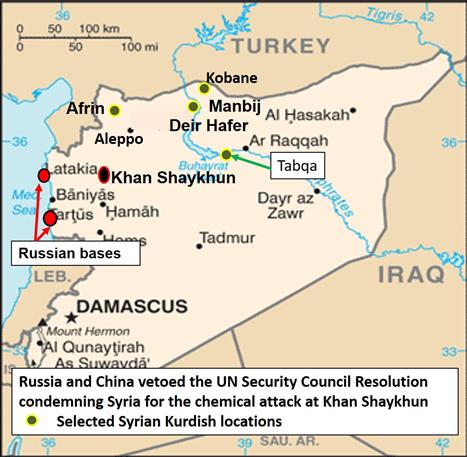
Special comment for new analysts. It always is wise to investigate as many versions of a story as are available. Each adds something to the reconstruction of what happened. The open source coverage of the chemical attack at Khan Shaykhun on 3-4 April is the latest example of the need to reserve judgment until the facts are established by credible evidence.

Open source coverage has established beyond doubt that a chemical attack or incident occurred. The Syrian rebel leaders are consistent in blaming the Syrian air force as having dropped chemical bombs. The government is equally insistent that it has no chemicals to use. Both have motives to lie. Both have used chemicals in the past, but only the rebel version of the latest incident received attention at the UN and in mainstream news coverage.

 
There is another version of what happened worth considering. For example, the London based news website Ra’y al-Yawm published the following version of events.

“Syria: Sources Confirm That the Explosion of a Chemical Manufacturing Workshop Belonging to Armed Factions is Responsible for Killing Scores in Khan Shaykhun in Idlib. Syrian Army Denies Possessing Chemical Weapons, and Russia Denies Conducting Raids in the Area.”

“Military sources in Syria have spoken to our correspondent about accusations against the Syrian and Russian air forces of using chemical materials and toxic gases in an attack that killed or wounded scores of people in Khan Shaykhun in the Idlib countryside.’

“The sources stated that a workshop used for fitting rockets with poisonous gas payloads exploded in Khan Shaykhun, killing or wounding the workshop’s personnel and causing a release of toxic substances that injured nearby civilians.

The news website is anti-American, but also very pro-Palestinians and pan-Arab. It is no friend of the Syrian government.

In terms of Means Opportunity and Motive (MOM), both sides could be responsible. Various rebel opposition groups have posted video images of their chemical weapons labs from time to time. We know some rebel groups use chemicals. The alternative story raises a question as to whether Western intelligence agencies knew or suspected that the rebels had a chemical or other weapons storage facility in Khan Shaykhun. If so, the location would be a target.

As to opportunity, an air attack would provide credible cover for a disastrous accident or for an accurate aerial bombing of a rebel weapons storage location that contained chemicals as well as conventional weapons. The alternative is plausible and similar events have occurred outside conflict situations, such as the Bhopal disaster in India in 1984.

As for motive, the war is going against the rebels. They have an urgent need for outside help to restrain the Syrian government forces and the Russians.

As for opportunity, the fighting in Idlib has not seemed to be going so poorly for the government that it required a chemical attack to cause a breakthrough. There is credible evidence that the Syrian government has used chemical weapons to try to reverse deteriorating tactical situations or to break hard core resistance. We do not have the sense that either condition applied to Khan Shaykhun.

Syria and Russia are less careful about civilian casualties than Western powers have tried to be. The Russians and Syrians tend to consider civilians in rebel held areas to be sympathizers or actual supporters of the rebels. The rebels also are not careful about killing civilians, sending them back to Allah, they say.

The above statements are about general intent to use chemicals, past practice and present means.

As for this attack, the Syrian air force is essentially a subset of the Russians. Both have motives to lie about a chemical attack, but both have no motive to conduct a chemical attack because the fighting is going their way. We judge the Russians would know whether Syrian aircraft dropped bombs with chemical weapons. Their denial is self-serving, but that does not make it a lie.

There is much about the ground battle situation that is not known. We remain agnostic about who was responsible for yet another disaster in Syria.

The point of this essay is that the other explanation confutes the rebel story and cautions against a quick rush to judgment based on only one side of the story. One point of certainty is that both sides have used chemical weapons in the war. One of the practices that analysts are prone to indulge is called “premature closure,’ which means drawing a hard conclusion before all the pertinent evidence has been discovered.

Meanwhile, the war drums are getting louder here in the West, and even Donald Trump seems willing to dance. Lewis Amselem, A.K.A. “DiploMad”, has just written a post called Syria: The Siren Song of War. He asks exactly the right question:

Bottom line: Do we have the ability to “repeal” Assad? Yes. Do we have the ability to “replace” Assad? I doubt it.

Also: Scott Adams “calls bullshit”.

Is Assad A Fool?

The world is in an uproar about the apparent gas attack in Syria. Western nations, and the Western media, have blamed Bashar al-Assad. The Russians say their man Assad didn’t do it; that a conventional bombing strike against a rebel storehouse must have released toxic substances that were to be used in chemical weapons.

I have no doubt that Mr. Assad is a brutal and ruthless man, and I do not ascribe to him any moral compunction that would have stayed his hand. I must say, however, that I have no reason to doubt that he is shrewd and intelligent, and so I cannot imagine that he would not have seen the colossal stupidity of making such an attack — especially right now, when the world, which is so weary of this civil war and the chaos it has caused, had all but abandoned the idea of removing him from power. Was there some tactical gain he achieved — with a gas attack, far from the front lines, that killed a hundred or so people, many of them civilians and children — that could not have been accomplished with conventional ordnance? If so, I can’t see it.

For Assad to have done this thing, then, makes no sense. It certainly makes far less sense than the alternatives: that the Russian account is correct, or that it was a false-flag operation mounted in reaction to the diminishing prospect of a Syrian regime change.

These considerations are, it seems to me, so obvious that I think it is their relative absence from the mainstream discussion of this event that wants explaining. (It’s certainly just the thing if you want to make a case for U.S. action against the regime, and by proxy, against Russia.)

Always ask: cui bono?

Into The Sunset

This from our e-pal Bill Keezer just now:

California Senate OKs statewide illegal immigrant sanctuary bill

Educated readers will recall that United States history already includes some examples of such “nullification”; for fans of peace and order, or of the Union as presently constituted, the precedent is not particularly encouraging. Leaving that aside, however, one effect of this, should it become law, is that it would create a great flood of illegals deciding, like Jed Clampett, that “California’s the place you oughtta be!” The effect on California’s already-overstressed public services, healthcare, education, and prison system should be instructive.

A parting thought, if you will forgive the harshness of the metaphor: the combination of this initiative, and its likely effect, with growing support for “Calexit” puts me in mind of Aesop’s fable about the fox and the fleas.

This, Or A Warm Gun

“The teacher asked once what did we talk about when we talked about happiness. And then one student said that happiness is what happens when you go to bed on the hottest night of the summer, a night so hot you can’t even wear a tee-shirt and you sleep on top of the sheets instead of under them, although try to sleep is probably the most accurate. And then at some point late, late, late at night, say just a bit before dawn, the heat finally breaks and the night turns cool and when you briefly wake up, you notice that you’re almost chilly, and in your groggy, half-consciousness, you reach over and pull the sheet around you and just that flimsy sheet makes it warm enough and you drift back off into a deep sleep. And it’s that reaching, that gesture, that reflex we have to pull what’s warm – whether it’s something or someone – towards us, that feeling we get when we do that, that feeling of being safe in the world and ready for sleep, that’s happiness.’

”• Paul Schmidtberger, Design Flaws of the Human Condition

Time Out

It’s been a busy few days, with little time to write. (Nor, to tell the truth, have I had much I’ve wanted to say.) I spent the weekend playing music with friends, which is a much healthier pastime than brooding on the great sucking vortex that forms the current, crepuscular era of Western culture and politics.

With regard to said vortex, however, here are two recent gleanings: Victor Davis Hanson on the Alt-Left, and the irrepressible Jim Goad (good on substance, if not exactly my kind of style) on this endless Trump-Russia business.

A Profound Crisis Is Inevitable

Evola:

Indeed, no one can ignore the deep crisis of the ”˜rationalising’ of existence attempted by bourgeois culture, given the many examples of the emerging of the irrational or ”˜elemental’ (in the sense of the elemental character of a force of nature) through the fissures of this culture on every level.

Today, with the return of this obsession with ”˜rationalising’, there is a tendency to render service to an ideal that is not political but ”˜social’ and which belongs to physical comfort, and to marginalise and discredit everything that is comprised of existential tension, heroism and the galvanising force of a myth. But it has been correctly pointed out that a profound crisis is inevitable at the point when prosperity and comfort will finally become boring. The early signs of this crisis are already apparent. They consist of all those forms of blind, anarchic and destructive revolts embraced by a youth that, precisely in the most prosperous nations, notice the absurdity and senselessness of an existence that is socialised, rationalised, materialistic, and dominated by the so-called ”˜consumer culture’. In these revolts, this elementary impulse finds no object and, left to itself, becomes barbaric.

– Fascism Viewed From the Right, 1964

Red-Collar Work

As I mentioned a few weeks ago, I’ve been reading The Outline of History, published in 1920 by H. G. Wells. I’m still at it — I tend to have several books going at once, and this two-volume item is about 1,200 pages long.

I’ve just read the brief entry on the conquests of Timurlane (Tamerlane) — who, as I’m sure you know, was very good at conquering, but not so much at anything else.

We read:

[I]n the fifteenth century a last tornado of nomadism arose in Western Turkestan under the leadership of a certain Timur the Lame, or Timurlane. He was descended in the female line from Jengis Khan. He established himself in Samarkand, and spread his authority over Kipchak (Turkestan to South Russia), Siberia, and southward as far as the Indus. He assumed the title of Great Khan in 1369. He was a nomad of the savage school, and he created an empire of desolation from North India to Syria. Pyramids of skulls were his particular architectural fancy; after the storming of Ispahan he made one of 70,000. His ambition was to restore the empire of Jengis Kahn as he conceived it, a project in which he completely failed. He spread destruction far and wide; the Ottoman Turks — it was before the taking of Constantinople and their days of greatness — and Egypt paid him tribute; the Punjab he devastated; and Delhi surrendered to him. After Delhi had surrendered, however, he made a frightful massacre of its inhabitants. At the time of his death (1405) very little remained to witness to his power but a name of horror, ruins and desolated countries, and a shrunken and impoverished domain in Persia.

The dynasty founded by Timur in Persia was extinguished by another Turkoman horde fifty years later.

It’s a dreary story, and I think we should all be glad not to have lived through it. One thing in particular, though, stuck in my mind. In case you missed it:

Pyramids of skulls were his particular architectural fancy; after the storming of Ispahan he made one of 70,000.

My word, I thought to myself, what a thing to have to assemble. I decided to do some calculations.

Let us assume that the pyramid in question is square, and not triangular, and not based on some other polygon. (I can’t confirm this, but it seems likely, as the square pyramid was by far the most popular kind in the ancient world.) If that’s so, then the total skull-count would have to fit in somewhere along the square-pyramid number series, which begins with 1, 5, 14, 30, 55, 91, 140, 204, 285, 385, 506, 650… (This sequence, by the way, is item A000330 in the On-Line Encyclopedia of Integer Sequences.)

The general formula for the nth item is (n (n+1) (2n +1)) / 6.

The 58th entry in this sequence is 66,729, while the 59th is 70,210. (Timurlane himself, by the way, may not have been familiar with this formula. I would hate to have been standing around watching this thing go up if he got close to the end and realized he was a few skulls short.)

We’ll go with the closest approximation, and say that the pyramid Timurlane built in Ispahan used 70,210 skulls, which means it was 59 skulls on a side, and 59 layers high.

How big is that? Well, we’ll need to simplify, I think, by assuming spherical skulls. (I hate to do it, but I don’t have all night here, and at least it isn’t as bad as this. And no Cromwell jokes, please.) The average male human skull has a circumference of 22 inches or so. Dividing by pi, we get a diameter of 7 inches.

So now we need to calculate the height of a square pyramid of stacked 7-inch spheres 59 layers high. The formula for that, where d is the diameter of the spheres, and n is the number of spheres on each side of the square base, is: d + d(n-1)√1/2.

The result? Timurlane’s pyramid of 70,000-odd skulls at Ispahan was 24.5 feet high. The base was 34.4 feet on a side (59 x 7″).

Now comes the tough part: how the hell do you build such a thing? How do you climb up that slippery mess, neatly piling skulls, without knocking the whole thing down? The only way I can imagine would be to have built some sort of superstructure from which people could dangle as they dropped the skulls into place. What an effort!

I have a feeling Timurlane himself didn’t hang from ropes placing skulls; if I know anything about Army work, this would be the sort of thing he’d have delegated. Did he have a skull-pyramid team that traveled with him? I bet he did. It’s pretty specialized work.

For some reason, Mr. Wells is silent on this important historical question, so I decided to look on Google just now. I didn’t find much of anything about how Timurlane did it, but I did find this.

“That’s Why You Have The Leaking.”

Well, there you are, then.

The Caravan Passes

Over at Social Matter, William Fitzgerald has posted this excellent analysis of the Gulenist movement’s role in last year’s coup attempt in Turkey. If you have any interest in this sort of thing you should make sure you read it.

It Ain’t Broke. Here’s How To Fix It.

If you’re like me, you may be feeling “out of step” because you’ve been having trouble adopting the Progressive way of thinking about things. You have to watch everything you say in public, and your maladjusted belief system may have cost you friendships, or even your job!

Have you found that despite all this, no matter how hard you try, you just can’t unsee all of that stubborn “reality” right before your eyes?

Well, folks, help is on the way! Soon you’ll be able to fit right in. It turns out that to think like you should, all you need to do is disable parts of your brain.

Anything Goes

Here we have a perfect example of what the late (and greatly missed) Lawrence Auster called the Unprincipled Exception:

Hijab becomes symbol of resistance, feminism in the age of Trump

The Muslim hijab as a symbol of Western-style feminism? Could anything be more obviously absurd? Clearly, then, absurdity doesn’t matter here: this is nothing more than the grabbing of whatever is closest to hand and using it to bludgeon an opponent. It is like an angry housewife throwing the dishes.

Feminists: both you and Islam have a common enemy, namely the traditional culture of the West. Islam will, of course, gladly help you destroy it.

But do you really imagine that once you have leveled and pulverized Western masculinity and femininity — and by doing so, have brought down the twin pillars of your civilization — you will then make agreeable terms with Islam?

Class and Mobility

Sturdy class structures, although they may diminish individual opportunity, keep superior genes, when they arise, within each class. In doing so, then, they strengthen classes at every level.

High social mobility, by contrast, tends to “boil off” superior individuals, who, when they are given the opportunity to do so, move up and out — taking their genes with them. In this way every class, at every level, loses its best people to a class above it. Because the class system is not bottomless, this means that the lowest classes continuously deteriorate, while more gifted individuals cluster in the higher classes. (This latter tendency is perhaps mitigated, somewhat, by the somewhat lower likelihood of inferior higher-class individuals moving downward in class.) This necessarily increases social inequality, and therefore social tension. It also instantiates the “Peter Principle”, in that individuals will rise until they find their level of social or professional incompetence, then stay there. This leads to the presence at every level of individuals who are not naturally well-fitted members of that class. This has an entropic and disordering effect on organic hierarchies.

On the other hand, too rigid a class structure prevents the ascension of exceptional individuals, and so not only thwarts individual liberty, but also blunts the leading edge of a society’s progress and accomplishment.

So: What is the proper balance? What is it that we should be seeking to optimize?

Cloaks And Daggers. Especially Daggers.

In his latest column, Patrick Buchanan weighs in on the Trump/Russia story.

The propaganda war is ablaze: the MSM would have you believe that the Trump campaign colluded with Russia to interfere with the election — although nobody has ever produced, or even claimed, that there is any evidence of collusion for this purpose (beyond various people having contacts and connections), given any particulars of any conversation (let alone of any quid pro quo), or so much as suggested that the vote was tampered with in any way. Indeed, all that is known to have been compromised, by somebody, are the emails of John Podesta and the DNC — which revealed only the unethical machinations of the Democrats, in collusion with the media, to help ensure the coronation of Hillary Clinton. The New York Times also reported that the Obama administration, in its last days, altered privacy rules and disseminated this classified intelligence to multiple government agencies, including those of foreign countries.

Meanwhile, multiple felonies have plainly been committed in the repeated disclosure to the media of what should have been carefully secured intelligence.

Where is all this going? As a friend of mine used to say: “you tell me, and we’ll both know!” It seems safe to say, though, that there’s much, much more to this story — and that the stakes, on both sides of the aisle, couldn’t be higher. We are headed for a very interesting spring and summer.

We Are Down On Bended Knee

Earlier this month we posted an interview with the Daily Mail reporter Katie Hopkins. In that interview, Ms. Hopkins described for Tucker Carlson what she had found on a recent trip to Sweden.

Here is an opinion piece from Ms. Hopkins on yesterday’s attack in London.

… As Usual

We’ve heard an awful lot about how the election of Donald Trump has emboldened and “enabled” hate-filled right-wingers to express themselves with vandalism and assault. In particular there’s been a rash of swastika-scrawling, and of bomb-threats against Jewish centers.

When these things happen, we on the dissident Right simply wait, knowing that the odds are very good indeed that it’s a false-flag job, and that the perp will turn out to be some member of the group ostensibly (and ostentatiously) victimized. This is because we know a thing or two about the two sides here, and the way they behave. As I said in a post on this topic back in December:

Most conservative, traditionalist sorts are fonder of order than chaos, of tidiness than graffiti, of civility than insult, of police than hooligans, of those who obey the law than those who break it, etc. In short, they are much less likely to deface public buildings with graffiti, and to lie to the police about things that didn’t happen, than the good souls who brought you Ferguson, Baltimore, Occupy Wall Street, the Rolling Stone rape story, the Michael Brown mythos, and so on. Even when they are sufficiently aroused to assemble in protest, they do not break things, or defecate on flags and police cars. They show up, mill around for a while, tidy up after themselves, and go back to their homes and jobs.

The pattern is extremely consistent:

1) Some act of vandalism or assault against an oppressed minority is reported: a swastika, a noose, unwitnessed harrassment or bullying, a bomb threat, etc.;

2) The “mainstream media”, and their avid consumers among blue-empire Goodwhites, are noisily and flamboyantly appalled that such right-wing “hate” still exists in The Current Year;

3) Eventually the perp is exposed, and turns out not to have been any sort of righty at all, but rather a member of the oppressed minority, or some generic lefty seeking to cast opprobrium upon Badwhites;

4) The offense is swept from memory, and the story swiftly interred by the media;

5) Repeat.

Here and here are this week’s examples.

Déjà  Vu

“Periodic sackings are part and parcel of living in a major city.”

Honorius, 410 A.D.

Across The Great Divide

Well, here is something quite remarkable for our time: an actual “conversation about race” in which two people, with completely incommensurable axioms and worldviews, discuss the topic for a full hour without shouting each other down, or resorting to violence. (Astonishingly, there isn’t even any mention of Hitler.) The interlocutors are Jared Taylor, of American Renaissance, and one Amna Nawaz of ABC News — who, if it isn’t too simplistic to describe the landscape this way, neatly represent entirely opposite poles of contemporary Western social thought.

They do not, of course, alter one another’s views on the subject one iota, but they actually do manage to sit across from one another for an hour and just talk. (Right past each other, like a couple of neutrinos.)

Will this help anything? No, because their worldviews are, as I said above, incommensurable. It quickly becomes clear that Mr. Taylor and Ms. Nawaz can’t agree about the most basic values and units and categories by which any human mind frames and organizes and measures the world. There is almost no common ground even regarding truth itself — moral, historical, biological, cultural, political or otherwise. But at least the encounter, however futile, proceeded with a brittle civility, which is far better than usual for this sort of thing.

I won’t score the “debate” — what would be the point? (Well, OK, maybe I’ll just say that I think that Mr. Taylor’s presentation is far more consistent, and far better grounded in history and human nature, than Ms. Nawaz’s, which rests almost entirely on the tenets of the modern West’s dominant universalist religion.) Mainly I offer it as a gloomy example of how little commonality there is between these radically antagonistic visions of reality, and how little chance of any “conversation” making any difference to anything. Keep in mind that this entirely unproductive interview is as good as it gets.

Stick-To-It-Ivity

This is hilarious.

Roll Over, Beethoven

I was saddened yesterday to hear that Chuck Berry had died. (He was 90, and so it was bound to happen soon, but it was a jolt nevertheless.)

He was a majestic, and majestically stationary, feature of my generation’s musical landscape. He was always there, a great peak on its eastern horizon, and the shadow he threw across it at the dawn of rock music never seemed to grow any shorter.

He made his first record a year before I was born, and was already venerable by the time I started listening attentively to this nascent musical form, beginning in the early 60s. Probably my introduction to Chuck Berry’s music was the Beatles’ early covers of Roll Over Beethoven and Rock And Roll Music, but trying to remember exactly when you first heard a Chuck Berry song is, for an American musician of my age, like trying to remember your first cheeseburger.

He was a tremendously influential innovator, but unlike some of the artists he influenced — most notably, the Beatles — having discovered a new and fertile continent, he made himself comfortable at the water’s edge and remained there. But everyone who came later to explore and improve this new world did so by way of the city he founded, and they all picked up the local accent.

Here’s an example of that: Chuck Berry schooling a disciple you may recognize.

I’m sorry he’s gone, and grateful that he lived. Wish I could’ve watched him duckwalking through the Pearly Gates.

Arms Race

We’ve devoted some space lately to the mutated and camouflaged religion (and not just any religion!) that goes by the name of Progressivism. (Once you’ve spotted it, you can’t un-see it; it’s as plain as this owl.)

But why the camo in the first place? Moldbug explains:

The question is: why? How did we fall for this? How did we enable an old, well-known strain of Christianity to mutate and take over our minds, just by discarding a few bits of theological doctrine and describing itself as “secular”? (As La Wik puts it: “Despite occasional confusion, secularity is not synonymous with atheism.” Indeed.)

In other words, we have to look at the adaptive landscape of ultracalvinism. What are the adaptive advantages of crypto-Christianity? Why did those Unitarians, or even “scientific socialists,” who downplayed their Christian roots, outcompete their peers?

Well, I think it’s pretty obvious, really. The combination of electoral democracy and “separation of church and state” is an almost perfect recipe for crypto-Christianity.

As I’ve said before, separation of church and state is a narrow-spectrum antibiotic. What you really need is separation of information and security. If you have a rule that says the state cannot be taken over by a church, a constant danger in any democracy for obvious reasons, the obvious mutation to circumvent this defense is for the church to find some plausible way of denying that it’s a church. Dropping theology is a no-brainer. Game over, you lose, and it serves you right for vaccinating against a nonfunctional surface protein.

A Dangerous Place

The strategic-security situation has been a neglected topic here for a while. Time to catch up a little.

One of the most septic, and possibly most infectious, areas of conflict at the moment is Yemen, the site of a deepening proxy war between Islam’s major players. The nation is completely dysfunctional, with almost no chance of recovery, and it is a stronghold of al-Qaeda — an organization that is anything but “on the run”.

Recently the analyst Thomas Joscelyn testified before the Senate Foreign Relations committee on the situation in Yemen. His report is here. He was also interviewed by John Batchelor, and you can listen to the discussion here.

Who Rules?

The political right is aboil over the latest judicial interference with President Trump’s efforts temporarily to restrict immigration from dangerous and unstable Muslim territories. The question is framed in terms of a heated battle for sovereignty in America, with the sense that the judiciary — which is to say, individual judges, with nothing to check their power, and keep them from going “rogue” — now seems to have the upper hand, in ways that the Framers never would have condoned, or even imagined possible

There is good reason to be concerned — although in this instance the law, especially the history of related case law, is far more complex than you might realize. Writing at Lawfare, Josh Blackman has offered a detailed analysis of these legal arcana, in three parts.

Part I discusses the Immigration and Nationality Act, Part II covers due process, and Part III looks at the Establishment Clause.

The posts are technical, long and detailed — but as we all know, the details are where the Devil is.

Can Progressivism Really Be A Kind Of Religion?

William Vallicella, the Maverick Philosopher, having read my own recent item on William Deresciewicz’s article about Progressivism-as-religion, has just offered a post expressing his disagreement.

Bill writes:

It is true that leftism is like a religion in certain key respects. But if one thing is like another it does not follow that the first is a species of the other. Whales are like fish in certain key respects, but a whale is not a fish but a mammal. Whales live in the ocean, can stay underwater for long periods of time and have strong tails to propel themselves. Just like many fish. But whales are not fish.

I should think that correct taxonomies in the realm of ideas are just as important as correct taxonomies in the realm of flora and fauna.

These are fair points. I think, however, that a historical study of Progressivism reveals a much closer cladistic relation between the modern Left and a certain strain of American Protestantism than exists between whales and fish: it is more, I think, like a lungfish that has learned to live out of water. The question “at what point is such an animal no longer a fish?” is an interesting one, and Bill would likely insist that living in water is essential to being a fish; but I’ll say that if the move is recent enough that the critter still has its scales and fins and gills — and if its mommy was a fish! — then the distinction is much less clear.

Bill continues:

Leftism is an anti-religious political ideology that functions in the lives of its adherents much like religions function in the lives of their adherents. This is the truth to which Prager alludes with his sloppy formulation, “leftism is a religion.” Leftism in theory is opposed to every religion as to an opiate of the masses, to employ the figure of Karl Marx. In practice, however, today’s leftists are rather strangely soft on the representatives of the ‘religion of peace.’ (What’s more, if leftism were a religion, then, given that leftism is opposed to religion, it follows that leftism is opposed to itself, except that it is not.)

Or you could say that leftism is an ersatz religion for leftists. ‘Ersatz’ here functions as an alienans adjective. It functions like ‘decoy’ in ‘decoy duck.’ A decoy duck is not a duck. A substitute for religion is not a religion. Is golf a religion? Animal rescue?

My quibble with this is that it appears, implicitly, to assign all of the taxonomic distinction to the single feature of religion that modern secular Progressivism explicitly rejects: theistic metaphysics. For this reason Bill applies the alienans adjective ‘ersatz’. I would, instead, describe Progressivism as a ‘non-theistic’ religion, or a crypto-religion. In this sense the adjective functions more in the way ‘electric’ does in ‘electric guitar’. The electric guitar is a cladistic descendant of the original ‘acoustic’ form of the instrument, and has so many features in common with it that it seems wrong not to think of it as a kind of guitar, despite its not having a hollow body shaped and braced to amplify and project its sound.

As for Leftism being ‘anti-religious’, it is of course overtly so, but with a peculiar fervor that is, I think, strongly reminiscent of the bitter sectarian enmities we see among conventional religions. If you see the secular Left as being itself a masked religion, then one begins to see it as anti-‘religious’ in the same way that Protestants are anti-Catholic, Sunnis are anti-Shi’ite, etc.

We might say that there is in the human cognitive apparatus a religious module that can handle a variety of inputs, but which produces similar output, and that there is a universal tendency for it to want to latch onto something.

Bill writes:

Now let’s consider the criteria that Deresiewicz adduces in support of his thesis that the elite liberal schools are religious. There seem to be two: these institutions (i) promulgate dogmas (ii) opposition to which is heresy. It is true that in religions there are dogmas and heresies. But communism was big on the promulgation of dogmas and the hounding of opponents as heretics.

Communism, however, is not a religion. At most, it is like a religion and functions like a religion in the lives of its adherents. As I said above, if X is like Y, it does not follow that X is a species of Y. If colleges and universities today are leftist seminaries — places where the seeds of leftism are sown into skulls full of fertile mush — it doesn’t follow that these colleges and universities are religious seminaries. After all, the collegiate mush-heads are not being taught religion but anti-religion.

On the view I’m offering above, Communism simply hijacked the religion module with some novel input. And while Bill is right that “if X is like Y, it does not follow that X is a species of Y”, it also does not follow that if X is like Y, X is not a species of Y. It may or may not be.

Bill mentions environmental extremism:

Pace Deresiewicz, there is nothing religious or “sacred” about extreme environmentalism.

No? I took up this point two years ago:

The mythos, from Genesis to Redemption, has been transplanted almost entirely without alteration:

In the beginning, there was only God.

From God arose Man.

Before his Fall, Man lived simply, and in perfect harmony with God. It was a Paradise on Earth.

Then a disaster happened. Man acquired a new kind of Knowledge: knowledge that he did not need, but that conferred upon him enormous temptation. In his unwisdom, and against God’s wishes, Man succumbed. His new Knowledge gave him great power, but at a terrible cost: he had turned his back on God, and his Paradise was lost. In his exile, he would wield his ill-gained power in prideful suffering and woe.

But then came a Messenger, offering the possibility of Redemption: if Man were to renounce his awful Knowledge, and learn once again to surrender himself to the love of God, he would be forgiven, and could find his way back to Paradise. It would not be easy ”” it would require that he make terrible sacrifices, atone for his many sins, and give up his worldly comforts and much that he had come to love ”” but if his faith was strong, his Salvation could become a reality, and he could once again live in Paradise, in sweet communion with God.

In order to move from the old religion to the new one, we need only substitute “Nature’ for “God’ in the passages above. That the two conceptions are almost perfectly isomorphic, and that both are manifestations of the same underlying impulse, should be plainly evident. But perhaps one must be a heretic oneself to notice it.

Very shortly afterward, I had further confirmation from a top-tier environmentalist, Rajendra Pachauri, the director of the U.N.’s Intergovernmental Panel on Climate Change, who said the following thing:

[T]he protection of planet earth, the survival of all species and sustainability of our ecosystems is more than a mission. It is my religion and my dharma.

Pace Bill, that seems pretty religious to me.

But the objections raised are good ones. If I want to say that X is a species of Y, then I should have some good reasons for doing so. Here are some that I had just offered in a response to our commenter Jacques, just before I saw Bill’s post:

In characterizing Progressivism as a religion I have in mind several things, for example:

1) The sacralization of various objects and concepts, such that an insufficiently worshipful attitude toward them is considered blasphemous;

2) The soteriological aspect of Progressivism, which aims always at some unattainable Utopia that is forever just out of reach;

3) The characterizing of dissenters as not just intellectual opponents, but as sinners and heretics embodying actual evil;

4) The important role of faith;

5) The suppression of factual inquiry in areas where articles of faith may be threatened;

6) The extent to which political and cultural norms and aims are expressed in terms of sin and atonement;

7) The historical (and behavioral) continuity of modern Progressivism with early American Protestantism, in a traceable sequence that retains the Puritan “mission into the wilderness’ while gradually becoming more and more secularized and worldly.

I would agree that the religious impulse is well-nigh universal, and in that sense a great many outwardly secular worldviews might be seen as religious. I think, however, that Progressivism needs “outing’ as such, especially given how many of the features of religion it instantiates, and how often it manifests outspoken hostility to traditional religions. (If nothing else, once you see it clearly as a crypto-religion the whole thing makes a lot more sense, and I like to help make sense of things.)

Finally, Bill lists some individual qualities that he considers essential to religion. They are:

1. The belief that there is what William James calls an “unseen order.” (Varieties of Religious Experience, p. 53) This is a realm of absolute reality that lies beyond the perception of the five outer senses and their instrumental extensions. It is also inaccessible to inner sense or introspection. It is also not a realm of mere abstracta or thought-contents. So it lies beyond the discursive intellect. It is a spiritual reality. It is accessible from our side via mystical and religious experience. An initiative from its side is not to be ruled out in the form of revelation.

I’m not sure that Progressivism fails to meet this criterion. In particular I think that the Progressive belief in a kind of supernatural moral telos is plainly evident in phrases like “the right side of history” and “the arc of the moral universe bends toward Justice”.

2. The belief that there is a supreme good for humans and that “our supreme good lies in harmoniously adjusting ourselves” to the “unseen order.” (Varieties, p. 53)

See above. See also where failing to “adjust” will get you on a college campus these days. (Or ask Charles Murray.) If adjusting to the unseen order is the supreme good, then willfully refusing to do so is to choose evil. This is clearly consistent with the way heretics like Murray are treated.

3. The conviction that we are morally deficient, and that this deficiency impedes our adjustment to the unseen order. Man is in some some sense fallen from the moral height at which he would have ready access to the unseen order. His moral corruption, however it came about, has noetic consequences.

Is this not plainly evident, for example, in the ethnomasochistic self-abasement of liberal whites for their own racism? Is this charge of moral deficiency not made on every page of Howard Zinn’s Progressive Bible, A People’s History of the United States? Is it not at the core of radical environmentalism, as noted above?

4. The conviction that our moral deficiency cannot be made sufficiently good by our own efforts to afford us ready access to the unseen order.

This is exactly, for example, what whites are now told about their racism: that no matter how hard they try, they will always be racist, in ways they can never see or fully understand, simply because they are white.

5. The conviction that adjustment to the unseen order requires moral purification/transformation.

Such as this. Or this.

6. The conviction that help from the side of the unseen order is available to bring about this purification and adjustment.

Well, God is off-limits. But we can get pretty close.

7. The conviction that the sensible order is not plenary in point of reality or value, that it is ontologically and axiologically derivative. It is a manifestation or emanation or creation of the unseen order.

I don’t think you could speak seriously about “the arc of the moral universe” without believing something like that.

In sum: the only salient difference, as far as I can see, between 21st-century Progressivism and conventional definitions of ‘religion’ is the absence of an explicit and supernatural concept of God — a concept that, if we look back at the centuries-long evolution and mutation of New England Protestantism in America, was gradually leached out (and, I would say, did not die, but went underground), leaving the sense of a sacred and urgent “mission” completely intact.

While we may dispute what does and doesn’t constitute a correctly defined “religion”, Progressivism is, in effect, a religion to the people who espouse it: it activates all the same behaviors, dispositions, and cognitive postures. What we might call the “religious stance” is, I believe, the most accurate way for the rest of us to confront it.

I doubt I will change Bill’s mind here (never an easy thing to do!), but I hope I’ve at least shown that there’s room for reasonable disagreement.

Comments are welcome.

The Weaker Sex

Just ran across this: a study of hand-grip strength showed that 95% of males are stronger than 90% of females.

The abstract:

Hand-grip strength has been identified as one limiting factor for manual lifting and carrying loads. To obtain epidemiologically relevant hand-grip strength data for pre-employment screening, we determined maximal isometric hand-grip strength in 1,654 healthy men and 533 healthy women aged 20”“25 years. Moreover, to assess the potential margins for improvement in hand-grip strength of women by training, we studied 60 highly trained elite female athletes from sports known to require high hand-grip forces (judo, handball). Maximal isometric hand-grip force was recorded over 15 s using a handheld hand-grip ergometer. Biometric parameters included lean body mass (LBM) and hand dimensions. Mean maximal hand-grip strength showed the expected clear difference between men (541 N) and women (329 N). Less expected was the gender related distribution of hand-grip strength: 90% of females produced less force than 95% of males. Though female athletes were significantly stronger (444 N) than their untrained female counterparts, this value corresponded to only the 25th percentile of the male subjects. Hand-grip strength was linearly correlated with LBM. Furthermore, both relative hand-grip strength parameters (Fmax/body weight and Fmax/LBM) did not show any correlation to hand dimensions. The present findings show that the differences in hand-grip strength of men and women are larger than previously reported. An appreciable difference still remains when using lean body mass as reference. The results of female national elite athletes even indicate that the strength level attainable by extremely high training will rarely surpass the 50th percentile of untrained or not specifically trained men.

I post this Á  propos of nothing in particular, other than as a general reminder that there are indeed natural categories in the world — and that they are not, post-modernist hallucinations notwithstanding, infinitely interchangeable. I’m sure some readers will find it intensely irritating.

Magna Est Veritas

The insight that modern Progressivism is best understood as a religion (especially in the concentrated form it takes in the college campuses from which it emanates to the broader society) seems suddenly to be en vogue. (We reactionary types have been hammering this point for years, so it’s nice to see the truth prevail a bit.)

Here’s Andrew Sullivan, who also correctly notes the similarity of today’s Puritans to the original ones. (This is no coincidence; the apple does not fall far from the tree.) And here’s Frank Bruni in the Times.

That a lefty like Mr. Bruni should lament the current phase in the natural evolution of an entropic and descending ideology is further evidence of the “delamination” of the left that I mentioned in the previous post. He will also get no sympathy from us: this, Mr. Bruni, is the future you chose.

There Is A Tide

In order correctly to understand the modern Left, it’s important to recognize it as a secularized religion. Tracing the development of this religion, from its origins in Protestantism, then Puritanism, then through its many transmutations in America — from sixteenth-century Massachusetts, through its northern and western Protestant expansion, through the “Awakenings” of the seventeenth and eighteenth century, through the secularizing influence of Universalism and Unitarianism, through the sequential attachments of its “mission into the wilderness” to various sacred causes such as abolition, Prohibition, women’s suffrage, global government, desegregation, feminism, environmentalism, Blank-Slate biological universalism, open borders, LBGT-etc. activism, and global warming, to name some salient examples — has been a major project of the dissident and reactionary Right over the past couple of decades. I’ve written about it often.

The leftmost edge of the Left has accelerated sharply leftward in recent years. This has exerted tidal stresses on what was never a monolithic cultural bloc to begin with, and the laminae are starting to pull apart — with the result that many old-fashioned and relatively moderate liberals are beginning to see for themselves the unmistakable features of a fundamentalist and authoritarian religion beneath the contours of what they had previously imagined to be nothing more than a compassionate and humanistic political attitude. Given that many of these sorts pride themselves on their atheism, to see that they have been associated with a religion is immediately to declare apostasy.

Such a man is the essayist William Deresciewicz, who describes himself as “an atheist, a democratic socialist, a native northeasterner, a person who believes that colleges should not have sports teams in the first place — and … a card-carrying member of the liberal elite.” He is, however, appalled to detect a religion taking control of our academic institutions, and has written a good essay at The American Scholar to say so. You should read the whole thing, but I will offer a few excerpts.

Here’s the point, simply stated:

Selective private colleges have become religious schools. The religion in question is not Methodism or Catholicism but an extreme version of the belief system of the liberal elite: the liberal professional, managerial, and creative classes, which provide a large majority of students enrolled at such places and an even larger majority of faculty and administrators who work at them. To attend those institutions is to be socialized, and not infrequently, indoctrinated into that religion.

Some of us would say that he could be more specific — that in fact we are looking at a warped and camouflaged form of Calvinism here — but to see that this is very clearly and unmistakably a religion at all is the most important insight, and Mr. Deresciewicz has made it.

He continues (my emphasis):

What does it mean to say that these institutions are religious schools? First, that they possess a dogma, unwritten but understood by all: a set of “correct’ opinions and beliefs, or at best, a narrow range within which disagreement is permitted. There is a right way to think and a right way to talk, and also a right set of things to think and talk about. Secularism is taken for granted. Environmentalism is a sacred cause. Issues of identity — principally the holy trinity of race, gender, and sexuality — occupy the center of concern. The presiding presence is Michel Foucault, with his theories of power, discourse, and the social construction of the self, who plays the same role on the left as Marx once did. The fundamental questions that a college education ought to raise — questions of individual and collective virtue, of what it means to be a good person and a good community — are understood to have been settled. The assumption, on elite college campuses, is that we are already in full possession of the moral truth. This is a religious attitude. It is certainly not a scholarly or intellectual attitude.

Precisely correct. And where there is religion, there is heresy:

Which brings us to another thing that comes with dogma: heresy. Heresy means those beliefs that undermine the orthodox consensus, so it must be eradicated: by education, by reeducation — if necessary, by censorship.

… “The religion of humanity,” as David Bromwich recently wrote, “may turn out to be as dangerous as all the other religions.”

Mr. Deresciewicz also notes the tip, at least, of the anti-white iceberg:

It has long struck me in leftist or PC rhetoric how often “white” is conflated with “wealthy,” as if all white people were wealthy and all wealthy people were white. In fact, more than 40 percent of poor Americans are white. Roughly 60 percent of working-class Americans are white. Almost two-thirds of white Americans are poor or working-class. Altogether, lower-income whites make up about 40 percent of the country, yet they are almost entirely absent on elite college campuses, where they amount, at most, to a few percent and constitute, by a wide margin, the single most underrepresented group.

He also looks at the relative powerlessness of university faculties:

In the inevitable power struggle between students and teachers, the former have gained the whip hand. The large majority of instructors today are adjuncts working term to term for a few thousand dollars a course, or contract employees with no long-term job security, or untenured professors whose careers can still be derailed. With the expansion of Title IX in 2011 — the law is now being used, among other things, to police classroom content — even tenured faculty are sitting with a sword above their heads. Thanks not only to the shift to contingent employment but also to the chronic oversupply of PhDs (the academic reserve army, to adapt a phrase from Marx), academic labor is cheap and academic workers are vulnerable and frightened. In a conflict between a student and a faculty member, almost nothing is at stake for the student beyond the possibility of receiving a low grade (which, in the current environment, means something like a B+). But the teacher could be fired. That is why so many faculty members, like that adjunct instructor at Scripps, are teaching with their tails between their legs. They, too, are being silenced. Whether they know it or not, student activists (and students in general) are exploiting the insecurity of an increasingly immiserated workforce. So much for social justice.

The author’s apostasy from this cryptoreligion is incomplete: while its promise of Heaven may be false, he still fears its Hell. For example, there’s this:

Students have as much merit, in general, as their parents can purchase (which, for example, is the reason SAT scores correlate closely with family income).

The” reason? That there is a far more obvious one, grounded in simple and evident facts of human difference and heredity, makes this a museum-quality sample of cult-Marx Blank-Slatism. But I quibble: that a self-described “card-carrying member of the liberal elite” should write an essay like this at all is impressive, and heartening.

It is, also, just maybe, encouraging as well. Here’s why:

I (and others) have argued that because of the radical skepsis at the heart of the modern Left — the legacy of the Enlightenment, in which nothing is exempt from the most withering and critical scrutiny — that there is no limiting principle, no bedrock, upon which this implacably descending ideological movement can ultimately come to rest.

(Two years ago I likened this to the collapse of massive stars. We might also borrow a different astronomical metaphor: it’s as if the Left, as it approaches its own singularity, is now crossing its Roche limit, where tidal forces begin to tear it to pieces.)

If, as the process accelerates, the Left continues to delaminate and disintegrate, perhaps only a smaller and smaller core will tumble into the abyss — as others, such as Mr. Deresciewicz, find bedrock, at last, below which they cannot descend.

The Principle Of Least Action

“The ordinary man prefers easy ways so long as they may be followed, and is almost willfully heedless whether they end at last in a cul-de-sac.”

— H.G. Wells, The Outline of History, p. 359

The Much-Needed Gap

Here‘s Christina Hoff Sommers on the widespread and persistent myth of the sexist “wage gap”.

Spooks, Rebukes, And Kooks

There is a fascinating spin war taking place over possible government surveillance of the Trump campaign. According to multiple sources, including the New York Times, there were wiretaps, and there were also at least two applications for surveillance to the secretive Foreign Intelligence Surveillance Act courts — one in June that was refused, and one in October that was granted. There have been multiple leaks and references to intercepted communications. General Mike Flynn has already been defenestrated as a result, and Jeff Sessions is under pressure. (Needless to say, to leak such material is a felony.)

Last week Mark Levin made all of this the subject of his evening radio show, and the next day Donald Trump complained about it in a tweet. For Mr. Levin’s trouble, he’s been lambasted as a deranged right-wing conspiracy theorist, and former National Security Director James Clapper went so far as to say on Sunday that the FISA-authorized surveillance didn’t even happen.

All that Mr. Levin did, however, was to comment on widespread reporting from the Times and other (ostensibly) reliable sources. It certainly seems as if the surveillance story was a popular one when it looked bad for Mr. Trump and his people, but is being backpedaled hard now that it the opposition is using it to cast an unfavorable light on the Obama administration (that is, for using the power of government to snoop on the opposing party’s candidate during a presidential election. Which would be bad).

(Speaking of the Obama administration, they did two remarkable things in their last days: one, Loretta Lynch signed an order greatly expanding the circle of agencies that can receive this sort of (very secret) intelligence without violating privacy laws, and two, the administration “scrambled” to spread the information as far and wide as they could.)

The story is murky and complex, and still very much in motion. I have no idea what the truth is. I do, however, have an excellent article for you that explains some of the legal arcana. A longish excerpt:

Here are the problematic aspects of the Obama surveillance on Trump’s team, and on Trump himself. First, it is not apparent FISA could ever be invoked. Second, it is possible Obama’s team may have perjured themselves before the FISA court by withholding material information essential to the FISA court’s willingness to permit the government surveillance. Third, it could be that Obama’s team illegally disseminated and disclosed FISA information in direct violation of the statute precisely prohibiting such dissemination and disclosure. FISA prohibits, under criminal penalty, Obama’s team from doing any of the three.

At the outset, the NSA should have never been involved in a domestic US election. Investigating the election, or any hacking of the DNC or the phishing of Podesta’s emails, would not be a FISA matter. It does not fit the definition of war sabotage or a “grave’ “hostile’ war-like attack on the United States, as constrictively covered by FISA. It is your run-of-the-mill hacking case covered by existing United States laws that require use of the regular departments of the FBI, Department of Justice, and Constitutionally Senate-appointed federal district court judges, and their appointed magistrates, not secretive, deferential FISA courts.

Out of 35,000+ requests for surveillance, the FISA court has only ever rejected a whopping 12. Apparently, according to published reports, you can add one more to that ”” even the FISA court first rejected Obama’s request to spy on Trump’s team under the guise of an investigation into foreign agents of a pending war attack, intelligence agents apparently returned to the court, where, it is my assumption, that they did not disclose or divulge all material facts to the court when seeking the surveillance the second time around, some of which they would later wrongfully disseminate and distribute to the public. By itself, misuse of FISA procedures to obtain surveillance is itself, a crime.

This raises the second problem: Obama’s team submission of an affidavit to to the FISA court. An application for a warrant of any kind requires an affidavit, and that affidavit may not omit material factors. A fact is “material’ if it could have the possible impact of impacting the judicial officer deciding whether to authorize the warrant. Such affidavits are the most carefully drawn up, reviewed, and approved affidavits of law enforcement in our system precisely because they must be fully-disclosing, forthcoming, and include any information a judge must know to decide whether to allow our government to spy on its own. My assumption would be that intelligence officials were trying to investigate hacking of DNC which is not even a FISA covered crime, so therefore serious questions arise about what Obama administration attorneys said to the FISA court to even consider the application. If the claim was “financial ties’ to Russia, then Obama knew he had no basis to use FISA at all.

Since Trump was the obvious target, the alleged failure to disclose his name in the second application could be a serious and severe violation of the obligation to disclose all material facts. Lastly, given the later behavior, it is evident any promise in the affidavit to protect the surveilled information from ever being sourced or disseminated was a false promise, intended to induce the illicit surveillance. This is criminalized both by federal perjury statutes, conspiracy statutes, and the FISA criminal laws themselves.

That raises the third problem: it seems the FISA-compelled protocols for precluding the dissemination of the information were violated, and that Obama’s team issued orders to achieve precisely what the law forbids, if published reports are true about the administration sharing the surveilled information far-and-wide to promote unlawful leaks to the press. This, too, would be its own crime, as it brings back the ghost of Hillary’s emails ”” by definition, FISA information is strictly confidential or it’s information that never should have been gathered. FISA strictly segregates its surveilled information into two categories: highly confidential information of the most serious of crimes involving foreign acts of war; or, if not that, then information that should never have been gathered, should be immediately deleted, and never sourced nor disseminated. It cannot be both.

Recognizing this information did not fit FISA meant having to delete it and destroy it. According to published reports, Obama’s team did the opposite: order it preserved, ordered the NSA to search it, keep it, and share it; and then Obama’s Attorney General issued an order to allow broader sharing of information and, according to the New York Times, Obama aides acted to label the Trump information at a lower level of classification for massive-level sharing of the information. The problem for Obama is simple ”” if it could fit a lower level of classification, then it had to be deleted and destroyed, not disseminated and distributed, under crystal clear FISA law. Obama’s team’s admission it could be classified lower, yet taking actions to insure its broadest distribution, could even put Obama smack-middle of the biggest unlawful surveillance and political-opponent-smear campaign since Nixon. Except even Nixon didn’t use the FBI and NSA for his dirty tricks.

Watergate would have never happened if Nixon felt like he could just ask the FBI or NSA to tape the calls.

Please go and read the whole thing, here.

Omelet, Eggs

Roger Scruton, speaking of the evolutionary origins of human morality:

“Morality is like a field of flowers beneath which the corpses are piled in a thousand layers.”

Trouble In Paradise

Here is an interview of Daily Mail reporter Katie Hopkins by Tucker Carlson. Ms. Hopkins describes her recent trip to Sweden.

By the way, speaking of Sweden and Tucker Carlson, here’s John Derbyshire’s understanding of Donald Trump’s recent “last night in Sweden” remark that set off such a commotion:

It happened that Tucker Carlson over at Fox News, which the President is known to watch, had done a segment the evening before about crime among Muslim immigrants in Sweden. Plainly the President meant to say: “You look at what’s happening in Sweden, as I saw last night.” That sentence is syntactically more complex, though, so his mind fed his tongue something simpler.

It can happen to anybody. I’ve had embarrassing experiences, and so have you.

This sounds entirely plausible, I think. The “last night” part of the remark never really made sense to me.

Posterity

Okay, enough doom and gloom.

Here’s a picture of my grandson Liam, who is, if I am not mistaken, the cutest child that ever lived.

 
Ladies?

Murray On Middlebury

Following on our earlier post — and with thanks to our commenter Jason for the link — here are Charles Murray’s own remarks on having been assaulted by a violent leftist mob at Middlebury College last week. We read (the item refers to Professor Allison Stanger, who had invited Mr. Murray for an interview, and Bill Burger, the college’s Vice President for Communications):

I had expected that they would shout expletives at us but no more. So I was nonplussed when I realized that a big man with a sign was standing right in front of us and wasn’t going to let us pass. I instinctively thought, we’ll go around him. But that wasn’t possible. We’d just get blocked by the others who were joining him. So we walked straight into him, one of our security guys pushed him aside, and that’s the way it went from then on: Allison and Bill each holding one of my elbows, the three of us plowing ahead, the security guys clearing our way, and lots of pushing and shoving from all sides.

I didn’t see it happen, but someone grabbed Allison’s hair just as someone else shoved her from another direction, damaging muscles, tendons, and fascia in her neck. I was stumbling because of the shoving. If it hadn’t been for Allison and Bill keeping hold of me and the security guards pulling people off me, I would have been pushed to the ground. That much is sure. What would have happened after that I don’t know, but I do recall thinking that being on the ground was a really bad idea, and I should try really hard to avoid that. Unlike Allison, I wasn’t actually hurt at all.

The three of us got to the car, with the security guards keeping protesters away while we closed and locked the doors. Then we found that the evening wasn’t over. So many protesters surrounded the car, banging on the sides and the windows and rocking the car, climbing onto the hood, that Bill had to inch forward lest he run over them. At the time, I wouldn’t have objected. Bill must have a longer time horizon than I do.

Again: Who? Whom? This is the real thing here, folks: a mob unafraid to do violence against its ideological enemies. If the New York Times and Hollywood celebrities are the good cop, this is the bad cop.

This is nothing new in America; it is nothing new in the world. But it is here, and it is here now — and if you are morally, politically, or religiously sympathetic to the ancient civic and cultural traditions of Western civilization, or to the historical American nation (or, indeed, to any of the human universals and natural categories that have given essential structure to every society that has ever flourished anywhere on Earth), then you, and all that you cherish, are what that mob seeks to destroy.

How long before someone is killed at one of these riots? How long before the motionless and tormented eagle reveals its “formidable beak and claws”?

R.O.E.

We offer a hat-tip to Nick Land for exhuming this two-year-old passage from John Glanton at Social Matter:

You have to admire the Left for its clarity of vision. It has identified its enemies, and it does what it can to drive them from the field. The recent fireworks in Indiana are a perfect illustration. Team blue knows that Christians are hateful homophobes, and so it goes to bat for the right of homosexuals to sue them over wedding cakes. The Right, with its characteristic acumen, mistakes this bushwhack for a principled stand. “Ah!’ they say, “But if you support the right of a gay man to force a Christian to make a cake then you must support the right of the KKK to force a black baker to make a cake!’ The average liberal couldn’t imagine a more irrelevant rejoinder. They aren’t making any such proposition at all. In their calculus, Christians (of the Not-fans-of-Pope-Francis type at least) are the bad guys and thus their interests are hateful and invalid and must be opposed. The KKK are bad guys and thus their actions are hateful and invalid and must be opposed. You attack bad guys. You don’t attack good guys. Whence the confusion?

The fact that they have such a clearly defined enemy is, incidentally, why the Left can mobilize effectively despite being a creaky, Frankenstein mass of mostly incompatible interest groups. Mexicans will ethnically cleanse blacks when their territories run afoul of one another, but they both vote for the same party. Homosexuals don’t always enjoy the gentlest of treatment from their Muslim friends, but they nevertheless routinely support Democratic politicians who promise more immigrants and “refugee resettlements’ from all the vibrant corners of Africa and the Middle East. The Democrat coalition is organized not around a coherent vision of the future but a shared opponent.

See also the late Lawrence Auster on the Unprincipled Exception.

The Big Bad Bear

John Derbyshire’s been asking: why is Russia our enemy?

I’ve wondered too:

A more enlightened worldview would see Russia ”” a great Christian nation, and one that has made priceless contributions to the treasure-store of Western civilization ”” as a natural ally in these perilous times. We have much in common, including ancient, existential enemies who gloat to see us fighting with with each other rather than uniting against them. Yet our stance toward Russia has been relentlessly bellicose, with our support of the Ukrainian revolution, and our actions in Syria, being only the most obvious examples.

Lewis Amselem, a.k.a “Diplomad”, seems as puzzled as we are.

No Hate Here!

 
We’ve been hearing a lot about how the election of Donald Trump has brought a lot of haters out into the open. As Mr. Trump himself might say: so true. Here’s a thing that happened two days ago:

MIDDLEBURY ”” Middlebury College Professor Allison Stanger was injured by protesters Thursday evening as she was escorting a controversial speaker from campus. She was treated at Porter Hospital and released.

Charles Murray, a political scientist who has been criticized for his views on race and intelligence, was invited to speak on campus by a student group. He was greeted late Thursday afternoon outside McCullough Student Center by hundreds of protesters, and inside Wilson Hall, students turned their backs to him when he got up to speak.

College officials led Murray to another location and a closed circuit broadcast showed him being interviewed by Stanger, the Russell J. Leng ’60 Professor of International Politics and Economics.

As Stanger, Murray and a college administrator left McCullough Student Center last evening following the event, they were “physically and violently confronted by a group of protestors,’ according to Bill Burger, the college’s vice president for communications and marketing.

Burger said college public safety officers managed to get Stanger and Murray into the administrator’s car.

“The protestors then violently set upon the car, rocking it, pounding on it, jumping on and try to prevent it from leaving campus,’ he said. “At one point a large traffic sign was thrown in front of the car. Public Safety officers were able, finally, to clear the way to allow the vehicle to leave campus.

“During this confrontation outside McCullough, one of the demonstrators pulled Prof. Stanger’s hair and twisted her neck,’ Burger continued. “She was attended to at Porter Hospital later and (on Friday) is wearing a neck brace.’

The reactionary case is getting easier and easier to make: nowadays the left jumps you, pries your jaws apart, and forces the red pill down your throat. (If you take an “accelerationist” view of how the left might be undone, you’re getting your wish.)

Also from the article:

Murray, who apparently was unhurt in the incident, is best known for his 1994 book, “The Bell Curve,’ for which he was criticized for an assertion that people of different races have different economic outcomes because of their inherent difference in intelligence.

Imagine that: framing an economic hypothesis based on something that is almost certainly true, is well supported both by basic evolutionary theory and objective data, and is, if nothing else, entirely plausible, uncontradicted by any obvious facts, and eminently worthy of reasoned debate. (Kill him!)

The item ends with the usual appeal to the hate-branding racketeers at the SPLC, who have somehow become as ubiquitous an “authority” in this context as “four out of five dentists” were in the toothpaste commercials of my youth:

The Southern Poverty Law Center has called Murray a “white nationalist’ who has used “racist pseudoscience.’

Charles Murray is a mild-mannered fellow, of exceptional intelligence and perspicacity, who has done nothing more than to look closely at society, data, and human nature in an attempt to answer some vexing and persistent questions. He is, quite literally, a gentleman and a scholar, and is no more of a “hater” than Bruce Wayne’s Aunt Harriet.

If you’re wondering where the hate really is, here’s a tip: look at who is assaulting whom.

Thanks In Advance

I’m sure you all have it marked on your calendars, but my birthday’s coming up in April. (I’ll be 61!)

If you still don’t know what to get me, have a look here.

The Torments Of The Damned

In a heartwarming opinion piece today at the New York Times, Thomas Edsall laments the internet’s toxic effect on what it calls “democracy” — a term that, if I understand the piece correctly, is to be defined as a political system in which two political parties, and a few other “dominant organizations” (here, the Times clears its throat and points to itself), control all access to communication and political power.

Let’s have a look at the thing, from top to bottom. It begins by complaining that, in this frightening new era,

As the forces of reaction outpace movements predicated on the ideal of progress…

We’ve certainly been doing what we can — and now even the Times admits we’re winning. Let’s savor the moment, comrades.

… and as traditional norms of political competition are tossed aside…

Or, to put it another way, “as daylight finally shines on the corruption of Party machinery…”

… it’s clear that the internet and social media have succeeded in doing what many feared and some hoped they would.

Or, perhaps, what some feared and many hoped….

They have disrupted and destroyed institutional constraints on what can be said, where and when it can be said, and who can say it.

Fantastic. The mask is off. All we see here is the will to power.

Let us pause for a moment, to imagine that you, dear reader, have something to say. If so, would you like to be able to say it? Would you like to say it in print, in public, or online? Would you like to be able to say it now? Would you like to be able say it yourself?

Should these choices be yours? Not according to Thomas Edsall. They should be subject to the approval of “institutions” — such as the editorial board of the New York Times.

According to Matthew Hindman, a professor of media (who must, I suppose, be worried that the Devil will take him):

“… someone looking at the United States would have to be worried about democratic failure or transitioning to a hybrid regime.”

Such a regime, in his view, would keep the trappings of democracy, including seemingly free elections, while leaders would control the election process, the media, and the scope of free debate.

One of the chief absurdities of popular government in general is the notion that somehow, a nebulous “will of the people” emerges and takes form and flesh. It never does any such thing, because it can do no such thing. What happens, rather, is that the struggle for power becomes a competition among what Sir Henry Sumner Maine called “the Wire-pullers” (take a moment here to read this, from Sir Henry himself).

Consider the Democratic Party’s electoral process last year. Look at how enormously unpopular Hillary Clinton was, even among Democrats. Why was she the candidate? For one reason only: because she had been anointed by her party’s wire-pullers, who not only declined to offer any serious alternative, but also engaged in strenuous and often unethical machinations to make sure that her principal opponent was hammered down. Moreover, the only reason anyone got to hear about any of that was because the internet made it possible .

So: if “leaders” control the election process, that’s bad, but if the Debbie Wasserman Schultz, the New York Times, and Thomas Edsall do so, that’s good.

(Furthermore, how is fully open debate, unfettered by “institutional constraints”, less free, rather than more so?)

Next we hear from Nathaniel Persily, a law professor at Stanford, who, speaking of the Trump movement, makes the same lament:

… this sort of campaign is only successful in a context in which certain established institutions — particularly the mainstream media and political party organizations — have lost their power around much of the world.”

Have lost their what? Ah yes. Power. Sorry, old chap.

They are right to be worried. Here is Samuel Issacharoff (who is, to ensure diversity of opinion, another law professor, this time from NYU):

We are witnessing a period of deep challenge to the core claims of democracy to be the superior form of political organization of civilized peoples…

Indeed we are, and for very good reasons that were very well understood, right up to (and, it is important to note, during) this nation’s founding. Democracy had, throughout all of recorded history, a very bad track record indeed, for very good reasons. It requires some very particular conditions to work at all, and they are all conditions that the West has systematically destroyed.

The current moment of democratic uncertainty draws from four central institutional challenges, each one a compromise of how democracy was consolidated over the past few centuries. First, the accelerated decline of political parties and other institutional forms of engagement; second, the weakness of the legislative branches; third, the loss of a sense of social cohesion; and fourth, the decline in democratic state competence.

“Loss of a sense of social cohesion”, you say? I wonder how that could have happened. And a “decline in democratic state competence”, even as the West, relentlessly expanding its franchise while flinging open its borders, became more and more democratic? An impenetrable mystery.

Professor Issacharoff continues:

“Technology has overtaken one of the basic functions you needed political parties for in the past, communication with voters,’ he said. “Social media has changed all of that, candidates now have direct access through email, blogs and Twitter,’ along with Facebook, Instagram, Snapchat and other platforms.

Imagine that! Candidates having direct access to the people. It’s so awfully… democratic.

A little further on, Mr. Edsall asks: who benefits more from all of this, the left or the right? That leads us to this gem:

There is good reason to think that the disruptive forces at work in the United States ”” as they expand the universe of the politically engaged and open the debate to millions who previously paid little or no attention ”” may do more to damage the left than strengthen it. In other words, just as the use of negative campaign ads and campaign finance loopholes to channel suspect contributions eventually became routine, so too will be the use of social media to confuse and mislead the electorate.

In other words, when the electorate are confused and misled, it’s bad for the left. This, presumably, is because the left is the home of reason and truth. (You may disagree, of course. But only within approved institutional constraints.)

What’s interesting about this piece, and its curious implicit definition of “democracy”, is that the authors clearly realize how fraught with peril actual democracy is, and so they acknowledge that, rather than sovereignty resting with “the people” — which, as thinkers from Plato to the Founders well understood, is a buttered slide to disaster, chaos, and tyranny — it must in fact rest elsewhere. What’s got them all so chapped is that it they think it should rest with them, and they can tell they’re losing their grip on it. It’s the oldest story in the world.

There’s more. Read the rest here.

The Remnant

Remember Supernova 1987a? (Of course you do.) Well, NASA’s been keeping an eye on it for you. Fantastic video and images here.

Salem 2017

A couple of months ago I was contacted by a woman named Lucy Diego, who was putting together an anthology of neoreactionary essays and wanted to know if she might use some of what I’ve written here. (I was happy to agree.)

Ms. Diego runs an art gallery in London that last year mounted an NRx-themed exhibit and hosted a series of talks.

A couple of days ago I saw this item in the New York Times. Apparently Ms. Diego, by hosting the show and talks, and by expressing an impermissible opinion on Facebook, has attracted the attention of an angry mob, who are now picketing her gallery and calling for its closure. As for Ms. Diego herself, she has reasons to be concerned for her own safety, according to the Times:

She noted that the police had advised her to stay indoors, and said that she had not left her house in several days, after receiving threats online.

We hear a lot these days about “hate”. This is what it actually looks like.

Ms. Diego would probably appreciate your expressions of support. You can reach her at info@ld50gallery.com.

Closing The Circle

A couple of weeks ago I picked up a copy of The Outline of History, written in 1920 by H.G. Wells. I’m halfway through the first volume of two. It’s a fine example of post-WWI Progressive-era thinking, and Mr. Wells was of course a wonderful craftsman, so I’ve been enjoying it enormously. (The entire book has been put online in a website of its own, here.)

In Chapters 12 through 14 — The Races of Mankind, The Languages of Mankind, and The First Civilizations, Mr. Wells described the gradual expansion of humanity, and human culture, eastward around the globe. It was a slow process, and it reached the Americas last. The earliest hominid settlers to the Western Hemisphere got here over a land bridge at the Bering Strait, but as the ice receded and the seas rose, that bridge was submerged, and the Americas were cut off.

We read:

And in these thousands of years during which man was making his way step by step from the barbarism of the heliolithic culture to civilization at these old-world centres, what was happening in the rest of the world? To the north of these centres, from the Rhine to the Pacific, the Nordic and Mongolian peoples, as we have told, were also learning the use of metals; but while the civilizations were settling down these men of the great plains were becoming migratory and developing from a slow wandering life towards a complete seasonal nomadism. To the south of the civilized zone, in central and southern Africa, the negro was making a slower progress, and that, it would seem, under the stimulus of invasion by whiter tribes from the Mediterranean regions, bringing with them in succession cultivation and the use of metals. These white men came to the black by two routes: across the Sahara to the west as Berbers and Tuaregs and the like, to mix with the negro and create such quasi-white races as the Fulas; and also by way of the Nile, where the Baganda (= Gandafolk) of Uganda, for example, may possibly be of remote white origin. The African forests were denser then, and spread eastward and northward from the Upper Nile.

The islands of the East Indies, three thousand years ago, were probably still only inhabited here and there by stranded patches of Paleolithic Australoids, who had wandered thither in those immemorial ages when there was a nearly complete land bridge by way of the East Indies to Australia. The islands of Oceania were uninhabited. The spreading of the heliolithic peoples by sea- going canoes into the islands of the Pacific came much later in the history of man, at earliest a thousand years B.C. Still later did they reach Madagascar. The beauty of New Zealand also was as yet wasted upon mankind; its highest living creatures were a great ostrich-like bird, the moa, now extinct, and the little kiwi which has feathers like coarse hair and the merest rudiments of wings.

In North America a group of Mongoloid tribes were now cut off altogether from the old world. They were spreading slowly southward, hunting the innumerable bison of the plains. They had still to learn for themselves the secrets of a separate agriculture based on maize, and in South America to tame the lama to their service, and so build up in Mexico and Peru two civilizations roughly parallel in their nature to that of Sumer, but different in many respects, and later by six or seven thousand years….

When men reached the southern extremity of America, the Megatherium the giant sloth, and the Glyptodon, the giant armadillo, were still living.

There is a considerable imaginative appeal in the obscure story of the early American civilizations. It was largely a separate development. Somewhen at last the southward drift of the Amerindians must have met and mingled with the eastward, canoe-borne drift of the heliolithic culture. But it was the heliolithic culture still at a very lowly stage and probably before the use of metals. It has to be noted as evidence of this canoe-borne, origin of American culture, that elephant headed figures are found in Central American drawings. American metallurgy may have arisen independently of the old world use of metal, or it may have been brought by these elephant carvers. These American peoples got to the use of bronze and copper, but not to the use of iron; they had gold and silver; and their stonework, their pottery, weaving, and dyeing were carried to a very high level. In all these things the American product resembles the old-world product generally, but always it has characteristics that are distinctive. The American civilizations had picture-writing of a primitive sort, but it never developed even to the pitch of the earliest Egyptian hieroglyphics. In Yucatan only, was there a kind of script, the Maya writing, but it was used simply for keeping a calendar. In Peru the beginnings of writing were superseded by a curious and complicated method of keeping records by means of knots tied upon strings of various colours and shapes. It is said that even laws and orders could be conveyed by this code. These string bundles were called quipus, but though quipus are still to be found in collections, the art of reading them is altogether lost. The Chinese histories, Mr. L. Y. Chen informs us, state that a similar method of record by knots was used in China before the invention of writing there. The Peruvians also got to making maps and the use of counting frames. “But with all this there was no means, of handing on knowledge and experience from one generation to another, nor was anything done to fix and summarize these intellectual possessions, which are the basis of literature and science.’

The chapter ends with this (my emphasis):

When the Spaniards came to America, the Mexicans knew nothing of the Peruvians nor the Peruvians of the Mexicans. Intercourse there was none. Whatever links had ever existed were lost and forgotten. The Mexicans had never heard of the potato which was a principal article of Peruvian diet. In 5,000 B.C. the Sumerians and Egyptians probably knew as little of one another. America was 6,000 years behind the Old World.

This reminded me of something: eleven years ago, I wrote a post about “ring species”. The example I gave was this:

In Britain are two species of seagulls called herring gulls and lesser black-backed gulls. They are easy to tell apart; as you might already have guessed, the black-backed gulls have darker backs, and as befits two distinct species, they don’t interbreed. But if you keep an eye on the black-backed gulls as you travel east across the northern latitudes, their coloration becomes lighter and lighter, until, when you get round to North America, they are an intermediate grey. They continue to become lighter and lighter, until we get all the way back round to Britain, where ”” lo and behold ”” they are now the herring gulls.

I hadn’t thought of humans as a “ring species” before (well, in one sense, perhaps — see the bit about chimps and humans in the linked post), but as I was reading Wells on the familiar history of the New and the Old World it dawned on me that there was very little difference between the “ring” of black-backed and herring gulls and the story of Europe’s encounter with the Americas, in the latter half of the last millennium.

Well, there’s one big difference: unlike the gulls, when the human species finally closed its ring, it was as predator and prey.

Court v. Constitution

By now you’ve probably heard about the flagrantly tendentious decision by the Fourth Circuit in Kolbe v. Hogan, which upheld a flimsy “assault-weapons” ban in Maryland.

The ruling is here. Here, here, here, and here are some responses.

Land’s End

In its ongoing purge of all heterodox opinion, Twitter has now suspended Nick Land’s account, @Outsideness.

They have no possible pretext for doing so, other than the suppression and silencing of ideological dissidents. Nick Land has never threatened anyone, nor even used a profane word.

If you have any doubt that there is now an rapidly intensifying war going on between colliding views of society, history, government, and human nature, doubt no more.

100 Years On

As dark allusions to the rise of Hitler circulate in the wake of the new administration’s immigration-enforcement initiatives, making the rounds tonight is this anonymous remark:

Clearly we must do what the world did after it recognized the horror of the Holocaust: come together in support of the founding of a Mexican homeland. A place where Mexicans can live free of the threat of deportation. A Mexican state, if you will, located in the ancestral homeland of the Mexican people.

As before, I think His Majesty’s government would view this with favour.

Stockholm Syndrome

There’s been quite a fuss about Donald Trump’s having suggested that Sweden might be having problems digesting millions of profoundly alien, mostly Muslim, immigrants. The narrative conflict could not be starker: on the one side, a description of a formerly safe, homogeneous and peaceful Scandinavian nation descending into a darkening abyss of rape, fear, cultural disintegration, unpoliceable zones, and silencing of dissent, while on the other we hear an increasingly embattled Cathedral’s assurances that all of this is just “fake news” from the Far Right, and that things in Sweden, while admittedly a bit strained in places (just like they are everywhere, friends!), are really pretty swell overall — and that the good-hearted Swedes are of course much happier now, cheered and strengthened by the bracing tonic of Diversity, than they ever might have been in their benighted and racist past.

This is a propaganda war. As far as the global Progressive hegemon is concerned, the stakes are existential: its survival depends completely upon whether the minds of its subjects will continue to be suitable hosts for its memes, and that in turn depends upon whether it can continue to suppress the immune systems of the native cultures of the West. It has managed to do this very effectively indeed for seven decades now, but in recent years the disease has progressed so far, so fast, that millions of ethnic Europeans are now awakening to their peril, understanding — too late, perhaps — that they must resist or die.

I won’t do the Progressive clerisy’s work here; my sympathies are with the heretics. To that end, here’s a recent compilation from VDare to counter what you’ll be reading in the Times, and hearing on NPR.

So: which is it? Sweden-as-Eden, or Sweden bleedin’? Both sides can’t be right — and one hardly knows whom to trust anymore. What, then, is to be done?

In our new secular religion, belief in absolute human universalism and interchangeability is a fundamental moral imperative. Should Sweden, then, to “keep the faith”, carry on importing Muslims en masse, and hoping for the best? Or should it close its borders to them, thereby committing discrimination, the darkest possible sin?

The answer you’d expect from the Cathedral is of course the same one we get from the Times; this is not a coincidence. But if you’re willing to flirt with apostasy, here’s something to keep in mind (a kind of “Pascal’s Wager”, if you like): as I explained years ago in my post Simple Common Sense About Diversity And Immigration, immigration moratoria are easily reversible, while immigration is not. If your mistake turns out to be too little importation of profoundly alien peoples and cultures, well, you can always have more. If, on the other hand, you find out that your mistake was too much of it — as Sweden is doing now — it’s already too late.

Doesn’t all this seem perfectly obvious?