Adventures In Machineland

To get this site back up and running over the past couple of days, I created an account with a security company that does automated scanning and malware removal. After a day of work, the machinery had got the site cleaned up well enough for Bluehost to put it back online.

When I went back to my new security dashboard just now, however, I found an alarming message: a “defacement” had been detected somewhere in my WordPress database, and the security outfit was going to decertify the website as “clean” if I didn’t get it sorted out in 72 hours.

It turned out that what had happened was this: in reviewing the site, the scanner had run into this old post about the world-championship tournament between Viswanathan Anand and Magnus Carlsen back in 2013.

The title of the post was “Pwned!”. (For those of you who aren’t familiar with this geeky word, have a look here.) It turned out that the scanner figured that this was the mark of a hacker’s having defaced the page! I explained to the security-company’s tech-support agent that this was actually the title of the post, and the scanner will “whitelist” it henceforward.

Unfortunately, though, it appears that the comment-form caching problem that we’ve been having still hasn’t been solved. I hope to get that taken care of soon. Thank you for you patience.

Service Notice

Well! We’re back, it seems, after having been shut down for two days.

What happened was this: while looking in to the problem we’ve been having with comment-form caching, the Bluehost admins found that the site had been riddled with viruses and malware. They suspended it until I could get it cleaned up, which I now have done. (If the site goes down again, it means there’s still work to do.)

I’m not sure if the original problem is fixed yet, though. We’ll see.

Anyway, thanks for your patience, and thanks also to those who wrote me to express concern.

E Pluribus Unum

A noble sentiment, but I think we’ve got our work cut out for us.

Smile

Timeless advice, never given more beautifully.

The New Cathars

I thank Bill Keezer for sending me an excellent essay, by law professor Amy Wax, on the collapse of civil discourse in academia. Professor Wax has had a better opportunity than most of us to observe this collapse first-hand, thanks to the cataract of abuse she endured for having commented publicly on another socially destructive collapse: the breakdown of “bourgeois values” in American culture. (That initial commentary was an op-ed in the Philadelphia Inquirer, back in August. You can read it here, and if you haven’t, you should stop right now and do so.)

We read:

Shortly after the op-ed appeared, I ran into a colleague I hadn’t seen for a while and asked how his summer was going. He said he’d had a terrible summer, and in saying it he looked so serious I thought someone had died. He then explained that the reason his summer had been ruined was my op-ed, and he accused me of attacking and causing damage to the university, the students, and the faculty. One of my left-leaning friends at Yale Law School found this story funny ”” who would have guessed an op-ed could ruin someone’s summer? But beyond the absurdity, note the choice of words: “attack’ and “damage’ are words one uses with one’s enemies, not colleagues or fellow citizens. At the very least, they are not words that encourage the expression of unpopular ideas. They reflect a spirit hostile to such ideas ”” indeed, a spirit that might seek to punish the expression of such ideas.

I had a similar conversation with a deputy dean. She had been unable to sign the open letter because of her official position, but she defended it as having been necessary. It needed to be written to get my attention, she told me, so that I would rethink what I had written and understand the hurt I had inflicted and the damage I had done, so that I wouldn’t do it again. The message was clear: cease the heresy.

“Cease the heresy”. We see this sort of language, which describes the prevailing culture in religious terms, more and more. There is a very good reason for this, namely that what we are dealing with is, in actual fact, a religion. I have been making this case for a long time now (the idea is not original with me, of course), but I think a concise post that puts the argument together in one place is in order, and I shall write one.

Meanwhile, read Professor Wax’s latest essay here.

What Does ‘Free’ Mean?

Here’s a little video clip of Michael Shermer and Jordan Petersen discussing free will.

Although there isn’t a whole lot of detail here, the view they seem to converge on is not far from my own. (I haven’t written about this in ages.)

See my own posts on this topic, in the series of links below.

1. Plant Petard. 2. Press “Hoist”.

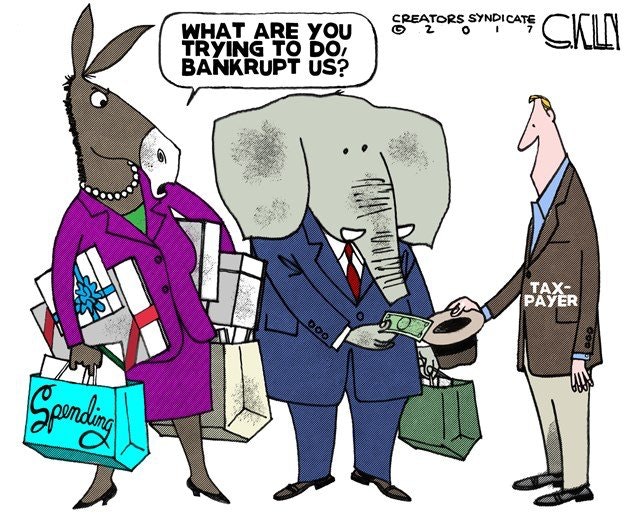
Well! It appears the shutdown’s over. (Somehow, the nation survived.)

It would take real determination not to see this as a political win for Donald Trump, and a black eye for Chuck Schumer. As we noted on Friday, the Democrats had three separate chances to make a deal, and there was never anything in the proposed funding bill that Democrats opposed (and the bill did include six years of funding for the children’s health-care program called CHIP). But so rabid are the Democrats’ base that Schumer et al. thought it was in their political interest to dig in their heels*, shut down the government, and blame the Republicans.

The plan to seize and control the narrative failed. The winning message was clear and incontrovertible: the Democrats have now drifted so far left as to be willing to shut down the government — thereby disrupting the lives, security, and household economies of millions of American citizens and service personnel — simply in order to secure benefits for illegal aliens. Moreover, for them to do this after blaming Republicans for “holding America hostage” during the last shutdown a few years ago was obviously and deeply hypocritical. (You can see some accusations of “hostage-taking” on the eve of the previous shutdown, when Republicans were refusing to extend the debt-ceiling unless given legislative concessions, in comments to our own posts, here and here.)

A nasty blow, too, was the viral circulation of this little video from that previous shutdown battle, in 2013:

Realizing their mistake, the Democrats blinked. For this they are already being blasted by their base (which should tell you all you need to know about their base). Now we shall have a three-week postponement, during which there will be “discussions” of what to do about immigration policy.

A plausible compromise, in my opinion, would be:

‣   A limited amnesty for DACA recipients (who may number well more than 800,000, the figure usually given) that would consist of resident status, including permission to work, but not citizenship or voting rights. In order to qualify for full citizenship, they would have to apply individually, like everyone else.

‣   An end to “chain migration” and the “diversity lottery”. (There should be no compromise whatsoever on this.) The visas currently apportioned to the lottery would no longer be issued.

‣   Funding for the Wall.

(This is just the beginning of a rational immigration policy, which should immediately end “birthright citizenship” and obstetrical tourism, and which should sharply curtail legal immigration as well. But I’ll leave that for another post.)

The Democrats won’t agree to this, of course. Why? Because the amnesty described above, despite giving so-called “Dreamers”** what they want most — residency, legitimacy, and the right to work — doesn’t give the Democrats the one thing they really want: millions of new Democratic voters (and millions and millions more, as chain-migration does its ruinous, multiplicative work). DACA recipients would be thrilled if the Democrats accepted such a compromise. The Democrats in Congress, however, couldn’t care less.

This alone should show you that the Democrats’ apparent concern for these people is just a sham. I lived in the U.S. until age 43 without having a vote, and had a perfectly happy life. (I might as well still not have it, too: since becoming naturalized in 1999, nobody I’ve every voted for, with one embarrassing exception, has ever won anything. A universal franchise has nothing to do with good governance, and is arguably its worst enemy.)

So: in three weeks, we are going to be right back in the same place again (minus the six-year funding of CHIP, which was wisely left in the stopgap bill). What will happen? Will the Democrats do the same thing all over again if they don’t get full amnesty, including chain migration? Are they that stupid? (They may very well be.)

Will Congressional Republicans be traitorous enough to grant it? (I certainly hope not — but you never know with these people.) They have the upper hand now, and if they hold firm to something like the compromise outlined above, they can win. And after this, I think they know it.

Above all, Mr. Trump must not waver. I don’t think he will. He knows a winning position when he sees it.

This will turn out, I think, to have been a very important victory — a watershed.
 

* Speaking of digging in the heels, did you know that the word “recalcitrant”, meaning “to be obstinately uncooperative”, has the Latin (perhaps older, maybe Etruscan) root “calx”, meaning “heel”? (It is also the root of the anatomical name of the heel-bone, “calcaneus”.)

** Brilliant propaganda, that word! It is used at every possible opportunity by the media, implanting a tiny partisan brain-worm — an insidious moral-intuition virus — every time readers or viewers absorb it.

Star Trek

This is nice: a 3D simulated fly-through of the Orion Nebula, in visible and infrared light.

What times we live in! The nature of astronomical nebulae was almost completely unknown as recently as the beginning of the last century; it wasn’t even a hundred years ago that astronomers debated whether the spiral nebulae* might in fact be evidence of the audacious idea that there may be galaxies other than our own.

Now we have detailed close-up imagery of every large object in our solar system, and large-scale maps of the three-dimensional arrangement of the innumerable galaxies (and great intergalactic voids) that make up the whole of the observable Universe. And just for fun, we get to zoom around in the Orion Nebula.

*The “spiral nebulae”, it turned out, are other galaxies, at vast distances. The Orion Nebula is not one of these — it is a stellar nursery in our own galaxy, about 1,340 light-years away.

Here We Go Again

Well, another government shutdown looms. The Democrats are refusing to sign on to a budget resolution, because it doesn’t include a “clean” DREAM act.

Over at Hot Air, “Allahpundit” explains:

Let’s run through this again, because job one for Schumer and Pelosi over the next 24 hours will be to muddy waters that are actually quite clear.

First offer from Republicans: Let’s fund the government and pass a DREAM amnesty, as both sides want to do, and in return you give us some concessions on chain migration and the wall. Republicans have no choice but to use DREAM as leverage for those concessions despite their support for the policy because Democrats are incredibly reluctant to tighten admission policies under the best of circumstances. So how about a little something in return for DREAM, in the name of compromise? Nope, says Schumer. Won’t do it. We’ll give you a few billion in mad money for border improvements but we’re not doing anything that might move the U.S. towards skills-based criteria for immigrants and away from “bring the whole family!’ policies.

Second offer from Republicans: Okay, since we’re stuck on a DREAM deal, let’s table the whole immigration issue for now and instead agree to fund the government and extend CHIP long-term, as both sides want to do. We’ll come back to DREAM afterwards when we’re not facing a hard deadline. Nope, says Schumer. Won’t do it. The amnesty fanatics in my base refuse to let us sign on to any funding deal that doesn’t include DREAM. Even though not only is DACA still in effect, the feds are letting enrollees renew their enrollments.

Third offer from Republicans: Okay, since Democrats are hung up on amnesty and worried about voting for a bill that doesn’t include it, let’s temporarily change the rules so that they don’t have to vote for the bill at all. Last night McConnell asked for unanimous consent from the Senate to let Republicans pass a funding bill with 50 votes instead of the 60 that the filibuster requires. It’s not at all certain that he has even 50 votes right now, but he was willing to take full responsibility for the bill’s passage via his caucus alone. If he found the votes he needed, the government would stay open without any Democratic assent to the DREAM-less bill. Nope, said Schumer. Won’t do it. He objected to the motion for unanimous consent. McConnell still needs 60, all but ensuring a shutdown.

Needless to say, the media and the Democrats (but I repeat myself) are presenting this as a Republican shutdown. With tiresome predictability, conscientious voices on the Right are pointing out that the situation is precisely the same as what happened in 2013, with the parties reversed, yet Republicans were blamed for that too.

I say “tiresome predictability” because pointing out double standards like this is not only useless, but deeply misguided. The assumption seems to be that if the Left is shown to be behaving inconsistently, then they will be shamed into standing down. This is wrong on two counts:

First, we are way beyond “shame” here. This is war. The Democrats know this, and have known it for a long, long time.

Second, conservatives and Republicans are looking for consistency in the wrong place. There is in fact a consistent principle, one that is never violated, and it is a simple one:

Attack the enemy always, with whatever weapon comes to hand, and never, never yield an inch.

Once you understand this, everything makes clear and simple sense.

Hmmm

A little birdie just whispered into my ear the words “Project Pelican”. I’m sure it’s nothing to worry about…

#MeToo

The problem is more widespread than we think, folks.

Places And People Are Not All The Same

Required reading, sent my way by several readers this morning: a former Peace Corps volunteer’s reflections on her time in Africa.

Here.

Windshield v. Bug

If there’s anything worse than an imbecile, it’s a smug imbecile. And — forgive me if this seems ungallant — if there’s anything worse than that, it’s a smug, “progressive” imbecile with a chip on her shoulder (but I fear I repeat myself).

When it gets better is when such a person is put in front of a camera to be tossed and gored in conversation with her betters. Jordan Peterson does the honors, here.

Kneel!

Thirty-three years ago, Harvard severed all connections to single-sex clubs such as fraternities and sororities; since then these organizations have been entirely independent of the university. Now, in a repressive blow against freedom of association, Harvard has decided that merely distancing itself wasn’t enough: it will henceforward seek out and punish students who are members of these clubs.

Destructive earthquakes are rare in Cambridge, Massachusetts. Pity.

Story here.

Road Kill

A while back I asked: is digital civilization sustainable? I wondered whether we had, in the long run, any good reason to expect cybersecurity to stay out in front of those who work around the clock to breach it. Despite ever-increasing (and increasingly burdensome) layers of security, we seemed to be, at best, neck-and neck with the bad guys.

Where I work, our electronic infrastructure is more and more ”˜locked down’ every day. I’m one of the engineers who have to respond whenever there’s a problem with our software at any of our facilities around the world, but the security barriers have become so numerous and so stifling that I typically spend many, many hours just gaining temporary access to the part of the system I need to examine. Generally I spent vastly more time doing this than diagnosing and fixing the actual problem. The problem, moreover, is not limited to the details of our own security arrangements; we also must comply with a bewildering assortment of external regulations and certifications. Tasks that used to take me minutes or hours now take days.

Despite all of this, breaches of corporate and governmental systems are more and more common, even as the armor-plating grows ever more confining, cumbersome and costly. Given that we’ve put all of our eggs into this basket, there must be an underlying assumption that security can stay ahead of the threat.

But what if, in the long run, it can’t? What if the armamentarium of the hackers can become so formidable that it will always prevail? What if it simply turns out to be the case, in principle, that it is always going to be easier to break in than to keep intruders out? Considering the extent to which all of society now rests on digital technology and the Internet, this would be a titanic collapse; it would be on the order of the fall of Rome.

I wrote this at the end of 2014. Since then we have only increased our dependency on networked technology, and with it our exposure — in new ways every day — to risk.

An article today at The Weekly Standard looks at a new battleground in the cybersecurity wars: our network-enabled cars and trucks. Read it here.

On Laïcité And The Cryptoreligion Of the Modern West

Over at the Maverick Philosopher Bill Vallicella has published a post commenting on the failure of “Laïcité” — the doctrine of separation of church and state, intended to pre-empt religious political factionalism — in Europe. Bill advances the argument that, because modern Leftists are such unreflective secularists, they’ve lost their understanding of the “deep-rootedness” of religion in human nature.

We read:

Laicity is French secularity, the absence of religious influence and involvement in government affairs. It has had the salutary effect of preventing civil strife over religion. But to appreciate why laicity is important and salutary one must understand that the roots of religion lie deep in human nature. But to appreciate why laicity is important and salutary one must understand that the roots of religion lie deep in human nature.

Bill is absolutely right about this. He continues:

Leftists cannot take religion seriously and they don’t think anyone else really takes it seriously either, not even Muslims.

…The issue at present is not whether religion is true but whether it answers to deep human needs that cannot be met in any other way. My point is not that leftists think that religion is false or delusional, although they do think it to be such; my point that they don’t appreciate the depth of the religious need even if it is a need that, in the nature of things, cannot be met.

Not understanding religion, leftists fail to understand how important laicity is to prevent civil strife over religion. And so they don’t properly uphold it. They cave in to the Muslims who reject it.

Right again, I think. But here I must ask a key question: if religion is, as Bill says, an essential, deeply rooted aspect of human nature that answers “deep human needs that cannot otherwise be met”, how, then, can an entire generation of civilized and educated people simply discard it?

My answer is that they can’t, and more importantly, they haven’t — however much they may think they have. What has happened instead is that in the space of less than a century, Western Christianity has mutated into a new and pernicious form — one that has, under the pressures of naturalistic and scientistic skepticism, “Progressive” ideology, and the catastrophic moral horrors of the twentieth century, hidden God and Christ from view, flattened and immanentized the hierarchy of Earth and Heaven, and replaced individual salvation with a vague and universalist collective soteriology.

The adherents of this cloaked and mutated form of Christianity imagine themselves to have broken free of religion altogether, but they have in fact done nothing of the sort. If they fail to take Islam seriously enough to suppress its influence under the principle of laicity, it is because Islam now seems so far removed from their own belief system that it is no longer taken seriously as a religious rival.

Christianity, however, is reviled, and rightly feared, by the liberal elites of the secular West. This is because they sense its ancestral cultural pull. It threatens to undo their own doxastic evolution in a way that Islam does not.

As I mentioned, the great metamorphosis of Christianity entered the pupal stage beginning about a century ago in America. I looked at this in some detail in this post, from last July. If this topic interests you, I think you’ll find it worth your time.

Twofer

Here’s another from VDH: President Nobama.

Hardly a day goes by without some reminder of what a miraculous stroke of fortune it was, in what Professor Hanson calls “the lateness of the national hour”, that Hillary Clinton lost that election.

R.I.P.

I’m note with sorrow the death of Dolores O’Riordan, lead singer of the Irish group the Cranberries. She was a unique talent, with a haunting, unforgettable voice.

Ms. O’Riordan suffered throughout her brief life, battling depression and anorexia. From her pain came beautiful, sometimes gorgeously uplifting music. We should be grateful to her for that gift.

CNN vs. FDR

Good piece today by Victor Davis Hanson on how an antagonistic news network might have treated the declining Franklin D. Roosevelt. Here.

Let The Tweeter Beware

Here’s the latest Project Veritas video about Twitter.

You shouldn’t be surprised by any of this. When it comes to “free” online services, the rule is: if you aren’t the customer, you’re the product.

The Truth Will Set You Free — Of An Income

The blogger JayMan (one of the most intelligent and articulate voices you’ll find online) comments on the Steven Pinker brouhaha, here.

In my own comments a couple of days ago, I said that “Dr. Pinker, quite understandably for someone who wishes to remain employed”, was “trying to thread a needle.” JayMan puts this far more succinctly, using a neologism I hadn’t heard: Pinker was trying to avoid being “Watsoned”. What does that mean? It the reference isn’t familiar to you, JayMan provides a link. Go and have a look.

Gestanken-Experiment

Thought experiment regarding immigration from “shithole” countries:

1) Think of a so-called “shithole” country, and one that obviously isn’t (say, Haiti and Finland).
2) Swap all the people, leaving all their stuff behind.
3) Check back in 25 years.
4) What results do we expect?

 
P.S. I don’t mean to belabor this topic, but the self-righteous spate of gleeful outrage over this alleged comment by Mr. Trump is more than I can bear in silence.

Is It Just Us?

A foible of the English language is our fondness for words that repeat a syllable (or two) with a different vowel. Some examples:

Flim-flam
Tip-top
Flip-flop
Hip-hop
Mish-mash
Zig-zag
Pitter-patter
Chit-chat
Riff-raff

I’m sure you can think of others. (There are also examples that are purely imitative of sounds, such as “ding-dong”, “tick-tock”, and “clip-clop”, but I’m not counting those.)

Do other languages do this?

Pinker And The Priests

Steven Pinker, who by some miracle still finds himself employed despite holding some deeply heretical notions (of which those he expresses are surely just the tip of the iceberg), is under fire today for some remarks he made at a panel at Harvard. The snippet that’s been making the rounds is this:

The other way in which I do agree with my fellow panelists that political correctness has done an enormous amount of harm in the sliver of the population that might be, I wouldn’t want to say persuadable, but certainly whose affiliation might be up for grabs, comes from the often highly literate, highly intelligent people who gravitate to the alt-right, internet savvy, media savvy, who often are radicalized in that way, who swallow the red pill, as the saying goes, the allusion from The Matrix. When they are exposed the first time to true statements that have never been voiced in college campuses or in The New York Times or in respectable media, that are almost like a bacillus to which they have no immunity, and they’re immediately infected with both the feeling of outrage that these truths are unsayable, and no defense against taking them to what we might consider to be rather repellent conclusions.

Dr. Pinker is trying very carefully to thread a needle here. From a platform in the central basilica of the modern-day Cathedral, he is trying to explain to the clerisy the plain Newtonian fact that “reaction” is the result of “action”. In doing so, however, he had to say some very troublesome things: that some people on the “alt-right” are highly literate and intelligent, and that the proximate cause of their doxastic insubordination is exposure to “true statements”. This is unforgivable stuff, and so he has now drawn the attention of the Inquisition, and is getting some “action” himself.

He has since explained that he was taken out of context, that like all good people he condemns the alt-right, that the conclusions drawn by these highly literate and intelligent people, despite their foundation in “true statements”, are nevertheless not only false but “repellent”, and so on.

To this end he made, in his original remarks, various arguments. A transcript of his remarks in full is here; I will take excerpts as we go.

Let me give you some examples. Here is a fact that’s going to sound ragingly controversial but is not, and that is that capitalist societies are better than communist ones. If you doubt it, then just ask yourself the question, would I rather live in South Korea or North Korea? Would I rather live in West Germany in the 1970s or East Germany or in the 1960s? I submit that this is actually not a controversial statement ”” but in university campuses, it would be considered flamingly radical.

Quite so.

Here’s another one: Men and women are not identical in their life priorities, in their sexuality, in their tastes and interests. Again, this is not controversial to anyone who has even glanced at the data. The kind of vocational interest tests of the kind that your high school guidance counselor gave you were given to millions of people. And men and women give different answers as to what they want to do for a living, and how much time they want to allocate to family versus career, and so on. But you can’t say it. I mean, someone, a very famous person on this campus did say it and we all know what happened to him. He’s no longer ”¦ Well, he is on this campus but no longer in the same office.

Strong stuff! You can already feel the triggers, well, triggering. (The “very famous person” was of course, Lawrence Summers. Dr. Pinker very bravely came to Dr. Summers’ defense thirteen years ago, when, as president of Harvard, Summers was tarred and feathered for suggesting that there might in fact be statistical cognitive differences between men and women.)

Here’s a third fact that is just not controversial, although it sounds controversial, and that is that different ethnic groups commit violent crimes at different rates. You can go to the Bureau of Justice Statistics. Look it up on their website. The homicide rate among African Americans is about seven or eight times higher than it is among European Americans. Terrorism. Go to the Global Terrorism Database, and you find that worldwide, the overwhelming majority of suicide terrorist acts are committed by Islamist extremist groups.

You have to admit, there is something bracing about seeing such things said in public. At Harvard, no less!

Our hero is in getting himself in very big trouble here, it seems. But wait…

Now, these are unwarranted conclusions. Because for each one of these facts there are very powerful counterarguments for why they don’t license racism and sexism and anarcho-capitalism and so on.

Ah.

The fact that men and women aren’t identical has no implications for whether we should discriminate against women, for a number of reasons. One of them is: for any traits in which the sex is different, two distributions have enormous amounts of overlap, so that you can’t draw a reliable conclusion about any individual from group averages.

Some thoughts here:

First, Dr. Pinker is exactly right. Statistical distributions tell us nothing at all about any individual, and we should greet every person we meet as an individual.

Second, the conclusion one should draw from this is that it’s crazy to focus on the unequal distribution of women and men in fields for which they have statistically different aptitudes and affinities. (Can we stop doing that, please? Don’t hold your breath.)

Third, that men and women overlap in individual traits is nevertheless not a sufficient reason to ignore the general issues of fundamental sexual differences and intersexual dynamics. It is still a terrible idea, for example, to put women in combat units.

Number two, the principle of opposition to racism and sexism is not a factual claim that the sexes and races are indistinguishable in every aspect. It’s a political and moral commitment to treat people as individuals, as opposed to pre-judging them by the statistics of their group.

That may be Dr. Pinker’s principle of opposition, and it’s the only legitimately available one — but it isn’t the principle most of his audience goes by, and by acknowledging in this forum the radioactive truth that there are even real statistical differences between the sexes and races, he’s making things awfully hot for himself.

In the case of, say, rates of violent crime, it used to be ”” go back 100 years, the rate of violent crime among Irish Americans was far higher than among other ethnic groups. That obviously changed.

Indeed. But blacks have been here since long before the Irish, though, and as Dr. Pinker points out, they are even now, well more than a century after the great waves of Irish immigration and assimilation, “seven or eight times” more homicidal than European-Americans. (This is not limited to homicide, either; African-Americans even commit “white-collar” crime at much higher rates.)

There’s no reason that that can’t change in the case of current racial differences.

This is true in principle, but it may also be true that there’s no particular reason for anyone, after all this time and effort, to expect that it will. Dr. Pinker, quite understandably for someone who wishes to remain employed, also makes no mention of persistent statistical shortfalls in African-American IQ and educational achievement compared to Americans of Irish descent.

In the case of terrorism, the majority of domestic terrorism is committed by right-wing extremist groups, not by Islamic groups within this country.

Now wait a minute. Sure, there was Timothy McVeigh, and I’ll give him Dylan Rooff, but looking at the record of mass murder over the past couple of decades, there have also been, just off the top of my head, the 1993 World Trade Center bombing, 9/11, Orlando, San Bernardino, Fort Hood, Virginia Tech, Sandy Hook, Chattanooga, the D.C. snipers, the New York truck attack, the Aurora massacre, Columbine, the Unabomber, the Congressional softball shooter, and the Black Lives Matter cop-killings — not one of which was perpetrated by “right-wing extremists”. (Jihadis have also made plenty of foiled and botched attempts to blow things up, including some pretty recent ones.) The bollards, concrete barriers, and military deployments we see everywhere in New York and other big cities these days aren’t going up because of the Tea Party, or even Stormfront. So I’m calling “bullshit” on this one.

Of course, through much of its history, Islam was far more enlightened than Christendom.

Well, sure, if you call aggressive wars of expansion and enslavement, subjugation of infidels, entire nations built on piracy, etc. “enlightened”.

There was no equivalent of the Inquisition.

No punishment of heretics (and remember, because it is a tenet of Islam that all people are born as Muslims, all infidels are heretics) in Islam? Please.

There was no equivalent of the wars of religion in the classical history of Islam.

Even leaving aside the ancient Sunni-Shia conflicts, the entire history of Islam is a war of religion. I mean, in Islam the entire unsubjugated world is called the “House of War”, for Pete’s sake.

The politically correct left is doing itself an enormous disservice when it renders certain topics undiscussable, especially when the facts are clearly behind them. Because they leave people defenseless, the first time they hear them, against the most extreme and indefensible conclusions possible. If they were exposed, then the rationale for putting them into proper political and moral context could also be articulated, and I don’t think you would have quite the extreme backlash.

Most of this is certainly true. It is not at all true that conclusions somewhat rightward of Dr. Pinker’s are all “extreme” and “indefensible”, but it is most assuredly true that if there is something real happening, something with observable and often distinctly undesirable consequences, and you create a social climate in which decent people feel themselves unable to speak about it (or, as seems to have happened all over the West, unable even to permit themselves to think critically about it without immediate, deeply conditioned moral self-censorship), then the situation will deteriorate to the point where the few people who will think or speak about it — or, a step or two later, take action about it — are often the sort of people who are not restrained by ordinary morality. If Europe, for example, was looking for the very best way possible to create exactly what it had hoped above all else to avoid — arousing an angry and potentially violent identitarian movement — how better to do it than to flood the continent with obstreperous and unassimilable young Muslim males, and forbid native Europeans to object, on pain of prosecution?

Despite my criticism here, I have to give praise Dr. Pinker for his remarks. He’s done very important work for years now in standing up to universalist orthodoxy (along with other brave scientists like Edward O. Wilson), and he has taken some lumps for it. His book The Blank Slate was an act of real defiance, and it was, for many people of my addle-pated generation, the first time they’d ever seen a serious academic dare to speak forbidden truths about human nature.

Now he’s stuck his neck out again. I can hardly blame him for not sticking it out all the way.

Down In The Valley

Well, the cat’s out of the bag (to the extent that it has been in the bag at all, lately): As we learn from undercover videos of its engineers (who mostly appear, judging by appearances and accents, to be recent arrivals to these welcoming shores), Twitter is indeed using shadow-bans to mute the voices of “conservatives”, “rednecks”, and “shitty people”.

Meanwhile, James Damore has filed suit against Google for his firing on heresy charges. May God strengthen his arm.

Back in August, I commented on Mr. Damore’s firing, and Apple CEO Tim Cook’s donation of a million dollars to the execrable SPLC:

If you’re like me (of course you are!), all this makes you want to have nothing more to do with either Google or Apple. Thinking about that, though, made me realize how hard it would be for most of us to do so.

For starters: if you have a modern cell-phone, it is almost certainly an iPhone (Apple), or some sort of Android device (Google).

Maybe you use iTunes (Apple) to play music, perhaps on your Mac (Apple again). Or maybe you use the Chrome browser (Google), and maybe you use it to do Internet searches (Google again, obviously). Perhaps you watch videos on YouTube (Google), or maybe you find your way around with Google Maps, or Google Earth. If you’re a blogger, you might well be on Blogger (Google again). There’s also a good chance you have a GMail account. (I have two.)

So: you’ve begun to realize that these very powerful companies are strongly aligned against proponents of traditional Western nations and cultures. But it’s probably also the case that you are a daily, and at this point deeply dependent, user of their products. (As I’m fond of saying, invention is the mother of necessity.) Are you prepared to give all that stuff up? I doubt it. I’m certainly not inclined to; in fact I wonder how I ever lived without it.

This is something of a problem, no?

It is actually quite a horrifying problem. It’s also easy to see how it could very rapidly get much, much worse, as more and more aspects of our everyday lives are mediated by electronic networks. All of the information we consume, the money we spend, the cars we drive (or, ere long, the cars we are shuttled around in, like Spam in a can), the books we read, our communications, our appliances — everything — is connected to, or controlled by, an Earth-girdling electronic network. (Those things that aren’t already, soon will be.) Meanwhile, at every moment we are sensed, monitored, and detected: by way of the phones we carry (notice how you can’t even disable them by removing the batteries anymore), surveillance cameras, “smart” TVs, electronic toll-booths, credit-card transactions, and — the latest thing — devices like this in our homes and cars.

We have already made ourselves utterly dependent on all of this, without, as far as I can tell, any serious consideration at all, and our dependency will only deepen, very rapidly indeed, over the next few years.

To be dependent on something is a grant of power, and more importantly, a grant of trust. To grant absolute dependency as a voluntary choice, then, which is what we appear to be doing, should entail some rational grounds for absolute trust.

Right, then. How much do you trust Google? How much do you trust this man?

Do you begin to feel the horror?

Fierce Tiger Descends Mountain

For tonight, I have an article by a Chinese national, Puzhong Yao, who emigrated to the West — first to England, then to the United States — to complete his education, and to work in the financial industry. He is obviously highly intelligent, and has done very well. He writes about the difference between Chinese and Western culture, and the role of luck in our lives. You will find his story interesting, I think.

There is one aspect of his tale, however, which should give us all pause. I will explain.

Mr. Yao hails from Shijiazhuang, a city I had never heard of, despite its having a population of more than ten million people. (I doubt you have either.) Its claim to fame is as “the headquarters of the company that produced toxic infant formula.”

At 15, Mr. Yao took a high-school placement examination. He did well enough to place in the top ten of the 100,000 students taking the test in Shijiazhuang that year, and so he got into the best class in the best school in town.

As bright as he was, he found himself badly outperformed at this new school. When the first year’s final exam came along, he finished second from the bottom. He simply couldn’t keep up with the brilliant students all around him, and so he asked his parents to send him abroad. They did.

The young Mr. Yao ended up in England, where he flourished. There, he scored first nationwide in the high-school math exam, and was admitted to Trinity College, Cambridge.

We read:

Three years later, I graduated with first class honors and got a job offer from Goldman’s Fixed Income, Currency and Commodity division, the division founded by my hero Rubin. It seemed like whatever I wished would simply come true. But inside, I feared that one day these glories would pass. After all, not long ago, I was at the bottom of my class in China. And if I could not even catch up with my classmates in a city few people have even heard of, how am I now qualified to go to Cambridge University or Goldman? Have I gotten smarter? Or is it just that British people are stupider than the Chinese?

There are 1.4 billion people in China: almost half again as many as in the United States and Europe combined, with a slightly higher average IQ. Given such a large number of people, and the way distributions at the tails of bell-curves work, it does not take much of an edge in IQ for the number of Chinese at the far-right end of the curve to be far in excess of the numbers in the West. (This is at a time when the average IQ of Western nations is declining, no doubt due in large part to a tsunami of Third World immigration.)

What does all of this portend? Comments are welcome.

Does A Commitment To Democracy Require Radical Tolerance?

We’ve just had an interesting conversation over at Bill Vallicella’s place. Bill proposed that subversive political parties be excluded from participation, and we went from there to a discussion of the relative merits of democracy itself. (Over the last decade or so I have become deeply skeptical of democracy — which is, after all, just one form of government among many, but has become a sacred principle of our new, secular religion.) Joining in was a Canadian reader of Bill’s.

The key variable, it seems to me, in a democratic republic is the breadth of the franchise. Bill remarked that “pure democracy is pure disaster”, which of course it is. Given this, I pointed out, it follows that republics are vulnerable to the liabilities of democracy in proportion both to a) the extent to which their sovereignty grants power to democratic processes, and b) the universality of the franchise. But republics tend, it seems, always toward expansion of the franchise. (The American system certainly has, amendment by amendment, and in recent years we’ve even seen people seriously propose to give illegal aliens the vote.)

At one point, dismayed by my lack of enthusiasm for our present form of government, Bill asked me: “What are you, a monarchist?”

I asked in reply:

What’s so terrible about monarchy? It has many advantages over democracy, and the whole world ran this way until very recently. Democracy, as we’ve agreed, is vulnerable to entryism Á  la Hitler, and even at its best it creates constant political turmoil and factional strife. It forces politicians to think in very short time-frames, and so they compete to make the most appealing promises to voters: promises that, as they well know, somebody else will have to keep.

Am I a monarchist? All I will say about that is that all I want is to be governed well. I don’t really care who’s in charge. What I want from government is the security of my rights, care for my nation’s future, defense of its borders, and the maintenance of public order. Those are the things government is for — and the question of which form of government is better at this is, in my view, a purely empirical one. (On balance, if I were offered the choice to give up my infinitesimal sliver of illusory power so that people like Lena Dunham and Ta-Nehisi Coates don’t get one either, I think I’d likely take it.)

Ask yourself: are we governed well? Have we been, in living memory? Look at Congress. Look at our presidential races, and the choices we get. Look at our political discourse. What happened? Is this as good as it gets?

Churchill is often quoted as saying:

Democracy is the worst form of Government, except for all those other forms that have been tried from time to time.

I think another remark of his is much more to the point:

The best argument against democracy is a five-minute conversation with the average voter.

Quite so. Try as I might, I simply cannot find persuasive the notion that the aggregate of ignorance is wisdom.

You can read it all here.

Racist Thing #102

Meritocracy.

The Multidimensional Geometry Of Music

Today I read an article about Dmitri Tymoczko, a music theorist at Princeton, who has developed a new spatial framework for the representation and comprehension of music, using mathematical objects called “orbifolds”. It seems fascinating, but I’m sure I haven’t fully grasped it yet. (The easiest way to take such things in is by visual representation, and so I will be poking around online to see what sort of software tinkerers have come up with.)

Anyway, have a look here. (Hat-tip: Brian Eno.)

Goodbye Real World!

Yes, the caption says it all.

As much as I enjoy life, I do find it difficult, at times, to be optimistic about the future. (Readers may have noticed this.)

Some days it’s harder than others.

Suicide Cult

With a hat-tip to Bill Vallicella, here’s a review of Douglas Murray’s new(ish) book on the murder of Europe by its political elites: The Strange Death of Europe: Immigration, Identity, Islam.

Back in May, we excerpted an essay by Mark Steyn, writing on the morrow of the Ariana Grande concert-bombing in England, in which he mentioned this book. Mr. Steyn spoke of the way that gradual decline can be imperceptible:

As I asked around Europe all last year: What’s the happy ending here? In a decade it will be worse, and in two decades worse still, and then in three decades people will barely recall how it used to be”¦

My own gloomy response was this:

Mr. Steyn is exactly right. It is, sadly, the brevity of human lifespans that makes such decline so easy. The world is new, and therefore normal, to each generation; it is only the old who can see clearly the value of what has been, and is being, lost and forgotten. But they are old, and weary, and soon they die.

European civilization is old, too, and soon will do the same.

I’d made a note to myself to read Mr. Murray’s book at the time, but it slipped my mind. I am grateful to Bill for the reminder.

Weed Whacker

I see in the news that Attorney General Jeff Sessions is looking to change the DOJ’s lax policy regarding enforcement of marijuana laws. I think he’s right to do so.

To put my own cards on the table: I’d like to see pot legalized. I think it’s a silly thing to criminalize, and its illegality is a waste of judiciary, law-enforcement, and penal resources. Moreover, marijuana’s contraband status has created a truly gigantic black market that will never go away, and the substance’s enduring and widespread popularity make millions of otherwise law-abiding citizens a criminal class. Laws like this, that nobody really takes seriously, do nothing but degrade respect for the law. Finally, a regulated and taxable marijuana industry could be an enormously productive economic sector.

Nevertheless, Federal law makes marijuana illegal in all 50 states, and for the government to keep these laws on the books while state after state openly flouts them serves only to make a mockery of the rule of law itself. It is a breakdown in public order — and disorder breeds further disorder.

Consistency and fairness in the law is critically important. We live in an era of tremendous overcriminalization, in which there are so many laws that we can hardly get through the day without breaking a few of them. If the nation’s innumerable laws and administrative regulations were all enforced uniformly, firmly and rigorously, we’d all be in jail. The fact that we aren’t, then, means that your liberty, and mine, hangs merely upon the whim of the government — and, “the government” being an abstraction that has no mind or will of its own, what this really means is that our liberty hangs upon the whim of whoever happens to be running the government. This is an intolerable state of affairs in supposedly free republic under the rule of law, and the only reason we haven’t risen up with torches and pitchforks is that most people have never had the bad luck to run afoul of the system, or to attract the notice of the wrong, powerful, person or agency.

If it were up to me, the Federal laws against marijuana would be struck down, and the matter handed off to the States. The only way this will happen, though, is if Congress feels pressured to make it happen — and that pressure won’t exist if the public doesn’t apply it. The best way to arouse public awareness of a bad law is to enforce it — and so I think Mr. Sessions is doing the right thing, even if he and I would prefer a different outcome.

On Hangovers

You won’t often find me linking to the New Yorker these days, but this article by Joan Acocella is so good I’m passing it along.

Dip On Don

As we begin the new year, Lewis Amselem, a.k.a. “Diplomad” has some comments on “The Year of the Donald”, here. An excerpt:

The resistance to Trump’s nomination and election started with prominent Republicans, such as Romney and the Bush clan, and continued with brave talk of riots in the street, “pussy hats,” vote recounts, electoral college challenges, Russian “collusion” investigations, and ended with ISIS on the run, US oil production roaring along, a new tax scheme, thousands of regulations slashed, the economy booming, Hollywood in a tailspin, Jerusalem recognized as the capital of Israel, illegal alien criminals rounded up, UN budget cuts, a teetering EU, riots in Tehran, the “deep state” exposed, the Supreme Court turned around, the Maduro regime on the ropes, and lefties fighting over first class seats on United Airlines (BTW: I know the “teacher” who got booted from her first-class seat by that whacky leftist Congresswoman; she’s a hard-core leftist “activist” who made my life and career very difficult many years ago. Lefties like to travel first class.)

Mr. Amselem is optimistic about the coming year, and I have to say his summary does give one a sense of promise. I’m not so sure — I think there will be much turmoil in 2018, and I have the feeling we are overdue for one of those major events that shake thing up in unforeseeable ways, but I hope he’s right. (In the long run, I think things are much too far gone for the Trump presidency to be anything more than a delaying action, but I’d be very happy to be wrong about that.)

I will say this (along with one of the commenters on Diplomad’s post): I still thank Heaven every single day for Hillary Clinton’s having lost that election.

Happy New Year!

To all of you. Thanks as always for reading and commenting.

Buckle up! 2018 looks like it’s going to be an “interesting” year.

Watch Carefully

Mass protests are underway in Iran against the totalitarian Islamic regime that has been in power since 1979.

Something very significant happened yesterday: as reported by the AP, Tehran has announced that it will no longer enforce the dress code for women that has been in place since the revolution.

This is a moment of great peril for the regime. Authoritarian regimes are in the most danger not when they oppress the people with an iron grip, but when they begin to reform, to make concessions, when conditions begin to soften and improve.

Eric Hoffer saw this with extraordinary clarity. In The True Believer, written in 1951, he said:

Discontent is likely to be highest when misery is bearable; when conditions have so improved that an ideal state seems almost within reach. A grievance is most poignant when almost redressed… Our frustration is greater when we have much and want more than when we have nothing and want some. We are less dissatisfied when we lack many things than when we seem to lack but one thing.

Hoffer made this astonishingly prescient observation about the Soviet Union:

The most dangerous moment for the regime of the Politburo will be when a considerable improvement in the economic conditions of the Russian masses has been achieved and the iron totalitarian rule somewhat relaxed.

An Iranian uprising like this happened during Barack Obama’s presidency. He looked the other way. Donald Trump almost certainly will not, and you can be sure that the mullahs of Tehran know it. To those who understand history and the psychology of mass movements, the concession Khamenei has just made is a sign that his regime is in grave danger this time around. It may have been a fatal misstep.

Racist Thing #101

Farmer’s markets.

Holiday Cheer

With a hat-tip to Bill Vallicella, we have for you an essay in which Rod Dreher, citing Theodore Dalrymple, examines the expanding sinkhole at the foundation of Western civilization: the family.

The causes are many — among them are secularism (which, I believe, belongs right at the top of the list), multiculturalist decohesion, the substitution of the universal State for the responsibilities of fatherhood, the withering away of civic virtue, and a sustained assault on tradition and cultural heritage — but solutions are few, if they exist at all. Dreher calls for a rebirth of religious belief, which would certainly be a tonic, but it’s hard to imagine that’s going to happen.

As thinkers from Spengler to Stoddard have argued, the process by which high civilizations die is a decline in the birthrates of their elites, and an excess of fecundity in their sullen and resentful underclass. (History suggests that this problem, once begun, is inexorable, and fatal.)

Read Dreher’s essay here.

Weimerica

Today the fashion magazine Vogue tweeted this photograph. The caption read:

“Is your hair holiday party ready?”


I found it more than a little disturbing (and no, it wasn’t because of the missing hyphen in the compound adjective “holiday party”, as bad as that is). To me the photograph leapt off the screen as macabre image of a civilization in the descending stages of mortal decay.

It isn’t her hair that gives me the willies, though. It’s the death in those eyes — and that horrifying smile.

ABCDEFGHIJKMNOPQRSTUVWXYZ

(Noel!)

Merry Christmas, everyone.

One Hundred Racist Things

The rightish television presenter Tucker Carlson today offered his Twitter followers one of the best “tweetstorms” I’ve ever seen: #100RacistThings. You can see the thread here, but it’s so good I’m going to preserve it for posterity in this post — because this is the sort of thing that gets people banned from Twitter these days.

1. Tamarisk trees in Palm Springs, California.
2. The ice cream truck song.
3. Credit scores.
4. Car insurance.
5. Crime statistics.
6. Halloween costumes.
7. Calling Elizabeth Warren “Pocahontas.”
8. Most of the better Disney movies.
9. Dr. Seuss.
10. White flight.
11. Reversing white flight.
12. White chefs who make burritos.
13. Milk.
14. Tanning.
15. NFL owners.
16. Being mad about NFL national anthem protests.
17. Mathematics. (See also here.)
18. Science.
19. Yale requiring English students to study Chaucer and Shakespeare.
20. All white people.
21. Proper English grammar.
22. Patriotism.
23. The iPhone X’s facial recognition technology.
24. Makeup.
25. Emoji.
26. Amy Schumer.
27. To Kill a Mockingbird.
28. The SAT.
29. Military camouflage.
30. Electronic music.
31. The August solar eclipse.
32. Bitcoin.
33. The “okay” sign.
34. Having a white person box against a black person.
35. The pornographic industry.
36. Apu from The Simpsons.
37. The white nuclear family.
38. Algorithms.
39. Artificial intelligence.
40. “Jingle Bells.”
41. Lucky Charms.
42. Deporting people.
43. Bernie Sanders supporters.
44. Pumpkin spice lattes.
45. White people celebrating Cinco de Mayo.
46. Lacrosse.
47. The Betsy Ross flag.
48. The Gadsden flag.
49. Expecting people to show up on time for things.
50. Cartoons of frogs.
51. Nostalgia.
52. Soda taxes.
53. Coca-Cola (but not Pepsi).
54. Wendy’s.
55. Aesthetics.
56. Star Wars.
57. Hollywood.
58. The Oscars.
59. Democrats.
60. Republicans.
61. The Nightmare Before Christmas director Tim Burton.
62. Walmart.
63. The Hindi loanword “thug.
64. Babies.
65. Bulletproof glass.
66. Referring to “canoes” and “paddles.
67. College football.
68. The NBA draft.
69. Referring to ethnic food as “ethnic food.”
70. The White Privilege Conference.
71. Abbreviating the word “guacamole”.
72. Property taxes.
73. Tax cuts.
74. New Jersey. The whole state.
75. School grades.
76. Canada.
77. American Airlines.
78. Not renting your home to criminals.
79. Criminal background checks.
80. Art history.
81. Atheism.
82. School discipline.
83. Saying you are English.
84. English-only education.
85. Othello.
86. Capitalism.
87. Socialism.
88. Karl Marx.
89. Highways.
90. Diabetes.
91. Climate change.
92. Accurately describing criminal suspects.
93. Pollution.
94. Not wanting white people to leave a college campus.
95. The Bible.
96. McDonalds.
97. Craft beer.
98. The British monarchy (but NOT the royal family).
99. The Washington Redskins.
100. Everything.

Radio Garden

OK, here’s something really fantastic: a website that enables you to scroll around the globe and pick up radio broadcasts from pretty much everywhere. Here.

Anchors Aweigh!

Congress has a lot to do in the new year. I certainly hope ending obstetric tourism is somewhere near the top of the list.

Splice The Mainbrace!

The tax-bill’s done. Not perfect, perhaps, but what is? Aside from its most important feature — lowering the corporate-tax rate — it repeals the Obamacare “individual mandate” (take that, Mr. Chief Justice!), and it makes room for further energy exploration in Alaska.

Better still, it’s a major blow to Schumer, Pelosi, Warren, & Co. — and if the bill produces real improvements in prosperity, the Democrats’ monolithic opposition to its passage might very well hole them below the waterline come November.

We’ll take it.

Behind The Notes Lies The Infinite

With a hat-tip to the indefatigable ‘JK’, here’s a delightful video: Riccardo Muti on conducting.

Cartoon


On Toy Birds, and The Complementarity Of Predictability And Complexity

A reader (who is also an old friend) emailed me today, in response to yesterday’s post.

That post contained this passage:

In either of these cases ”” the origin of the stupefying complexity of living systems as either a self-organizing process across “deep time’, or as an act of God ”” if we turn and apply the metaphor to the obvious complexity of human societies, we should be humbled. We can no more create such a thing from scratch than we can build a fly. Just as the bodies we inhabit are “given’, so are our societies and our cultures. We should appreciate them as precious and mysterious gifts, not as disposable artifacts.

In response, my friend drew my attention to this: a small drone in the form of a hummingbird.

I think his reply, which was very brief, was more tongue-in-cheek than a serious critique, but it deserves some consideration. The little drone — a tiny “ornithopter” — really is an impressive gadget, and I’m sure we’ll even have far better ones before long.

But it is no hummingbird. It is a dead thing, a toy. Can it fly? Yes it can. But if you want to see the difference between this and a hummingbird, turn it loose in the wild and see how it does.

Fine, you might say, but it isn’t hard to imagine a future little ornithopter that might last for years in the wild! And I will say: that’s fine, but eventually it will break down and fail.

Well then, what about ornithopters that can do all the things that hummingbirds do: survive in the wild, combine with others to make copies of themselves, and evolve over time to adapt to changing conditions?

And I will say: when you have done that, you have created the conditions for emergent, chaotic, self-organizing complexity, and you will have no way to predict where it will lead. What this new system will not do is exactly whatever you planned when you turned it loose — and once you have done so you will quickly find that it has moved beyond your control.

It’s a tradeoff: you can have control, and predictability, in a ‘toy’ system so narrowly limited as to be comprehensible — or you can have life, and spontaneous order. The latter is where all the magic happens.

Service Notice

I noticed that comments on old posts had been automatically closed. I’m not sure why; it may have been an anti-spam move on my part a while back, or just something that happened during a site update. Anyway, I’ve got better spam protection now, and they are open again.

The Personhood Of Society, Part 2

A few days ago I posted a brief item about the idea of “society” as something more than an aggregate of individuals. It began:

How can anything benefit “society”? There is nothing we can call “society” that actually experiences anything at all — and what (and to whom) is the value of a benefit unexperienced? If “society” benefits, it is only experienced by individual persons, each of whom experiences any social benefit or blessing as an individual. There is not, nor can there be in humanity as presently constituted, any “mass man”

I described this as a “hard-nominalist” view. It is so in the sense that it argues that the only actually existing entities that can experience the harms or blessings of social and political policies and circumstances, or that can express a creative will, are individual human beings. Presumably the purpose of good government, and the advantage of healthy culture, is that they foster happiness, and decrease suffering. But the very idea of “suffering” or “happiness” requires the existence of something that is capable of conscious experience, and it is impossible to see how “society” or “culture” are such things. Only human beings, then, can suffer or be happy, and so it is only at the level of individual human lives that any benefit to “society” can manifest itself in any real sense.

This view, however, seems at first glance to be incompatible with how we are accustomed to thinking and talking about these things. We speak often of society being harmed by, or having an interest in, some or other arrangement or outcome. We also speak often about society as a living organism; the metaphor is rich and deep. I’ve relied on it often myself.

How is a healthy society like a living organism? The similarities are many, and persuasive:

1) A society, like a living thing, is made of countless smaller, living parts, which must interact harmoniously and productively for the organism to survive. In an animal or plant, these are individual cells; in a society they are individual people.

2) The “cells” of a living organism are differentiated, and perform different roles.

3) These differentiated cells are arranged to form essential organs and subsystems. These subsystems must perform various necessary tasks, such as taking in energy sources, distributing energy throughout the system, eliminating waste products, sensation of both the internal and external environment, defense against threats, synthesis of necessary things from raw materials, communication between its own parts and with other organisms, repairing damage, anticipating and preparing for what the future may bring, and much more.

4) An organism, in order to survive, must make essential discriminations — between “self” and “other”, food and poison, friend and enemy, predator and prey, etc.

The close parallels between societies and living things means that it is a useful and simplifying assumption to take what Daniel Dennett has called the “intentional stance” in trying to understand complex societies. To explain what the term means, Dennett has used the example of a chess-playing machine. Clearly there is no conscious agent, no purposeful homunculus, inside the machine; there is nobody there that “wants” to win the game. If we want to predict its behavior, we might examine it at the lowest and most deterministic level, namely its hardware and the code it’s running. But this is a needlessly difficult and time-consuming task; if we know the game of chess, the simplest approach to predicting its behavior is simply to look at the machine as if there is an intentional agent inside that knows the rules and wants to win.

Likewise, if we adopt the “intentional stance” toward a society, we can ascribe to it various interests: that, like a living thing, it wishes to survive, that it wishes to minimize pain and maximize pleasure, that it has long-term interests it ought to look after, that it should recognize and respond to threats, and so on. In this way we can identify various measures of its success and well-being — and when we have done that, we can begin to assess how well it is doing in maximizing these values. We can, if we like, even begin to speak in a meaningful sense of its “health”, and of its prospects for survival.

At this point we should pause to consider, with some respect, another aspect of the living things we see all around us: that they are complex in countless ways that are far beyond our understanding. The origin of this complexity is yet unknown, except as either a vague and general idea of natural selection, or as direct creation by God. In the former case, we must accept a “bottom-up” account of self-organizing complexity and emergent hierarchy, in a gradual process spanning an ungraspable immensity of time; the details of which, to the small extent that we can see them at all, are visible only in retrospect, and explicable only in the most general ways. In the latter case, we are simply confronted with the infinite creative genius of God, and there the story ends.

In either of these cases — the origin of the stupefying complexity of living systems as either a self-organizing process across “deep time”, or as an act of God — if we turn and apply the metaphor to the obvious complexity of human societies, we should be humbled. We can no more create such a thing from scratch than we can build a fly. Just as the bodies we inhabit are “given”, so are our societies and our cultures. We should appreciate them as precious and mysterious gifts, not as disposable artifacts.

We must, however, keep this in mind: no metaphor is perfect, and neither is this one.

To be continued…

Whose Side Was This Man On?

Here’s a story you might not have heard: about a years-long operation against Hezbollah’s global criminal-syndicate apparatus, and how it was smothered by the Obama administration in the runup to the Iran deal. (From Politico, no less.)

It’s long, but it deserves your attention.