Where Do They All Come From?

So many talented people! Here’s a splendid solo version of Eleanor Rigby by a gifted young musician named Josh Turner.

Russia? Fuhgeddaboudit.

In case you missed it: according to this item in the Washington Times, millions of noncitizens may indeed have voted in recent elections.

An Idea Whose Time Had Come

A while back a reader pointed out to me in an email that my e-pal David Duff and I often seemed to be oddly “in sync” with our blog-posts. Yesterday I visited David’s excellent blog Duff and Nonsense after a few days’ absence, and saw that like me, he’d also put up a post about Jon Ossoff’s loss in the recent Congressional election down in Georgia. Not only that, though: he’d also used the same photo of a morose CNN election-night panel. All fine so far: that photo had been making the rounds that day, for the simple reason that liberal tears are sweet nectar to the rest of us. What seemed eerie, though, was that mon ami Duff had, in his own item, resurrected the same Wildean “death of little Nell” quote that I had opened with.

This, I thought, wanted explaining. So I’ve settled on two possibilities, both summed up in familiar aphorisms. I think it comes down either to:

Great minds think alike

or

Fools seldom differ.

You can take your pick.

No Good Options

Here is a depressingly thorough look at the problem of North Korea. It examines four things the U.S. might do: 1) pre-emption Á  la Thucydides; 2) smaller-scale military pressure; 3) decapitation of the Kim regime; or 4) more of what we’ve done so far, namely nothing.

Not one of these choices is appealing. It is common these days to imagine that every problem has a solution. Some, however, don’t.

Power Tools

Some years ago I read The 48 Laws of Power, by Robert Greene. The book, which has become an international best-seller, has its flaws, but it is, on the whole, a sharp and insightful distillation of timeless principles.

Today I ran across a half-hour animated summary of this vade mecum for the ruthlessly ambitious. Here it is.


Molon Labia!

Presented without comment:

Beyond Pro-Choice: The Solution to White Supremacy is White Abortion

An excerpt:

White women: it is time to do your part! Your white children reinforce the white supremacist society that benefits you. If you claim to be progressive, and yet willingly birth white children by your own choice, you are a hypocrite. White women should be encouraged to abort their white children, and to use their freed-up time and resources to assist women of color who have no other choice but to raise their children.

Racism And Murderism

Here is a brilliant piece by Scott Alexander on what we mean by ‘racism’. It’s long, but you should read it all.

It also includes this gem, right at the end:

I don’t want civil war. I want this country to survive long enough to be killed by something awesome, like AI or some kind of genetically engineered superplague. Right now I think going out in a neat way, being killed by a product of our own genius and intellectual progress ”“ rather than a product of our pettiness and mutual hatreds ”“ is the best we can hope for. And I think this is attainable! I think that we, as a nation and as a species, can make it happen.

I think he’s too optimistic, of course. But don’t let that stop you from reading this really excellent work of cultural analysis.

Rise And Fall

Over at Jacobite magazine, Nick Land has posted an item called Modernity’s Fertility Problem. It addresses a liability that, although it presents itself in an especially virulent form today, is hardly unique to modernity, and has been the death of high civilizations since antiquity.

We read:

Modernity has a fertility problem. When elevated to the zenith of savage irony, the formulation runs: At the demographic level, modernity selects systematically against modern populations. The people it prefers, it consumes. Without gross exaggeration, this endogenous tendency can be seen as an existential risk to the modern world. It threatens to bring the entire global order crashing down around it.

We’ve discussed this here before. A couple of years ago, in precisely the same context, I wrote:

Observers of the life-cycles of civilizations long ago noticed that there is a natural demographic process that tends to enfeeble high civilizations as they reach their apogee. The idea is that as civilizations advance, they create more and more knowledge, literature, art, etc., and that for the civilization to continue to advance requires that there be enough people in each succeeding generation with the cognitive and behavioral capacity to absorb it all and carry it forward. The fact that these traits are highly heritable means that those in each generation who possess these necessary qualities must maintain a certain rate of fertility in order to ensure that there will be a large enough pool of such resources in the next generation.

The problem, however, is that high civilizations offer a great many agreeable distractions and diversions for these cognitive elites (not least of which is the work of building upon the knowledge and culture passed to them by their antecedent generation) — and so the messy, expensive, and time-consuming work of raising children becomes less and less attractive. Once the fertility rate drops below a certain critical point, there simply aren’t enough children of sufficient quality to shoulder the load, and the whole structure becomes more and more top-heavy. Eventually it collapses. This has happened again and again throughout history.

In his discussion of this phenomenon, Mr. Land focuses his attention on where the problem is, and has always been, the most acute: cities. He quotes an essay by William McNeil, Cities and their Consequences:

Intensified exposure to infectious disease was the traditional reason why cities did not reproduce themselves. … But it is the cost of raising children in all urban environments, not disease, that best explains why urban populations generally decline without immigrants from rural areas. Wherever adults go off to work in factories, shops and offices, and small children are not allowed to accompany them, who looks after the young? How can they be readied for gainful employment? Public education and pre-schooling are seldom available in urban slums, particularly outside Western countries, but occasionally even within them, too. Grandmothers and elderly neighbors can sometimes do the job, but extended family coherence is not as prevalent in cities, and often such caregivers are not available. Professionals of various descriptions must then be found. That renders the cost of children’s upkeep high, and the nurturing that such professionals usually offer rarely matches their large fees. … Even as children are more expensive in cities, they are less economically useful at an early age. There are few berries to be picked, no small domesticated animals to herd. There is a much longer wait until children can begin to contribute to family income in urban settings.

Land pauses here to identify recognition of this fertility crisis as a crisis as being roughly congruent with membership in the new Right (in his words, the ‘far right’). To the goodthinkful modern mind, if you notice this problem, and think it really is a problem, then you are already, if not actually beyond the pale, perched upon it, looking out toward the darkness.

Why is that? It’s because problems have causes, and because this problem has some causes that are rooted in sacred modern beliefs. If you start tugging on these threads, a good deal of contemporary social fabric will soon begin to unravel.

Land continues:

Feminism has been the first, inevitable target. It is tightly correlated with the collapse of fertility, and is something modernity tends (strongly) to promote. The expansion of female social opportunities beyond obligate child-rearing could scarcely lead anywhere other than to a drastic contraction of family size. The inexorable modern trend to social decoding — i.e. to the production of an abstract contractual agency in the place of concretely determined persons — makes the explosion of such opportunities apparently uncontainable. The individualism fostered by urban life might, to the counter-factual imagination, have been in some way restricted to males, but as a matter of actual historical fact the dereliction of traditional social roles has proceeded without serious limitation, with variation in speed, but no indication of alternative direction. The radically decoded Internet persona — optionally anonymous, fabricated, and self-defining — seems no more than an extrapolation from the emergent norms of urban existence. Feminist assumptions, at least in their ‘first-wave’, liberal form, are integral to the modern city.

There’s a lot to unpack here. I wouldn’t have used the term “social decoding”, which as far as I understand, refers to the process by which different people will extract different meanings from social messages depending upon their particular cultural embedding (a deeply and typically postmodernist notion). In the context of “the radically decoded Internet persona”, I take the point here to be about the process by which, especially in the past half-century of the modern West, higher-level natural categories and individual particularities are stripped away.

This peeling away of properties and categories is due to a number of factors. First, it is a natural result of the simultaneous centralization and intrusiveness of government power, in which every aspect of life is increasingly managed and monitored; this is simply not possible, as a matter of scale, while preserving fully detailed individuality as regards the multitudes being so governed. In this way, then, the blooming profusion of qualities and particularities that differentiate every person must give way, in public interactions, to a smaller, and lower, subset of more basic commonalities. (It is precisely analogous to what computer science refers to as a “base class”. Highly centralized governments must address their people through what a C++ programmer would call a “base-class pointer”.) Second, it is an equally natural consequence of postmodernism generally, which exerts an entropic and deliquescent effect on every salient, objective feature of the world. Third, it is due also to the uprooting of immigrants to cities from their homes, which provides an opportunity for self-reinvention. The range of possibilities for doing this would have been far smaller in earlier times (though still considerable), but nowadays it is practically unlimited.

These complexities aside, what is quite plainly and certainly true in the paragraph quoted above is that feminism “is tightly correlated with the collapse of fertility, and is something modernity tends (strongly) to promote”, and that the “expansion of female social opportunities beyond obligate child-rearing could scarcely lead anywhere other than to a drastic contraction of family size.” (If any of you reject that premise, I’ll be interested to know why.)

Religion is up next. Simply put, religious people have more babies.

Religious traditionalist lamentations in this regard are, of course, nothing new. Christianity — especially under Catholic inspiration — has connected modernity to sterility for as long as modernity has been noticed. A number of crucial factors have nevertheless changed. Since the early years of the new millennium, secular liberals have begun to notice the connection between religiosity and fertility, and to express gathering concern about its partisan political consequences. In a 2009 paper, Sarah R. Hayford and S. Philip Morgan discuss the transition from a traditional discussion of the topic, focused upon differential Catholic and Protestant fertility, to its contemporary mode, subsequent to the convergence of denominational differences, and now mapping more closely onto red / blue state partisan affiliations. Their abstract is worth citing (almost) in full:

Using data from the 2002 National Survey of Family Growth (NSFG), we show that women who report that religion is “very important’ in their everyday life have both higher fertility and higher intended fertility than those saying religion is “somewhat important” or “not important”. Factors such as unwanted fertility, age at childbearing, or degree of fertility postponement seem not to contribute to religiosity differentials in fertility. This answer prompts more fundamental questions: what is the nature of this greater “religiosity”? And why do the more religious want more children? We show that those saying religion is more important have more traditional gender and family attitudes and that these attitudinal differences account for a substantial part of the fertility differential.

This should hardly be surprising; nearly every religion inclines a person to a viewpoint that extends beyond the atomic self, both horizontally and vertically, and fosters a sense of embedding in both time and culture. That extension into future time depends on having children.

Land continues:

“Shall the Religious Inherit the Earth?” asked Eric Kaufmann in a 2010 book with that name. A peculiar twist in the Darwinian inheritance had begun to bring the heritability of religious attitudes into prominence, and linking it (positively) to the question of reproductive fitness. Those groups previously seen as having been unambiguously vanquished by a triumphant evolutionary science were now subject to an ironic — and from the progressive perspective deeply sinister — evolutionary vindication. This is a story that has still scarcely begun to unfold.

Exactly right, I think. I’ve believed for many years now that religiosity increases fitness, and that secularism is maladaptive. (I recommend David Sloan Wilson’s (aptly named!) Darwin’s Cathedral for a theoretical overview.) I wrote about this in 2009 from the perspective of social cohesion, but its depressing effect on fertility is perhaps an even more serious problem.

Land also touches on the profusion of sexual categories, which places ordinary, binary breedership at an increasing numerical disadvantage in the range of available options, but this is simply another manifestation of the current-day triumph of entropic postmodernism, radical skepsis, and atomization, in which everyone is condemned to define themselves, even down to the most basic (and actually objective) qualities. It is a lethal sickness.

Now we get to what Land considers an inevitable stage in the effect of urbanization in a small and globalized world — and in this, he may be right that we are in new historical territory. It is that great modern cities, in contrast to earlier times, have fully consumed their hinterlands, and now, due to the ease of travel in the modern era, attract more and more immigrants from everywhere in the world. In this way they become engines of demographic replacement, on a scale that even the greatest cities of the past cold never manage. This, argues, Land, leads in turn, quite lawfully and dependably, to reaction:

Politics, by prophetic etymology, is about cities. The inevitability of an emergent ‘Alt-Right’ in the mass politics of advanced modern societies is already fully predictable from a minimal understanding of how cities work. It is simple delusion to imagine that mere contingency rules here, perhaps under the guidance of particular political personalities. Rather, the urban metabolism — essentially — at a certain phase of its development, generates circumstances overwhelmingly conducive to the eruption of popular ethno-politics. Cities are demographic parasites. They trend intrinsically to a dynamic that — beyond a comparatively definite threshold — cannot fail to be perceived as a systematic policy of ethnic replacement.

Here we have got into more speculative territory, I think. “Cannot fail to be perceived as a systematic policy of ethnic replacement”? Really? I’m sure that it cannot fail to perceived as such by some, but, living as I do in New York City, and reading the media organs of those elites who run the place, and hob-nobbing with my affluent and bien-pensant friends and neighbors here in Park Slope, Brooklyn, I can assure you that it is hardly perceived that way by all. Indeed, to perceive it that way would be a thing from which most of the people I know around here would recoil in horror.

Land continues:

There is still much hope of coaxing toothpaste back into its tubes. In other words, there is a massive failure to appreciate the profundity and magnitude of the processes underlying the current global crisis. For instance, the incendiary language of migration-driven ‘genocide’ is not going away. It is bound, on the contrary, to spread, and intensify. The re-emergence of the race topic, and all of its associates, is deeply baked into the modernist cake. Comparative modernity is automatically racialized once global metabolism lends differential (urban/rural) fertility its ethnic specificity. What is unfolding, among other things, is the racial disaggregation of the “population bomb”, with drastic inevitability. This is not a product of intellectuals, but of the modern process inherently, and all attempts by intellectuals to obstruct its cultural condensation are hubristically misconceived. “Who, actually, is having kids?” It is a species of insanity to think this question can be strangled in the crib.

In other words, there is “still much hope” that the reaction provoked by these fatal liabilities and inherent pathologies of secular modernity will at some point provoke a life-saving immune reaction in the body politic. Is that so? Or is it perhaps the case, as I have argued here, that it is the uniquely lethal property of our modern, postwar memeplex that it functions like AIDS: a memetic pathogen that I have labeled “CIV”, for “Cultural Immunodeficiency Virus”. It attacks the very mechanism by which a healthy, living culture would defend itself, and its wasting effects are already visible all around us.

This is not the first turn of the wheel. This cycle of early vigor, high accomplishment, cultural complacency, decadence, irreligion, loss of virility, and plummeting fertility has been the rule, not the exception, in the arc of civilizations throughout history. Usually the story ends with accelerating pressure from, and finally invasion and conquest by, lean and hungry outsiders. Does this all not look familiar? Will this time be different?

They’re Just Not That Into You

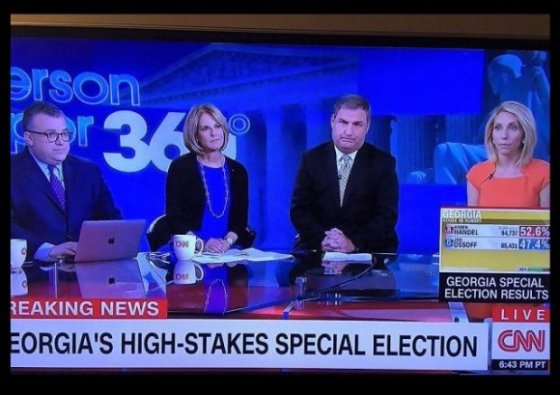
To paraphrase Oscar Wilde: one would have to have a heart of stone to read of the death of little Jon Ossoff’s Congressional aspirations without laughing. This photo of CNN’s election-night panel as the loss became apparent is pure sunshine:

 
With the hope that springs eternal, however, Dems and their media (perhaps I have that backward) are spinning their defeat as a sign of “momentum” — despite that the Republican victor’s margin in Georgia’s Sixth District was considerably larger in yesterday’s contest than Mr. Trump’s was in the general — and imagine that they are now perfectly in position for a “wave” election in 2018.

As they say down South: bless their hearts.

That Ship Has Sailed

Our previous post mentioned an article at National Review by David French. I’d also like to comment on another item by Mr. French, published two days earlier.

The piece was a commentary on Wednesday’s rifle attack, by left-wing kook James Hodgkinson, on Republican members of Congress as they practiced for a baseball game. Mr. French notes the increasingly harsh and angry tone of political discourse these days (perhaps I shouldn’t even call it “discourse”, as the word implies actual conversation), but worries about suppression of political speech in response. Rather, he argues, the problem is not with our liberty to speak, but lies an underlying degradation of comity, cohesion, compassion, and conscience.

We read:

The American experiment is built on a concept that’s rarely discussed in modern politics: ordered liberty. Edmund Burke famously and correctly argued that “the only liberty that is valuable is a liberty connected with order; that not only exists along with order and virtue, but which cannot exist at all without them.’ When John Adams insisted that “our Constitution was made only for a moral and religious people’ and that “it is wholly inadequate to the government of any other,’ he was getting at the same point.

All too often, the response to a breakdown in this scheme ”” and make no mistake, an act of political terrorism represents just such a breakdown ”” is to try curtailing liberty, rather than repairing moral order. The gun-control debate is a perfect example: A criminal violates the law, and invariably the cry rings out for more law and less freedom. The free-speech debate (especially on college campuses) is following suit: In response not just to crime but even to the “injury’ of hurt feelings, the cry rings out for more law and less freedom.

The answer, says Mr. French, is not a call for “civility”, which is a superficial remedy that only suppresses the symptoms. We must, he argues, get at the disease itself:

What we’re losing isn’t so much “civility’ but the fundamental worldview in which even our ideological enemies are seen as human beings created in God’s image and in which an “ends justifies the means’ instrumentalist morality is shunned in favor of respecting universal moral standards that bind both sides.

Despite our fraying social fabric, ordered liberty still exists. In fact (and ironically, given our gun-control debates) there’s one American community that exhibits a demonstrable commitment to it: concealed-carry-permit holders. They carry weapons every day (that’s the liberty) and yet they commit crimes at lower rates than even police officers (that’s the order). In fact, the exercise of their liberties is inextricably linked to their respect for order.

That’s how the system should work. That’s how it was designed to work. Absent virtue, liberty can lead to disorder. In the face of that disorder, however, we shouldn’t restrict liberty; we should rebuild virtue. That doesn’t mean standing down in the great political conflicts of our time, but it does mean standing up for a deep truth: Freedom carries with it responsibility, and that responsibility includes respecting the fundamental humanity and individual dignity of even your greatest foes.

I find nothing to disagree with in any of this. The diagnosis is correct, and the essay expresses a noble yearning: let us arrest our decline by rebuilding virtue!

To this I must ask, however: upon what foundation, exactly, is virtue to be rebuilt? Upon our cherished Anglo-American traditions? Upon our sense of familial and cultural commonality, and our sharing of history and heritage? Upon the sacred principles of our Christian beliefs? Upon our reverence for the past, and our sense of duty to the future? Upon our modern-day cultural priorities of frugality, self-sacrifice, discipline, and deferment of present enjoyment for the sake of the greater good?

You see the problem, of course. Read the essay here.

The French Defense

You may have heard about a depressing criminal case here in Massachusetts, in which a young woman, Michelle Carter, was accused of involuntary manslaughter for talking her boyfriend into killing himself. Ms. Carter was found guilty just the other day.

There’s no question that Ms. Carter did an evil thing. I had serious misgivings about the verdict, however — and so apparently did National Review‘s David French, who wrote a brief and lucid item about the verdict. Here’s the gist:

I see two serious problems with this verdict ”” one moral, the other legal. First, Conrad Roy is responsible for his death. To argue that Carter committed manslaughter is to diminish Roy’s moral agency. It denies his free will. It’s wrong to deny compassion to someone so troubled that they’d attempt suicide, but we can’t move so far in the other direction that we race to find who’s “really’ to blame when a person voluntarily takes their own life. It’s still an act of self-murder, and while Carter undoubtedly played a persuasive role, I can’t imagine where we will draw the line. Will we prosecute mean people for manslaughter when troubled teens kill themselves?

Second, there are real First Amendment implications with this verdict. Carter’s actions were reprehensible, but she was sharing with him thoughts and opinions that he may have found persuasive but had the capacity to reject. A legal argument that renders otherwise-protected speech unlawful because it actually persuades would blast a hole in First Amendment jurisprudence.

Exactly right, I think. What Ms. Carter did was monstrous, and the memory of it should haunt her for the rest of her days. But law and conscience are two very different things, and the verdict was mistaken.

Read the rest of Mr. French’s article here.

Living On The Edge

The other day I went for a stroll along the shore here in Wellfleet. The Outer Cape is very nearly the easternmost extension of the continental United States (save for a stretch of coastline in eastern Maine), and as I stood facing the sea I was aware of standing precisely on the boundary of two vastnesses: the great and stormy Atlantic before me, with the whole American continent stretching out behind.

But there was more to it than that: I stood also on the exact limit of a vertical frontier. Beginning precisely at the soles of my feet was nearly eight thousand miles of solid Earth, while above me the thin blue sky soon gave way to infinite and empty space.

As I thought about this I remembered that there was still another sense in which we all stand upon an edge, a boundary, a frontier: our occupation of the mysterious place that we call the present. It is always vanishing, but always with us; it is infinitesimally small, but somehow it is where everything happens. Behind us, like the vast American continent, is the past; it is, like the land itself, “written in stone”. Ahead is the future, as teeming and unknowable as the ocean.

Cold Civil War Heats Up

A disgruntled Bernie Sanders supporter directed rifle fire at a Congressional baseball-team practice in Alexandria today. The House majority whip, Steve Scalise, was shot in the hip, and several others were injured as well, including two Capitol policemen. The gunman, 66-year-old James Hodgkinson of Belleville, Illinois, was killed. He had apparently asked Rep. Ron DeSantis, moments before the shooting, whether the people on the field were Republicans. (They were.)

Given that this was a man using a rifle from some distance away, it is remarkable that there weren’t many deaths (although as I write there are some reports that one of the injured has died). Some wags on Twitter have remarked that the body count would have been a great deal higher if it had been a right-wing shooter, because lefties generally know nothing about guns.

I won’t comment further, for now, other than to say that nobody should be surprised by this.

Service Update

I must apologize for the lack of content here over the past week or so. As I mentioned earlier, it’s been a busy time: sadly, I still must labor to earn the daily crust, and meanwhile we have been preparing for a wedding. (Also, on Monday the 12th, the lovely Nina and I celebrated our thirty-fifth wedding anniversary. How this beautiful, cheery and intelligent woman has put up with a dyspeptic gnashgab like me for so long I can’t imagine, but there it is.)

The real problem, though, is simply that for a little while now the Muse has been silent, and so the usual topics have left me more than a little flat. The news drones on: another terror attack somewhere; more political team-sport in Washington; more climate-change hysteria; more entropic postmodernist absurdities; more lefty religion (but I repeat myself); more celebrity-gawking; more outrage; more hashtags — just more and more of all of it, without even enough variety to make it really worth commenting on. Usually I would go on doing so anyway, to quote Mencken, “for the same reason that a hen goes on laying eggs”, but every now and then the ovary shuts down for a bit, and you start to feel you’ve said what you have to say. This is one of those times. They never last very long.

Plug

Tired of the crap the kids are listening to? Do yourself a favor and buy this album, made by grownups.

Trust me on this; I know about these things.

Service Notice

A busy few days here. Back in a bit.

Cower Of London

Here’s Ed West, writing in the “Speccie”:

The reason we keep on hearing about ”˜British values’ uniting our nation is precisely that they don’t; communities that genuinely do have a sense of group feeling don’t need to go on about a set of values that supposedly binds them. Why would they? This is not just about immigration; since the Second World War at least western societies have had a huge growth in values diversity, people being freer to chose their lifestyles; the internet has accelerated this. But these sort of values-diverse societies can only really run smoothly on the understanding that no one tries to blow the others up.

Yes, that no one tries to blow his neighbors up is a necessary condition for a happy and harmonious society, but it is hardly a sufficient one. It is, perhaps, sufficient for a well-functioning hotel, or parking facility — but not for a community, and certainly not for a nation.

Meanwhile, new vehicle-proof bulwarks have been installed on London’s bridges, as England’s descent into a wartime security state accelerates. (When you won’t build a wall around your country, you must build walls around everything inside your country.)

I’m glad that my father, who grew up in London and lived through the Blitz, didn’t live to see this. I’m sure he’d think it is far worse: what he saw in that hour was an ancient nation and people adamantly resolved to defend their home and culture, no matter the cost; what he would see today in the city of his birth is a deracinated and exhausted people adamantly resolved to do anything but.

Western Man


Bon Débarras!

We note with satisfaction that President Trump pulled us out of that Paris-Agreement boondoggle yesterday. We never should have been in it in the first place: it was never put to Congress, and we signed up solely on the whim of Barack Obama, as a demonstration of sacerdotal virtue.

The “motte-and-bailey” style of the left’s arguments for remaining are amusing: on the one hand we hear that the contract was nothing to worry about, as it didn’t even bind us to anything, and on the other we’re told that our withdrawing from such a casual, non-binding agreement will, somehow, lead to the extinction of all life on Earth in the next few years.

If you haven’t read the thing, you can do so here. If you thought it must be a straightforward document having only to do with things like carbon sequestration, you’d be very much mistaken: it’s full of the usual religion about “gender equality”, “empowerment”, “intergenerational equity”, “Mother Earth”, and so on. It also imagines that we have the puissance to be able to clamp a 2° C lid on temperature increase, while at the same time it ignores all of the benefits — and there would be significant agricultural benefits — of a warmer climate and higher CO2 levels. (Carbon dioxide is plant food, and is currently at very low levels compared to earlier eras of Earth’s history.)

Mainly, though, it serves two holy purposes: to sluice money away from wealthy nations, and to “empower” a global priesthood of bureaucrats, busybodies and uplifters, guaranteeing them employment and enrichment as they lead us through the purifying process of salvation through atonement.

But I’ve said enough; I’ll turn things over to Lewis Amselem, a.k.a. Diplomad, who would like to add a few remarks of his own. Before you go, though, be sure to watch this brief message from one of the founders of Greenpeace.

Render Unto Caesar

Our e-pal Bill Keezer has sent along an essay by Ian Hutchinson, a professor of nuclear science and engineering. Dr. Hutchinson is also a Christian, and his article is a riposte to people like Lawrence Krauss and Richard Dawkins, who flatter themselves that the certainty of their atheism is grounded in truth, rather than their own scientistic faith. (I used to share this belief myself until quite recently, so I know how convincing it can be.)

Dr. Hutchinson presents three hypotheses about the Resurrection. Hypothesis #2 is a clear and concise critique of scientism, one of the best I’ve read.

The essay is not long. Read it here.

Any Questions?

If you’re planning to major in political science at New York’s Hunter College, you can earn three points by taking a course called “Abolition of Whiteness“.

You may now be thinking something like this:

“Wow, that’s some pretty blatant racism there; it almost sounds like a call to genocide. Somebody should ask these people: what if it had been called ‘Abolishing Blackness’, or ‘Hey, Let’s Get Rid of the Jews’? Would that be OK?”

If so, what you are doing there is all wrong, and you need to “wise up”; you’re looking for principled consistency in the wrong place. There is a consistent principle here, but it isn’t the one you think it ought to be. As John Glanton has explained, it is, rather, a very simple one:

You have to admire the Left for its clarity of vision. It has identified its enemies, and it does what it can to drive them from the field. The recent fireworks in Indiana are a perfect illustration. Team blue knows that Christians are hateful homophobes, and so it goes to bat for the right of homosexuals to sue them over wedding cakes. The Right, with its characteristic acumen, mistakes this bushwhack for a principled stand. “Ah!’ they say, “But if you support the right of a gay man to force a Christian to make a cake then you must support the right of the KKK to force a black baker to make a cake!’ The average liberal couldn’t imagine a more irrelevant rejoinder. They aren’t making any such proposition at all. In their calculus, Christians (of the Not-fans-of-Pope-Francis type at least) are the bad guys and thus their interests are hateful and invalid and must be opposed. The KKK are bad guys and thus their actions are hateful and invalid and must be opposed. You attack bad guys. You don’t attack good guys. Whence the confusion?

The principle, then is as old as human affairs. It is nothing more or less than this:

We hate you, and we want you gone. Whatever that takes.

If you haven’t understood this yet, you haven’t understood anything.

Domino Theory

Here’s a video clip that dramatically illustrates an interesting and counterintuitive fact: a small domino can knock over a domino up to 50% bigger than itself. This means that this knocking-over can very quickly “scale up”.

 
How is this possible? The first domino in this video can’t weigh more than a gram, while the last one weighs a hundred pounds. The answer is that the energy released is put into the system when you stand the dominos up, and because dominos are tall and thin, they are “tippy”. All that’s needed is for each domino to release enough energy to get the next domino’s center of gravity shifted far enough that it is no longer over the footprint of its base.

This is rich in metaphoric and isomorphic possibility. What else might be “tippy”?

Eat A Peach

I’m saddened to note the death of yet another important musician of my generation: Gregg Allman, at the age of 69. They seem to be going faster and faster now.

Introducing: The 2022 Cadillac Eris!

I predict:

Before too much longer, new cars will come with an autonomous, “self-driving” mode. In the beginning, at least, this will be an option that drivers can switch on or off.

There will be a great many married couples of “a certain age” in which the wife will want the husband to use the self-driving mode, and he won’t want to. In this way technology will bequeath to us a brand-new source of marital discord — pretty much the last thing anyone needs.

This one’s nowhere near as dire as most of my predictions, I realize, but I make it with high confidence.

The Church of Christ Without Christ

I’ve just run across a really excellent essay, from 2014, about our hegemonic modern religion — a religion that the author, Joseph Bottum, correctly identifies as deracinated Protestant Christianity.

The essay is long, but there is very little in it for me to disagree with. To the neoreactionary reader it will sound some very familiar Moldbuggian notes.

Read it here.

It’s Turtles All The Way Down

From the Federalist: a reasoned response to a student’s claim that quiet, wood-paneled rooms at universities are a form of oppression.

The problem, of course, will be that the very idea of persuasion by “reasoned response” is itself an oppressive cultural artifact.

And so it is: it is how our culture oppresses unreason. Unfortunately, this creates a “disparate impact”. I’m afraid it will have to go.

Stairway To Hell

Mark Steyn weighs in on Manchester, here. A longish excerpt:

A few months ago, I was in Toulouse, where Jewish life has vanished from public visibility and is conducted only behind the prison-like walls of a fortress schoolhouse and a centralized synagogue that requires 24/7 protection by French soldiers; I went to Amsterdam, which is markedly less gay than it used to be; I walked through Molenbeek after dark, where unaccompanied women dare not go. You can carry on, you can stagger on, but life is not exactly as it was before. Inch by inch, it’s smaller and more constrained.

And so it will prove for cafe life, and shopping malls, and pop concerts. Maybe Ariana Grande will be back in the UK – or maybe she will decide that discretion is the better part of a Dangerous Woman’s valor. But there will be fewer young girls in the audience – because no mum or dad wants to live for the rest of their lives with the great gaping hole in your heart opening up for dozens of English parents this grim morning. And one day the jihad will get lucky and the bomb will take with it one of these filthy infidel “shameless” pop whores cavorting on stage in her underwear. You can carry on exactly as before, but in a decade or two, just as there are fewer gay bars in Amsterdam and no more Jewish shops on the Chaussée de Gand, there will be less music in the air in western cities. Even the buskers, like the one in Manchester’s Piccadilly Gardens today serenading a shattered city with “All You Need Is Love”, will have moved on, having learned that it’s a bit more complicated than that.

I am currently reading Douglas Murray’s fine book, The Strange Death of Europe, which lays out, unsparingly, the central illusion of the last half-century – that you could demographically transform the composition of hitherto more or less homogeneous nation states on a scale no stable society has ever attempted, and that there would be no consequences except a more vibrant range of local restaurants.

Then this:

As I asked around Europe all last year: What’s the happy ending here? In a decade it will be worse, and in two decades worse still, and then in three decades people will barely recall how it used to be…

Mr. Steyn is exactly right. It is, sadly, the brevity of human lifespans that makes such decline so easy. The world is new, and therefore normal, to each generation; it is only the old who can see clearly the value of what has been, and is being, lost and forgotten. But they are old, and weary, and soon they die.

European civilization is old, too, and soon will do the same.

Scoop!

From the Washington Post, a penetrating insight:

Some in Manchester, and beyond, see the attack as one that targeted women and girls

To read the whole story, go to the Post‘s online search-box and enter the keyword “DUH”. Or click here.

Pet-Rock Democracy

Here‘s a good piece by Victor Davis Hanson on our current political hysteria. And while we’re at it, don’t miss Buchanan’s latest.

PS – just saw that our e-pal David Duff had linked the Hanson piece as well. It’s making the rounds.

Bismillah

A jihadi blew himself up in Manchester, England last night, at a pop concert crowded with teenage girls. There will be the usual effusion of pious public responses, followed by some incremental increase in the hindrances, indignities and surveillance imposed on innocent Westerners in their homelands. There will then be a lull of indeterminate duration, another attack somewhere, further effusions, and another click of the ratchet.

The Twitter humorist Iowahawk had this to say:

As Steve Sailer once wrote: “Political correctness is a war on noticing”. Most dangerously it appears to keep us from noticing what I have called The Obvious Thing:

Allowing mass Muslim immigration is the stupidest and most irreversibly self-destructive thing that any Western nation can do.

If it is axiomatic, though, that diversity trumps civilization (or even, for unlucky citizens, survival), then it’s all beyond our control; you might as well shake your fist at the weather. London’s Muslim mayor, in good Oriental fashion, has advised us to take this fatalistic view: “these things” are just “part and parcel of living in a great, global city”, and we’d better be prepared to endure them. (We might point out that London, which has been a “great, global city” for many centuries, never had to worry at all about explosive Muslim martyrdom until Britain admitted millions of the Prophet’s followers, but that would be “noticing”.)

After the truck attack in Stockholm last year, former Swedish PM Fredrik Reinfeldt noted that these things are the “price of an open society”. This generalizes well: for example, psychosis and early death are the price of a methamphetamine addiction.

So let’s all give a worldly shrug, post a hashtag or two, and and move along. After all, what can be done?

Graecopithecus freybergi

Big news, if true: humans emerged in Europe, not Africa.

Facing Down The Witch-King

Following on our previous post, our reader and commenter “Whitewall” has sent along a link to a post by the professor of history at the University of Chicago who was, as it turns out, the object of Dr. Karl Seigfried’s fulminations.

The post, a brave and rational woman’s response to a darkening madness that seeks to engulf her (and all the rest of us), is at her blog Fencing Bear At Prayer. I will be visiting often.

The West is at war with a fell and implacable foe, and this embattled scholar is on the frontlines. May the righteousness of our cause give her strength, and may she keep her sword in hand.

The Very Model Of A Modern Marxist Jabberwock

Our reader and commenter Robert, a.k.a. “Whitewall”, has sent along an item from the University of Chicago Divinity School’s newsletter Sightings. It’s a fascinating glimpse into the mind of the postmodern cult-Marx priesthood that haunts the halls of the 21st-century Cathedral. (That is to say, the ones who are responsible for the grooming and education of the pupae of our cultural and social elites.)

The author has an interesting bio:

Dr. Karl E. H. Seigfried is an author, educator, and performer finishing his third graduate degree, an MA at the University of Chicago Divinity School. He is President of Interfaith Dialogue at the University of Chicago and the first practitioner of ÁsatrÁº to enter one of the Divinity School’s graduate programs. His biography, publications, and contact information can be found at www.norsemyth.org.

The problem addressed in Dr. Siegfried’s essay is one that most of us wouldn’t find particularly clamant: the paucity of non-white academics specializing in medieval European history and literature, and how very little of that history and literature seems to focus — clearly because of bias and oppression — on medieval Europeans “of color”.

That would be bad enough all by itself, but what truly makes makes this a full-blown crisis for Western civilization is that certain groups of people have dared to claim this heritage as their own, and to celebrate it, not without some pride, as distinctly European. Shockingly, the story doesn’t end there: the people doing this seem overwhelmingly to be white.

Given that this poses a threat to human survival on a par with the Toba bottleneck, something must be done. The problem, however, is that those who actually take even the slightest interest in medieval European history tend overwhelmingly, for some reason, to be people of pallor (such as Dr. Seigfried himself).

Clearly, then, drastic action is needed:

The clearest way forward is one that even many progressive scholars don’t want to hear about: affirmative action in academic hiring. This is the clearest answer, not the simplest or the quickest. We need a coherent system designed and put into place by individual departments with support from their parent institutions, and we need it now.

Commitment to hiring members of underrepresented communities as tenure-track appointments will not work out without a wide pool of postgraduates in the given field. Wide pools of postgraduates will not exist without diversity within undergraduate programs. Diversity within undergraduate programs cannot happen without robust recruiting at the secondary education level. There must be simultaneous commitment at all levels for any real change to happen.

All good, of course, but I’m not sure that Dr. Seigfried’s plan of attack is sufficiently comprehensive. We should consider some sort of intervention in utero.

This is not to say, though, that Dr. Seigfried isn’t taking the crisis seriously. He continues, with admirable boldness (my emphasis):

Departmental hiring committees have to move beyond tired claims of objectivity that regularly lead to the whitest candidate being the one hired and instead declare, for example, that the next five hires must be made from underrepresented communities.

There is simply no more time to waste on idle chit-chat, people. As Dr. Seigfried explains:

When neo-Nazis are literally marching in the streets looking to assault anyone who denounces their beliefs, we need to stop the endless parsing and take action.

I had rather thought it was the other guys doing most of the marching and assaulting, but obviously I’m out of touch. To the ramparts! There isn’t a moment to lose.

Read the rest here.

Peccavi

Recently I quoted Col. Jeff Cooper. Our e-pal Bill Keezer passed along the quotation to Bill Vallicella, who reposted it on his blog.

Bill did, however, notice that I had offered no source, and remarked that he doesn’t like unsourced quotations. He looked for a source, and couldn’t find one. I can’t either. I have amended the post.

Bill’s right: this was an oversight. I have no reliable way of knowing that Jeff Cooper actually said or wrote this, and I should have made that clear. Not to do so is indifference to the propagation of error. (That’s not to say that the attribution is in fact erroneous — but it might be, and I posted it with indifference to whether it is or isn’t.)

Caveat lector: as Abraham Lincoln once said, “Don’t believe everything you read on the Internet.”

Of Machines and Monkeys

In a response to our Jeff Cooper quote a couple of posts ago, commenter Uriel Fiori linked to a post from 2013 by Nick Land. That post, at his blog Outside in, is called “Monkey Business”, and it discusses a tension in neoreactionary thinking about something called “orthogonalism”.

Simply put, “orthogonalism” is a way of thinking about telos, and the question of means and ends. The orthogonalist assumes the existence of ends that transcend any means available to them. We must eat, but not for the sake of eating; we eat to preserve life. The provision of food is not, therefore, an end in itself. This can be generalized to economics as a whole; the purpose of capitalism, for example, is not the maximization of resources per se, but is rather to increase the availability of resources that are necessary preconditions for the satisfactions of other, more human ends, such as the mitigation of poverty and hunger, and the increase of degrees of human freedom that results from the elimination of high-priority requirements that must be satisfied before other uses of our time and attention can become possible. In other words, there is a sort of triage that necessarily occurs in human life, with something, not always clearly defined, at the apex of the hierarchy of purpose.

This implies, for example, that when capitalistic maximization of resources becomes an end in itself, and other human values are subverted or subordinated to that aim, it is a “means-end-reversal” that will be pointed out and resisted by orthogonalists, who believe that the ultimate end is indeed, and will remain, transcendent. The question for the orthogonalist then becomes: what is at the apex of the hierarchy of goals, and why?

Read More »

Coming Apart

I’ve mentioned Charles Murray rather a lot recently; this is because he is often in the news lately, and has been right on the frontlines of the culture war. The pillorying and excommunication of this meticulous and mild-mannered scholar also shows the extent to which ideological and cryptoreligious loyalties and prejudices have contaminated science as well as culture. The only upside to any of this is that his plight, as miserable as it must certainly been for him, has shocked a lot of other academics into a fresh realization of how bad things have gotten. (E.O. Wilson was subject to the same treatment back in the late 70’s, but I think that many might have imagined that things had got somewhat better since then. They haven’t, and I imagine Dr. Murray is, at this point, about three-quarters of the way to becoming a full-blown reactionary. We’ll be very proud to welcome him to the fold.)

Recently the young-adult website Vox posted a “debunking” of Dr. Murray’s work, here. It not only attacked Dr. Murray himself, but Sam Harris for being taken in by it all in his recent podcast with Dr. Murray (which we linked to here).

Here’s a response.

No One Sings Like You Anymore

I note with great sadness the death of Chris Cornell. He was a musician of exceptional gifts; in particular, I consider him one of the greatest vocalists in the history of rock music. He will be deeply missed.

One Thing Leads To Another

“If there is one fact we really can prove, from the history that we really do know, it is that despotism can be a development, often a late development and very often indeed the end of societies that have been highly democratic. A despotism may almost be defined as a tired democracy. As fatigue falls on a community, the citizens are less inclined for that eternal vigilance which has truly been called the price of liberty; and they prefer to arm only one single sentinel to watch the city while they sleep.”

– Chesterton, The Everlasting Man

Power Tools

“Weapons are the tools of power. In the hands of the state, they can be the tools of decency or the tools of oppression, depending on the righteousness that state. In the hands of criminals, they are the tools of evil. In the hands of the free and decent citizen, they should be the tools of liberty. Weapons compound man’s power to achieve whatever purpose he may have. They amplify the capabilities of both the good man and the bad, and to exactly the same degree, having no will of their own. Thus, we must regard them as servants, not masters”“and good servants of good men. Without them, man is diminished, and his opportunities to fulfill his destiny are lessened. An unarmed man can only flee from evil, and evil is not overcome by fleeing from it.’

”” Attributed to Col. Jeff Cooper

Emmanuel Goldstein Murray

Recently the social-sciences scholar Charles Murray was assailed by a hate-filled audience at Middlebury College. It happened again today in a Congressional committee room.

Watch the video here.

Tank Slapper

I haven’t written much about the ongoing siege of the Trump presidency; I haven’t frankly, had much to add. But I should say something, I suppose.

It should be obvious to all that a bloodthirsty coalition of the media and members of the United States Government (especially, in the latter category, members of the judiciary and the intelligence community) are waging a bitter, take-no-prisoners campaign against this sitting President, using everything they can lay a hand on. From the start there has been a torrent of leaks, obviously coming from people with privileged access (and therefore also, obviously in many cases felonious), and the press has, in every news cycle, done everything in its power to damage and destabilize Mr. Trump’s administration. Every day is another barrage of unsourced accusations, and (in particular) charges of treasonous collusion with Russia for which no evidence is ever given.

There is not the least attempt at coherence or consistency. Things that were defended (or, at least, ignored) when Democrats did them — like sharing anti-terror intelligence with Russia, or alleged carelessness with classified material, or believing James Comey shouldn’t be the FBI director — are front-page scandals for Mr. Trump. (What this shows is simply that looking for such consistency, is naive, as we’ve pointed out before.)

Now Ross Douthat of the New York Times is calling for the removal of Mr. Trump using the mechanism outlined in Section IV of the Twenty-Fifth Amendment: the Vice-President and Cabinet declare him “unable to discharge the powers and duties of his office” — and should the President disagree, a two-thirds majority of both houses of Congress chucks him out anyway.

I doubt that this could happen, but you never know. I do know that if it does happen, it will be seen by scores of millions of Americans as a forcible usurpation of the man they sent to Washington to “drain the swamp” — by the very snakes, leeches and reptiles they sent him there to do battle with. It will ratchet the nation another step closer to dissolution (or worse).

I’ve said for a while that politics in America are divided beyond all hope of healing, and that the civic and social cohesion that is absolutely essential for the central governance of such a vast and diverse nation is irreparably destroyed. It has seemed inevitable to me for at least five years that the United States, as presently constituted, will not exist very much longer. One metaphor I’ve used for the state of our politics is the way a car goes off the road: the driver sees, almost too late, that he’s drifted out of his lane, steers wildly back to center, overcorrects, yanks the wheel even more frantically back the other way, and after a few iterations of this ends up losing control altogether, with disastrous consequences.

With that metaphor in mind: if you’re wondering about the title of this post, here’s a video that should make it clear. I think the term deserves wider currency.

The Future, By The Numbers

Making the rounds is a video by Mark Steyn in which he discusses the demographics of Europe and Africa, and Steve Sailer’s “Most Important Graph In The World“.

Take particular note starting at 9:55, if you’ve been wondering why Europe’s leaders don’t seem to give a damn about the future.

Stuff To Read

I’m busy in the obvious ways this Mothers Day (Mother’s Day? Mothers’ Day?), so I’ll just pass along two articles that are worth your time: Angelo Codevilla on our cold civil war, and Erik Kuehnelt-Leddihn on three ways that democracies become tyrannies (the Tocquevillean model, quoted here just recently, is number three).

Word Of The Day

Two, actually: baizuo, and shengmu. They’ll come in handy.

Learn more here.

Update: I was remiss not to give a hat-tip to Nick Land for this.

You May Say That I’m A Dreamer…

If I may, readers, I beg you to allow me a momentary departure from our customary rigor and gimlet-eyed realism:

Conjure this up in your mind’s eye: a nickel-iron meteorite, ten or twenty meters in diameter, plows into the National Mall at high velocity on a busy autumn weekday. In stroke, it’s all gone — Congress, the White House, Treasury, Foggy Bottom, Justice, EPA, IRS, K Street, the pundits, the whole enchilada. Just gone. Just a big smoking crater where it all used to be, with, after a little while, a lot of curious Americans peering over the rim…

Just a fantasy, of course, and needless to say the chaos that would follow would be spectacularly awful (not to mention the tragic deaths of all the innocent Washingtonians — of whom, I understand, there may be as many as several dozen — who would perish in the initial impact). But as I read the news day after day, it’s hard not to think about how splendid it would be if we could just, somehow, make it all go away, and give the whole thing another try.

For most of the nation’s history, the Federal government played an almost unnoticeable role in most Americans’ lives.

Imagine!

Ship Of Fools

When I linked to Andrew Sullivan’s New York article about neoreaction last week, I hadn’t realized that it was just one piece of a much larger Festschrift the magazine had thrown together for its April 30th edition. I’ve just had a look at the rest of it.

The collection is, like the modern West itself, large and weak; it is really nothing more than an extended “point-‘n’-splutter”, with scarcely an attempt at rebuttal. The editors clearly think that the core tenets of reactionary thought — e.g., that the West is in serious trouble, and that central aspects of modernity such as democracy, secularism, universalism (and the doctrine if human uniformity that universalism entails), and radical skepsis regarding every tradition and natural category, are at the root of the problem — are so obviously absurd that mere mention of them suffices to discredit the movement. The shallowness, and smug confidence, on display here are impressive; that an editor of a major publication could, for example, completely dismiss the profoundly cultured and erudite Julius Evola with the sentence fragment “Quasi-fascist esoteric weirdo who pretended to be a baron and sported a monocle” betrays a blithe and unreflective ignorance so stupendous that it startles even me.

Imagine, readers, that the West is the Titanic. On the one hand, you have a group of passengers who felt a heavy impact in the night, and have noticed the deck beginning to tilt. They have realized that the situation is dire, and are trying to wake the others.

Among these vigilantes are sailors and engineers with expertise in both the ship’s design and the particularities of the local waters. While calling for the lifeboats, they have also arrived at some well-informed opinions about how this slow-moving disaster happened, and how such things might be avoided in future. They will point out that this part of the North Atlantic is full of icebergs in April, and that the ship had been moving too fast to be able to see its way ahead. They will also point out issues with the design of the ship (below-decks compartments that can fill with water like an ice-tray), and with insufficient caution on the part of the captain and crew (leaving watertight doors open that ought to have been sealed). Those who survive will also remark upon the overweening confidence of the ship’s designers, and of the owners of the White Star Line, in the vessel’s “unsinkability”. As we all know now, the Titanic was very sinkable indeed.

On the other hand, you have the editors of New York magazine, munching hors d’oeuvres and enjoying the band. Their comments are here, if you’re inclined to bother.

The Edacity Of Hope

According to the Express, Barack Obama is going to be paid $2.5 million dollars for a speech he’s giving in Milan today. This follows on a $400,000 speech he gave on Wall Street a while back, and a $65-million advance he and his wife were given for books they (or someone) will be writing.

Mind you, as far as I’m concerned he’s welcome to get what he can for his road-show. If that desiccated harpy Madonna can go on tour and pull in $300 million, why shouldn’t Barack Obama put his snout in the trough? (I almost said “more power to him”, but I think we’ve had quite enough of that for a while, thank you.) I will, though, just remind Him that He once told us “I do think at a certain point you’ve made enough money.” (In fairness, I suppose we should keep in mind that he never said what that “certain point” actually is.)

So: why am I bringing this up? Not, I assure you, to try to enforce some sort of ethical consistency on the part of a Machiavellian left-wing ideologue and preening, unshameable narcissist; I might as well holler up a drainpipe. I’m simply presenting it as evidence that such consistency is nowhere to be found, that those who tell you otherwise are at best fools, and more often liars, and that those who take the moral high ground to lecture us about civic virtue are usually found, on closer inspection, to be standing atop a large and growing pile of dollars.

A Bit More Optimistic?

I just paid a visit to Bill Vallicella’s website — I hadn’t stopped by in a couple of days — and saw that he had mentioned me in a recent post. Bill quoted a remark he had made in a comment-thread back in 2015:

We need a broad coalition of the sane which would include many libertarians, the few liberals who haven’t lost their minds, and most conservatives, with each subgroup tempering its own tendency toward extremism.

I had replied:

I used to hope for this, and believe it was possible, but now, to my sorrow, I just can’t see how it is ever going to happen. With every passing day, and every tick of the demographic clock, we move faster and faster in the opposite direction, and I can see in America today nothing even remotely resembling a coherent political opposition on the Right. As I wrote in my letter to you, I think we have slipped past the ‘event horizon’, and all future timelines now must pass through the singularity. What form that will take, and what will come after, I can barely imagine — but I don’t think it will be pleasant for anyone.

In his post of two days ago, Bill asks whether I am “a bit more optimistic” now that Donald Trump has been elected. It’s a good question. I’d certainly like to be, but to know if such optimism is warranted it’s important to be clear about what our problems are, and whether they are more likely to be solved now that Trump’s in office. Here are a few:

1) The collapse of the culture. Just today Bill posted a piece by Victor Davis Hanson about the near-total victory of the radical Left in our academies. Given that universities are upstream from the ideological future, and that these are where the next generation of ruling elites are likely to come from, it’s hard to see much call for optimism there. I note also the relentless erosion and corrosion of all civilized norms and mores, and the relentless vulgarization of language and discourse. The level of gratuitous obscenity that is routine in public media today would have been unthinkable when I was younger; for a very recent example there is Stephen Colbert’s referring to Donald Trump’s mouth as “Vladimir Putin’s cock holster” on network television. We have fallen very, very far indeed — and as is usual for falling things, the velocity is increasing.

2) Disintegrating social cohesion. As Bill has said himself, many times, “there is no comity without commonality” — and in contrast to the America of our youth, where there was near-universal commonality of basic cultural, historical, ethical, and social axioms, there is almost nothing that is culturally universal anymore. On the “progressive” left, the only solid principles (and they are not even mutually consistent) seem to be (a) that one must make up one’s axioms as one goes along, even as regards the most fundamental and categorical truths of the external world, and (b) that those axioms must fall within very narrowly circumscribed ideological guidelines, which include, first and foremost, the awarding of status according to a towering hierarchy of “oppression” — with the natural and traditional principles that have always provided the scaffolding of civilization sitting at the apex of that pyramid. (Bill himself has posted, just today, an enumeration of just a few of these incommensurable social and ethical postulates.)

Moreover, an essential element of social cohesion has always been a culture’s sense of extension in time, of the present as a link in a chain between past and future, and of living generations being duty-bound to good stewardship of the labors and heritage of the past for generations yet unborn. This “transmission belt”, essential for the survival of any society, is now broken: where the past is not simply forgotten, it is remembered only to be despised. In 2013 I described this problem, and lamented that “we are cut off from both past and future, imprisoned in the present as no generation of people has ever been before.” This pernicious presentism has only gotten worse in the four years since, and the society that I described back then as “this tottering, gibbering thing, this fly-blown, stitched-together corpse of a “culture’”, has only advanced in its decomposition. So: optimism? I think not.

3) Demographic change. The crumbling of social cohesion is accelerated by the pernicious ideologies of universalism, postmodernism, and multiculturalism. They work in destructive combination — and deny, respectively, the existence of persistent and innate differences between human populations, the foundation of objective truth upon which any possible evaluation of such differences might be made, and the importance of commonality for social cohesion (and by extension, social survival). Under this unholy trinity of principles, the West has been flooded for decades now with profoundly alien and unassimilable immigrants, and has willfully blinded itself to the consequences. It may be that the West is slowly arousing itself from its postwar stupor, and awakening to its peril — but I’m afraid it is too little, and too late. (The defeat of Marine Le Pen in today’s elections in France is sad confirmation of this: that she did as well as she did is testament to the awakening, while her resounding defeat by the Eloi cuckold Macron is tragic evidence that it is indeed too little, and too late.)

4) The deepening underclass, and the stratification and encapsulation of the well-off. As I’ve written before, societies that offer high social mobility are subject to a “boiling off” of superior qualities from the lower classes; those who can move up and out, taking their genes with them. Charles Murray’s most recent book Coming Apart looks at this problem in depressing detail, and points out also that people, having risen to higher socioeconomic strata, tend, now more than ever, to find spouses who have similar innate and acquired advantages. This concentrates talent in the upper strata, and concentrates dysfunction below. The effect of this is a widening gap between upper and lower classes, a gap that is deeply resistant to social amelioration because it is due, at bottom, to innate differences in cognitive potential and behavioral traits.

Moreover, there is a strongly correlated difference in birth-rates; members of elite social and cognitive strata have fewer children, and so there is a tendency for every high civilization to produce an ever-diminishing number of offspring having the qualities, both innate and acculturated, that are necessary to carry forward the culture’s store of knowledge, art, and literature, even as that burden grows larger and heavier with every generation. This problem is not going to get better: as far as I can tell, the lesson of history is that it never does.

5) Democracy itself, the universal franchise, and the short-term interests of politicians. I believe that we are seeing in the West the late-stage pathology of the inherent liabilities of democracy — a system that, at the time of America’s founding, had always been well understood to lead, in a few short steps, to tyranny. The Founders were rightly appalled by the prospect of democracy, knowing where it must lead, and so they did what they could to prevent its natural progression in America. But “rust never sleeps”, and so all of the safeguards against democracy that they put in place — subsidiarianism, a limited franchise, restriction of popular elections to one-half of one-third of the branches of government, and so on — have, little by little, rusted away, even as the founding culture and shared sense of heritage that were so clearly understood to be the real foundation of civic durability in America have been deliberately and irreversibly dismantled.

What we see in America now is a perfect socio-political storm: the enormous power now vested in the federal Leviathan makes control of it a glittering, and existentially important, prize; the stakes have never been so high. Meanwhile, this vast expansion of the size, power, and reach of government comes at a time when all of the horizontal ligatures, organic hierarchy, and embedding in past and future time that give a culture health, harmony and order are being deliberately and patiently destroyed. Finally, as I have written extensively elsewhere, the communication revolution of the past decade brings everything into immediate contact with everything else; just as chemical reactions proceed more rapidly under conditions of heat and pressure, social reactions that in earlier times might have taken years or decades to develop now flare and accelerate explosively — far too quickly for any measured or reflective response.

As I said above, these are only a few of the difficulties we face. (As you’ve probably guessed, I could go on at some length about all of this.) So, to answer Bill’s question: am I “a bit more optimistic” in the springtime of the Trump era than I was in June of 2015?

No. Donald Trump’s victory was gratifying, of course, mostly in that it drove a stake through the heart of Hillary Clinton’s political career — but rather than a genuine and lasting course correction, I think it was more like the way a car goes off the road: the driver sees, almost too late, that he’s drifted out of his lane, steers wildly back to center, overcorrects, yanks the wheel even more frantically back the other way, and after a few iterations of this ends up losing control altogether, with disastrous consequences. (The fact that this election came down to Donald Trump versus Hillary Clinton is itself evidence of serious and advanced pathology.)

Yes, Trump & Co. are in power now — but do things in America, and the rest of the world, seem in 2017 to be getting more orderly and civilized, or sharply less so?

Do you have the feeling that a fever has passed, and that mutual respect, good sense, and civic health are returning to American society?

Right. Neither do I.

Reacting To Reaction

Here’s a remarkably frank look at neoreaction, from the increasingly red-pilled Andrew Sullivan. I’m too busy at the moment to comment — other than to say that Mr. Sullivan still has too much universalism and Progressive optimism in him to grasp the nettle just yet — but it’s encouraging to see the “progress” our side is making. What was, just a few years ago, an obscure intellectual eddy that made not a ripple in the American mainstream is now beginning to have a noticeable effect on ideological navigation.

I hope to have more to say about Mr. Sullivan’s essay shortly.

Service Notice

After much wrangling with Bluehost, I believe the server-side caching problems we’ve been having with the site are now fixed. Please leave a comment if you see any more odd behavior.