Thread Of The Day

Here’s Twitter’s most interesting and unusual feed, @ThomasWictor, on Niger and Benghazi.

Go Not Gently!

A group of concerned thinkers, including Roger Scruton, have written a rousing manifesto calling for the defense of Europe against its accelerating cultural suicide. The document is called The Paris Statement, and it is good strong stuff. (I learned about it from this article at Reaction, where you can find additional commentary.)

You can read the Statement here. With a document of this length I will naturally have a quibble or two, but something like this — a clear and ringing declaration of European identity and purpose, that names and denounces the mortiferous ideology that has brought this great civilization to the brink of death — is Europe’s only hope. If it becomes a rallying creed for a pan-European awakening, as our own Declaration did, it might have a miraculous effect.

I will excerpt a few brief passages (and have bolded some for emphasis):

From part 1:

Europe belongs to us, and we belong to Europe. These lands are our home; we have no other. The reasons we hold Europe dear exceed our ability to explain or justify our loyalty. It is a matter of shared histories, hopes and loves. It is a matter of accustomed ways, of moments of pathos and pain. It is a matter of inspiring experiences of reconciliation and the promise of a shared future. Ordinary landscapes and events are charged with special meaning””for us, but not for others.

From part 2:

Europe, in all its richness and greatness, is threatened by a false understanding of itself… the false Europe praises itself as the forerunner of a universal community that is neither universal nor a community.

From part 7:

The true Europe is a community of nations. We have our own languages, traditions and borders… This unity-in-diversity seems natural to us. Yet this is remarkable and precious, for it is neither natural nor inevitable.

From part 9:

The true Europe has been marked by Christianity… It is no accident that the decline of Christian faith in Europe has been accompanied by renewed efforts to establish political unity””an empire of money and regulations, covered with sentiments of pseudo-religious universalism, that is being constructed by the European Union.

From part 12:

Our shared life is an ongoing project, not an ossified inheritance. But the future of Europe rests in renewed loyalty to our best traditions, not a spurious universalism demanding forgetfulness and self-repudiation. Europe did not begin with the Enlightenment. Our beloved home will not be fulfilled with the European Union. The real Europe is, and always will be, a community of nations at once insular, sometimes fiercely so, and yet united by a spiritual legacy that, together, we debate, develop, share””and love.

Part 13:

The true Europe is in jeopardy. The achievements of popular sovereignty, resistance to empire, cosmopolitanism capable of civic love, the Christian legacy of humane and dignified life, a living engagement with our Classical inheritance””all this is slipping away. As the patrons of the false Europe construct their faux Christendom of universal human rights, we are losing our home.

From part 15:

Libertine hedonism often leads to boredom and a profound sense of purposelessness. The bond of marriage has weakened. In the roiling sea of sexual liberty, the deep desires of our young people to marry and form families are often frustrated. A liberty that frustrates our heart’s deepest longings becomes a curse. Our societies seem to be falling into individualism, isolation and aimlessness. Instead of freedom, we are condemned to the empty conformity of consumer- and media-driven culture. It is our duty to speak the truth: The Generation of ’68 destroyed but did not build. They created a vacuum now filled by social media, cheap tourism and pornography.

From part 17:

Europe’s multicultural enterprise, which denies the Christian roots of Europe, trades on the Christian ideal of universal charity in an exaggerated and unsustainable form. It requires from the European peoples a saintly degree of self-abnegation. We are to affirm the very colonization of our homelands and the demise of our culture as Europe’s great twenty-first century glory””a collective act of self-sacrifice for the sake of some new global community of peace and prosperity that is being born.

Part 20:

The hubris of the false Europe is now becoming evident, despite the best efforts of its partisans to shore up comfortable illusions. Above all, the false Europe is revealed to be weaker than anyone imagined. Popular entertainment and material consumption do not sustain civic life. Shorn of higher ideals and discouraged from expressing patriotic pride by multiculturalist ideology, our societies now have difficulty summoning the will to defend themselves. Moreover, civic trust and social cohesion are not renewed by inclusive rhetoric or an impersonal economic system dominated by gigantic international corporations. Again, we must be frank: European societies are fraying badly. If we but open our eyes, we see an ever-greater use of government power, social management and educational indoctrination. It is not just Islamic terror that brings heavily armed soldiers into our streets. Riot police are now necessary to quell violent anti-establishment protests and even to manage drunken crowds of football fans. The fanaticism of our football loyalties is a desperate sign of the deeply human need for solidarity, a need that otherwise goes unfulfilled in the false Europe.

There is much, much more: the second half of the document moves from diagnosis to prescription, and it is a prescription, for the most part, that any traditionalist should applaud. Go and read the whole thing.

‘A’ For Effort

Ah, Diversity. How its worship enriches us!

It doesn’t, of course. But it does, at least, make for some last-minute entertainment, here on the deck of the Titanic.

There are some areas of human activity that lie forever beyond the reach of heartfelt wishes and fond imaginings: places where reality is still there even after you stop believing in it. One of these, for example, is competitive sports — where a runner’s velocity is still, stubbornly and implacably, distance over time. Another is engineering — which is difficult, and which makes certain non-negotiable demands. To build a bridge, or send an aircraft aloft, requires skills, talents and aptitudes that, whether we like it or not, are no more evenly distributed among the sexes and races than upper-body strength or fleetness of foot. You can rail against this all you like — and I’m sure some of you will rail against me for pointing it out. But when you’re done, there it is, nonetheless.

This means that places that do a lot of engineering are going to be staffed, very disproportionately, by members of certain population groups, and by males. For the sort of work that requires truly elite mathematical and spatial skills, the effect is going to be very noticeable indeed. This is a matter — not entirely, perhaps, but nearly so — of cold, hard statistics having to do with distributions of cognitive and behavioral traits. (As we must always point out, none of this tells you anything about any individual person. Seven-foot-tall men are far more common than seven-foot-tall women, but that doesn’t mean that they tower over them. Brilliant engineers, likewise, can be of any sex or race.)

This variety of trait-distribution is a real problem for companies like Google and Apple, who would — believe me! — like nothing better than to be able to make splendidly and durably engineered products with a workforce consisting largely, and ostentatiously, of females, blacks, Hispanics, and others likewise crushed by arbitrary forces of vile oppression. Sadly, though, the stubborn realities of the actually existing world require them to make a choice — and their having chosen good engineering over optics means that their technical staff is overwhelmingly white or Asian, and male.

This is a terrible predicament, and so they do what they can. Reality isn’t going anywhere, though, which leaves them little else to work with but theater, and spin. And so we have this news item, in which Apple’s black female Diversity chief attempts to convince her audience that if you squinch up your eyes just right, you can see Diversity anywhere — even among, for example, twelve blue-eyed, fair-haired males. You can imagine how that went over.

Mind you, in a more orderly and homogeneous (but I repeat myself!) society, such a group might, in fact, seem quite diverse. One might be a Calvinist, another a Catholic. One might be trim and athletic, another fat and flabby. One might play the bassoon, while another is putting together a Cannibal Corpse tribute band. They might vary enormously in temperament, style, political opinions, levels of education and wealth, and a thousand affinities and aversions. After all, the only things held constant here are hair color, eye color, and sex.

Ha! None of that matters, not at all. There are boxes to be checked here, comrade. Needless to say, the gambit was a failure, and the unfortunate spokeswoman was made to apologize. The problem, however, isn’t going anywhere: companies that do engineering are still going to face the same stubborn realities, and the same impossible demands.

Pass the popcorn!

As It Will Be In The Future, It Was At The Birth Of Man

From Albion’s Seed, page 896:

There is a cultural equivalent of the iron law of oligarchy: small groups dominate every cultural system. They tend to do so by controlling institutions and processes, so that they tend to become the “governors” of a culture in both a political and a mechanical sense.

The “iron law of oligarchy“: yet another reason not to worship at the altar of democracy.

Recently I quoted Mencius Moldbug:

Just as pornography can stimulate the human sex drive without providing any actual sex, democracy can stimulate the human power drive without providing any actual power.

As the Durants reminded us: “in the end superior ability has its way.”

Goodbye, Columbus

Everywhere you look, the Admiral of the Ocean Sea is out, and Indigenous Peoples are in. (Well, the indigenous peoples of Europe, not so much…)

Those of us who don’t get all our history from Howard Zinn, however, know that the Noble Savage was a good deal more savage than noble. Some details here.

C6ISR

Here’s an interesting Twitter thread, from Thomas Wictor: the world’s leading authority on WWI flamethrowers, and a most unusual fellow.

Yikes!

The volcanic island of La Palma (one of the Canary Islands) is in the news after an earthquake swarm.

Why “yikes”? See here.

The Marshmallow Test

I’ve finally been reading David Hackett Fischer’s Albion’s Seed: Four British Folkways in America. (I’ve known for years that this book was essential reading for anyone interested in the cultural history of the United States, but late is better than never.)

The book is delightfully engaging. I just came across this, in a chapter on the “building ways” of the Scottish, Scots-Irish, and English border-county settlers who populated the Appalachian backcountry (page 656):

The historiography of the log cabin has centered mostly on the history of the log, but at least equally important is the history of the cabin.

What follows is a discussion of the cabin architecture of the violent border regions of northern England and lowland Scotland. This history of violence and uncertainty is key to understanding both the prickly backcountry temperament and the low time-preference that leads people to invest so little in their architecture. Fischer quotes a long-ago historian of Scotland, John Major, who wrote in 1521:

In Scotland, the houses of the country people are small, as it were, cottages, and the reason is this: they have no permanent holdings, but hired only, or in lease for four or five years, at the pleasure of the lord of the soil; therefore do they not dare to build good houses, though stone abound, neither do they plant trees or hedges for their orchards, nor do they dung their land; and this is no small loss and damage to the whole realm.

These folkways persisted in the transplanted settlers of the region. Prosperity that doesn’t come from reaving and conquest can only come from playing the “long game”, and to do so requires low time-preference. If your culture has been shaped by centuries or millennia of rootlessness and instability (at which point, arguably, your genome has been shaped as well), this will not come naturally. The backcountry territory settled by this cohort is still among the poorest areas of the nation.

Outline For A Diagnosis Of Late Modernity: Part 1

After the Las Vegas shooting, I noted that when I was a boy guns were a common and unremarkable part of normal American life:

I grew up in a rural area of west-central New Jersey. When I was a boy, all the households around me had a gun or two. We boys used to stack up hay-bales and put targets on them (a charcoal briquette was a favorite choice) to shoot at with a .22. Schools and scout-troops often had rifle ranges; I myself got a marksmanship Merit Badge while at summer camp with the Boy Scouts. I don’t recall being aware of any gun laws at all; you could buy ammo at the general store. (Gun safety was a big deal, though, and kids were taught to handle firearms carefully and respectfully.)

This was the state of normal (non-urban, middle-class, predominantly white) American culture half a century ago. Guns were an unexceptional part of that bygone world, and were easily accessible to all of us (you could order pretty much any gun you liked through the mail, by sending cash in an envelope!). Somehow, though, we hardly ever murdered each other, and mass shootings were very, very rare.

Something, I said, had changed, and it clearly isn’t access to guns.

What is it, then? Why does the life of our society seem so degraded, and life itself so much emptier, even as our material conditions have improved? This question is better suited to a book than a blog-post, but a blog-post will serve, at least, as a place-holder for a survey of the problems and their symptoms, and pointers to further questions. In this and subsequent posts I want to look at, in no particular order, of some of the symptoms I’ve noticed in my sixty-one years. (I hope the reader will forgive me if I make liberal use of excerpts from earlier posts.)

1) One factor has been the secularization, and encryption, of religion. While a secularized crypto-religion can retain much of its form and function, the removal of the actually transcendent, and its replacement with worldly substitutes, places the apex of the cosmic hierarchy down among us, instead of above us. This not a difference in degree: it is a qualitative difference, and it leads to a disruptive change in the effect of religion on human societies.

From April of last year:

The religious impulse, the need for sacred objects, and the hunger for salvation will always find some form of social expression…

Religion wants a “skyhook’: something above us upon which we can depend, and with which we can make a kind of contract. In return for our faith, and for a promise of effort and self-sacrifice in the required virtuous forms, we are given protection, or even salvation.

As children, we trust in the protection of our fathers and mothers, and we submit to their authority in return. But even as adults, the world around us is still chaotic and merciless, and to have so many things beyond our control is frightening and stressful. We know that as adults we must make our way somehow in the material world ”” but we are finite, and we know in our bones that the mysterium tremendum is not. Dwarfed by this infinitude, we seek to attach ourselves to something transcendent; salvation in God is our warrant against that great chaos.

When the supernatural basis for all of this is removed ”” when God dies ”” we’ve lost our skyhook; the warranty is void. But we are no less overborne by the chaos and mystery we face. We continue to seek the transcendent, but the sky is now empty, and the heavens have lowered. Having sliced off the apex of the sacred pyramid ”” the unifying presence of God ”” we are left with a truncated, frustrated hierarchy. God had been the Absolute from which both the natural world, and all human agency, emanated, but now the roots of both Nature and the soul of Man are exposed and disconnected.

We have not, however, lost our sense of awe, and of transcendent beauty and mystery, when we contemplate the natural world ”” and so in our new, sawed-off religion, we preserve Nature as a sacred object. (Indeed, with God now departed, many of us now promote Nature to fill his place.) And having lost God as the agent and guarantor of our protection and salvation, we must set our sights, and pin our hopes, upon the only thing we can still discern above us: the State.

The State! It is a low and shabby God, but it’s all that’s left. Needs must, when the Devil drives.

2) Among the casualties of the truncation of the transcendent hierarchy is a belief in any foundation for natural categories. If the human mind is not an emanation of divine order — if there is in fact nothing above us — then the world we find ourselves in is just a brute fact, a contingent jumble of phenomena. We yearn to make sense of it, but in doing so we now have nobody, and nothing, to consult but ourselves. If we begin to doubt, there is nothing beneath us but the abyss. If God is dead, then we must be God to ourselves — we must become our own Creators.

This is a terrifying and lonely responsibility, and it is understandable that many would seek to distract themselves from it with anything they can find. If you are trying to understand why culture seems shallower and shallower all the time, why our attention-spans are becoming shorter and shorter, and why so many lives dissolve into drugs, pornography, and the moment-to-moment flicker of little screens, this would be a good place to start digging.

3) The consequence of this need for constant distraction and stimulation is like the “tolerance” of habitual drug-users: we need more and more of it, faster and faster, just to maintain the same effect. This has a crushing effect on our sense of time: because memory cannot compete with the vividness of our artificial stimulation, the past vanishes, while our hunger for immediate distraction drives out any thought of the future. We find ourselves living more and more narrowly in the present — but unlike the attentive being-in-the-moment that is at the root of all esoteric disciplines, our new and pathological presentism is one in which we are not really “present” at all.

4) Amplifying the effect of our dwindling control of attention has been the sudden collapse of the effective size of the human world. Modern communication (in particular, social media) has brought each node of the global human network into direct and immediate contact with every other. Not only has the volume of the world-system shrunk effectively to zero, but it has flattened as well; every incoming datum, from a family member’s text-message to news of a catastrophe a continent away, is just another “ping”, another sensory twitch. (I have written about this at length, here.)

5) This disruptive discontinuity in the social habitat of the human species has happened in almost no time at all. Suddenly, the frame is completely changed. Throughout all of human history, humans have lived their lives in a limited and local social context of connections, obligations, and responsibilities. This embedding in family, extended family, and local community was the base of every society’s organic structure. All natural checks on human behavior arose in this local and personal context. Suddenly, in a single tick of history’s clock, all of that is gone: the local, and more importantly, the personal. is dwarfed, overwhelmed, by a rushing flood of impulses from every corner of the world. The web of personal obligations and responsibilities is swept away — and with it, the interlocking system of direct, proximate and permanent relations that are what, in a thousand ways, give shape and definition to our very selves. We become atoms in a fog of human particles, colliding and impinging and ricocheting off one another — but with the death of the local and persistent, we easily lose all distinction between foreground and background. We lose, perhaps above all, accountability.

That’s enough for tonight, I think. This partial list is, of course, just the beginning of this outline, but I want to take my time. I’ll pick it up again in the days and weeks ahead.

The “Irrational” Slur Against Trump Voters

With a hat-tip to Bill Vallicella, here’s a long and detailed assessment of the claim that Donald Trump’s voter-base — middle- and working-class Americans — made an irrational choice that was contrary to their own interests. The author demonstrates that this view is unsupportable, and that those who make it are usually applying a standard of “interests” that they would not apply to themselves.

Bill adds his own meta-analysis, here.

Eastward Ho!

Sorry for the lack of substantial content around here lately. From time to time I become so weary of the passing scene that I hardly know what to say about it. I’ll be back to normal soon, I expect.

Meanwhile: Diplomad is kissing California goodbye. Can’t say I blame him.

More

As the gun-ban furor continues, here are two more items you should read:

I used to think gun control was the answer. My research told me otherwise.

Mass Shootings Are A Bad Way To Understand Gun Violence

The X Factor

Just after the slaughter in Las Vegas, Hillary Clinton (remember her?) took to Twitter to offer this tendentious and ignorant comment:

The crowd fled at the sound of gunshots.

Imagine the deaths if the shooter had a silencer, which the NRA wants to make easier to get.

In Ms. Clinton’s moated and wholly self-referential mind, a “silencer” — which, perhaps, she has seen in the movies — is a magical cylinder that turns the deafening report of a firearm into a barely audible puff. This is, simply put, false. (It is also the case that any “silencer” the Las Vegas shooter might have used would have melted to slag almost immediately.)

Want to learn the truth about what are correctly called “suppressors”? Then read this article by Larry Correia. (While you’re at it, see this item by David French in response to Jimmy Kimmel’s post-Vegas histrionics.)

I am 61 years old. I grew up in a rural area of west-central New Jersey. When I was a boy, all the households around me had a gun or two. We boys used to stack up hay-bales and put targets on them (a charcoal briquette was a favorite choice) to shoot at with a .22. Schools and scout-troops often had rifle ranges; I myself got a marksmanship Merit Badge while at summer camp with the Boy Scouts. I don’t recall being aware of any gun laws at all; you could buy ammo at the general store. (Gun safety was a big deal, though, and kids were taught to handle firearms carefully and respectfully.)

This was the state of normal (non-urban, middle-class, predominantly white) American culture half a century ago. Guns were an unexceptional part of that bygone world, and were easily accessible to all of us (you could order pretty much any gun you liked through the mail, by sending cash in an envelope!). Somehow, though, we hardly ever murdered each other, and mass shootings were very, very rare.

Something has changed, obviously. And it isn’t access to guns.

Don’t Kid Yourselves

In the wake of the LV massacre we hear the usual outcry from gun-rights opponents. It’s just another instance of the great and widening chasm separating the two Americas, and as always the hue and cry will simply push the two sides farther apart.

In confronting this act of evil, the “progressive” mind leaps reflexively, and emotionally, to two conclusions: namely, that something must be done, and that government ought to do it. The details don’t even matter much; the most vociferous gun-rights restrictionists are generally those least well-informed about firearms.

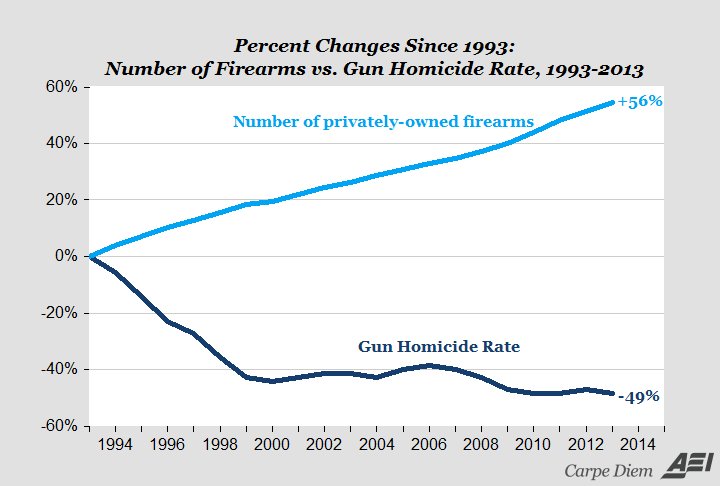
Those of us on the other side of this divide see it very differently: that there is ineradicable evil in the world. No new law or government policy will change this. Indeed, no proposed law would have prevented this massacre; there are about 300 million guns in America, and a psychopath bent on slaughter will get his hands on what he wants, laws or no laws. The problem is too many guns in America, you say? Then explain why gun homicides have fallen by half in recent years, even as gun sales have skyrocketed.

I don’t want to drone on about gun control in this post; I’ve already done so, here and elsewhere. My point, rather, is that in this increasingly shrunken, pressurized, overheated and chaotic world, nothing is going to prevent these horrors. (I think mere shootings is just the beginning.) The abyss is real — and however much we may flatter ourselves that we can paper it over with ostentatious gestures, some of us are always going to fall through.

Straight Into Darkness

Sorrow is everywhere today: following on the sickening atrocity in Las Vegas is the news that Tom Petty — one of the greatest rockers and songwriters of my generation — has died.

Let’s Call The Whole Thing Off

I’m still waiting for the Muse to return from vacation. Meanwhile, here’s a fine post on disagreement by our friend Bill Vallicella.

Note the link in Bill’s post to the acerbic NRx blogger ‘Porter’. I’d earlier called Bill’s attention to Porter’s post on the NFL brouhaha, which you might enjoy also.

Steyn On Decline

With a tip of the hat to our pal Bill Keezer, here’s a good item by Mark Steyn on the “progressive disease” I’ve called C.I.V. It’s all been said before, but it needs saying again and again.

Best line:

“When you demolish your own inheritance, the lot does not stay empty. Something arises in its place.”

Why You Should Subscribe To CRB

Here’s an essay by William Voegeli on immigration, published at Claremont Review of Books back in August. It is outstandingly clear and comprehensive.

I’ll offer a brief excerpt, in which Voegli makes what I think is the most important point of all about immigration policy (I have bolded the relevant passage):

Given the stakes, the conservative instinct toward caution applies with extra force to immigration. Cautious governance entails constant awareness that an immigration policy that turns out to be excessively restrictive can easily be reversed, but revising an insufficiently restrictive one will be difficult and undoing its consequences even more so. Caution also means treating the successful assimilation of previous large waves of immigrants to America as a fact of history, not a law of nature. Past performance is no guarantee of future results, as the brokerage firms’ ads say, particularly given that the biggest single source of immigration today is an adjacent nation, not ones separated from North America by thousands of miles and a difficult ocean passage. Nor did the Ellis Island immigrants come to a nation where the Americanization of newcomers was stymied by the fierce opposition of multiculturalists.

Conservatives are cautious not just about how to proceed but about how the world works. No matter how secure and admired a set of arrangements appears, it is always vulnerable to external antagonists and internal decay. America’s experiment in self-government needs to be conserved because it is reckless to assume it will simply sustain itself.

Exactly right. (See points 7-11, here.)

Perhaps my favorite passage of all was this:

Politics is hard, so it is not enough to settle any question by ascertaining how Vox.com thinks about it in order to endorse the opposite approach. In the majority of cases, however, this method will yield a very good beginning.

Mr. Voegeli’s article deserves your attention. Go and read it all, and pass it around.

Homeward Bound

Well, the lovely Nina and I are on our way back. We’re traveling a day later than we meant to: we’d flown from Boston to Vienna (and had left our car at Logan Airport), but while we were overseas the carrier, Air Berlin, having declared bankruptcy, canceled all flights to Boston forever. So now we are in Dusseldorf waiting five hours for a connecting flight to JFK, where we’ll spend the night in an airport hotel and get a shuttle to Boston tomorrow — after which it’s a mere two hours’ drive to get home to Wellfleet.

We had a fine time — Vienna was as gracious as ever, and Prague is one of the most beautiful cities I’ve ever seen (and, as predicted, still thoroughly and happily European) — but I’ll be glad to get home. Long, cramped flights are no fun for a beefy six-foot-tall hombre of my advancing years — and given my conservative disposition (Michael Oakeshott explains, here) I’m rather a homebody anyway.

It may be a while before I’m fit for purpose again, so here are three things to read.

First: you may have heard of a new book called Testosterone Rex, by Cordelia Fine, that argues that there are no innate differences between males and females. (This is of course obvious nonsense, but it is getting raves in all the right circles, of course, because it says all the right things.) Here’s a review by Greg Cochrane.

Second: An item by Patrick Buchanan that looks at the Trump presidency as a rebirth of Gaullism.

Third: former federal prosecutor Andrew McCarthy on the Mueller investigation.

Back soon.

Notes From Abroad

Vienna, September 19th —

As it was last time we were here, Vienna — unlike so many other European cities — still manages to maintain its European character, at least in its more affluent districts (I should note that we have not moved around the city much this trip, and have only been inside the Ring and in our daughter’s neighborhood in a quiet section in the Third District, near the Hundertwasser House.) There is a growing sense of entropy, and more graffiti and little signs of decay each year, but it is still… well, still Vienna. Disorder has never been well-tolerated here, and it still isn’t. The place remains distinctly and proudly Austrian.

Tomorrow we are off to Prague for two nights. As with the other former Iron Curtain nations, Czechia is not going gently into that good night. We’ve never been to Prague before, so I can’t compare it to how it was, but I expect it, like Vienna, to be a distinct, and heartening, contrast to places like Paris, London, or Amsterdam.

One thing I can say: it’s been a blessing to be distracted from the news. I understand that the Norks keep launching missiles, that Mr. Trump made a speech at the U.N., that Hillary Clinton still won’t go away, and that there have been further eruptions of barbarism in St. Louis and elsewhere (oh, and this), but that’s really about all I know. I can’t really see how I’m any the worse off for my inattention.

Europe: Prostrate And Bleeding

File this under “Diversity and its Blessings”.

I’m off to Vienna and Prague tomorrow; I’ll let you know how things seem there.

Pit Stop

Well, I’m back home in Wellfleet after a splendid three-day weekend on Star Island. (The high point of the weekend was a tribute performance we gave on Saturday night in honor of the late Walter Becker, consisting of a baker’s dozen of Steely Dan’s greatest hits. (It would have been impossible to get that together in such short order — Steely Dan is difficult music! — were it not for the presence of some really outstanding musical pros in our little circle of friends.)

I won’t be home for long — on Thursday the lovely Nina and I are off to Vienna for about ten days to visit with our daughter, her husband, and our little grandson Liam, now a toddler (as of about a week ago).

I’m afraid content may be sparse while we’re away. To be honest, it was so nice to get completely away from news and politics last weekend that I have little eagerness to dig back in. I did notice, however, that Bill Vallicella has again taken up the problem of consciousness — and, with the subject being an old hobby-horse of mine, and his comment-box being open, I joined the conversation. Bill and I have been on opposite sides of this for at least a decade now — I think that the physical brain probably, somehow, gives rise to consciousness, and he doesn’t — but I’m always glad to have another go at it. We’ll see.

Service Notice

I’ll be away this weekend (as I was last year at this time) for our annual musical retreat on Star Island. Back early next week.

The comment-box is open, if anyone would like to broach any topics for consideration.

Blood Sport

Mencius Moldbug on fascist-hunting:

Unfortunately no central statistics are kept, but I wouldn’t be surprised if every day in America, more racists, fascists and sexists are detected, purged and destroyed, than all the screenwriters who had to prosper under pseudonyms in the ’50s. Indeed it’s not an exaggeration to say that hundreds of thousands of Americans, perhaps even a million, are employed in one arm or another of this ideological apparatus. Cleaning it up will require a genuine cultural revolution – or a cultural reaction, anyway. Hey, Americans, I’m ready whenever you are.

The logic of the witch hunter is simple. It has hardly changed since Matthew Hopkins‘ day. The first requirement is to invert the reality of power. ((On inversion, see also here.)) Power at its most basic level is the power to harm or destroy other human beings. The obvious reality is that witch hunters gang up and destroy witches. Whereas witches are never, ever seen to gang up and destroy witch hunters. By this test alone, we can see that the conspiracy is imaginary (Brown Scare) rather than real (Red Scare).

Think about it. Obviously, if the witches had any power whatsoever, they wouldn’t waste their time gallivanting around on broomsticks, fellating Satan and cursing cows with sour milk. They’re getting burned right and left, for Christ’s sake! Priorities! No, they’d turn the tables and lay some serious voodoo on the witch-hunters. In a country where anyone who speaks out against the witches is soon found dangling by his heels from an oak at midnight with his head shrunk to the size of a baseball, we won’t see a lot of witch-hunting and we know there’s a serious witch problem. In a country where witch-hunting is a stable and lucrative career, and also an amateur pastime enjoyed by millions of hobbyists on the weekend, we know there are no real witches worth a damn.

Much more here.

Moscow On The Hudson

Here’s the mayor of New York City, Bill de Blasio, quoted in New York Magazine (my emphasis):

Q: …Where has it been hardest to make progress? Wages, housing, schools?

A: What’s been hardest is the way our legal system is structured to favor private property. I think people all over this city, of every background, would like to have the city government be able to determine which building goes where, how high it will be, who gets to live in it, what the rent will be. I think there’s a socialistic impulse, which I hear every day, in every kind of community, that they would like things to be planned in accordance to their needs. And I would, too. Unfortunately, what stands in the way of that is hundreds of years of history that have elevated property rights and wealth to the point that that’s the reality that calls the tune on a lot of development.

What’s telling about this isn’t Hizzoner’s antipathy to the central principle of America’s founding; anybody’s who’d been paying any attention at all already knew the guy was a communist. It’s that things have moved so far along that he no longer feels the slightest inclination to conceal it.

Take 3… Rolling!

A happy item in the New York Times today: Power Station Studios, where I was a staff engineer from 1978 to 1987, has been bought by Berklee College of music and will be re-opening after a long-overdue renovation.

Power Station, Studio A: my alma mater.

This is the second time this magnificent facility, which in my opinion is the best place on Earth to make a record, has cheated death. In 1996 the original Power Station, in deep financial trouble, was rescued from imminent condo-hood in by Chieko and Kirk Imamura, who renamed it Avatar [note: this link might not work for long].

Now it seems that Berklee will be sprucing the place up and putting it back in business again as Power Station. This is very good news.

… Also in today’s Times, this gem:

“Every day that you’re working as a model, you’re objectified somehow.”

Well, duh.

This Brother Is Free

I didn’t see this coming: Walter Becker is dead at 67. If you’re a musician of my generation, or a fan, that’s a heavy blow.

It Ain’t Necessarily So

Many of you will have read Jared Diamond’s Pulitzer-decorated book Guns, Germs, and Steel. It makes what has seemed to many (even to me, when I first read it) an overwhelmingly persuasive case that the persistent inequalities in power, influence, and prosperity among the world’s population groups — why, for example, did Europeans colonize the Third World, and not the other way round? — were due entirely to the constraints and accidents of geography, and of native fauna and flora. The book was a mighty affirmation of our era’s hegemonic human-universalist worldview, and along with its Pulitzer, received lavish praise from all quarters. It quickly became a central resource in the modern, Progressive (but I repeat myself) canon.

As time went by I came to understand that the argument put forward in GG&S, while certainly presenting important and clarifying insights and questions, is not quite the slam-dunk it seemed. Now Greg Cochran, co-author of The 10,000-Year Explosion has put up a series of blog-posts examining Diamond’s arguments.

You can read these posts here. And if you haven’t read Cochran’s book: drop everything, follow the link above, and do so at once.

From Worse To Bad

Here’s Hanson again, with some comparative analysis.

Doggo

Sorry it’s been so slow around here. It’s August, when I always take it easy a bit — but I’ll confess that I’m also getting a little spooked by the extent to which we are all (and I’m no exception) living more and more of our lives online.

Our attention, which is more precious than gold, and the one thing we must master if we are to have any hope at all of inner development, is increasingly spent in a virtual world created, manipulated, and harvested by a few increasingly powerful companies. (Note that we “pay” attention, a usage that captures quite precisely the crucial fact that attention is a finite and valuable resource.) Our words, our wishes, our habits, our movements, are noticed, tracked, sifted, and analyzed — and remembered. (If you have a Google account, try going to https://myactivity.google.com/myactivity on a logged-in browser.) Meanwhile the human world, once so vast and cool, has now been compressed into a tiny hot space in which everything is brought into immediate contact with everything else. As I wrote in the essay linked just above:

In short, the smaller and hotter the world is ”” in other words, the more likely it becomes that any two “particles’ will impinge on each other in a given time ”” the more volatile, reactive, unstable, and “twitchy’ it becomes. As volatility and the rate of change increase, it becomes more and more difficult for systems and institutions that operate at a constant pace ”” the legislative processes of large democracies, for example ”” to respond effectively to innovations and crises.

As we adjust to this accelerating impingement, our attention, constantly interrupted and diverted, becomes harder and harder for us to control, even as we become more and more deeply addicted to being peppered with (mostly useless) information. To lose one’s smart-phone — in other words, to lose a thing that never existed in all of human history until just over a decade ago — is now a crisis requiring immediate action. Imagine really cutting yourself off: no cell-phone, no Google, no Amazon, no YouTube, no Facebook, no Twitter, no email, no texting, no Google Maps, no Wikipedia. Just a land-line, the radio, basic TV, and books. (Just like it was until I was in my forties.) Could you do it?

Let’s put it this way: whether you think you can or not, I bet you won’t. I bet I won’t either.

Something very big is happening to us, and it’s happening very quickly. Some days I really don’t want to look at the computer at all. So that’s why it’s been quiet here.

OK! Having said all that, here are a few links:

First up, a new way of looking at what the brain does, using algebraic topology.

Speaking of brains, it appears that IQ may be on the decline in the West — fourteen points since Victorian times. (Why that might be, I leave as an exercise for the reader, for now at least.)

Meanwhile, here’s Heather Mac Donald on a spirited defense of ordinary virtues by a pair of academics, and the cataract of bile it has earned them.

Finally, a detailed look at the cooling oceans, and the lengthening rhythm of interglacial cycles (don’t forget that we are in a warm spell in the middle of an Ice Age). We used to get interglacials every 41,000 years; now they come much less frequently. Learn more here.

Arcs And Circles

Victor Davis Hanson (my emphasis):

For the last decade, we were lectured that the arc of history always bends toward our own perceptions of moral justice. More likely, human advancement tends to be circular and should not to be confused with technological progress.

Just as often, history is ethically circular. No Roman province produced anyone quite like a modern Hitler; Attila’s body count could not match Stalin’s.

In the classical Athens of 420 B.C., a far greater percentage of the population could read than in Ottoman Athens of A.D. 1600. The average undergraduate of 1950 probably left college knowing a lot more than his 2017 counterpart does. The monopolies of Google, Facebook, and Amazon are far more insidious than that of Standard Oil, even if our masters of the universe seem more hip in their black turtlenecks than John D. Rockefeller did in his starched collars.

Meanwhile…

Our discussion of “white supremacy” continues, over at Bill Vallicella’s place.

Paradise? Bah.

I don’t like the tropics; they’re too profuse. Anything goes, completely unchecked.

Give me the North. Each winter Life’s follies, feints, and flourishes are weighed, measured and tested. The ones that make it back the following year need to show something serious: at best, ingenuity, but at the very least, genuine toughness.

Everything in the North means business.

The Futility Of Memorials

For nearly all of us, a gravestone or other physical memorial is in any real sense as temporal, as evanescent, a thing as we ourselves are. For when such memorials no longer serve as a token, reminder, or feeble proxy for the deceased in the minds of those who knew them, they simply display a name — and a name, unattached to the memory of an actual person, is just a string of letters.

When the reference to memory is broken, at last, with the death of all who knew him, a person ceases, in any imaginably meaningful sense, to exist. It is a second, and final, death.

Pick One

Here are two syllogisms about race.

The first:

(1) All human groups have identical statistical distributions of cognitive, behavioral and personality traits.
(2) Human groups, when considered as groups, have measurably different life-outcomes and levels of success in our societies.
(3) Given (1), these different outcomes can only be due to wholly exogenous factors, such as cultural obstacles and systemic racism.

The second:

(1) Various human groups, due to their particular histories of selection under widely varying environments, can be expected to have different statistical distributions of cognitive, behavioral and personality traits.
(2) Human groups, when considered as groups, have measurably different life-outcomes and levels of success in our societies.
(3) Given (1), these different outcomes may be due to innate factors, exogenous factors, or some combination of both.

If you accept syllogism #1, you are a good and decent person. You may express your views in public without fear of ostracism, public shaming, censorship or loss of employment.

If you accept syllogism #2, even provisionally, you are a loathsome bigot, and a purveyor of hate. You deserve ostracism and, wherever possible, persecution. In more enlightened nations than ours, you can expect to be prosecuted under the law.

Any questions?

Hey, Hold On There

It would be an awfully suspicious coincidence if Truth turned out to be exactly what we think it ought to be.

R.I.P.

I had sad news today: my old friend and colleague Jason Corsaro died yesterday of cancer. I’m not sure of his age, but he must have been about my age, 61.

Jason and I came up together as assistant engineers at Power Station Studios (now Avatar); he was promoted to full engineer just before I was, around 1982 or so. He was flamboyantly talented, and before you knew it everyone wanted to work with him. His first major album was Madonna’s Like A Virgin (on which I also worked, as one of my last sessions as an assistant). It was a huge hit, but he was still honing his craft. Shortly afterwards he developed an arcane processing chain for drum ambience that resulted in a shockingly massive, aggressive sound (for you audio geeks out there, it involved, among other things, running the distant “room mikes” through heavy compression, a side-chain-triggered noisegate, and — this is where it got weird — a Publison DHM89 harmonizer, with the delay crosspoints reversed so that the sound came out backwards). If you’re familiar with the enormous sound of Robert Palmer’s Addicted To Love, or the band Power Station’s version of Get It On (Bang A Gong) well, that’s the sound I’m talking about — and back then, during the Great Snare Wars of the middle 1980’s, this was roughly the equivalent of bringing an A-10 Warthog to the Battle of Crécy. Jason’s fame was assured, and he became a very busy man. A partial list of his credits, which includes, among other records, Soundgarden’s Superunknown and Steve Winwood’s Back in the High Life, is here.

I hadn’t been in touch with Jason for a while, but we were close friends back in the trenches in those early years. He was a good man, and a truly great engineer — an artist and an innovator. His life is over far too soon.

Rest in peace, brother.

Tar Baby

Last week a Google engineer expressed, in a perfectly reasonable memorandum about human diversity, the view that the company had become a left-wing monoculture in which dissenters actually might have to worry about being fired. For publishing this essay, he was fired.

Now Apple’s CEO Tim Cook has announced that the company is giving a million dollars to the execrable “hate”-hunting racket called the Southern Poverty Law Center.

If you’re like me (of course you are!), all this makes you want to have nothing more to do with either Google or Apple. Thinking about that, though, made me realize how hard it would be for most of us to do so.

For starters: if you have a modern cell-phone, it is almost certainly an iPhone (Apple), or some sort of Android device (Google).

Maybe you use iTunes (Apple) to play music, perhaps on your Mac (Apple again). Or maybe you use the Chrome browser (Google), and maybe you use it to do Internet searches (Google again, obviously). Perhaps you watch videos on YouTube (Google), or maybe you find your way around with Google Maps, or Google Earth. If you’re a blogger, you might well be on Blogger (Google again). There’s also a good chance you have a GMail account. (I have two.)

So: you’ve begun to realize that these very powerful companies are strongly aligned against proponents of traditional Western nations and cultures. But it’s probably also the case that you are a daily, and at this point deeply dependent, user of their products. (As I’m fond of saying, invention is the mother of necessity.) Are you prepared to give all that stuff up? I doubt it. I’m certainly not inclined to; in fact I wonder how I ever lived without it.

This is something of a problem, no?

“White Supremacy”

Our e-pal Bill Vallicella, the Maverick Philosopher, has a post up about “white supremacy”, a loosely defined term that is very much en vogue just now. Dr. Vallicella quotes Robert Paul Wolff:

Hatred has fundamentally very little to do with White Supremacy. White Supremacy is a policy of domination and economic superiority of Whites in a multi-racial society. African-Americans are not worried about whether White people want to be friends. Most of the African-Americans I know have quite enough friends, thank you very much. African-Americans demand legal, economic, and political equality. And that terrifies many Whites, who do not want to give up the superior legal, political, and economic position in American society that they acquired through being born White.

Well, this may be a good definition of “white supremacy”; I don’t really know much about it. I can certainly say that it does not describe the views of anyone I know, or would care to know, in neoreactionary circles, or in what is sometimes called the “dissident Right”. It doesn’t even describe the views of people like Jared Taylor, who is often slandered in the mass media as a “white supremacist”.

Consider: a generation of identitarian politics across the West has deliberately cultivated tribal resentments among non-whites. For decades white people have been blamed in media and academia for all the world’s ills, while aggressive immigration policies have openly sought to make them minorities in every one of their homelands (a prospect that is widely celebrated in our mainstream institutions). In colleges and universities, white applicants are disfavored for admission, while curricula feature pugnacious courses on eliminating “whiteness”. At the Academy Awards, a black actor says of his latest film “I get to kill all the white people! How great is that?”, and the audience laughs and cheers.

Is it any wonder, then, that in this toxic climate, many white people are developing a sense of identitarianism themselves? This is not “supremacy”; it is nothing more than a perfectly natural (and, therefore, easily predictable) sense of unity and belonging, in an explicitly and increasingly hostile environment. Express this readily understandable sentiment in public, however, and you are now a “white supremacist” — and your sense of identity is not mere attachment, but can only be “hate”.

“White supremacist”, then, is nothing more than a cudgel, to be used without mercy against anyone who says, however reluctantly, that: yes, we are white, and we are not ashamed of it, and if you are determined to divide all of society into competing racial groups, then our people will have to play the game too. It is a truly awful state of affairs, and it will all get much, much worse before it gets any better. “Diversity is our strength”? Rubbish. As we are already learning to our sorrow, it is anything but: it is the death of peace and order and comity, and, at last, of nations and cultures.

In his post, Bill said this:

Perhaps Malcolm Pollack will comment on this definition over at his place. He tilts in the alt-right direction; I reject the alt-right.

As do I. The term has become irretrievably tainted, and the self-described “alt-right” is now a gathering-place for actual white supremacists (as defined by Wolff, above), actual Nazis, virulent anti-Semites, and others who quite fairly can be described as “hate groups”. I want nothing to do with them.

Bill then adds the following:

Here are some preliminary thoughts/questions of my own.

1) If White Supremacy is a policy, who is implementing it? The government? Is the government insuring the economic superiority of Whites? How? By what programs?

2) Blacks have every right to demand legal and political equality, but they cannot reasonably demand economic equality. That is something they have to work for.

3) Whites are in an economically superior position to blacks, no doubt, but one cannot validly infer from this that Blacks have been unjustly discriminated against.

4) It is false that Whites enjoy by birth legal and political privileges denied to Blacks. If you think they do, name the privileges.

5) Suppose a white Southerner considers slavery a grave moral evil and is glad the Union was preserved. He opposes, however, the Left’s iconoclasm re: statues of Robert E. Lee, et al. Is this person a White supremacist?

6) If ‘white supremacist’ is not to be just another smear word like ‘racist,’ then it has to be defined. How ought it be defined?

7) Suppose Whites as a group are superior to Blacks as a group in some respect R, and suppose Jones points this out. Is Jones a white supremacist with respect to R? This raises the question: How can White Supremacism with respect to R be a bad thing, which it is supposed to be, if it is true?

8) Wolff’s decoupling of White Supremacy from hatred suggests that he is thinking of it as something ‘institutional’ or ‘systemic.’ Are our institutions white supremacist? What might that even mean given that our institutions allowed for the elimination of slavery and Jim Crow?

These all reflect, quite exactly, my own thoughts and questions, and so my own impression is that Bill and I agree about all of this with near-perfect congruency.

What a miserable era this is becoming. What a sad decline — with, I think, much worse on the way.

Diversity For Dummies

I’ve said quite enough about Diversity lately, so here’s statistician William Briggs to help shoulder the load.

Today’s Lesson

A comment on Charlottesville: this sort of chip-on-the-shoulder activism is a no-win for the Right. It attracts too many of the lowest, stupidest, and most undesirable elements, and as we have seen, it results in officially sanctioned violence.

I remember a slogan from back in the Vietnam War era: Fighting For Peace Is Like Fucking For Virginity. Creating disorder in the name of order is very much the same thing.

The Left is moving, with increasing energy, towards such offensive absurdities as to alienate ever-increasing numbers of normal and traditionally minded Americans. The social, ideological, and political structures it has created are collapsing from their own internal weaknesses, costs, and contradictions. As it accelerates leftward, the fractal nature of faction and grievance, and the absence of any limiting principles, begins tearing Leftism apart from inside, as its zealots turn upon each other.

As Napoleon said: never interrupt your enemy when he is making a mistake. What the Right needs to do is simply to stand clear, be true to its principles, make its case where possible, and to prepare for, but not incite, violent conflict. It also has some very important historical and intellectual work to do, namely to understand what went wrong, and make sure that as we rebuild we do not repeat our errors.

In short, the reactionary Right needs to think of itself not as a battleship, but an ark.

What Goes Around

What never seems to occur to those who anathematize and seek to bury the past is that they in turn prepare the future for their own erasure.

The result is a sullen and solipsistic presentism in which, as Burke foresaw, men become nothing more than “the flies of a summer”.

Wagging The Dog

It is a great temporal vanity to see, in the study of history, only the present struggling to be born. It is, quite literally, preposterous.

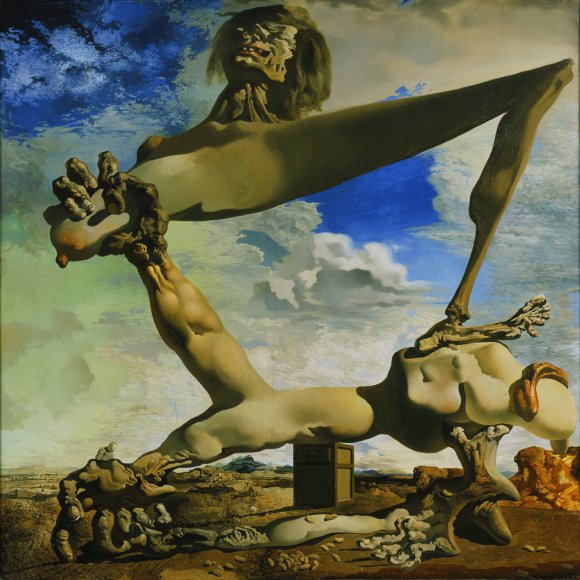
Soft Construction With Boiled Beans


Pax Dickinson gives his eyewitness account of what happened in Charlottesville on Saturday, here.

[A quibble: Mr. Dickinson writes that the chaos created by the police stand-down (and the apparently deliberate throwing-together of the “Unite The Right” demonstrators with the hungry Antifa mob) “ultimately led directly to the vehicular incident that killed a woman and badly injured more than a dozen others.” I doubt very much that Mr. Dickinson knows exactly why the driver of that car did what he did.]

Elsewhere:

Commentary by DiploMad, here.

At the New Yorker, estimates of the likelihood of civil war range up to 60%. Seems a tad low.

Rut-Roh

Four years ago, I wrote the following thing:

America’s ideological landscape is like the continent itself: transected by deep fault-lines at the irregular boundaries of rigid plates. Though crushed tightly together, these great masses seek to move in different directions, and so they strain relentlessly against one another. The pressure builds, and builds ”” until, sooner or later, it must release itself in a destructive convulsion. …

The plates press and moan and grumble. The water in the wells is rising, and muddy. Dogs and cats fidget restlessly. Farm animals are balky and skittish. Migraines are up sharply, and radios are on the fritz.

The ground began to tremble in earnest today. If you are the worrying sort, now would be a good time to start.

Hold The Door!

Have a look at this time-looping defense of abortion, by Princeton professor Elizabeth Harman.

Somewhere in the back of my mind I just can’t help forming a sneaking suspicion that Professor Harman arrived at her conclusion first, rather than being dragged to it by the irresistible force of her argument.

The Fools On The Hill

Every Tuesday evening, in the ten o’clock hour of his program, radio host John Batchelor discusses Russia with Stephen F. Cohen. Dr. Cohen is professor emeritus of Russian studies at Princeton and NYU, and is a rare voice of sanity in this time of anti-Russian hysteria.

Mr. Batchelor’s show is always worth listening to — it is one of the most interesting and informative current-events resources in all of media — but his discussion with Professor Cohen is a weekly high point. In last night’s conversation the topic was the latest round of Congressional sanctions against Russia, and how they are only making a very bad situation worse. Professor Cohen also explains why this new Cold War is even more dangerous than the first one.

You can listen to a podcast of last night’s show, in two parts, here and here. See also the website of the American Committee for East-West Accord, to which Professor Cohen is a contributor.

Service Notice

More than a few readers have complained to me about the “Captcha” used to screen comments here. I’ve just installed a new one that, for most of you, shouldn’t be visible at all. I hope it works well enough that I can keep using it.

The Narrowing Effect Of Diversity

I’ve just read an article at Crisis magazine called The Day the Music Died. (Hat-tip to Bill V.)

From the article:

When pursued to its logical conclusion, multiculturalism leads to monoculturalism, and eventually to a monochrome society. That’s because without a common culture to unite them, multicultures break down into competing subcultures. When this happens, the ruling authorities step in and make laws outlawing “hate” and “insensitivity” in the hope that everyone can be forced to respect everyone else.

Quite so. The mechanism by which this happens is simple, and easily understood. That it isn’t blazingly obvious to all can only be explained, I believe, by its conflicting with some higher creed that rules this self-evident truth out-of-bounds as a dangerous heresy. (Which it is: from the perspective of the hegemonic Universalist religion we call Progressivism it is a very dangerous heresy indeed — because it is so obviously true.)

I’ve written about this often, but I feel the need to summarize it from time to time, to keep it fresh in the reader’s mind, and to find new ways of clarifying the argument. I boiled it down last year in a post called Tractatus Logico-Multiculturalus, and examined it in practical terms back in 2013, in Simple Common Sense About Diversity and Immigration.

If you’re familiar with what’s called a Venn diagram, which is used to display the relations between sets, the analysis is transparently clear. (If you aren’t, spend a few minutes here before proceeding.)

Consider the following (I will quote in part from Tractatus Logico-Multiculturalus):

1) Every distinct culture (i.e. the “multi” part of “multiculturalism) has distinct features and properties. (Obviously they must, or what would make them distinct?)

2) This means that every distinct culture can be thought of as containing a set of beliefs, traditions, attitudes, affinities, aversions, etc. that, taken together, are what distinguish that culture from other cultures.

3) Given that we can in this way view cultures as sets of distinguishing features, we can create a Venn diagram representing the relation between two or more cultures. If the cultures are similar (say, Danes and Swedes), there will be a great deal of overlap between them. We can also easily imagine two cultures (e.g. Swedes and Sentinelese Islanders) where the two sets have almost no area of intersection.

4) Many of the properties that make up a culture are normative features; i.e. beliefs about how one ought to behave, ought to dress, what one ought and ought not say or do in public, and thousands of other mores and customs.

5) Norms are often contradictory in a way that, say, food is not. (Food and music, the most commonly cited blessings of multiculturalism, are non-normative. To the extent that music is considered normative, it becomes subject to cultural exclusion.)

6) Every acculturated human is normatively inclined to do, and publicly to favor, the things that his culture prescribes — and to avoid, and publicly criticize, what his culture forbids. (Even though normative prescriptions and proscriptions must, in principle, subtract absolute liberties, in an organic culture they do not do so in a meaningful way, because we do not feel our liberty diminished by compulsions or prohibitions regarding things we would or would not do anyway.)

7) Where normative cultural features are concerned, those that are not shared are often considered, by members of other cultures, distasteful or even offensive.

8) That which is offensive is discouraged in the public square, for the sake of “respect” and comity.

9) In terms of our Venn diagram, this means that the broader norms of the “multiculture” — that which is permissible in public expression — can only include the intersection of the two sets. Although this occurs in the name of “inclusion”, it is actually, and necessarily, a process of exclusion, namely of whatever cultural particularities are not held in common by all components of the multiculture. As we have seen above, as more cultures are added, this set of commonalities contains fewer and fewer elements.

Imagine, then, Culture A, with 10,000 enumerable cultural features. Because they are broadly shared by all, nobody is much offended by any of them, and so all of these features can be expressed as naturally in the public square as in the privacy of the home.

Now add a second culture, B, to the Venn diagram. The overlap is close, but not perfect; of the set of 10,000 properties in the first culture’s circle, the second culture shares 9,000 of them. However, because public expression is to be limited to the intersection of the two cultures’ properties, we have now, from the perspective of Culture A, reduced its freedom of public cultural expression by ten percent — from its full set of 10,000 properties down to 9,000.

Now add a third culture to the mix (and a third circle to the diagram). Because the third culture is distinct from each of the other two, it will, necessarily, further shrink the number of properties common to all three sets — and thus will further reduce the collection of common beliefs and behaviors that are available for public expression.

This means two things: first, that the more cultures you add to a society the narrower, not broader, the range of public expression becomes; and second, that there will be an ever-increasing disparity between private life (which is now the only place where the full range of cultural life is possible) and public intercourse (which necessarily grows more and more restricted). This is a meaningful limitation of public liberty that is keenly and easily felt by all. Where once the private square flowed almost unnoticeably into the public, now each group feels constrained by the others. This in turn leads to a withdrawal from public life, and a breakdown of social cohesion. Meanwhile citizens, in their public role as citizens, are reduced to the basest sorts of commonality.

In sum, then: multiculturalism limits public liberty, creates a tension between public and private life that reduces public participation and lowers social cohesion, fragments societies into competing groups and lowers public trust, and, by denying any culture full public expression and support, actually contributes to the decay and death of the world’s rich cultural diversity. Cultures that might live and flower in relatively homogeneous homelands now wither and die under the relentless pruning and curtailment that is necessary to make muticulturalism work at all, and the multicultural society itself becomes a shrunken and cautious thing. The organic order and harmony unique to each culture suffocates and dies; into that vacuum steps a top-down, external order that acts on citizens only as barely differentiated atoms.

Why would anyone want this? The alternative is what the world has always been until very recently: for every culture, a homeland in which it may express itself freely and fully, and in which public and private life join in the unique, organic order that arises from the cultural particularities of its own people.

How is that not a better, richer world?

Derbian Minimalism

In this week’s podcast, John Derbyshire makes the case for a severe throttling-back of immigration. Listen here. The comment-box is open for discussion.