Valkyrie

Speaking of NASA, here’s their latest robot. Seeing that they’ve given it a female shape and name, I’d have thought ‘Fatima’, or perhaps ‘Ayisha’, would have been far more appropriate — but ‘Valkyrie’ it is, at least pending a little re-education amongst the staff.

Pale Blue Dot

On October 13th, NASA’s Juno probe, which is scheduled to arrive at Jupiter on Independence Day 2016, made a ‘slingshot’ flyby of Earth in order to boost its velocity. Using some low-res calibration cameras, it took a time-lapse movie of its approach to the Earth-Moon system.

I don’t know why NASA is bothering with Jupiter, given its Prime Directive, but I suppose Mr. Bolden & co. know what they’re doing.

Anyway, have a look here.

Stop The World

This is exquisite: Glenn Gould playing the Goldberg Variations, 1981.

You Ain’t Seen Nothin’ Yet

Back in July, I wrote the following:

To the conservative, traditions arise naturally from the workings of human nature, as part of the ontogeny and organic development of societies. They are not the result of scientific planning or sociological theorizing — and like biological species themselves, they only come into view in retrospect. They are, in a sense, part of the “extended phenotype” of our species and its various subgroups, as languages are; and just as languages do, they naturally adapt to, and come to represent, those things that actually matter to the various human groups from which they arise. (Many have been, at least up till now, more or less universal.) In this way they contain a great deal of deeply-buried knowledge about the optimal functioning of the human social organism, often for reasons, and in ways, that themselves need not be explicitly represented in the organism’s consciousness. Because of this, disrupting them will always have unknowable consequences — and so, at least, tradition justifies respect for its embodied wisdom, and caution as regards casual tampering.

To those on the Left, traditions are artifacts. Rather than being organic outgrowths and aspects of human nature itself, they are human creations; they are social technology, whose only purpose is to control and manipulate human behavior. In this view, human “nature” hardly exists at all, and traditions are wholly external things; indeed almost everything about human behavior and human life is external to the individual. This means that to mold human beings, or human societies, into any desirable configuration is simply a matter of discarding traditions, and inventing new ones, until we obtain the correct result. Because of this, tradition justifies very little indeed.

This is hardly an original idea; it has been prominent in Western discourse at least since Edmund Burke.

In his latest newsletter, Jonah Goldberg addresses this theme, in the context of a review he is preparing for Commentary of Yuval Levin’s new book about Burke and Thomas Paine.

Goldberg writes (my emphasis):

The challenge for each new generation is figuring out what’s worth keeping and what worth tinkering with. The progressive attitude is that everything is eligible not just for tinkering, but wholesale replacement. The people who lived yesterday were idiots, but we are geniuses! The conservative attitude is to assume that our parents and grandparents weren’t fools and that they did some things for good reasons. But — and here is the Hayekian part — it’s also possible that some things our forebears bequeathed us are good for no “reason” at all. Friedrich Hayek argued that many of our institutions and customs emerged from “spontaneous order” — that is they weren’t designed on a piece of paper, they emerged, authorless, to fulfill human needs through lived experience, just as our genetic “wisdom” is acquired through trial and error. Paths in the forest aren’t necessarily carved out on purpose. Rather they emerge over years of foot traffic.

This reminds me of a story Kevin Williamson tells in his book.

There is a lovely apocryphal story, generally told about Dwight D. Eisenhower during his time as president of Columbia University: The school was growing, necessitating an expansion of the campus, which produced a very hot dispute between two groups of planners and architects about where the sidewalks should go. One camp insisted that it was obvious — self-evident! — that the sidewalks had to be arranged thus, as any rational person could see, while the other camp argued for something very different, with the same appeals to obviously, self-evident, rational evidence. Legend has it that Eisenhower solved the problem by ordering that the sidewalks not be laid down at all for a year: The students would trample paths in the grass, and the builders would then pave over where the students were actually walking. Neither of the plans that had been advocated matched what the students actually did when left to their own devices. There are two radically different ways of looking at the world embedded in that story: Are our institutions here to tell us where to go, or are they here to help smooth the way for us as we pursue our own ends, going our own ways?

The paths were formally recognized by the planners only after the paths were created through human experience. In the parable of the fence, Chesterton says you must know why the fence was built before you can tear it down. But Burke and Hayek get at something even deeper: What if no one built the fence? Okay, that would be weird. But metaphorically, what if no one built it. Or what if everyone built the fence without realizing it. What if we are surrounded by fences that were never consciously built or planned but were instead the natural consequence of lived experience like the footpath at Columbia?

My inner Hayek and Burke believes this to be the case. So much of what makes civilization civilized is intangible, spontaneous, and mysterious. An unknowable number of our greatest laws are hidden, our greatest wisdom is authorless, and our most valuable treasures are in our hearts. This should foster enormous humility about how to out-think humanity.

Indeed it should, and when I began to write this post I thought I’d leave it there.

But another organic outgrowth of human nature, another feature of our extended phenotype, is relentless technological advancement, which can be as disruptive as any social engineering. Even simple ideas, like the stirrup, can have world-changing consequences — and the pace of technological change is now accelerating exponentially. The coming decades of technological innovation hold the genuine promise of revolutionary liberation — from disease, from hunger, from poverty, from toil, and even from the confines of Earth, and of our own bodies — but will also make possible terrifying new forms of tyranny, wielding powers whose breadth knows no Earthly limit, and whose depth extends into our very cells. Even the most oppressive despot of a century ago could do little to affect the day-to-day, and moment-to-moment, lives of his far-flung subjects; in recent years we have made possible, and blithely accepted, a level of surveillance and control that has never existed before in the history of the world.

While I was at Singularity University last year, I heard someone say “If you can see the road ahead, you aren’t going fast enough.” The speaker made his remark, to a room full of like-minded Silicon Valley entrepreneurs, in a spirit of can-do enthusiasm, but it made my blood run cold.

In both this newsletter and a recent column, Mr. Goldberg discusses the disruptive power of technology, and touches on one of its impending effects: that minimum wage increases are a boon to robots.

From the newsletter:

If you make human labor more expensive, non-human labor becomes more attractive. If you tell car-wash owners that they have to pay their employees $100 an hour, the owner will most likely search his desk for that business card from that salesman from Acme Robots.

Robots have lots of things going for them. They don’t steal from the cash register. They don’t show up late with some sob story about how their dog ate their car keys. They don’t spit in the customer’s food or lick the tacos and post pictures of it on the Internet. Robots don’t file sexual-harassment suits just because you got over-served at the Christmas party and thought it would be funny to hand out photocopies of your butt.

…My main point is that conservatism — full-spectrum, traditional conservatism and not just a checklist of timeless principles, or a political agenda in Washington — requires an appreciation, even love, for the way things are. And technology forces change more than ideas do (indeed, many of our ideas are simply the sparks that fly from the friction of technological change). Sure, Richard Weaver was right when he said, “Ideas have consequences.” But you know what are really consequential? Thingamabobs, geegaws, doohickeys, and whoziwhatsits.

We’ve heard before that industrial machines, and then computers, were going to cause disruptive change — and so they have. They have brought many, many blessings, but Mr. Goldberg is right to point out that robots and other intelligent systems are now about to displace a lot of working people as minimum wages rise.

This is, however, about a lot more than industrial machines and robots. I don’t think most people yet realize just how fast the arc of technological innovation is bending skyward right now, and what that’s really going to mean. I hang around with the people who are making this stuff happen, and they don’t know what it’s going to mean. Nobody does. It seems, though, that it takes a conservative temperament to find this worrisome.

We’re going so fast that we can’t see the road ahead. That may seem just about right to my friend at SU, but in my darker moments it scares the bejesus out of me.

Links

That’s life.

— Democracy! Meh.

Do you ever get the feeling

— Well, they do love to play with yarn

— A Protestant Manifesto, 1942.

Quip of the month. Orwell smiles.

We don’t need no stinkin’ Constitution.

Floral design.

A negative income tax? (We could look at that universal-suffrage thing while we’re at it.)

Bob and Ray. Just because.

It’s the JOOOOZ!

Doorway to Hell.

Read this book.

The Pleiades, in 3D.

Does life exist?

Dave Brubeck, 1961. (And what an alto saxophone is supposed to sound like.)

Keeping Our Frontiers Secure

From PJ Media, here’s a report on a recent restaffing of the Department of Homeland Security’s legal team. Given the bios of the new hires, readers should be forgiven for coming away with the impression that their selection reveals something of a departure from ideological neutrality. (And from any interest whatsoever in enforcing our immigration laws.)

3…2…1…

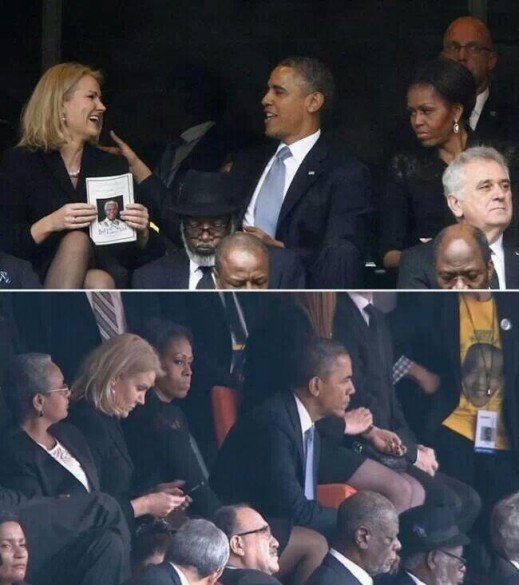
Nelson Mandela has just died. Waiting for President Obama to release a tribute featuring himself.

Update:

…aaaaand — here it is!

A twofer this time: a picture of himself, AND he quotes himself, too!

Feet Of Clay

When I was a young boy (the son of two scientists), I was fascinated by paleontology, and always imagined that it would be what I would do when I grew up. It didn’t work out that way, but I never lost my interest in natural history and the theory of evolution.

One man I admired very much was the Harvard paleontologist Stephen Jay Gould. I read all of his books of essays, and learned a great deal from them. He was not only a distinguished scientist, but a gifted writer as well. To me he seemed the perfect intellectual: civilized, eloquent, and staggeringly erudite, but always accessible, even to the lay reader. He had a wonderful eye for the perfect metaphor, and a sense of humor, too.

It wasn’t until a bit later on, as I read more and more broadly, that I began to realize (with some sadness) that Dr. Gould was rather a controversial figure, both scientifically and politically. Most disturbing of all was the revelation that his scientific work had in fact been compromised by his political ideology, and that some of what I had learned from him simply wasn’t so.

Learn more about that, here.

The Prestige

“He who desires or attempts to reform the government of a state, and wishes to have it accepted and capable of maintaining itself to the satisfaction of everybody, must at least retain the semblance of the old forms; so that it may seem to the people that there has been no change in the institutions, even though in fact they are entirely different from the old ones.”

– NiccolÁ² di Bernardo dei Machiavelli

Stop The Presses!

Making the rounds this evening is a study of male and female brains that reveals — you’d better sit down for this — that they are actually wired up, and operate, rather differently. There’s an article about it in The Independent, here.

A great deal of costly and coercive public policy is based on the assumption that males and females are, in every respect except their reproductive anatomy and gross physical dimorphism, perfectly identical — and that therefore all statistical disparities between men and women with regard to behavior, life choices, representation in the workforce, social and recreational activities, and so on, are due entirely to, at the very least, obsolete cultural traditions that are remediable by aggressive re-education and social engineering, and at worst, malevolent bigotry on the part of men.

The organizing principle of nearly every human society that ever existed, until a collective, hallucinatory insanity overtook the developed world in the 20th century, is that men and women are biological and psychological complements. Throughout human history, always and everywhere, the fusion of their complementary aspects has been understood not only as necessary for the generation of life itself, but also as the psychic and social substrate upon which all societies — from the smallest tribes to the mightiest civilizations — were erected. Nowadays, though, this is a dark and dangerous heresy — the sort of opinion that can cost you your job.

It was a surprise, then, to see this comment from one of the researchers:

“It’s quite striking how complementary the brains of women and men really are,’ said Rubin Gur of Pennsylvania University, a co-author of the study.

Yes, you could knock me down with a feather! Not the complementary part, mind you — that’s just common sense. But it’s awfully surprising to see it said.

Ooh La La

OK everybody, here’s a treat for you: the Faces, live in 1972. Rod Stewart at the peak of his powers, with one of the greatest old-school rock bands of all time — Ron Wood, Ronnie Lane, Ian McLagan, and Kenny Jones. Nicely recorded, too.

Here.

Blow, Wind, And Crack Your Cheeks

Another of our steeples drench’d, I’m afraid. More here.

We are dying, dying…

Brood 3301

Here’s something that’s apparently been going on for a while now that I’m just hearing about: Cicada 3301.

“The world is so full of a number of things;
I’m sure we should all be as happy as kings.”


Happy Thanksgiving

Thanks to all of you, readers, for all your time and attention these past eight years. Thanks especially to those of you who have joined the conversation here. It’s why I started this blog in the first place.

Forward!

From the blogger known as ‘educationrealist’, here’s a penetrating look at Common Core, and some of the reasons why it is such a bad idea.

One of the reasons it’s a bad idea: it fails to acknowledge an essential and utterly self-evident truth, namely that the ability to learn and master complex topics is not evenly distributed among members of our species.

And if you ‘progressives’ think we are making progress in education — well, after you’re done reading the post linked above, have a go at this Harvard entrance exam from 1900 or so, and get a feeling for what it once meant, in a bygone age of the world, to be ‘ready for college’.

Solitude

It’s a long day at work for me today — 11:35 p.m. and I’m still at it.

All I have to offer is this little item from XKCD, which I happened on earlier today, in an idle moment.

Back soon.

Ready For Prime Time?

There’s a bosky little corner of the blogosphere that is home to an intellectual movement to which I am ideologically sympathetic, and with which I am loosely associated. It is known variously as the Dissident Right, the Dark Enlightenment, or Neoreaction.

This seditious cabal been around for years, but only lately has begun to attract glimmers of mainstream attention. Now the website TechCrunch, one of the most popular sites on the Web, has published an article called Geeks for Monarchy: The Rise of the Neoreactionaries.

The blogger Scharlach, whose Habitable Worlds blog is very much in the thick of things, neoreaction-wise, comments on the TechCrunch article here. He observes, rightly, that the article takes too narrow a view of a community that is more than just a gaggle of monarchists. He also singles out for reposting an excellent comment taken from the TechCrunch article’s comment thread (which seems to have drawn quite a few neoreactionary bloggers out of the woodwork).

Have a look, here.

King Of The Hill

Well, Carlsen did it. He defeated Anand 6.5-3.5, with three wins and not a single loss, and is now the world champion.

You can go over all the games here.

Diversity vs. Reality

Our e-pal ‘hbd* chick’ (a scholar of human reproductive patterns and variation whose outstanding blog should be on your regular reading list, if it isn’t already) posted an excellent item yesterday on the increasing difficulties confronting adherents of the ideological cult of Diversity in the face of damning and discrediting evidence. (At this point the more intellectually honest of them — if that isn’t already too much of a contradiction in terms — must be beginning to feel, as Tom Lehrer once remarked, “like a Christian Scientist with appendicitis”.)

h. begins by calling our attention to an article in The Atlantic — which is hardly a reactionary organ — entitled The Paradox of Diverse Communities. The title is misleading, as there is no “paradox” anywhere in view: just a dawning realization that diversity is antagonistic to social cohesion. (This obvious truth used to be just simple common sense, always and everywhere — until our civilization lost its mind, and its sense of natural order, in the latter half of the twentieth century.)

The article discusses a new study, by a pair of Michigan State researchers, that uses a computer model to investigate what’s called “community psychology”:

Their simulations of more than 20 million virtual “neighborhoods’ demonstrate a troubling paradox: that community and diversity may be fundamentally incompatible goals.

Again, this is nothing even resembling a paradox. The only way anyone could possibly see the incompatibility of community and diversity as a paradox would be to imagine “community” and “diversity” to be in some sense identical, as if at some soteriological Omega Point of infinite Social Justice they merge to become undifferentiated aspects of the ultimate Good. (Which is, I suspect, exactly what people who write this sort of thing do imagine.)

But it turns out there’s trouble in Paradise:

Their models focus on the emergence of the “community-diversity dialectic’ based on two simple principles: homophily ”“ the tendency of people to bond with others like themselves ”“ and proximity ”“ the tendency of people to bond with those nearby.

…After 20 million-plus simulations, the authors found that the same basic answer kept coming back: The more diverse or integrated a neighborhood is, the less socially cohesive it becomes, while the more homogenous or segregated it is, the more socially cohesive.

Well, this may be news to The Atlantic, but I do seem to recall seeing it on the cover of Duh magazine a few years back.

Reading on:

These findings are sobering. Because homophily and proximity are so ingrained in the way humans interact, the models demonstrated that it was impossible to simultaneously foster diversity and cohesion “in all reasonably likely worlds.” In fact, the trends are so strong that no effective social policy could combat them, according to Neal. As he put it in a statement, “In essence, when it comes to neighborhood desegregation and social cohesion, you can’t have your cake and eat it too.”

Sobering? One can only hope.

…the trends are so strong that no effective social policy could combat them.

I don’t doubt that for a minute. May I suggest that we stop trying?

Anyway, enough from me. Get thee hence and read hbd’s post, here.

Story Of O

My God, is there no limit to this man’s narcissism? (No need to reply, we already know the answer.)

Can he not honor anything or anyone without placing himself in the frame?

Harry Reid vs. Harry Reid

The Democrats today decided to grab a little more power — for now at least — by changing the Senate rules so as to prevent filibustering of executive nominees. This enables them to bypass the Republican minority in order to get some left-wing judges onto the D.C. circuit court.

The rule they changed has been in place since 1789; it is intended as a bulwark against what is commonly called “the tyranny of the majority”, one of democracy’s more pernicious defects. (It has many.) The New York Times once referred to it as “a time-honored Senate procedure that prevents a bare majority of senators from running roughshod.”

Here’s a speech by Harry Reid to the Senate, from May 18th, 2005 — back when the Democrats were the minority party, and therefore a little more concerned with that whole tyranny-of-the-majority thing:

Mr. President, yesterday morning I spoke here about a statement the Majority Leader issued calling the filibuster a “procedural gimmick.’

The Websters dictionary defines “gimmick’ as ”“ – “an ingenious new scheme or angle.’ No Mr. President, the filibuster is not a scheme. And it is not new.

The filibuster is far from a “procedural gimmick.’ It is part of the fabric of this institution. It was well known in colonial legislatures, and it is an integral part of our country’s 217 years of history.

The first filibuster in the U.S. Congress happened in 1790. It was used by lawmakers from Virginia and South Carolina who were trying to prevent Philadelphia from hosting the first Congress.

Since 1790, the filibuster has been employed hundreds and hundreds of times. Senators have used it to stand up to popular presidents. To block legislation. And yes ”“ even to stall executive nominees.

The roots of the filibuster can be found in the Constitution and in the Senate rules.

In establishing each House of Congress, Article I Section 5 of the Constitution states that “Each House may determine the rules.’

In crafting the rules of the Senate, Senators established the right to extended debate ”“ and they formalized it with Rule XXII almost 100 years ago. This rule codified the practice that Senators could debate extensively.

Under Rule XXII, debate may be cut off under limited circumstances.

”“ 67 votes to end a filibuster of a motion to amend a Senate rule.

”“ 60 votes to end a filibuster against any other legislative business.

A conversation between Thomas Jefferson and George Washington describes the United States Senate and our Founders Fathers vision of it.

Jefferson asked Washington what is the purpose of the Senate?

Washington responded with a question of his own, “Why did you pour that coffee into your saucer?’

“To cool it,’ Jefferson replied.

To which Washington said; “Even so, we pour legislation into the senatorial saucer to cool it.’

And this is exactly what the filibuster does. It encourages moderation and consensus. It gives voice to the minority, so that cooler heads may prevail. It also separates us from the House of Representatives ”“ where the majority rules.

And it is very much in keeping with the spirit of the government established by the Framers of our Constitution: Limited Government. Separation of Powers. Checks and Balances.

Mr. President, the filibuster is a critical tool in keeping the majority in check. This central fact has been acknowledged and even praised by Senators from both parties. In fact, my colleague from Georgia ”“ Senator Isakson ”“ recently shared a conversation he had with an official from the Iraqi government.

The Senator had asked this official if he was worried that the majority in Iraq would overrun the minority. But the official replied”¦ “no”¦.we have the secret weapon called the ”˜filibuster.’’

In recalling that conversation, Senator Isakson remarked: “If there were ever a reason for optimism”¦ it is one of [the Iraqi] minority leaders, proudly stating one of the pillars and principles of our government, as the way they would ensure that the majority never overran the minority.’

And he was right.

I spoke yesterday about Senator Holt and his 1939 filibuster to protect workers’ wages and hours.

There are also recent examples of the filibuster achieving good.

In 1985, Senators from rural states used the filibuster to force Congress to address a major crisis in which thousands of farmers were on the brink of bankruptcy.

In 1995, the filibuster was used by Senators to protect the rights of workers to a fair wage and a safe workplace.

Now Mr. President, I will not stand here and say the filibuster has always been used for positive purposes.

Just as it has been used to bring about social change, it was also used to stall progress that this country needed to make. It is often shown that the filibuster was used against Civil Right legislation. But Civil Rights legislation passed ”“ – Civil Rights advocates met the burden.

And it is noteworthy that today the Congressional Black Caucus is opposed to the Nuclear Option.

For further analysis, let’s look at Robert Caro, a noted historian and Pulitzer Prize winner.

At a meeting I attended with other Senators, he spoke about the history of the filibuster. He made a point about its legacy that was important. He noted that when legislation is supported by the majority of Americans, it eventually overcomes a filibuster’s delay ”“ as public protest far outweighs any Senator’s appetite to filibuster.

But when legislation only has the support of the minority, the filibuster slows the legislation ”¦prevents a Senator from ramming it through”¦and gives the American people enough time join the opposition.

Mr. President, the right to extended debate is never more important than when one party controls Congress and the White House. In these cases, the filibuster serves as a check on power and preserves our limited government.

Right now, the only check on President Bush is the Democrats ability to voice their concern in the Senate.

If Republicans roll back our rights in this Chamber, there will be no check on their power. The radical, right wing will be free to pursue any agenda they want. And not just on judges. Their power will be unchecked on Supreme Court nominees”¦the President’s nominees in general”¦and legislation like Social Security privatization.

Of course the President would like the power to name anyone he wants to lifetime seats on the Supreme Court and other federal courts.

And that is why the White House has been aggressively lobbying Senate Republicans to change Senate rules in a way that would hand dangerous new powers to the President over two separate branches ”“ the Congress and the Judiciary.

Unfortunately, this is part of a disturbing pattern of behavior by this White House and Republicans in Washington.

From Dick Cheney’s fight to slam the doors of the White House on the American people”¦

To the President’s refusal to cooperate with the 9-11 Commission”¦

To Senate Republicans attempt to destroy the last check in Washington on Republican power”¦

To the House Majority’s quest to silence the minority in the House”¦

Republicans have sought to destroy the balance of power in our government by grabbing power for the presidency, silencing the minority and weakening our democracy.

America does not work the way the radical right-wing dictates to President Bush and the Republican Senate Leaders. And Mr. President, that is not how the United States Senate works either.

For 200 years, we’ve had the right to extended debate. It’s not some “procedural gimmick.’

It’s within the vision of the Founding Fathers of our country. They established a government so that no one person ”“ and no single party ”“ could have total control.

Some in this Chamber want to throw out 217 years of Senate history in the quest for absolute power.

They want to do away with Mr. Smith coming to Washington.

They want to do away with the filibuster.

They think they are wiser than our Founding Fathers.

I doubt that’s true.

Well! As Groucho once said:

These are my principles. If you don’t like them … well, I have others.

Just remember: what goes around comes around. Given how things have been going for the Democrats lately, the composition of the Senate may be a little different after 2014.

Turn Out The Li-i-ights, The Party’s O-o-over…

Magnus Carlsen has done it again, defeating Anand in Game 9 to take a near-insuperable 6:3 lead. If he can manage a single draw in the remaining three games, he’s the new champ.

You can look at the game (a Nimzo-Indian, with Carlsen playing Black) here.

Lingo Links

Here are a few language-related links I’ve collected over the past few days:

The Webster’s that wasn’t.

Lost in translation.

More of the above.

Some old-school cussin’.

— OK, this last one isn’t about language, but here it is anyway: break-dancing Turks. No need to thank me.

Race, Race, Race, Race, Race, Race, Race, Race, Race

It seems to me that race is more in the news today than ever — and I’m old enough to remember the 1960s. For something that, according to all goodthinkful people, doesn’t even exist, it sure does get a lot of attention.

Or not, depending on the context. For example, the media seem just now to be noticing some things that have been going on for quite some time: spontaneous black-on-white assaults, and looting and mayhem by black “flash mobs”.

Both of these things have been going on for years, and have been written about at length in books and blogs, but as far as the mainstream media are concerned, it’s a brand-new problem. Here, for example, is Diane Sawyer, from just a few days ago, alerting us to a “new type of crime, popping up across the country.” She’s referring to the robbing of stores by flash mobs. (There’s nothing new about this at all, we “neoreactianary” types have had our eyes on all this stuff for ages.)

Who are these people? They are described only as “thieves”, “kids”, and “teenagers”.

On the radio today I heard “breaking news” about another “brand-new” kind of crime, one that has also been going on for years now under a near-total news blackout: the “knockout game“, also known as “polar-bear hunting”. This consists of young black men “cold-cocking” white and Asian passersby (that is to say, punching them in the head without warning, in an attempt to knock them unconscious with a single blow). It is occasionally fatal.

Who are these people? “Teens”.

Thomas Sowell has written at least two essays on this topic in recent weeks. Back in October he wrote this piece about a coming race war, and today he gives us an article about the “knockout game”, in which he comments on the media’s silence:

The main reason for many people’s surprise is that the mainstream media have usually suppressed news about the “knockout game’ or about other and larger forms of similar orchestrated racial violence in dozens of cities in every region of the country. Sometimes the attacks are reported, but only as isolated attacks by unspecified “teens’ or “young people’ against unspecified victims, without any reference to the racial makeup of the attackers or the victims ”” and with no mention of racial epithets used by the young hoodlums exulting in their own “achievement.’

Despite such pious phrases as “troubled youths,’ the attackers are often in a merry, festive mood. In a sustained mass attack in Milwaukee, going far beyond the dimensions of a passing “knockout game,’ the attackers were laughing and eating chips, as if it were a picnic. One of them observed casually, “white girl bleed a lot.’

That phrase ”” “White Girl Bleed a Lot’ ”” is also the title of a book by Colin Flaherty, which documents both the racial attacks across the nation and the media attempts to cover them up, as well as the local political and police officials who try to say that race had nothing to do with these attacks.

Race certainly does exist, however, when the aggrieved party is black. Also on the news today was a story headlining the fact that blacks in New York are 25 times more likely to be shooting victims. The story made reference to this report from the NYPD, which summarizes the city’s violent-crime statistics for the first half of this year. The report does indeed show that blacks were 73.9% of the city’s shooting victims, while whites made up a paltry 2.8%. The report left it there: blacks are victims 25 times as often as whites. Talk about privilege!

Left unmentioned, however, was another statistic, from the same table in the same report: blacks also committed shootings at far higher rates than whites, 70% to 2.9%. (Blacks and Hispanics together committed over 95% of all shootings.) Given that blacks make up 25.5% of the city’s population, while whites make up 45.5%, this means that blacks in New York commit gun violence at roughly 42 times the per-capita rate of whites. You don’t hear much about this.

You do hear, however, about the constant, oppressive threat that white people pose to black people, and how ‘unconscious bias’ makes them guilty in perpetuity. (Well, maybe not quite: Oprah thinks things may get better once a lot more white people are dead.)

I worked for many years — decades — as a recording engineer here in New York, and as far as race relations go, it was downright Utopian. If there is a more sweet-natured and race-blind community of people anywhere in the world than New York’s community of musicians, I haven’t heard of it. Musicians of all races come here from everywhere in the world, with one thing in mind — to make beautiful music together — and musicians are generally gentle, empathetic, big-hearted people. At the very least, they are united as members of a global and well-connected trait-group, and the bond is a strong one.

Musicians, however, are few — and living for so long in that anomalous, extraordinary bubble of pan-ethnic, trans-racial fellow-feeling gave me what was, sadly, rather a skewed perspective. In the real world, and for the great majority of people, there are very few trait-axes that exert a stronger assortative — and divisive — influence than race and ethnicity. (Language and religion, perhaps.) This is not a ‘social construct’, though of course a great many social constructs are built upon it; it is rather, at least in large part, an evolved expression of genetic self-interest, reflected in near-universal social and behavioral dispositions.

I imagined, back in those blithe, younger days, that we really had put all this behind us. It was naive of me to think that. We have not. Nor are we likely to.

Race is real. In aggregate, human populations differ. Because of those differences, their interests can differ, too — and that can lead to various kinds of unpleasantness. Birds of a feather, whether we approve or not, still tend to flock together.

This is the reality we must live with — and no matter what our race, we ignore it at our peril. As Thomas Sowell wrote:

[M]ost of the media see no evil, hear no evil, and speak no evil. In such an atmosphere, the evil not only persists but grows…

Apparently political correctness trumps human lives.

Sing, O Muse! … …Muse?

I apologize for the lack of substantial content here these past several weeks. There has been so much to comment on — if nothing else, I’ve been missing out on one of the great Schadenfreudefests of modern political history — yet somehow I’ve found it difficult to lift the pen.

Of course this has been due, in part, to the exhausting process, and emotional effect, of my father’s death. (A new obituary, by the way, has appeared in the LA times.) To confront so directly the nearness and permanence of death can take some of the starch out of a person, and can make the temporal affairs of the world — even the great causes and struggles that rouse us to take up arms for the sake of all that we hold dear — seem, in that clear, cold light, nothing more than a rustling of the wind in dry leaves.

Perhaps I just needed a little break. I’m sure this soon will pass.

Who’s Counting?

Interesting item in the New York Post today, especially in light of this item from a few years back.

Wonder if we’ll be hearing any more about this.

‘Orgasm Wars’

I pass this along without comment: an actual television show, from Japan.

Pwned!

In case you haven’t heard, there’s a world chess championship match underway in Chennai, India (that’s ‘Madras’, to those of you of a certain age). The reigning champ, 43-year-old Viswanathan Anand, is attempting to defend his crown against the Norwegian enfant terrible Magnus Carlsen, 22.

It isn’t going very well. After four draws, Carlsen, the highest-rated player in history, has just taken games 5 and 6, and Anand is not expected to survive.

You can play through the games, on interactive boards, here and here. Game 5 analysis here; brief analysis of Game 6 here.

Young Mr. Carlsen is a stupendously gifted player. After Game 5, former world champ Garry Kasparov tweeted:

Tarrasch said, “before the endgame the gods have placed the middlegame.” Sadly for Anand, in the endgame the gods have placed Carlsen!

Service Notice

I’m back home in New York, but I’m completely exhausted. These past few weeks have really taken it out of me, and it may be a days or two before I’ll get back to posting here.

Thanks again to everyone who has written, posted, and Tweeted their condolences. I really appreciate it.

A Life, In Brief

My father’s obituary is in today’s New York Times. You can read it here.

Kansas City, Here I Come

I’ll be there all week, on business. The days will be long, and there will be scant time for the blog, I’m afraid. I’ll do what I can, but it’s likely that political outrages will go unremarked, scientific breakthroughs will transpire in silence, amusing links will go unposted, and fatuous comments will even go unrebutted.

Here are a few little items to tide you over:

— An invisible bike helmet.

Koans and parables for programmers.

What Twitter owes you.

— Chin up! Things could be worse.

Music for every occasion.

Safety first!

Something to put under the tree for Mom.

Hizzoner The ?

My old friend Dave, aware of my gloomy presentiments about our incoming Mayor, sent along an item from Commentary that he thought might cheer me up. The article suggests that things might not go as badly for Gotham as it seems reasonable to expect. After all, argues the author, nobody‘s crazy enough to govern the way liberals promise to govern while they’re campaigning. Once in office, “progressive” crusaders tend to be mugged by reality, and have to dial down the battiness.

Among the Mayor-elect’s vaunted resolutions is his plan to reverse some controversial NYPD policies that have led, since their introduction by Mayor Giuliani (and continuation by Mayor Bloomberg), to clear reductions in violent crime rates in minority neighborhoods.

We read:

De Blasio is unlikely to get himself a second term if he reminds New Yorkers of the bad old days of crime. But what’s more interesting, and no doubt frustrating to conservatives, is the fact that progressives who run on dismantling successful security policies get elected because these days, voters just don’t believe them. Maybe it’s the Obama effect: years of shamelessly vilifying the American national-security establishment turned into obsessive targeted assassination, the surveillance state on steroids, and a third and nearly a fourth new military engagement in the Middle East once Obama grasped the levers of power.

A little further on:

The true liberal governing agenda is so reckless that most people on the left just assume liberals are making empty promises, and those on the right hope they are…

…It is characteristic of this new confidence”“which borders, at times, on a very un-New York complacency”“that few are willing to believe a progressive will govern as a progressive, that liberalism is fun in theory but there are too many lives at stake to put it into practice.

Gee, that’s swell. I feel better already.

I wrote back to my friend Dave:

This reminds me of “Lewis’s Trilemma“, C.S. Lewis’s argument about the nature of Jesus. (It’s been popping up in political discussions lately.)

Lewis said that Jesus had to be either “Lord, liar, or lunatic”. And when it comes to the politicians of the Left, either they are:

1) Actually capable of working the miracles they promise (equality without tyranny, etc.), or
2) So deluded by cognitive dissonance that they simply cannot perceive reality, or
3) Lying, evil, power-mad, narcissistic SOBs who know full well that they are bullshitting their way into office, and don’t care.

Obviously Barack Obama is type 3. What Bill DiBlasio is, I don’t know for sure yet.

I do know that nobody is type 1.

Anyway, you can read the article here. I’ll be hoping for the best, as always.

Pic Of The Day

Saved myself a thousand words here:

Tatters


Haiyan

Spare a thought tonight, all of you, in the comfort of your homes, for the poor people of the Philippines who are suffering the horror of Nature’s awful wrath. Many will not see tomorrow.

The Toothpaste Has Left The Tube

Here’s a 3D-printed 1911. In metal.

SmartLight

This is brilliant. Investors take note.

Links

Hovercrafts. No eels.

Safety first!

Thomas Sowell on race war in America.

— From Isegoria: the original Peabody & Sherman!

Hayek rips Keynes a new one.

— Gordon Ramsay explains how to cook a perfect steak.

A mendacious montage.

Jowls a-flappin.

It’s always in the last place you look.

— A sharp column from Patrick Buchanan.

Ave atque vale.

Domestic terrorists.

Unsportsmanlike conduct at the NFL.

Kevin Williamson on Nozick and income inequality.

Lucid wisdom from Milton Friedman.

Our next mayor.

On the uncertainty of climate models.

Why hot water freezes faster than cold water.

Democracy In Action

Today was Election Day, and at the top of the ballot here in New York City were the candidates for our next mayor. For the fifteen or twenty of us here in Gotham who would prefer a relatively conservative hand upon the helm, there was a fellow by the name of Joe Lhota — while for the other eight million or so there was Bill DiBlasio, a towering, open-borders Marxist with whom I disagree on everything except our city’s latitude and longitude. He will almost certainly win, which is a very bad thing.

Down the ballot I voted for an assortment of other comparatively conservative candidates who will surely lose; I also gave assent to my neighbor Bernard Graham’s elevation to the State Supreme Court. (Bernie’s an intelligent, sensible man, I think, and it is hard for me to imagine that he is anything but fair and reasonable on the bench. No doubt many of those whom he has ruled against will disagree, but that’s just in the nature of things.)

There were also some referenda. One of them proposed to extend the retirement age for judges from 70 to 80. I was all for that: the more geezer-wisdom in our jurisprudence, and the more living memory of the way things used to be in America, the better, I say. (I also had in mind what sort of replacements Bill DiBlasio, once he begins his Long March through the city’s institutions, will be finding for any judges who retire. I wish I could have voted for them to remain on the bench until death, or beyond.)

Another referendum proposed to allow casino gambling in some poor upstate areas. I dithered about that one a bit.

On the plus side, the casinos will bring a lot of business to these penurious districts, employ thousands of people, and sluice a generous flow of simoleons into the public fisc. Also, the libertarian in me feels that it is better, ceteris paribus, for the State to let people engage in business ventures instead of stifling them.

On the other hand, gambling is a dangerous vice, and those who practice it are often those who are least able to bear its toll. The gaming industry also waters a shady garden of auxiliary peccancies: loan-sharking, drug-dealing, prostitution, racketeering, and so on. The “traditional” conservative in me feels that for the State to encourage all of this fosters moral and social decay, and preys on the misery of the weak.

So: here we have an issue that clearly pits libertarians against traditional conservatives. Having sympathy for both ideologies, I found myself conflicted.

What say you, readers?

Home Again

I flew home today, and will be glad to put this awful week, and Southern California, behind me.

Thanks so very much to all of you who wrote to offer support and sympathy. It was a great comfort to me at a very difficult time.

We’ll be getting back to normal here soon. So much has been happening! I’ve missed the opportunity for some truly epic rants.

Again, many thanks to you all.

Curtain

My father, Dr. William Pollack, died at about 8:25 this morning, after having slipped into a coma last night.

He was a remarkable man. I will have more to say when the words come.

Service Notice

I’m still in California, where my father is slowly sinking, and is now almost completely unresponsive. I have put everything else aside — in particular writing, and work — but will try to get back to both in the next few days, as he lingers on. If nothing else it will be a distraction.

Thanks very much to all of you who have sent me emails and comments. It buoys the laden spirit.

Service Notice

Things may be quieter than usual here for the next few days. My elderly father, who has been in declining health for some time, has taken a very serious turn for the worse, and is gravely ill. I am flying to California to join my brother at his bedside.

Well, Whaddya Know?

As we all know by now, the good-for-nothing Obamacare website was built, at a cost to U.S. taxpayers of hundreds of millions, on a no-bid contract awarded to a Canadian company called CGI (which stands for Conseillers en Gestion et Informatique).

But why CGI? Wouldn’t it have made patriotic sense, at the very least, to have awarded such a lucrative contract to an American company? The choice seems unlikely to have been based on the company’s stellar record of past performance.

So what’s the deal here? Perhaps this will shed some light on the matter.

Soon I’ll Hear Old Winter’s Song

As noted in these pages seven years ago, I’m a “fall guy“. It’s always been my favorite season.

Here are some lovely photos of autumn in America. (I mean that literally, not figuratively, of course.)

Ice, Ice, Baby

In the Antarctic. The most in thirty years.

Happiness Is Just Around The Bend

In case you missed it: here’s a lesson in political philosophy from one Russell Brand, who is apparently a British entertainer of some sort.

His plan appears to be:

    Phase 1: Revolution!

    Phase 2: ?

    Phase 3: Justice!

Should work. He’s obviously given it a lot of thought.

Gold Leaf

In this article from Science Daily, we learn that eucalyptus trees are pumping gold out of the ground.

Relativize This

Here’s a a 3D zoomable panorama of the Sistine Chapel.

How The Other Half Lives

The indefatigable JK sends along this item, with the comment “Good thing they raised the debt ceiling in time.”

This is OUR MONEY, people.

A Nation Of Has-Beans

At Mangan’s.