Lost World

It’s been a long day at work, but I might have managed to write a post nevertheless — had I not lost myself for the past hour at the infinitely engaging (at least for a well-seasoned old gaffer like me) ‘miscellaneous” page at Lileks.com.

Have a look for yourself.

Forward!

We note with some surprise the Obama campaign’s adoption of the word Forward as its new slogan.

The word has, of course, been a rallying cry of socialists and Marxists for a very long time — so much so that Wikipedia even has an entry about it.

Perhaps this indicates a refreshing frankness on the part of the campaign, a willingness to fly their true colors, so that voters can make a genuinely informed choice — to call, as it were, a spade a spade, on the assumption that socialism is in fact what a lot of Mr. Obama’s essential coalition actually wants.

At the very least: as dog whistles go, that’s a pretty low-frequency one.

Eat Your Peas!

Uh-oh — according to Michael Marder, Ikerbasque Research Professor of Philosophy at the University of the Basque Country, Vitoria-Gasteiz, maybe we’d better not.

We reserve comment.

Seriously?

Here’s an item from NightWatch‘s Robert McCreary:

Iran: For the record. Supreme Leader Ayatollah Khamenei provided the following guidance in response to a question about whether it was sinful to use social media.

“In general, the use of social networking websites (such as Facebook, FriendFeed, Orkut, etc) is impermissible if their use entails a corrupt action (such as promoting corruption, spreading lies and false subjects) or if it creates fear of committing a sin, or if it boosts the enemies of Islam and Muslims, or if it is against the Islamic Republic’s laws.”

Comment: Khamenei’s comment is worth noting by a Western Readership for two reasons. First is that it shows how Shi’i Muslims are expected to ask their role models for emulation – the ayatollahs — for guidance on everyday activities ranging from eating to using social media.

The second reason is that the Ayatollah’s response conflates fear of committing sin with violations of the laws of the Islamic Republic or just boosting the enemies of Islam. In this moral architecture, illegality and evil are the same. That means that a traffic offense or other violation of national law is a sin, just like failure to keep the Ramadan fast, for example.

That is not how Iranian law works in daily practice, to be sure, but it is the thinking of the religious leadership and the extremely devout. The West generally abandoned such thinking before the Renaissance.

Mr. McCreary’s comment, in turn, is worth noting in that it shows he felt the need to point out to Western readers what should be completely unremarkable to anyone with an understanding of Islam, and in particular Shi’a Islam: that it is a complete, all-embracing system that provides explicit instruction for every aspect of human life; that in Shi’a Islam the guidance of the Prophet is moderated by a divinely inspired clergy; and most important of all, that the separation of religious from secular authority — in other words, the subordination of man to Man’s laws rather than God’s — is a fundamental sin.

Rhetorical question: How, in this day and age, can any educated person living in the West not know all of this?

Too Much Information

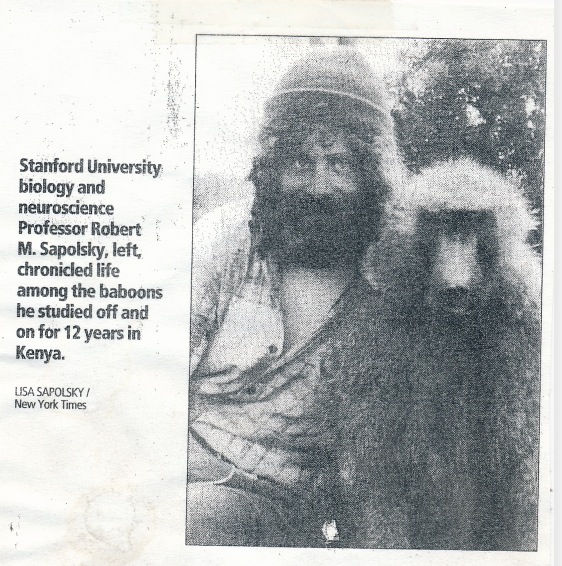
Here’s a hilarious newspaper clipping, sent to Lawrence Auster by a reader:

Read the caption carefully.

First World Problem

Here we are in 2012, and the most advanced technological civilization that has ever existed is stymied by three tons of meat in a log cabin.

What was it that Emerson said about hobgoblins?

The Call Of The Wild

First thing tomorrow I’m driving down to Milburn Landing State Park, near Pocomoke City, MD, for a weekend of camping with some boyhood chums: a long-overdue reunion inspired by a weekend we spent there 40 years ago this summer.

One of us lives in San Diego, one in Minnesota, one in Cincinnati, and one in Blacksburg, Virginia — so we almost never get to see each other. It’s really easy never to get around to things like this: you keep talking about it in a vague way, and the years roll by, and the next thing you know it’s too late, because you’re dead. Not this time, though!

Anyway, I’ll likely be right off the grid till next week. So here’s an entertaining video clip, just sent my way by my boy Nick: an experiment, involving monkeys, that, as the presenter mentions, goes a long way toward explaining Occupy Wall Street.

(After I watched it, though, I realized that to really get it right you’d need to have monkey A out digging up rocks, and monkey B just banging on the wall, throwing poo, and demanding half of monkey A’s grapes.)

Anyway, we’ll be back next week. I haven’t felt like writing much since getting back from California anyway; I’m still mulling things over, and sorting out what I want the tone of this blog to be going forward. Maybe this will get the juices flowing.

News You Can Use

Sitting for a portrait? Keep this in mind.

Going on a date? Head for Peter Luger’s.

Last, but not least: there’s no need to be glum just because Earth Day’s over. Not until you’ve read Iowahawk’s annual homage to Gaia, anyway.

Noose And Weather

Here’s some murderous rage from Forbes contributor Steve Zwick, who is scouting out lamp-posts for those who refuse to fall in line with his views on anthropogenic global warming:

We know who the active denialists are — not the people who buy the lies, mind you, but the people who create the lies. Let’s start keeping track of them now, and when the famines come, let’s make them pay. Let’s let their houses burn until the innocent are rescued. Let’s swap their safe land for submerged islands. Let’s force them to bear the cost of rising food prices.

They broke the climate. Why should the rest of us have to pay for it?

“They broke the climate”. (Pretty impressive, actually: who knew that a few dissenting voices could wield such Godlike power?)

String ’em up!

Before he does anything rash, Mr Zwick might want to have a chat with James Lovelock, who now says that all that early hysteria might have been, well, a little overheated.

Get Rich Quick

Nothing to it.

Mightier Than The S-word

Well, it appears that Marine le Pen will be the kingmaker in France this time around, having attracted fully a fifth of French voters to her National Front party in today’s election. This was nearly double the turnout for her opposite number on the Socialist far left, Jean-Luc Mélenchon.

Assuming that National Front supporters will more likely prefer Nicholas Sarkozy to today’s winner, the Socialist candidate Francois Hollande, a numerical defeat for Sarkozy today (27.9% for Hollande, 26.7% Sarkozy with 75% of the vote counted) may still translate into a victory in July’s runoff.

MSM reporters seem shocked that the National Front did so well. I’m not.

Spring Break

Sorry, haven’t had much to say since getting back, and it might be quiet here for a few more days. I need a little recess while I think about things.

Levon Helm, 1940-2012

Anyone of a “certain age” will be saddened by the death of Levon Helm, who has succumbed to cancer at age 71. His rustic voice was a big part of the soundtrack of our youth, and it hurts to see it silenced.

Plenty of Room

Longtime readers will know that I’m a big admirer of Richard Feynman. In the nanotech discussions last week at SU, there was frequent mention of his visionary 1959 lecture There’s Plenty of Room at the Bottom, which is widely regarded as the genesis of the field.

If you aren’t familiar with it, you can read it here.

That Was Fun

I’m back from my trip to Singularity University, and I’ll just say it was one of the more remarkable experiences I’ve ever had — something like a futurist’s boot-camp, in the company of a hundred or so very smart people. The days’ events began at about 8 a.m., typically didn’t let up until midnight or so, and consisted of a half-dozen or so lectures each day from global leaders in rapidly advancing areas of technology — AI, robotics, nanotech, genetics, biology, medicine, neuroscience, forecasting, computers and networking, and so on — interspersed with interactive workshops, group discussions, technology demos, and at the end of each day a gathering in the main building for people just to hang out and talk (lubricated with plenty of alcohol). The idea behind SU is to break apart the “silos” in these developing fields by assembling everyone in the same room and sort of banging their heads together. It’s a very good idea.

Because SU is in the heart of Silicon Valley, the idea that visionary entrepreneurship is the most effective way to get things done in this world is front and center throughout. The faculty are not people who talk about what folks are creating at the leading edge of all these fields: they are the people who are actually doing it — most of them, in addition to being academically prominent, are founders of edgy startups, or project leaders at places like Google — and you begin to feel that you are standing right at the growing tip of human endeavor. It’s intoxicating.

I’m still digesting it all, but I’m sure I’ll have a lot more to say as the days go by. One thing I will say right now, though: over the past few years the tone of this blog has become increasingly dark, and increasingly centered on partisan politics and civilization’s decline, and that may change a bit. That isn’t to say that my opinions have changed about any of those topics — you certainly will not be seeing me issuing any calls for a bigger Federal government, or more Islamic immigration, or tighter gun laws, and God knows we still desperately need a regime change in November — but the content here will probably be a lot less likely just to swirl around and around in those gloomy vortices. That way madness lies, and I think I had begun to lose sight of that.

Service Notice

I’ll be away for a few days: my friend Salim Ismail has invited me to participate in a program this week out at Singularity University, so I’ll be flying to San Francisco early Wednesday morning. I’ll be posting when I can — this looks like it’s going to be a fascinating experience — but the short programs at SU are high-intensity affairs that start early every morning and go far into the evening, so there won’t be much time for writing till I get back next week.

I know it’s been pretty dull here lately: there has been much to comment on, and a lot of it has to do with topics that are so highly charged that I’ve been wary, frankly, of wading in. I’ve been blogging here for seven years now, and need to reflect a bit on where it’s all led, and how exactly to move forward.

The world is changing very quickly now; its effective volume has shrunk very rapidly in the past few years, and so the pressure and temperature are increasing at an accelerating pace. There is some sort of phase transition on the way, I think, but whether any of what we know and love will survive it is terribly hard to say. It is clear, though, that the kettle is about to boil.

Singularity University is a hotbed of optimism about the future. I could use a dose of that, because I feel more like we are all sitting on a volcano, and the ground is starting to rise.

Fool On The Hill

Life is a risky business. To reach a comfortable dotage, one must thread one’s way past such omnipresent mortal hazards as cancer, auto wrecks, random assault, falling objects, air disasters, bullets stray or otherwise, atherosclerosis, capsizings, snakebite, cyclones, suicidal depression, carbon-monoxide leaks, cerebral haemorrhage, defenestration, shark attack, overdose, industrial accidents, poisoning, autoerotic asphyxiation, crib death, MRSA, jihad, pyroclastic flow, capital punishment, jealous lovers, anaphylactic shock, downed power-lines, avalanche, bicycle messengers, salmonella, icy sidewalks, derailings, surgical mishaps, rogue waves, heatstroke, cirrhosis, lightning, and so on.

This is a formidable gauntlet. With that in mind, it has always seemed to me that the game is sporting enough as we find it — but some of us find the challenge too modest, and so make hobbies of drag-racing, wreck-diving, free-climbing, hang-gliding, parkour, white-water rafting, and such like. Among the more jeopardous of these follies is “base jumping”, which consists of putting on a Rocket J. Squirrel suit and leaping from some crag or tall building. (None for me, thanks, but I’ll be sure to raise a glass at the wake.)

Here’s what it looks like.

Here’s what it looks like when it doesn’t go so well.

NATO’s Chickens: Home To Roost

Armed with weapons purloined from Muammar Qaddafi’s arsenal, Tuareg fighters and al-Qaeda in the Islamic Maghreb give us what I think is referred to around Washington these days as a “teachable moment”.

Today’s lesson? The law of unintended consequences.

Whither The Buck?

This entry is part 13 of 15 in the series Free Will

Sam Harris, the neuroscientist who made his bones as an anti-religious gadfly and member of the atheist “Four Horsemen” (now down, sadly, to three), has been writing and speaking lately about “free will”. The expression is rendered in scare-quotes because in Dr. Harris’s view “free will”, as generally imagined, is an illusion, and less: it is not even a coherent concept. I’m inclined to agree, as long as we leave in the part about “as generally imagined”.

Another of the “Four Horsemen” is the philosopher Daniel C. Dennett, who has written extensively on the subject of free will. His books Elbow Room and Freedom Evolves are expositions of compatibilism — the view that determinism is, despite our intuitions, compatible with responsible moral agency.

Sam Harris and Daniel Dennett have walked a long way arm in arm, but have come to a fork in the road. For Dennett, the fact that it is only through us, as deliberators, that the causal network in which we are embedded can produce decisions and behavior means that our choices are still our responsibility. For Sam Harris, not so much.

The key idea, in Dennett’s words, is that “if you make yourself small enough, you can externalize everything”. In order to preserve responsibility, then, we need to draw a boundary around ourselves, as nexuses of deliberation, that is big enough for us to live inside. Because we must choose what to do whether we like it or not, and because our choices are crucially affected by the contents of our brains — which includes, among everything else, our beliefs about such things as our own moral agency and responsibility — then to make this boundary expansive enough to regard ourselves as being responsible for what happens inside it is the key to a realistic view of freedom and moral agency. We can’t be “free” in the full-blown, radically libertarian way we imagine when we think naively about “free will”: that concept, when examined closely, isn’t even coherent. But once we shed our muddled, imaginary version of “freedom”, we can see that what we do have, though, is just fine for our purposes. Our deliberations matter, and they are ours — as long as we make “us” big enough.

Sam Harris disagrees.

Here is a video of a talk by Dr. Harris, as well as a short essay inviting Daniel Dennett to a public discussion of their disagreements. (Our friend Kevin Kim discusses the video here.)

And here is a transcript of a lecture given by Daniel Dennett in December of 2010 on how neuroscientists like Dr. Harris are getting it wrong.

I’m not going to say much more here (see our other linked posts on free will below), but I do want to point out a weakness in Professor Dennett’s talk. He uses a colorful analogy:

A favored image, not because it is good, but because it nicely captures the intuition people have is this: you go to Disneyland and go on the jungle boat ride, and the captain makes a dramatic show of almost steering into one catastrophe after another. Oh, you just missed that big hippopotamus, and then the crocodile, and — close call! — you narrowly avoided the waterfall! But of course the boat’s helm is completely non-functional, since the boat is running on an underwater track. There was never any chance it was going to go off the rails and collide with anything. There was a delicious illusion that there were these opportunities for disasters, all of which were deftly prevented from happening by the quick work of your skilled captain. A lot of folks think that this is the true face of determinism. “If determinism is true, my whole life is sort of on these hidden railroad tracks, and I don’t actually have any free will at all!” But, in fact, there is a fundamental difference: the activities, the desires, the reflections of the helmsman, the captain on the jungle boat are causally inert; they are not playing a role in determining the trajectory. But when you make a decision, the reflections going through your mind are in fact playing a role. Which is just what you should want.

The weakness is that this is not a strong enough analogy; it doesn’t capture the real problem. Better would be to imagine that the rails under the boat aren’t steering the boat directly; instead they control the brain of the captain. That gets us a little closer to the heart of the matter.

Anyway, Dennett and Harris are heading for a lively debate, I think. Have a look at the linked items.

Google Glasses

So: here’s the latest inevitable step toward having our brains permanently jacked into the Internet.

Are you going to want a pair of these?

In this demo the user talks to his glasses. But what’s the endpoint here? Once the interface is fast and intuitive enough, so that we can send and receive data as thoughts, and we can connect our thoughts to everyone else’s (ten years from now? five?), what then? The hive mind of the Borg?

Man Is the Only Real Enemy We Have

Here’s Eric Hoffer, writing in 1975:

After all that we have seen with our own eyes there ought not to be a grownup person who is not contemptuous of the gibberish about an ideal society and does not look for the lineaments of a commissar in the features of an idealist loudmouth.

The trouble is that the young who nowadays want to make history are not interested in history. They are unbelievably ignorant of much that has happened in this terrible century. They will follow anyone who wants to clear the ground for a new world by sweeping away all that exists.

– Before the Sabbath, p. 105

Gloves Coming Off

In case you’ve been shackled to a drainpipe for the past couple of weeks, there’s been an escalating tension in the air over the fate of Obamacare, now that the Supreme Court has heard the case.

President Obama, warning the other day that he would view a negative ruling by the Court as “judicial activism”, unburdened himself of a real whopper:

“Ultimately I am confident that the Supreme Court will not take what would be an unprecedented, extraordinary step of overturning a law that was passed by a strong majority of a democratically elected Congress,” Mr. Obama said in the Rose Garden appearance.

This is absurd, of course; ruling on the Constitutionality of acts of Congress is what the Court does, and has been doing since Marbury v. Madison. One can only assume that Mr. Obama,. with his degree from Harvard Law, does know that — so one can only assume that he simply doesn’t care, and is trying to paint the impending smackdown he is likely to get from SCOTUS as motivated by right-wing politics, rather than Constitutional jurispridence. All of a sudden he’s worried that he’s actually going to lose, and is laying the groundwork to turn the visceral anger of his base against the Court’s conservative Justices.

It’s working already. I have a student, a lawyer in his fifties, who in class last night complained to me that anyone could see that it was all just political: because after all, the ones who were seen as most likely to rule against the individual mandate — Roberts, Alito, Scalia, and Thomas — are all Republicans.

This is poorly reasoned — confusing correlation with causation — but we’ll be hearing a lot more of it, I think.

Anyway, as I said, tensions are high, and getting higher. Here we are in an election year, with the country breaking apart over irreconcilable, axiomatic disagreements about what America is and what governments are for, and the President’s signature accomplishment — bitterly fought and narrowly won on a blood-soaked political battlefield — is in real danger of being nullified. So when Mr. Obama fired off his warning shot across the Judiciary’s bow on Monday, it provoked a warlike response from a three-judge panel on the Fifth Circuit Court of Appeals, ordering the DOJ to report back by Thursday on whether the President actually believes that the Supreme Court has the power to strike down unconstitutional laws.

For the appeals court to make such a flamboyantly provocative gesture shows how high the temperature’s getting here. There’s often bad blood between the branches, but the smoldering feud between this administration and the conservative Justices is about as openly hostile as I’ve ever seen. (Remember the SOTU after the Citizens United ruling?)

Such high drama! and mighty entertaining — but the stakes are even higher.

Sign Me Up

For one of these.

Too Much Information

Our friend David Duff posted an item today in which he quoted an article from James Bamford at Wired about a new U.S. data-storage facility:

Given the facility’s scale and the fact that a terabyte of data can now be stored on a flash drive the size of a man’s pinky, the potential amount of information that could be housed in Bluffdale [the site of the facility] is truly staggering. But so is the exponential growth in the amount of intelligence data being produced every day by the eavesdropping sensors of the NSA and other intelligence agencies. As a result of this “expanding array of theater airborne and other sensor networks,’ as a 2007 Department of Defense report puts it, the Pentagon is attempting to expand its worldwide communications network, known as the Global Information Grid, to handle yottabytes (1024 bytes) of data. (A yottabyte is a septillion bytes””so large that no one has yet coined a term for the next higher magnitude.)

It needs that capacity because, according to a recent report by Cisco, global Internet traffic will quadruple from 2010 to 2015, reaching 966 exabytes per year. (A million exabytes equal a yottabyte.) In terms of scale, Eric Schmidt, Google’s former CEO, once estimated that the total of all human knowledge created from the dawn of man to 2003 totaled 5 exabytes. And the data flow shows no sign of slowing. In 2011 more than 2 billion of the world’s 6.9 billion people were connected to the Internet. By 2015, market research firm IDC estimates, there will be 2.7 billion users. Thus, the NSA’s need for a 1-million-square-foot data storehouse. Should the agency ever fill the Utah center with a yottabyte of information, it would be equal to about 500 quintillion (500,000,000,000,000,000,000) pages of text.

This rang a very old bell: a short story that I’d read as a boy in a science-fiction anthology called 17 x Infinity, published in 1963. This prescient tale, MS fnd n a Lbry, was written by Hal Draper in 1961, and was in the form of a report, written far in the future by alien archaeologists, on the collapse of our civilization (always a hot topic, of course, here at waka waka waka). The cause? Well, it’s short enough that you might as well just go read it yourself.

Service Notice

No posting today: I’m heading off to Ephrata, PA, for the annual banquet and awards ceremony of the national quilter’s association I’ve been sewing with since my early twenties. (I’ve been quilting since I was a boy; I should post some photos of some of my work sometime.)

My latest piece, which expresses the deepening polarization of American society in a geometric arrangement of corduroy and gingham, has been nominated for Best Topical Quilt, and I’m hoping I might even have a shot at Quilt of the Year. So wish me luck!

Back tomorrow.

Run Like An Egyptian

Oh, my. For a truly startling, completely unforeseeable turn of events, check out this item from the Times:

Islamist Group Breaks Pledge to Stay Out of Race in Egypt

CAIRO ”” The Muslim Brotherhood nominated its chief strategist and financier Khairat el-Shater on Saturday as its candidate to become Egypt’s first president since Hosni Mubarak, breaking a pledge not to seek the top office and a monopoly on power.

I’m sure you are as gobsmacked as I am. Why, the next thing you know, the sun will come up in the East.

Losing Our Way

More nanny-state idiocy from the Feds. Here.

Base And Apex: Which End Up?

In the comment-thread of a recent post, I’ve been arguing with our resident gadfly The One Eyed Man about the Constitutional legitimacy of Obamacare’s individual mandate — part of a broader disagreement about the proper scope of Federal power.

After much back-and-forth I wrote:

Bottom line: Constitutional law is a fascinating study, combining history, literature, philosophy, logic, and even psychology. You and I can discuss it at any length we like, and it’s stimulating and interesting to do so, but ultimately what we decide here doesn’t really matter. We have our opinions, but the only opinion that carries any weight is the Court’s, and even that one looks to be fairly closely divided on this issue.

Supreme Court appointments matter. It’s one of the big reasons why the the next Presidential election matters so much.

I almost added the following, but thought I’d post it here instead:

Most of the bickering about these Constitutional-limitation issues is a matter not of Constitutional “truth”, but of temperament, and of axiomatic differences about the proper form and scope of government. To paraphrase G.C. Lichtenberg, the Constitution is like a mirror: if a Utopian looks in, you can’t expect a realist to look out.

The United States Federal Government is the largest and most complex apparatus of state power that has ever existed. It rules over hundreds of millions of people and the largest economy in history, and it wields military strength that dwarfs any other that the world has ever seen.

“That may be true,” you say, “but why bring it up?”

I bring it up because we individual citizens are small, and the bigger the Federal government is, the smaller we each become in relation to it. Actions of the Federal government must be broad enough in scope to apply with the same fairness and aptness to the citizens of Wyoming, Alaska, Texas, and Hawaii as they do to me. I am one voice in hundreds of millions, and my local concerns will compete with those of all those other, far-flung corners of the Union — places whose social, political, religious and economic contexts and concerns may differ from my own community’s in a thousand ways.

On the other hand, my state’s government is far smaller, and my county and municipal governments smaller still. Being so much smaller means that they can focus with much sharper resolution on the particular issues that confront their little subset of the nation’s geography and population — and that those citizens will far better able to make their voices heard above the din.

People will generally be happier, will have more control over the affairs of government that daily affect their lives, and will better able to create a shared public life as a community, the more that the mass of government power lies as closely to their local community as possible. After all, the central principle of our Republic is that power flows from the people upward, not from the Federal government downward. The apex of collective power in Washington should be the small end of the pyramid, not its base.

Moreover, in a Republic of semi-autonomous States, each becomes its own laboratory of innovation. Given that there are many ways to solve the myriad problems of governance, decentralization of power makes possible the exploration and comparison of different solutions, with every State free to adopt those that seem best suited to their local temperament, and to serve as an example to others.

If you want further justification for this view, then consider that men are fallible, and prone to the abuse of power. Wisdom then suggests that the less centralized and concentrated the power, the narrower will be the possible scope of its abuse — and the closer those entrusted with such power are to those to whom they are answerable, the warier they will be of the consequences.

These, then, are some of the reasons why we conservatives prefer the bridle to the spur when it comes to aggrandizations and consolidations of Federal power. I won’t attempt to articulate the opposing view, but comments are welcome, as always.

Whitewash

In the past few days Heather Mac Donald has posted two essays on the jarring dissonance between mainstream coverage of race and violent crime and the underlying realities thereof. We hear all the time about the need for a “frank discussion of race in America”; perhaps this will help.

Read them here and here.

The comment-box is open.

Skinless And Boneless

Here’s a cogent item on the death of free speech in Britain, by Charles Cooke.

Volokh On Hypocrisy

Here.

Vapor Of Record

The New York Times opines today about yesterday’s Obamacare arguments in the Supreme Court. Predictably, the editors seem to believe that the effects of the Affordable Care Act are of sufficient national importance to trump its Constitutional audacity, and so they are willing to brush aside yesterday’s sharp questioning by conservative Justices as mere tendentiousness:

The insurance mandate is nothing like requiring people to buy broccoli ”” a comparison Justice Antonin Scalia suggested in his exasperated questioning of Solicitor General Donald Verrilli Jr. Congress has no interest in requiring broccoli purchases because the failure to buy broccoli does not push that cost onto others in the system.

Really? The point here is whether the individual mandate is as unique as the government would like the Court to think it is. But given that poor diets lead to poor health, and so to higher consumption of health-care services, why couldn’t the government, emboldened by a favorable ruling on the individual mandate, next make the case that failure to consume one’s vegetables increases the health-care cost burden on everyone else?

The point, as Justice Kennedy noted, is that to allow Washington this expansion of coercive power changes the relationship between the individual citizen and the federal government so profoundly, and is so conducive to further intrusive infringement of federal authority on individual liberty, that there is both an extraordinary burden of justification and a need for a clearly articulated limiting principle. It seems that the Solicitor General fell well short of both in yesterday’s arguments.

The argument by the Times seems to be: we want this, we need this, so the Court should just get out of the way. The editorial begins:

In ruling on the constitutionality of requiring most Americans to obtain health insurance, the Supreme Court faces a central test: whether it will recognize limits on its own authority to overturn well-founded acts of Congress.

Well, that’s one way of looking at it. (Gotta love that question-begging “well-founded”, too.)

Others might say that the “test” the Court faces is whether it will in fact do what it was created to do: recognize limits on the enumerated powers of the executive and legislative branches to usurp the rights of the States and of individual citizens.

We’ll have to wait and see; this could still go either way. But we can be a little more hopeful, I think, after yesterday’s session.

Our Day In Court

It was a big day at SCOTUS, and long awaited: the Justices heard oral arguments about the constitutionality of Obamacare’s individual mandate, and the buzz seems to be that it was rough sailing for the Solicitor General.

Transcript here. Decide for yourself.

Tomorrow: severability. If the mandate falls, does it take down the whole rotten structure? Judge Vinson thought so.

Any Questions?

Here’s Richard Feynman explaining, with trademark clarity and simplicity, how science works. (Would that the video clip were as clear, but it’s worth watching anyway.)

Turkey Shoot

Among the people I follow on Twitter is the popular comedian and writer Andy Borowitz, winner of the first National Press Club Award for humor. He pops up all over the place: you can read him in The New Yorker, at the Huffington Post, and in syndication in many major newspapers. He’s contributed to lots of TV shows, and turns up on screen all the time. Everybody in mainstream media loves this guy.

Not like that nasty Rush Limbaugh, who went right beyond the bounds of civil discourse a few weeks ago by calling Sandra Fluke, who at the time had just petitioned Congress to compel others to subsidize her sex life, a “slut”. How dare he? That’s just beyond the pale, and there was a good deal of stern tut-tutting from the Left about what is and isn’t permissible in a decent society. The President himself, Barack Obama, even called Ms. Fluke to tell her how badly he felt for her.

Now you may have heard that Dick Cheney, former U.S. Representative, White House Chief of Staff, Secretary of Defense, and Vice President, is recovering from a heart transplant.

Here’s a tweet posted this morning by Andy Borowitz:

All kidding aside about Dick Cheney, he really is a cocksucker.

As far as I know, this hilarious observation has caused no storm of outrage. Mr. Borowitz is of course free to say whatever he likes — and I realize that he is simply an entertainer, playing to an audience, and that japes like this are how he earns a crust. (The same, of course, could be said about Rush Limbaugh.) I repost his tweet here only to make clear that what you can and can’t get away with in the nation’s media depends very much on who you are, and on whether you insult approved targets — and there is no class of people more acceptable for all levels of vile derision than conservative white male demons like Dick Cheney. Imagine, if you can, Bill O’Reilly making the same tweet about Michelle Obama on the occasion of her recovery from life-threatening surgery, and the liveliness that would ensue.

Flex Time

The story making the rounds today concerns Barack Obama’s remarks to Vladimir Putin’s proxy Dmitri Medvedev, as detected by some open mics:

President Obama: On all these issues, but particularly missile defense, this, this can be solved but it’s important for him to give me space.

President Medvedev: Yeah, I understand. I understand your message about space. Space for you”¦

President Obama: This is my last election. After my election I have more flexibility.

President Medvedev: I understand. I will transmit this information to Vladimir.

“Flexibility”, you say. “Freedom to test the outermost limits of executive power, unrestrained by fear of any consequences at the polls”, you mean.

We’ll take a quick break from our usual incisive analysis to offer a personal message:

Yes, Mr. President, here’s hoping you have maximum flexibility, come January 21st. Sleep late? Take a walk? Watch some TV? Do some work around the house? Whatever you like, sir. Enjoy!

You’ll have all the time in the world, insha’Allah.

The Descent Of Man

An object at rest tends to remain at rest, I’m told, and I’ve been providing experimental confirmation for the past few days. Have no fear, though: just because we haven’t been chronicling the collapse of Western civilization as attentively as usual here at waka waka waka doesn’t mean it isn’t proceeding apace.

Sits My Heart At Ease

The lovely Nina and I, having pried open a tiny gap in our routine of ceaseless toil, made the five-hour drive back to the Outer Cape late last night. We arrived sometime in the “wee small hours of the morning”, and awoke to a clear blue sky, fragrant sea breezes, and warm golden sunshine — in short, one of those perfect early spring days that give the weary world a reason to carry on. We spent the afternoon hours on a long and languid ramble through one of Wellfleet’s remoter bayside forests, and afterwards we shared a bottle of wine and a simple but nourishing supper of leek-poached salmon, roasted red potatoes, and sauteed haricots verts, prepared by your humble correspondent.

So, when I sat down just now to scribble my daily offering, I realized I was simply in no mood for the relentlessly morose and pessimistic gloom-mongering you’ve come to expect here at waka waka waka. After all, who could nurture dark and dismal thoughts after such a splendid day in Spring? Not even me.

So: time for something light-hearted and optimistic, something merry and gay, to lift our spirits!

Here you go, then: a list of incredible weapons that only America has.

Now, Voyager

I follow a lot of different accounts on Twitter, but one of my favorites is @NASAVoyager2.

Here’s the latest:

I am currently 13 hrs 37 mins 31 secs of light-travel time from Earth (2012:081:2L)

That’s it: cool, calm and collected. I’ve been a follower for months now, and never once have I seen this thing emit a single dumb joke or snarky political barb. Gotta love it.

Sam Harris On Islam

Here’s a thoughtful new item by Sam Harris called Islam and the Future of Liberalism. A sample:

As I tried to make clear [in a recent podcast], we know that intolerance within the Muslim world extends far beyond the membership of “extremist’ groups. Recent events in Afghanistan demonstrate, yet again, that ordinary Afghans grow far more incensed when a copy of the Qur’an gets defaced than when their own children are accidentally killed by our bombs””or intentionally murdered. I doubt there is a more ominous skewing of priorities to be found in this world.

Should people be free to draw cartoons of the Prophet? There must be at least 300 million Muslims spread over a hundred countries who think that a person should be put to death for doing so. (This is based on every poll assessing Muslim opinion I have seen over the past ten years.) Should Ayaan Hirsi Ali be killed for her apostasy? Millions of Muslim women would applaud her murder (to say nothing of Muslim men). These attitudes must change. The moral high ground here is clear, and we are standing on it.

Of course, millions of Muslims are more secular and are eager to help create a global civil society. But they are virtually silent because they have nothing to say that makes any sense within the framework of their faith. (They are also afraid of getting killed.) That is the problem we must keep in view. And it represents an undeniable difference between Islam and Christianity at this point in history. There are also many nefarious people, in both Europe and the U.S., who are eager to keep well-intentioned liberals confused on this point, equating any criticism of Islam with racism or “Islamophobia.’ The fact that many critics of Islam are also racists, Christian fascists, or both does not make these apologists any less cynical or sinister.

The only way to know which way is up, ethically speaking, is to honestly assess what people want and what they believe. We must confront the stubborn reality of differing intentions: In every case it is essential to ask, “What would these people do if they had the power to do anything they wanted?’

This is a good beginning, and with it Dr. Harris parts ways with most of the political left. But it leaves us with the question: what to do? Here we hear only a familiar refrain: “These attitudes must change.”

Were I having a drink or three with Dr. Harris, I’d ask him:

“That’s it? ‘These attitudes must change’? But do you have any reason to think they will change? What if they don’t?”

They certainly haven’t shown any sign of doing so; the stubborn fact is that where there is any sizable Muslim population, a sizable subset of them will unapologetically harbor exactly the virulent Islamic beliefs and dispositions that Dr. Harris refers to here. “300 million Muslims spread over a hundred countries who think a person should be put to death” for drawing pictures of the Prophet, many of whom are willing to so something about it? What is the wisest posture for Western nations with large and growing Muslim populations to assume with regard to this fact? Surely it cannot be enough just to say “These attitudes must change”, and hope for the best.

I do respect Sam Harris — I admire his intelligence and forthrightness, and his readiness to consider every issue on its own merits. I often find myself agreeing with him, as I do with most (though not all) of this latest essay. I’d like to know how he would answer my question.

Disaster Strikes!

Here. I assume the Royal Navy has a carrier on the way.

Not With A Bang, But A Whingeing

Here, courtesy of VFR, is another illustrative account of the myriad blessings that the cult of Diversity showers upon us all. As anyone with a realistic understanding of history and human nature knows, high diversity erodes social trust and cohesion, and this story has it all: ethnic conflict, identity politics, race-hustling lawyers enriching themselves by stoking simmering resentments, bureaucratic squabbling over who has the appropriate bloodlines to represent each of the variously tinted and mutually antagonistic factions jostling for a spot at the trough, and of course the common cause that binds them all: displacement of white people.

Read it here.

She’s A Witch!

Still swamped here, with no time for a long post. At the top of the list of topics on my mind, though, is that insane Dharun Ravi thoughtcrime trial and verdict — in which an (admittedly unlikable) young man is facing 10 years in jail, a permanent felony record, and possible deportation for committing … a nasty little prank in which he spied on his roommate, in his own dorm, for a few moments. The central charge here is that he had impermissible thoughts — and it should be plain to everyone that this is nothing more than a show trial, meant to make a public example of Mr. Ravi, and to make very clear to all just what thoughts you can and cannot harbor in this age of “tolerance”. It is creeping totalitarianism, and all of you with any understanding of history, and with any awareness of just how rare and precious our fragile freedoms really are, should be getting very edgy right about now.

There are lots of rants I could link to here, but instead I’ll direct you to two (mostly) sensible posts by Jacob Sullum at Reason. They are here and here.

One Damn Thing After Another

I’m still sweating bullets this weekend trying to solve a baffling work-related technical problem, so here’s a new site for you to have a look at: Lists of Note. I’ll start you off with this list of predictions for the year 2000, made in 1949 by Robert Heinlein. You can take it from there.

Heinlein did a pretty good job, I think, as you might expect from a successful guy who made his living by imagining the future. (Not perfect, and way off on a few items, but pretty darn good.) Where he really scored was at the end, where he listed eight items that he thought “we won’t get soon, if ever”:

— Travel through time
— Travel faster than the speed of light
— “Radio” transmission of matter.
— Manlike robots with manlike reactions
— Laboratory creation of life
— Real understanding of what “thought” is and how it is related to matter.
— Scientific proof of personal survival after death.
— Nor a permanent end to war.

Here’s another: advice from Thelonius Monk. A sample:

DISCRIMINATION IS IMPORTANT.

Service Notice

I’ve been grappling for three days with a difficult problem at work and an impending deadline, and so have had no opportunity for writing — though Lord knows there’s a lot going on right now I’d like to comment on: Afghanistan, the Dharun Ravi verdict, the man who was buried alive by pinto beans, etc.

Things might be quiet here for another couple of days.

Update: one thing I can offer for your amusement is a corking good rant, this week’s Radio Derb. Here.

Help Wanted

Anyone have experience with Movable Type upgrades? I have a friend who needs some assistance.

I’ll Never Fall In Love Again

Oh, no, this is awful. It looks as if Obamacare is going to end up costing more than the Democrats told us it was going to!

Who could ever have imagined that they would deceive us like this? I feel so… used.

Stop The World

This in my inbox just now, from info@barackobama.com:

Friend —

If the general election were held today, President Obama would lose to Mitt Romney — according to the latest poll from Washington Post-ABC News.

And then there’s this, from today’s Times:

Obama’s Rating Falls as Poll Reflects Volatility

Despite improving job growth and an extended Republican primary fight dividing his would-be opponents, President Obama is heading into the general election season on treacherous political ground, according to the latest New York Times/CBS News poll.

At a time of rising gas prices, heightened talk of war with Iran and setbacks in Afghanistan, Mr. Obama’s approval rating dropped substantially in recent weeks, the poll found, with 41 percent of respondents expressing approval of the job he is doing and 47 percent saying they disapprove ”” a dangerous position for any incumbent seeking re-election.

Just thought some of you might need a little cheering up (though of course there’s a good distance yet ‘twixt cup and lip).

The Devil’s Workshop

Having spent hours on the road this afternoon schlepping back to Gotham from Cape Cod’s outer extremity, and facing the prospect of a long and early day of toil tomorrow, I’m feeling much too lazy to write anything this evening.

Fortunately, Bill Vallicella has posted up a link I can steal, and it’s just the thing: Bertrand Russell’s In Praise of Idleness — a wry meditation, very much “of its time”, from the apex of the Progressive era. I’d never read it before. Can’t imagine why.

Here’s something else, too: a curious hypothesis about our obesity epidemic, courtesy of Dennis Mangan.

A Feast For Crows

It was a lovely day today, with golden sunshine and temperature well into the 60’s, and so I took a walk along Mayo Beach, a south-facing harborside littoral a few hundred yards from our wooded hilltop.

Readers may recall that Wellfleet has had a rash of dolphin strandings this winter. As I walked the mile-long stretch from the Town Pier to Powers Landing, I passed not one, but two of them, dead on the shore.

Pictures below the fold, if you want to see them. (I apologize for the quality – I didn’t have my glasses with me, and the camera in my phone doesn’t seem to have got the light right.)

Read More »