Well, we’re stuck without power again, as of this morning. There are posts I’d like to write, but I’m not about to do so on this cell-phone, which is my only way of getting online.
Worst of all: beer getting warm again.
Well, we’re stuck without power again, as of this morning. There are posts I’d like to write, but I’m not about to do so on this cell-phone, which is my only way of getting online.
Worst of all: beer getting warm again.
Well here we are again, almost exactly a year later, perched on our little hilltop way out on a sandy spit in the Atlantic, bracing ourselves for a hurricane. Last year’s offering, Earl, missed us to the east; this one is supposed to pass by a little way off to the west. It’s always a lively ride being out here for these storms, though — whether it’s a hurricane, a nor’easter, or a blizzard — and I’m sure Irene will be no exception. At the least, we’ll probably lose electrical power for some interval of hours or days.
As always: should we not make it, dear Readers, thanks for coming round to visit these past seven years. It’s been a pleasure.
It was Richard Dawkins who gave us, in his 1976 book The Selfish Gene, the idea of the “meme”. The concept, by replicating itself into millions of human minds, has turned out to be a robustly successful meme in its own right — and Professor Dawkins is rightly credited with setting it loose in the wild.
I was surprised, therefore, to see that another Englishman — the Victorian author Samuel Butler — seems to have beaten Dawkins to the punch by a century or so. Yesterday I ran across this quote:
Opinions have vested interests just as men have.
The word “interests” is of particular relevance here, as it shows Mr. Butler taking the “intentional stance” toward ideas themselves. As I’ve stressed often (see here, here and here, for example) it is only by understanding replicators as things that can be seen as having “interests” that we can arrive at naturalistic accounts of intentionality and a Darwinian grounding for the notion of “design“.
I don’t know if anyone else has noticed this connection — a Google search of the quote together with “meme” turned up nothing — but I think Samuel Butler was perhaps the first carrier of the “meme” meme.
As advertised, we’re lying low out here in the remoter reaches of Cape Cod, and paying little attention to the wider world. I hear there are things going on out there — apparently something’s happening in the Middle East or something — but my attention has been more focused on oysters, old books, and keeping an ear cocked for the tinkle of ice at sunset.
Postings will continue to be sporadic till early September. For today, though, here’s one of those educational nature videos.
If we infidels are going to go around insisting that life arose spontaneously without miraculous intervention, then we’re naturally going to have a keen interest in providing an explanation of how that could have happened. To make the story hang together, what’s needed is for some sort of self-replicating molecules to have arisen, and a plausible suggestion as to how that can have happened. (DNA won’t do, as it requires too much ancillary machinery to do its work.)
Progress has been made. Here’s an article that will explain where we’ve got to so far.
P.S. Don’t miss the bit about the fuzzy beast with seven sexes.
Here’s the great voice-over artist Bob Kaliban in some recently discovered studio footage. Have a glimpse behind the scenes in the ad biz of old.
The Tea Party has taken heavy fire lately: blamed by the MSM for our recent market volatility and S&P credit downgrade, derogated as “hostage-takers” and “terrorists” by prominent Democrats, while leading Tea Party candidates have been the subject of scary magazine articles and intentionally hideous cover photos. (All part of the rough-and-tumble of American politics, of course; the Right does the same thing too.)
Yes, I’ll admit many of our new Tea Party pols are what could fairly be called zealots — or even, in a stretch, “extremists”, if you like (though clearly of the sort that carries the Barry Goldwater seal of approval). Nevertheless, I’m glad they’re out there. For all that their tactical choices may be unschooled and unsubtle, the principles they defend so ardently are those that have been the key to America’s greatness in the past, and are necessary for the preservation of what rump-greatness America has left. There’s no doubt that the Tea Party is carrying a lot more sail than ballast — but zoom out a little, and the Tea Party is the ballast desperately needed to right a badly listing ship that has been sporting, for a very long time now, far too much government sail.
As I was thinking these thoughts I ran across a cartoon that seemed apt enough to include here (also with a nautical metaphor), by Chuck Asay:
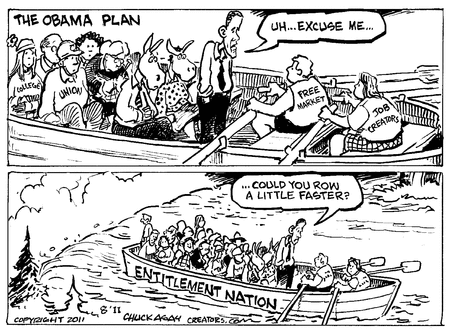
Long ago, Winston Churchill said more or less the same thing:
Some people regard private enterprise as a predatory tiger to be shot. Others look on it as a cow they can milk. Not enough people see it as a healthy horse, pulling a sturdy wagon.
Ah, the Casuals at the Beachcomber. What could be better? Here’s a live feed, if you read this in the next little while.
They’ve been playing this joint for 31 years.
Here’s some trenchant commentary on the UK’s oikophobic response to its wave of riots, from Brendan O’Neill at spiked.
I have a feeling this could really catch on…
What’s the biggest problem facing America today? What’s the Obama administration’s top priority?
Jobs, you say? The economy?
Of course not, silly!
It’s carbon.
In the past day or so Dennis Mangan and others have mentioned this important new study confirming the heritability of intelligence. The results will hardly be a shock to denizens of the HBD blogosphere, or for that matter anyone who has been following the actual science of psychometrics, but are bound to raise a hackle or two here and there.
The notions that this paper supports — that intelligence is real, that it is measurable, and that it is in large part heritable — are a good example of PC orthodoxy contradicting the findings of both everyday experience and scientific inquiry. Yet the orthodoxy persists. I recently had a fairly heated dinner-table argument with a Harvard sociologist in which she denied that the idea of ranking “intelligence” had any value at all, because there are so many “kinds” of intelligence. I suggested that even if that were so (and even if we generously leave aside the general problem-solving sort of intelligence that people usually think of and is the metric usually sought), one could still entertain the notion of being more or less intelligent as regards whatever particular “kind” of intelligence one might choose to consider, and that surely we would have to say that someone who did better in every “kind” of intelligence than someone else could fairly be ranked, by any reasonable examiner, as “more intelligent” than that other person.
At this she bobbed and weaved a bit, and then finally gave away the real basis of her resistance by saying that regardless of any of these points, we shouldn’t be conducting such research, as it could be fodder for discrimination. In her mind that was more or less the end of it, and in the interest of friendship and good digestion I let the matter drop.
She’ll be sorry to hear that the research has gone ahead anyway. I’ll try not to mention it.
As the long-awaited global apocalypse unfolds before our eyes, I’ve done what any responsible citizen with a proper sense of duty — or in fact, any sense at all — would do: run away. The lovely Nina and I have withdrawn to a well-provisioned bolt-hole in one of the nation’s easternmost extremities, and as long as the booze and oysters hold out, we should be fine.
I’d add some pithy comment on the accelerating collapse of civilization — I might, for example, toss off a post about how neatly the outbreak of racial mob assaults in the US, and of full-scale rioting by the UK’s feral underclass, provide a tangible, earthy complement to the rather more abstract convulsions currently laying waste the financial markets — but there isn’t much one can say, really, that isn’t perfectly obvious to all anyway. Simply put, we’ve made a fine mess of what was once a highly promising civilization, and now it’s all going to hell.
The wisest course, as far as I can see, is to drink a lot and read old books until the mighty wave crashes through the door, or the waters subside. As a result, it might be rather quiet around here for a little while. Please feel free to browse our archives, or try the “View a Random Post” link at upper right.
Or, if you’ve never visited it, go poke around James Lileks’s fabulously entertaining website. Just the thing to distract yourself with while you’re bracing for impact.
In today’s Times there’s a harsh look at Standard and Poor’s ratings system, by Nate Silver.
An excerpt:
[T]he evidence from the past five years suggests that it may be worthwhile to adopt a contrarian investing strategy that specifically bets against S.&P.’s ratings. If you were trying to predict a country’s default risk today, based on the market’s perception of its default risk two years ago as well as its S.&P. rating at that time, you would find that accounting for S.&P. ratings actually subtracted value from your model. That is, if the market had priced two countries as having a 20 percent default risk in 2009, but one of them had a AA rating from S.&P. and the other had a BB rating, the country with the worse S.&P. rating is likely to have proven to be the safer bet.
The reason for this is that S.&P. ratings probably have some influence on market perceptions about default risk ”” even though they aren’t very good. If markets evaluate a country as having a 20 percent chance of default, but S.&P. rates it as being quite safe, that price represents a compromise between daft investors who take S.&P.’s ratings to be gospel, and savvier ones who have conducted their own analysis and have concluded that the country is at significant risk of default. By betting against S.&P.’s ratings, you’re taking the side of the smart investors ”” and getting a subsidy from the suckers who think S.&P.’s price is right.
But there is another “tell’ to indicate that S.&P.’s ratings are slow to incorporate new information. It’s something which they seem to think is a feature of their ratings, but which instead is evidence that they are fundamentally flawed.
The giveaway is that S.&P.’s rating changes are serially correlated ”” that is, downgrades tend to follow downgrades, and upgrades tend to follow upgrades. According to the company’s internal analysis, once a country is downgraded it has a 52 percent chance of being downgraded again in the next two years. By contrast, there is just a 9 percent chance that S.&P. will reverse course and upgrade the country.
What this implies is that S.&P.’s ratings are inefficient about how they incorporate new information. If a country is downgraded from AAA to AA, and that implies that the country is quite likely to be downgraded again in the near future, the question is why S.&P. didn’t apply a steeper downgrade in the first place.
Consider the case, for instance, where I had a model to determine the value of shares in Google. Initially, my estimate had been that a price of $600 per share is appropriate. But then there is some shock to the system ”” say, some fresh evidence that the country is on the verge of another recession and that this could adversely affect Google’s profits. I estimate that $500 is now a fair price.
So I tell you that I’m willing to sell you Google shares, today, for $500. But I also tell you that tomorrow, I’m likely to lower my estimate further, so you can probably buy Google stock from me for $400 per share.
No competent brokerage firm would ever convey that kind of information to investors. If I signal to you that I’m likely to accept a cheaper price tomorrow than I am today, nobody would buy at today’s price.
But this is essentially what S.&P. does. Rather than downgrade (or upgrade) a country by several notches, even when there is abundant to support it, they instead do so in stages. Greek debt, for instance, has been downgraded seven times since January 2009, as S.&P. has slowly caught up with the grim realities that investors had long ago perceived.
I suspect the reason that S.&P. behaves this way is because they know that their ratings can have reverberations on the market and are trying to avoid a sudden downgrade that might induce panic.
But in so doing, they are violating their mission of providing the most earnest and accurate assessment of a country’s default risk at any given time. A country that is downgraded from AAA to AA is riskier, in S.&P.’s view, than one that was just upgraded from A to AA ”” even though they now have the same rating ”” since the former country is likely to be downgraded again and the latter is likely to be upgraded again. S.&P. knows this, and smart investors know this. But they won’t tell you this because dumb investors might get spooked, which could rattle the markets.
Read the whole thing here.
Winston Churchill was, in my opinion, the greatest statesman and wartime leader of the 20th century, and America’s surest friend since Lafayette. In the aftermath of 9/11, the UK sent a bust of Churchill to the President, as token of enduring solidarity from our closest and most natural ally among all the nations of the world. It stood in the Oval Office as a remembrance of how England and America stood shoulder to shoulder in the Second World War, and of how the English-speaking peoples, alone together, rescued Western civilization in one of its darkest hours.
It stood in the Oval Office, that is, until Barack Obama took office in 2009 and promptly sent it back. (Blood is thicker than water.)
Would that we had a Churchill to lead us now. David Gergen thinks so too.
“When the war of the giants is over the wars of the pygmies will begin.”
Awful news: 31 US troops, including 22 members of Seal Team Six, were killed in Afghanistan by a Taliban attack on a Chinook helicopter in Wardak province, Afghanistan.
This adds deep, and deeply symbolic, sorrow to what is already a very grim weekend indeed here in America.
They went with songs to the battle, they were young,
Straight of limb, true of eye, steady and aglow.
They were staunch to the end against odds uncounted,
They fell with their faces to the foe,
They shall grow not old, as we that are left grow old;
Age shall not weary them, nor the years condemn.
At the going down of the sun and in the morning
We will remember them.
– Laurence Binyon, For the Fallen
If you’ve ever wondered what it feels like to be a drug mule who’s just swallowed five condoms full of heroin, ask someone who’s long in the market this weekend.
“In the mountains the shortest route is from peak to peak, but for that you must have long legs.”
– Nietzsche, Thus Spoke Zarathustra
It’s been a fortnight now since Anders Behring Breivik’s havoc in Oslo. Cultural-conservative bloggers, aghast, have mostly tried to do three things in their subsequent commentrary:
First and foremost, to condemn Breivik’s mass slaughter as irredeemably evil;
Second, to dissociate themselves from any responsibility for it;
Third, to attempt, within the context of the strongest possible disapproval, to demonstrate that Breivik’s actions, however despicable, can nevertheless be understood as a consequence of the ethnically masochistic and self-abnegating immigration policies of European liberal elites.
This latter is a tricky business, and those commenting from the Right have had to wriggle a bit to avoid giving the impression that Breivik’s young victims in some sense “had it coming”.
The really awkward part for the anti-mulitculti, defense-of-the-West commentariat has been that Breivik’s view of the problem is roughly congruent with our own.
Got home too late to write anything tonight — worked a long day at the office, then stopped off on the way home to grab a couple of slices with what was left of my 401(k).
I had the TV on just now, and was watching Piers Morgan. He had on a fellow named Brad Thor, who apparently is a “terrorism expert” and author of “thriller”-style novels. They were talking about Norway, and about how much of a shock the Breivik rampage was to a nation that never saw it coming, and so was very poorly prepared to respond quickly or effectively. Mr. Thor, just in passing, made a remark of such breathtaking and unintentional irony that I feel the need to reproduce it here, without further comment.
He said, with a perfectly straight face, “I’d hate to see this result in a change to Norwegian culture, but it probably will.”
Well, we got our debt-limit increase.
It’s a fantastic piece of legislation: it starts right off by “saving” almost a trillion dollars over the next ten years. (We’ll borrow that much in the next nine months, but hey: politics is the “art of the possible”.)
Next, I think we should take care of the drunk-driving problem by raising the blood-alcohol limit.
Anyway, soon we’ll have a brand-new deficit-reduction commission working hard to find ways to cut a little fat. (Of course we’ve had 17 of these in the last 30 years, during which period US government spending, in constant dollars, has more than doubled. But if at first you don’t succeed…)
They shouldn’t have much trouble finding places where the federal government’s looking a little zaftig — but just to get them in the right mood, they might like to read this.
As advertised in this space a few weeks ago, Dr. John played at the Prospect Park Bandshell this past Saturday night (with go-go legend Chuck Brown and another very funky band called Red Baraat as openers). It was a fabulous show. Sorry you missed it.
Dr. John is a walking encyclopedia of the American musical heritage, and probably the foremost living exponent of old-school New Orleans piano-playing. In this video clip, he demonstrates some serious left-hand “trickerations”. Check out those tenths!
Here’s Paul Krugman talking to Christine Amanpour this morning about spending cuts:
“From the perspective of a rational person — in other words a progressive…”
If you want to foreclose on civil discourse, to go beyond argument to mere polemic, to whip up bitter factional antipathies, to make the process of democratic government little more than a civil war without (for the moment) actual physical violence, well, this is the way you do it.
Not only is Krugman going out of his way to be as insulting and provocative as possible, but in his foaming anger at all things conservative he also exhibits a gross misunderstanding of the very concept of reason itself, and of the difference between axioms and theorems.
“Progressivism” is a collection of axioms about what constitutes a desirable society. Once you have accepted those axioms, then you can use reason to evaluate policy on the basis of the foundation they provide. If, however, you build your worldview upon a very different set of axioms, as conservatives do, then the same process of reason — reason being what “rational” people do — will lead to different policy choices.
The choice of progressive vs. conservative axioms, as with any axioms, is not a matter of reason, but of temperament, intuition, and disposition. But so blinded by partisan rage is Paul Krugman, so besotted with ideological fanaticism, that he has rendered himself oblivious to this essential aspect of human reason.
John McCreary at NightWatch, always an indispensable resource for those who like to keep an ear to the ground, has offered some particularly pointed commentary on the Mideast over the past few days.
First, Afghanistan. Our open-ended nation-building project having foundered on some sharp and immovable realities, we are leaving. But rather than make clear to all the dismal facts about how matters stand in Afghanistan — public awareness of which might help us to make wiser choices in future — we seem to be engaging in a serious campaign of what Mr. McCreary refers to as “perception management”. (Other apt terms might be “disinformation” or “propaganda”.)
From yesterday’s dispatch (emphasis added):
Afghanistan: Suicide attacks occurred on 28 July in Tarin Kot, the capital of Oruzgan Province in southern Afghanistan north of Kandahar, and appear aimed at killing the governor and his staff. Clashes continued between assailants and security forces.
Comment: After the assassination of three top Afghan officials this month, the attack in Tarin Kot appears part of the Taliban tactic to eliminate the senior agents of the central government wherever they may be found.
Special NightWatch Comment: Citing a US officer acting as spokesperson for the NATO Command, USA TODAY reported on 28 July, “For the first time in five years insurgent-initiated attacks in Afghanistan have not increased with the start of a new fighting season, suggesting that a surge of U.S. forces has blunted Taliban momentum, according to the coalition forces.”
“The Taliban is ‘feeling the effects’ of a surge strategy over the winter to drive militants out of former Taliban strongholds and hold the terrain, said Navy Lt. Cmdr. Colette Murphy, a spokeswoman for the coalition command in Kabul, though she cautioned that the Taliban is not defeated.”
“In May and June, insurgent attacks were down about 2% compared with the same period last year, says the International Security Assistance Force (ISAF). Since 2006, insurgent attacks grew by 20% or more each year, according to the data. The NATO command in Kabul released a summary of the statistics in response to a USA TODAY request.”
The NightWatch data for May 2011, which is compiled only from open source reporting, indicate May 2011 was the most violent month in Afghanistan since 2001.
NightWatch‘s open source data is a sample and, thus, a sub-set of all insurgency and counter-insurgent violence. Thus, the 2,300 violent incidents reported in unclassified sources in May 2011 represents probably a third of the total violence for the month. Compared to May 2010, the May 2011 total is nearly six times larger.
The real story in Afghanistan is that violent clashes, attacks and IED incidents have grown steadily between November 2011 andJuly 2011. Despite cheerful NATO press releases, open source data indicate security steadily declined in nearly every province of Afghanistan in the past year. The UN data on security corroborate the downward trend.
Without knowing the actual data on which NATO bases its claim of improved security, it is impossible to evaluate the statement by the US officer in Kabul. The NightWatch and UN data, however, indicate clearly that Pollyanna-ish assertions about improved security conditions in Afghanistan are simply unfounded and unjustified. The recent spate of high-profile assassinations reinforces that conclusion.
And from today’s report:
Afghanistan: During an unannounced visit to Kandahar in southern Afghanistan, Admiral Mullen, Chairman, Joint Chiefs of Staff, gave a pep talk to the allied forces in which he mocked the significance of the recent assassinations of key Afghan officials in the south, including President Karzai’s half-brother, Wali Karzai. He said some believe this is all the Taliban can do, thereby quoting but not owning a highly controversial statement.
Special comment: The US military, for understandable reasons of morale, continues to put a positive spin on security developments, but Readers need to know that the facts continue to run in the other direction. The US military is engaging in a perception management operation apparently for English and American speakers. The message is the job is getting done and it’s time to leave.
It is time to leave because the US civilian political leadership has made that decision and is holding the military leadership to their agreement in 2008 that they could make significant gains in 18 months. The time has passed; the gains are local and impermanent, according to every tactical-level interview; and the Taliban know it. Resident reporters have described the situation in Kabul as a fragile structure waiting to collapse.
Assassination of stalwarts of the Karzai regime cannot be minimized. If Wali Karzai, Jan Mohammed and Hamidi can be assassinated, so can President Karzai.
This is a warning: the Taliban and other anti-government fighting groups are engaged in their own decapitation campaign ”¦ without drones, but up close and personal in Kabul and Kandahar. They appear to be capable of killing anyone they decide to target.
Also in today’s report are notable items about Turkey and Egypt:
Turkey: Turkey is experiencing stress because the Chief of the General Staff, the Commander of the Land forces, the Air Force Commander and the Navy Commander resigned on 29 July to protest the anti-military actions of Prime Minister Erdogan’s government.
General Isik Kosaner, the Chief of the General Staff, said he resigned from his post in protest of the jailing of military officers in a variety of court cases. Kosaner reportedly said it is impossible for him to continue in his post because he is unable to fulfill his responsibility to protect the rights of his personnel.
The senior officers who resigned with Kosaner are Land Forces Commander General Erdal Ceylanoglu; Air Force Commander General Hasan Aksay; and Navy Commander Admiral Esref Ugur Yigit.
Turkish President Abdullah Gul signed a decree appointing Gendarmerie Commander General Necdet Ozel as Chief of Land Forces. A reporter said Ozel would later be appointed the Chief of the General Staff of the Turkish armed forces in the place of General Kosaner.
Comment: The overarching issue is civilian control of the Turkish armed forces. Control of promotions and promotion policy is central to any military leadership structure. The resignations were as a reproach and a challenge to the Erdogan government for meddling in the military promotion system.
Kosaner’s position and that of the other service chiefs is that officers under arrest but no brought to trial should be promoted on schedule because they have committed no crime. There are some 400 officers in this condition as the result of the AKP government’s discover in 2007 of a coup plot in 2003 that never took place. This is the Ergenekon or Sledgehammer coup plot by the military to overthrow the pro-Islamist AKP government a year after its election.
Since coming to power in 2002, the Justice and Development Party (AKP) government has worked to break the political power of the armed forces and to erode its ethos as the guardian of the secular traditions of Ataturk. It has used a rising standard of living, relative prosperity and application for membership in the European Union, increased influence in Europe and the Middle East and promotion of more devout Islamic practices in public to marginalize the armed forces.
Outside the cities, the mass of Turks have proven in two elections that they support pro-Islamist and fundamentalist policies. The AKP has won both elections easily.
It also has used the Ergenekon investigation to keep the military leadership on the defensive and in the barracks under threat of arrest and prosecution for supporting a coup, now eight years ago. Respect for the military has declined significantly as a result.
Today’s resignations are without precedent and appear aimed at arousing sentiment against the strongly Islamist tendencies of the government. Grand gestures such as resignations almost always are sophomoric and fail to make a difference because no one is inexpendable and replacements, such as General Ozel, are always waiting for their chance to lead.
The exceptions are when mass military leadership resignations are precursors to popular uprisings or to a military takeover of the government. There are no signs and no chances of a popular uprising in support of the armed forces. The time for a coup would seem to have passed, but analysts said that about Pakistan in 1999 right before General Musharraf overthrew the Nawaz Sharif government.
Egypt: Tens of thousands of protestors gathered in Cairo’s Tahrir Square on 29 July after Islamist leaders called for nationwide demonstrations, BBC Middle East reported. The demonstrators called for Sharia law and an Islamic state.
BBC reported that most of the protesters were Muslim Brotherhood supporters. Egyptian Nile News TV channel reported that Salafists (i.e., essentially, Islamic fundamentalists) control Tahrir Square, and that there was no representation of other political factions.
Earlier, twenty eight other political groups, including the Youth Coalition and 6 April Movement, announced that they would continue their sit-in in Tahrir Square that began 8 July but would not join protests today because the Islamists violated an agreement made the week of 24 July to call for common demands, form a united front and avoid controversy, such as creating an Islamic state.
According to the secularist leaders, the Salafists broke the agreement by chanting pro-Islam slogans during the mass protest after Friday prayers in Qena. Salafists and other Islamists in Alexandria also started chanting after Friday prayers, Al-Masry Al-Youm reported.
As the day ended, Islamist protestors were said to be leaving Tahrir Square in Cairo. According to several Salafist clerics, the Islamists did not intend to turn the protests into an open-ended sit-in or to spend the night in the square.
Comment: The Islamists turned the weekly demonstration into a show of their political strength. Until today, the Islamists (Salafists) always preferred to remain in the background of the uprising. Today’s events prove the secular activists have been pawns who are unable to challenge the much more organized Islamists.
The message for readers is that the Islamists have the capability to become the next government of Egypt by dint of organization and democracy, unless the Egyptian military stops them.
US leaders should expect to have to choose between democratic elections that bring anti-US, anti-modern and anti-Israel Islamic fundamentalists to power in Cairo or undemocratic actions by the Egyptian armed forces to prevent that result.
You can subscribe to the NightWatch newsletter here.
Blogger Iowahawk tweets:
Instead of car that gets 55 miles per gallon, how about a govt that gets 180 minutes per billion?
I like that: minutes per billion as a measure of government bloat. Currently we get about 137 MPB.
I find myself imagining a gathering crowd watching the Capitol from some safe distance as the frenzy increases inside, with the two houses of Congress joined by the President in a furious battle-royal. The mighty building starts to quiver and shake. Clouds of steam begin to rise, and the walls start to glow — at first a dull red, then brighter and brighter. As the crowd uneasily steps back, the shaking and shuddering become more violent, and are joined by a low, almost sub-sonic rumble. The ground trembles, and then with a loud crack! the building begins to sink into the earth, as the glow turns fiery orange.
Through the billowing clouds the crowd watches as the Capitol slowly disappears from view. Now the dome, incandescent, is all that can be seen … soon it too is gone. After a while the clouds and rumbling begin to subside, and the crowd moves closer. The earth has fallen in, filling the hole, and all that remains is a few wisps of steam rising through the soil.
Silence.
It’s all gone — Democrats, Republicans, Tea Party, Boehner, Reid, Cantor, Pelosi, POTUS, the whole enchilada. Done.
The people stand amazed for a little while. Then one of them says:
“OK. Let’s all go home, take a little break. Think about what happened here. And then we’ll try this again.”
As the markets begin to totter in anticipation of the coming global collapse, investors are naturally wondering where to put their money. According to the latest data from NASA, I’d say definitely not the beach-umbrella or swimwear sectors. Maybe coal-mining and hockey equipment.
In this new climate of austerity, when we have to wean ourselves from so many lavish indulgences, it’s good to be reminded of life’s simple pleasures — like seeing someone give that Chris Hedges a good poke in the eye. Sam Harris does so here.
I had hoped to find some quiet time today for getting some thoughts written down about recent events (in particular the massacre in Oslo and what it means for the defense-of-the-West club that has been spotlighted from all angles in its aftermath), but it was not to be, and now, with a couple of very long work-days coming up, I’m not going to have much of an opportunity until Friday at the earliest. (I realize that my not having commented on it all has not exactly stopped the Earth in its orbit, but I think it’s incumbent on anybody who has written the sorts of things that I’ve been writing in this blog for years now to say where he stands in the wake of Mr. Breivik’s actions, and I intend to do so.)
For tonight, though, just a few links — starting with a couple from Science Daily:
— From the University of Leicester, what you might call “penetrating” insights into a popular activity.
— Does recent research into epigenetics mean new life for Lamarckism?
— In a follow-up to our story a while back about zombie ants, here’s a similar game involving ladybugs.
— On a more political note: Dennis Prager enumerates a few of the reasons why, as John Boehner said last night, “bigger government means smaller people”.
Might be quiet here for a couple of days.
I’ve been brooding and distracted, and trying to organize my thoughts for a serious post or two, but have hardly had a moment to myself all day, and so have nothing much to offer tonight.
Except, of course, this appetizing illustration of sodium-ion channels in action, courtesy of my daughter Chloe.
A conversation with my father on the subject of the Armenian mystic Gurdjieff has led me to a re-reading of Nietzsche’s Thus Spake Zarathustra, which apparently G. had recommended to his study groups. (My father was a member of Gurdjieff’s London group after the war until G.’s death in 1949, and in fact went to Paris a couple of times to offer medical assistance in G’s last year.)
One of the book’s central messages is that God is dead. New evidence, however, reveals that God hasn’t been dead at all. He’s just focusing mostly on Nascar these days.
In a dark mood, I ran across this little shaft of light yesterday:
When the sound and wholesome nature of man acts as an entirety, when he feels himself in the world as a grand, beautiful, worthy and worthwhile whole, when this harmonious comfort affords him a pure, untrammelled delight: then the universe, if it could be sensible of itself, would shout for joy at having attained its goal and wonder at the pinnacle of its own essence and evolution. For what end is served by all the expenditure of suns and planets and moons, of stars and Milky Ways, of comets and nebula, of worlds evolving and passing away, if at last a happy man does not involuntarily rejoice in his existence?
– Goethe, Essay On Winckelmann
According to this item, Internet-connectivity addiction is as powerful, and as difficult during withdrawal, as habituation to alcohol or tobacco.
This is such palpable nonsense that I thought it warranted an immediate post. Perhaps I’ll mention it on Twitter, too. But first I’ll see what the reaction’s been around the blogosphere.
Dear Mayor Bloomberg:
According to Scientific American, a meta-analysis of seven studies of the effects of salt consumption finds little or no health benefit from reduced-sodium diets.
Would you mind calling off the mutaween?
It is too soon to write a post that comments in any analytical way on the Oslo massacre, though its ramifications will be profound, perhaps even to the point of changing the arc of European history. In its grotesque particulars, which are still coming to light, it is an act of such devastating horror, of such monstrous, naked evil, that it would be unseemly to say anything more at this point than that all of civilization today shares Norway’s shock and grief.
There will be a very great deal to say about it in days and weeks to come, but not today.
I’m talking about the weather, of course. This heat wave is as bad as it ever gets here in Gotham, and that’s saying something.
Every year, as Spring latens, a creeping, hope-killing fear begins to stir in me, as I hear the brazen hinges of the Hell-mouth starting to swing open, and know that Satan, thinking of me as always, is warming his tongs and pincers in the fire below. From mid-May until the cavalry arrives in October, I eat from the Tree of Ez-Zakkoum, and taste the black despair of the damned.
On rare occasions, I write about it in these pages (see, for example, in chronological order, here and here and here and here and here and here and here and here), but after crawling into Midtown for a long day’s work, then teaching a very sweaty class back here in Brooklyn, I am absolutely drained. So there will be no post tonight. Tomorrow, perhaps, should I live.
Forgive me for asking, but what the hell are we doing aligning ourselves with these people? We’ve just given them the stamp of official US recognition, and granted them access to billions of dollars of frozen Libyan assets.
Also: can someone explain to me why on Earth we should be giving one nickel of foreign aid to China? (Or to anybody, for that matter, when we have to borrow it in the first place, largely from the Chinese?)
Yes, yes, I’m ranting, I know. Just can’t help it sometimes.
I hang out with a lot of older folks, and I’ve noticed something: the older they get, the more likely they are to think the world has simply gone insane. I wasn’t born until 1956, but I’m already pretty sure they’re right.
Looks like a little turf war brewing in Gaza. Story here.
One of the ways China has been eating our lunch lately is by sitting on the sidelines as we spend and bleed in God-forsaken Mideast ratholes, then snapping up the opportunities left behind as we stagger homeward with our pockets turned out. The latest example is here.
The investing website Seeking Alpha has published a transcript of CEO Steve Wynn’s remarks during the Q&A portion of Wynn Resorts’s Q2 conference call yesterday. A notable excerpt:
Well, here’s our problem. There are a host of opportunities for expansion in Las Vegas, a host of opportunities to create tens of thousands of jobs in Las Vegas. I know that I could do 10,000 more myself and according to the Chamber of Commerce and the Visitors Convention Bureau, if we hired 10,000 employees, it would create another 20,000 additional jobs for a grand total of 30,000. I believe in Las Vegas. I think its best days are ahead of it. But I’m afraid to do anything in the current political environment in the United States. You watch television and see what’s going on, on this debt ceiling issue. And what I consider to be a total lack of leadership from the President and nothing’s going to get fixed until the President himself steps up and wrangles both parties in Congress. But everybody is so political, so focused on holding their job for the next year that the discussion in Washington is nauseating. And I’m saying it bluntly, that this administration is the greatest wet blanket to business, and progress and job creation in my lifetime. And I can prove it and I could spend the next 3 hours giving you examples of all of us in this market place that are frightened to death about all the new regulations, our healthcare costs escalate, regulations coming from left and right. A President that seems — that keeps using that word redistribution. Well, my customers and the companies that provide the vitality for the hospitality and restaurant industry, in the United States of America, they are frightened of this administration. And it makes you slow down and not invest your money. Everybody complains about how much money is on the side in America. You bet. And until we change the tempo and the conversation from Washington, it’s not going to change. And those of us who have business opportunities and the capital to do it are going to sit in fear of the President. And a lot of people don’t want to say that. They’ll say, “Oh God, don’t be attacking Obama.” Well, this is Obama’s deal, and it’s Obama that’s responsible for this fear in America. The guy keeps making speeches about redistribution, and maybe we ought to do something to businesses that don’t invest or holding too much money. We haven’t heard that kind of talk except from pure socialists. Everybody’s afraid of the government, and there’s no need to soft peddling it [sic], it’s the truth. It is the truth. And that’s true of Democratic businessman and Republican businessman, and I am a Democratic businessman and I support Harry Reid. I support Democrats and Republicans. And I’m telling you that the business community in this company is frightened to death of the weird political philosophy of the President of the United States. And until he’s gone, everybody’s going to be sitting on their thumbs.
Yeah, yeah, I know: who cares what Steve Wynn thinks, etc. (after all, what does he know about running a business?).
Good rant, though.
With a hat-tip to our friend The Stiletto, we direct you to a pungent example of the machinery of justice at work.
The case concerns an Iowa jailbird who, it was alleged, had thrown feces at one of the screws — a simple act of defiance that is fully conformant with traditional primate style, and which will be familiar to anyone who has hob-nobbed with the caged chimpanzees at the zoo. (After all, you have to work with what you’ve got.) The inmate did the chimps one better, however — by exulting, after his home-made missile had found its mark, “I got you, [dysphemism for correctional officer]. I threw shit on you.’
Assaulting a prison guard with biological effluents is a felony under Iowa Code section 708.3B, and legal proceedings ensued. The defendant was found guilty, and appealed the verdict. In the appellate court, the defense sought to undermine the Court’s confidence as to the nature of the substance thrown, and raised two issues: first, that the prosecution had not called any expert witnesses to establish beyond doubt that the res iactus was, in fact, fecal in nature, and second, that the word “shit” in the accused’s triumphal ejaculation was semantically ambiguous, due to the word’s frequent appearance as a non-specific signifier in vernacular English.
With regard to the first point, the Legal Skills Prof Blog‘s James B. Levy notes that “the appellant court concluded that the ability to identify feces is within the province of the average person”. He quotes the court’s decision:
Indeed, it would be a rare person who had no personal experience with feces. We do not believe the identification of feces falls solely within the domain of expert testimony.
Hard to argue with any of that, I think.
The court, did, however, agree about the ambiguity of the word “shit”, and offered support for this view in a splendid footnote:
“Shit’ is defined as excrement. Webster”Ÿs Third New Int”Ÿl Dictionary 2098 (1993). But, the word has also been defined as nonsense, foolishness, something of little value, trivial and usually boastful or inaccurate talk, and a contemptible person. Id. This now ubiquitous word has acquired numerous popular usages apart from its literal meaning. It has been used to describe people, places, and things and to express a wide variety of emotions such as disappointment, disgust, despair, resignation, amazement, awe, shock, anger, and surprise. For examples, see State v. Vance, 790 N.W.2d 775, 784 (Iowa 2010) (“He is going to find the shit . . . .’); Estate of Harris v. Papa John’s Pizza, 679 N.W.2d 673, 676 (Iowa 2004) (“[S]hould be on his ”žshit list”Ÿ . . . .’); Civil Service Commission of Coralville v. Johnson, 653 N.W.2d 533, 541 (Iowa 2002) (“You ain”Ÿt going to be shit.’); Wilson v. IBP, Inc., 558 N.W.2d 132, 143 (Iowa 1996) (“[T]his guy”Ÿs full of shit.’); Marks v. Estate of Hartgerink, 528 N.W.2d 539, 542 (Iowa 1995) (“It takes a lot of guts and shit . . . .’); State v. Anderson, 448 N.W.2d 32, 34 (Iowa 1989) (“[W]hat”Ÿs this not guilty shit.’); Knox v. Municipal Court of City of Des Moines, 185 N.W.2d 705, 709 (Iowa 1971) (“You are still a Fascist and your swastika (indicating) Heil Harrison, Heil Harrison and all that shit.’); Graves v. O’Hara, 576 N.W.2d 625, 627 (Iowa Ct. App. 1998) (“We have f**king shit to haul . . . .’); State v. Shortridge, 555 N.W.2d 843, 845 (Iowa Ct. App. 1996) (“Holy shit, let”Ÿs get out of here . . . .’); Peck v. Employment Appeal Board, 492 N.W.2d 438, 439 (Iowa Ct. App. 1992) (“[A]sking what ”žshit jobs”Ÿ were available.’); State v. Findling, 456 N.W.2d 3, 7 (Iowa Ct. App. 1990) (“I mean this is really big shit here.’); Wiysel v. William Penn College, 448 N.W.2d 712, 713 (Iowa Ct. App. 1989) (“[H]is words were so much ”žsanctimonious shit.”Ÿ’); and Blong v. Snyder, 361 N.W.2d 312, 314 (Iowa Ct. App. 1984) (“[They] told him the pieces he had run were all ”žshit.”Ÿ’). The remarkable versatility of the word “shit’ is also demonstrated in George Carlin”Ÿs “Filthy Words,’ a verbatim transcript of which is set forth in full in the appendix to the United States Supreme Court”Ÿs opinion F.C.C. v. Pacifica Foundation, 438 U.S. 726, 752-53, 98 S. Ct. 3026, 3042, 57 L. Ed. 2d 1073, 1094 (1978).
Or, as any Zen Buddhist will tell you: words are just “a finger pointing at the moon”.
I’ve been reading Diarmaid MacCulloch’s outstanding history of Christianity (it’s enormously absorbing, and full of fascinating detail) and I’m currently immersed in the factional disputes of the fourth century A.D., when the biggest problem of the day was to work out a good account of the Trinity, and in particular the nature of Christ. It’s tricky — this triune-Godhead business can get awfully knotty, when you get down to details.
Leaving aside the Holy Spirit, about which nobody seemed to have any clear idea at all, the problem was how to assemble a coherent model that included all of these three features at once:
1) God, the First Person of the Trinity, is of the purest, transcendent divinity, eternal and uncreated and beyond real human understanding. There’s nothing human about God.
2) Christ was a man. That’s vitally important to his role as Redeemer: that he suffered as a man would suffer.
3) Christ is divine. Obviously this is a essential tenet of Christianity. In some sense at least, it is necessary to be able to say that Christ is God.
So the question is: what is Christ, that he can bridge, in one entity, the gulf between man and God? If Christ is to be truly identical to God, then he cannot in any meaningful sense be human; to the extent that Christ is human, he is necessarily distinct from God. Broadly speaking, there were two opposing views, neither perfectly satisfactory.
First was the view that Christ was in fact simply God made flesh, and that to the extent Christ had any real human nature at all, it was mixed in him with God’s divinity as water mixes with wine. But if you simply make Christ God Incarnate, then you are saying the the mind of Christ was really the mind of God. This was horrifying to some theologians, as it completely fails to satisfy requirement 2).
Second is the view known at the time as Arianism, which saw Christ as subordinate to God: a created being, partly human and partly divine, in which God’s divinity mixed with Jesus’s human nature in the way that oil mixes with water — separate and distinct, though both contained in the same vessel. The problem with this view is that by binding Christ so firmly to his humanity, it diminishes him in relation to God.
Attempts to untie this knot often descended to plays on language. Were God and Christ one “substance” (homoousios)? Were they of non-identical, but similar “substance” (homoiousios)? Or were they of different “substance” altogether (heteroousios)?
Well, who the hell knows! The one-substance faction gained the upper hand at the First Council of Nicaea in 325, but the problem never went away.
Anyway, Maculloch’s account of all this wrangling, and all the parties involved, is very interesting. As I was reading about it, though, a stray idea popped into my head: why not a quantum Christ?
The way a piece of quantumstuff (a “quon”) presents itself depends on the way you measure it (to be specific, in the way you reduce its eigenfunction): measure it one way, it’s a wave, measure it another way, it’s a particle. Also, the mathematical formalism of quantum mechanics specifies complementary pairs of attributes: the accuracy with which you determine the value of one attribute of a complementary pair (position, say) causes a proportional fuzziness in its complement (the complement of position is momentum). If you conduct your measurement so as to have maximum certainty about attribute a, its complementary attribute b is maximally undefined; it just can’t be helped. (And by the way, this isn’t just a problem with measurement, either: making a precise measurement of a forces b actually to become maximally undefined.)
So maybe Jesus the Son of Man is just Christ-measured-as-a-human. And maybe Divinity and Humanity are complementary attributes of Quantum Christ: zero in on his human aspect, and you know nothing certain about his divinity; focus on his Godhead, and you cannot pin him down as a man.
Just a thought. Please don’t ask me what the equations are going to look like.