As much as I love the Internet — I’m a keen consumer of information, and I don’t know how I spent the first four decades of my life without it — it sure is getting hard to keep up.
I have a personal email account, and a work account. In order that I don’t miss time-sensitive office emails, I’ve set things up so that my office email server forwards everything to my personal account. And because I can’t access my personal email server from the office (thanks to blocked ports in the corporate firewall), I have a GMail account as well, to which all incoming mail for my personal account is forwarded. Between all the office emails and personal correspondence, I probably get at least 70 or 80 items a day. Sometimes it’s people sending me interesting links they’ve found, which of course I want to read.
I subscribe to about half a dozen science-news digests, and ten or so political ones, from both sides of the aisle. (Barack Obama’s PR machine sends me a couple of things each day, too). I get breaking-news bulletins and daily summaries from several major news outlets, too. I’m a junkie for this stuff, and the Internet is a seductive “enabler”: you visit a site, read an interesting story, and then you notice that they have a free newsletter you can sign up for with a click or two. Why not? After all, you’d hate to miss the next fascinating item.
Because I write software for a living, I get a couple of daily tech digests. And my music-biz connections net me newsletters and bulletins from various studios, the Recording Academy, and whichever friends of mine have gigs coming up.
Then there’s martial-arts stuff; I belong to a couple of MA newsgroups that spit out items every day or two, or sometimes more often than that.
I play postal-style chess on Red Hot Pawn. I don’t have a lot of games going right now, but when I do, I get an email every time somebody moves. I also belong to the Internet Chess Club, which sends out a newsletter a couple of times a week.
Blogs send me email too. Whenever anyone comments here, or a new user registers, I get a notification. Also, if I’ve gone off to some other blog and left a comment, I’ll usually subscribe to the comment thread to see what comes in after. Sometimes I get email updates for threads I’ve commented on ages ago. (And of course, most days there’s a post to be written.)
I almost forgot about instant messages. I know plenty of people, and I have IM accounts on Yahoo, Skype, GTalk, and MSN Messenger, as well as our office Communicator. I get lots of IMs if I have those applications running, but I usually have them turned off.
I belong to several social-networking sites: Facebook, LinkedIn, and a couple of others. I get email from them too, just like everybody else.
I guess that’s about it for what comes in automatically, but there’s also stuff that I feel the need to go out and fetch. I like to read the paper every morning on the subway, and then there are a lot of blogs out there that I try to keep up with. There are maybe a dozen that I visit every day.
On top of all that, there are books to read. I can’t seem to pass a sidewalk bookseller without picking something up, and of course now that I have a Kindle, whatever new and interesting book that happens to catch my eye (or this or that old tome) is just an effortless click away.
We subscribe to a few magazines; I try to look at them before the next issue arrives. (I don’t always make it.)
I’ve just got a fancy new cell-phone. It’s an HTC “Incredible”, and I have to say it is pretty incredible. It is sleek and dense and black, like an iPhone, and it is connected not only to other telephones, but also to the Internet, which it displays on an amazingly sharp little touch-screen. It is also connected to my personal email server (to which, as mentioned above, all my office mail is automatically forwarded as well). And like all cell-phones these days, it sends and receives text messages (of which, I’m glad to say, I still receive blissfully few). Whenever something new arrives, it blinks. It blinks all the time.
When I was a kid, there was a phone on the wall in the kitchen of our house. (There was also an extension in my parents’ bedroom.) If somebody called, and nobody was home, the phone would just ring for a while, and then stop. There was no answering machine. If you tried to call us, and one of us was on the phone, you got a busy signal, and you had to try later. If I called one of my pals to see what he was up to, and nobody answered, well, that was that; I would just get on my bike and go out looking around to see where everybody was.
As for getting hold of information: we had a lot of books in the house, and a good encyclopedia. But if what you wanted to know wasn’t in there somewhere, then you were pretty much stuck. Sometimes you’d get on the phone and call someone who might know. Often, though, you just had to accept the fact that you couldn’t find out the answer. Maybe you’d look it up the next time you were at the library, if you remembered the question.
We had a TV. We got about seven channels. To find out what was on, you looked at TV Guide, a slim weekly magazine. If you wanted to see a movie, you went to the theater.
There were books to read; sometimes I read the newspaper. Once in a blue moon I got a letter in the mail. Email, cell phones, websites, cable TV, GPS, instant messaging, social networking, blogging, text messages, tweets, podcasts, .mp3s — and even videotapes and CDs — didn’t exist. Amazingly, we didn’t even realize they didn’t exist. They never even entered our minds.
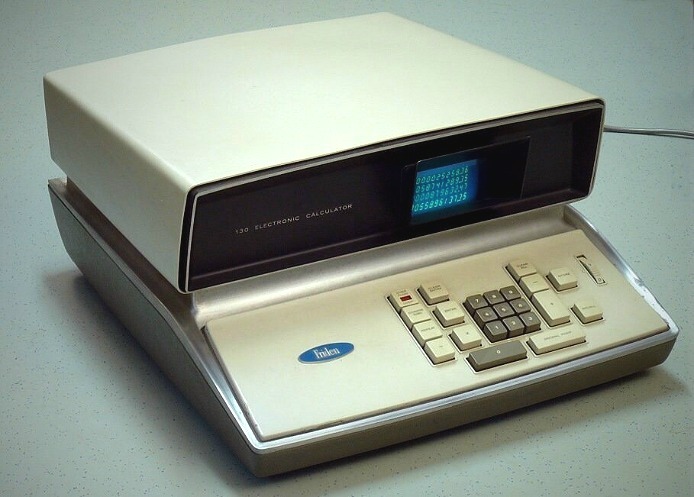
I remember going to my father’s lab when I was about nine years old. He mostly used a slide rule for his work, but he also had a great big Friden desktop calculator. It was a big beige slab, about the size of a desktop PC, with a little cathode-ray-tube display that showed a stack of numbers. It could add, subtract, multiply, divide, and I think it could also do square roots. It was the most incredibly amazing thing I had ever seen, and I couldn’t get enough of it. My dad wanted to show me around the lab, and tell me about the things he was working on, but all I wanted to do was watch this fantastic, futuristic machine add numbers.
All of this seems pretty unbelievable now. How could we have existed in such a profoundly different world and not have been, in some fundamental way, completely different people, living completely different kinds of lives? Looking back though, I don’t see it that way: it was all perfectly normal, and that’s the way I remember it. But after a week in that environment now, most of us would be gasping for air. We are radically transformed — and if it is the way we humans communicate, and how we use and acquire information, that defines us, then we are almost a different species, I think.
Are we better off? I guess we are — or at least, I don’t think I could go back. But it’s getting hard to keep up.